

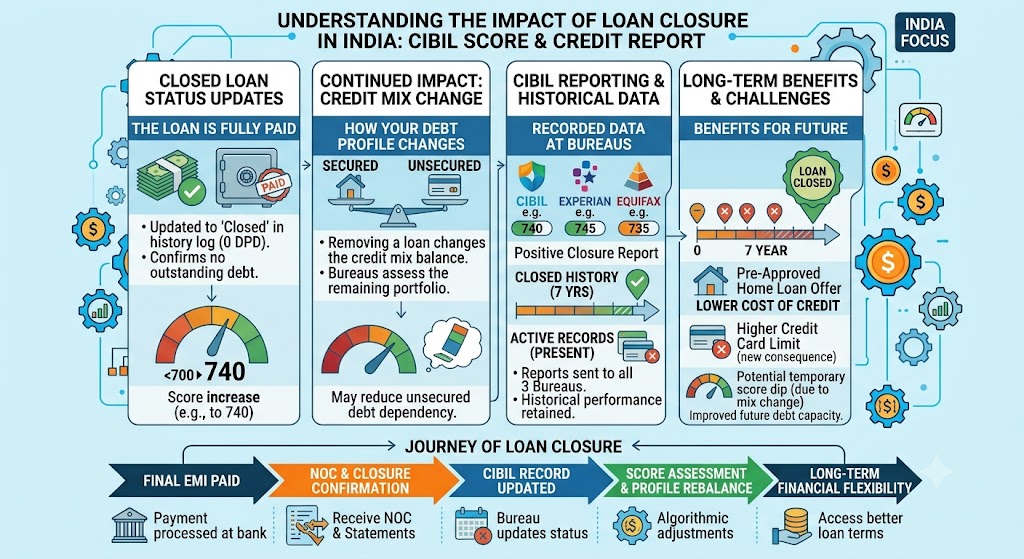
Closing a loan is an important financial milestone. Once you repay the outstanding amount, you may feel relieved because your monthly EMI obligation is over. However, many borrowers wonder whether closing a loan improves or reduces their CIBIL score.
The relationship between loan closure and your credit score depends on several factors, including your repayment history, the type of loan, your remaining credit accounts, and how the lender updates your credit report.
In India, lenders report loan account information to credit bureaus such as TransUnion CIBIL, Experian, and Equifax. Understanding how loan closure works can help you maintain a healthy credit profile and prepare for future borrowing.
What Is Loan Closure?
Loan closure refers to the process of completing your repayment obligations to a lender. When you pay all the outstanding principal, interest, and applicable charges, the lender can update the account status in its records.
Loan closure generally occurs in two ways:
-
Regular closure: You repay the entire loan according to the agreed repayment schedule or clear the remaining balance in full.
-
Pre-closure: You repay the outstanding loan before the scheduled tenure ends, subject to the loan agreement and applicable charges.
After completing repayment, check your lender's confirmation and ensure the loan account is reported accurately to the credit bureaus.
How Does Loan Closure Affect Your CIBIL Score?
Closing a loan does not automatically increase your CIBIL score. Depending on your credit profile, the score may remain stable, increase, or decrease slightly.
Here are the main factors that can influence the outcome.
1. Positive Repayment History
If you consistently paid your EMIs on time throughout the loan tenure, that repayment history can contribute positively to your credit profile.
Closing the loan does not mean that your accurate historical repayment information immediately disappears. Maintaining a record of responsible repayments can help demonstrate your credit management habits to future lenders.
2. Changes in Your Credit Mix
Your credit mix refers to the different types of credit you have used, such as secured loans and unsecured loans.
When you close a personal loan, for example, you may have fewer active credit accounts or a different mix of credit facilities. Depending on your overall profile, this change may influence your score.
However, you should not keep unnecessary debt simply to maintain a particular credit mix.
3. Changes in Active Credit Accounts
Closing a loan reduces the number of active loan accounts on your credit report. The effect depends on your other accounts, repayment history, and the scoring model used.
A loan closure alone is not a guarantee of a better credit score, nor does it automatically damage your creditworthiness.
4. Reduced Outstanding Debt
Paying off a loan reduces your outstanding debt and frees up money previously allocated to EMIs.
Lower debt obligations can improve your overall financial position and may strengthen your ability to manage future repayments. However, the reduction in outstanding debt does not guarantee an immediate increase in your credit score.
Loan Closed vs Loan Settled: What Is the Difference?
Understanding the difference between closed and settled is essential when reviewing your credit report.
|
Feature |
Loan Closed |
Loan Settled |
|---|---|---|
|
Repayment |
Full contractual dues paid |
Lender accepts less than the full amount due |
|
Account status |
Generally reported as closed |
May be reported as settled |
|
Credit profile |
Usually preferable when obligations are fully met |
May negatively affect future credit assessments |
|
Future loan applications |
Depends on the overall credit profile |
May require additional lender scrutiny |
|
Recommended approach |
Obtain closure confirmation |
Understand the implications and discuss resolution with the lender |
A loan marked as settled is not the same as one fully repaid and closed. If you have settled a loan, ask your lender whether any remaining contractual amount can be paid to resolve the account fully and whether the lender can update the reporting status accurately. Any status change depends on the actual repayment and applicable reporting rules.
What Should You Do After Closing a Loan?
Follow these steps to make sure your loan closure is completed properly.
Step 1: Obtain a No-Dues Certificate
Request a No-Dues Certificate (NDC), No Objection Certificate (NOC), or other written closure confirmation from your lender, as applicable.
Keep the document safely in case you need to verify the account status later.
Step 2: Check Your Final Loan Statement
Review your final statement to confirm that the outstanding principal, interest, and applicable charges have been paid.
If you notice any remaining balance or unexpected fee, contact the lender for clarification.
Step 3: Review Your CIBIL Report
After the lender has had time to update its records and report the closure, check your credit report.
Confirm that:
-
The loan account is marked as closed where appropriate.
-
The outstanding balance is accurate.
-
The account status is correct.
-
No unexpected overdue amount remains.
Updates may not appear immediately, so allow time for processing and reporting.
Step 4: Raise a Dispute if Necessary
If your credit report continues to show an incorrect outstanding balance or an account that should have been closed, contact the lender and raise a dispute with the relevant credit bureau.
Provide supporting documents, such as your closure letter, payment receipts, or final statement.
Step 5: Continue Managing Other Credit Accounts
Keep paying your remaining EMIs and credit card bills on time. Maintain manageable credit card utilisation and avoid unnecessary loan applications.
Your complete credit history matters more than the closure of any single account.
Does Closing a Personal Loan Improve Your CIBIL Score?
Closing a personal loan can reduce your outstanding debt, but the score impact varies.
For example, if you have repaid your personal loan in full and maintained a strong repayment history, the account may continue to reflect your previous responsible repayment behaviour.
However, if the loan was your only active instalment account, its closure may change your credit mix or other scoring factors. This means your score might not increase immediately.
The best reason to close a loan is to fulfil your repayment obligations and improve your financial position, not to achieve a guaranteed short-term score increase.
How Long Does It Take for a Closed Loan to Reflect on CIBIL?
The time required depends on when the lender updates its records and submits the information to the credit bureau.
If the account remains active on your credit report after repayment, first confirm the closure date with your lender. Then check the report again after the lender's reporting cycle.
If the information remains incorrect, raise a dispute rather than assuming the account will automatically update. Keep your payment and closure documents until the issue is resolved.
Common Mistakes to Avoid After Loan Closure
Avoid these mistakes to protect your credit profile:
-
Assuming that loan closure automatically increases your CIBIL score.
-
Failing to obtain written confirmation of full repayment.
-
Ignoring an outstanding balance shown on your credit report.
-
Confusing a settled account with a fully closed account.
-
Applying for several new loans immediately after closure.
-
Disregarding repayment obligations on other credit accounts.
Being proactive about your credit report can help you identify and resolve problems before your next loan application.
Frequently Asked Questions (FAQs)
1. Does closing a loan increase my CIBIL score?
Not necessarily. Loan closure reduces outstanding debt, but its impact depends on your overall credit profile and the scoring model.
2. Can my CIBIL score decrease after loan closure?
Yes, a score may decrease slightly if closing the account changes relevant scoring factors. However, a decrease is not inevitable.
3. What is the difference between a closed loan and a settled loan?
A closed loan generally means the full contractual dues have been paid. A settled loan generally means the lender accepted less than the full amount due.
4. How can I check whether my loan is closed on CIBIL?
Review your latest credit report and check the account status, balance, and repayment details. Contact the lender if the information is inaccurate.
5. Should I close my loan early to improve my credit score?
Do not pre-close a loan solely to improve your score. Consider your interest savings, applicable charges, available funds, and other financial priorities.
6. Does loan closure remove my previous late payments?
No. Closing a loan does not automatically remove accurate historical late-payment information from your credit report.
7. What should I do if my closed loan still shows an outstanding balance?
Contact your lender with the closure confirmation and payment records. If the information is incorrect, raise a dispute with the credit bureau.
Conclusion
Loan closure and CIBIL scores are connected, but closing a loan does not guarantee an immediate improvement in your credit score. The outcome depends on your repayment history, active credit accounts, credit mix, and the information recorded in your credit report.
Published on : 18th October 2026
Published by : Yogendra
www.vizzve.com || www.vizzveservices.com
Follow us on social media: Facebook || Linkedin || Instagram
🛡 Powered by Vizzve Financial
RBI-Registered Loan Partner | 10 Lakh+ Customers | ₹600 Cr+ Disbursed