

Introduction
Choosing a loan can be confusing when different banks and financial institutions offer different interest rates, repayment periods, processing fees, and loan conditions.
A loan with a lower interest rate may appear cheaper at first. However, additional fees or a longer repayment period can increase the total amount you pay.
A loan comparison calculator helps borrowers compare multiple loan offers using important financial details. It allows you to estimate monthly EMIs, total interest, repayment amounts, and other borrowing costs before making a decision.
Whether you need a personal loan for medical expenses, education, home repairs, travel, or an unexpected financial emergency, comparing loan offers can help you understand their costs more clearly.
This guide explains how a loan comparison calculator works, how to use it, which factors to compare, and how to choose a loan that fits your budget.
AI Answer Box: What Is a Loan Comparison Calculator?
A loan comparison calculator is an online financial tool that helps borrowers compare two or more loan offers based on interest rates, loan amounts, repayment tenures, monthly EMIs, processing fees, and total repayment costs.
By entering the details of different loan offers, borrowers can estimate which option may be more affordable. The calculator supports financial planning, but the final decision should also consider eligibility requirements, loan terms, lender credibility, and the Key Facts Statement (KFS).
Key Takeaways
-
A loan comparison calculator helps compare multiple loan offers.
-
Compare total repayment costs instead of looking only at interest rates.
-
Check monthly EMI affordability before accepting a loan.
-
Consider processing fees and other applicable charges.
-
Compare similar loan amounts and repayment tenures for a fair comparison.
-
Review the Annual Percentage Rate (APR) and KFS where applicable.
-
Calculator results are estimates; actual loan terms depend on the lender's offer.
What Is a Loan Comparison Calculator?
A loan comparison calculator is a digital tool designed to help borrowers evaluate different loan options side by side.
Instead of manually calculating every EMI, you can enter the loan amount, interest rate, repayment period, and applicable charges for each offer. The calculator then estimates the repayment details so you can compare the alternatives.
For example, suppose you want a personal loan of ₹3,00,000. One lender offers an interest rate of 11.5%, while another offers 13%.
The first offer may have a lower EMI and interest cost if both loans have the same repayment terms and comparable fees. However, you should compare the complete loan costs before choosing.
What Can You Compare?
A loan comparison calculator can help you evaluate:
-
Loan amount
-
Interest rate
-
Loan tenure
-
Monthly EMI
-
Total interest payable
-
Processing fees
-
Other applicable charges
-
Total repayment amount
-
Estimated upfront deductions
-
APR, when reliable figures are available
The features available depend on the calculator. Some tools compare only EMIs and interest, while more detailed tools include fees and other charges.
Why Should You Use a Loan Comparison Calculator?
Comparing loan offers before applying can help you understand the financial commitment involved.
1. Compare Interest Rates
Different lenders may offer different interest rates depending on their policies, the loan product, and the applicant's credit profile.
A comparison calculator helps you estimate how different rates affect your EMI and total interest.
2. Estimate Monthly EMI
Your monthly EMI affects how much money remains available for rent, food, transportation, savings, and other expenses.
Comparing EMIs can help you identify a repayment amount that fits your monthly budget.
3. Understand the Total Loan Cost
A loan involves more than the principal amount. Depending on the offer, you may also pay interest, processing fees, and other disclosed charges.
Comparing these expenses gives you a clearer picture of the overall borrowing cost.
4. Compare Different Repayment Periods
A longer tenure generally reduces the monthly EMI but can increase the total interest paid.
A shorter tenure may reduce total interest but require a higher monthly payment.
The calculator helps you evaluate this trade-off.
5. Make More Informed Financial Decisions
A side-by-side comparison can help you understand the differences between loan offers before accepting one.
However, the cheapest estimated option may not necessarily be the most suitable. Eligibility criteria, repayment flexibility, lender reliability, and contract terms also matter.
How Does a Loan Comparison Calculator Work?
A loan comparison calculator uses the information you enter to estimate repayments for each loan offer.
Step 1: Enter the Loan Amount
Enter the amount you intend to borrow.
For example:
Loan amount: ₹3,00,000
Use the same loan amount when comparing offers if you want to understand the effect of different interest rates and fees.
Step 2: Enter the Interest Rate
Enter the annual interest rate quoted by each lender.
For example:
-
Loan A: 11%
-
Loan B: 12.5%
-
Loan C: 14%
Make sure you understand whether the quoted rate is fixed or floating and whether the offers use comparable interest calculation methods.
Step 3: Select the Loan Tenure
Enter the repayment period in months or years.
For example:
-
12 months
-
24 months
-
36 months
Using the same tenure makes it easier to compare the cost of different interest rates.
Step 4: Add Processing Fees and Other Charges
Enter the applicable processing fee and any other known charges supported by the calculator.
Check whether fees are paid separately or deducted from the disbursed amount.
Step 5: Compare the Results
Review the estimated:
-
Monthly EMI
-
Total interest
-
Total repayment
-
Applicable fees
-
Overall borrowing cost
Finally, compare these estimates with the lender's official offer and KFS before making a decision.
Loan Comparison Calculator Formula
Most standard EMI calculators use the following formula for a loan with equal monthly instalments and a fixed interest rate.
EMI = P × r × (1 + r)ⁿ ÷ [(1 + r)ⁿ − 1]
Where:
-
P = Principal loan amount
-
r = Monthly interest rate expressed as a decimal
-
n = Total number of monthly instalments
-
EMI = Equated Monthly Instalment
To convert an annual nominal interest rate into a monthly rate, divide the annual percentage by 12 and then by 100.
For example, an annual interest rate of 12% gives a monthly rate of 1%, or 0.01, under this standard calculation.
Total Interest Formula
Total Interest = Total EMI Payments − Principal Loan Amount
Total Repayment Formula
Total Repayment = EMI × Number of Monthly Instalments
These formulas estimate standard amortising-loan repayments. Actual results can differ if the lender uses a different calculation method, applies variable rates, or includes fees outside the EMI.
Loan Comparison Calculator Example
Suppose you want to borrow ₹3,00,000 for three years.
You receive three hypothetical offers with different interest rates.
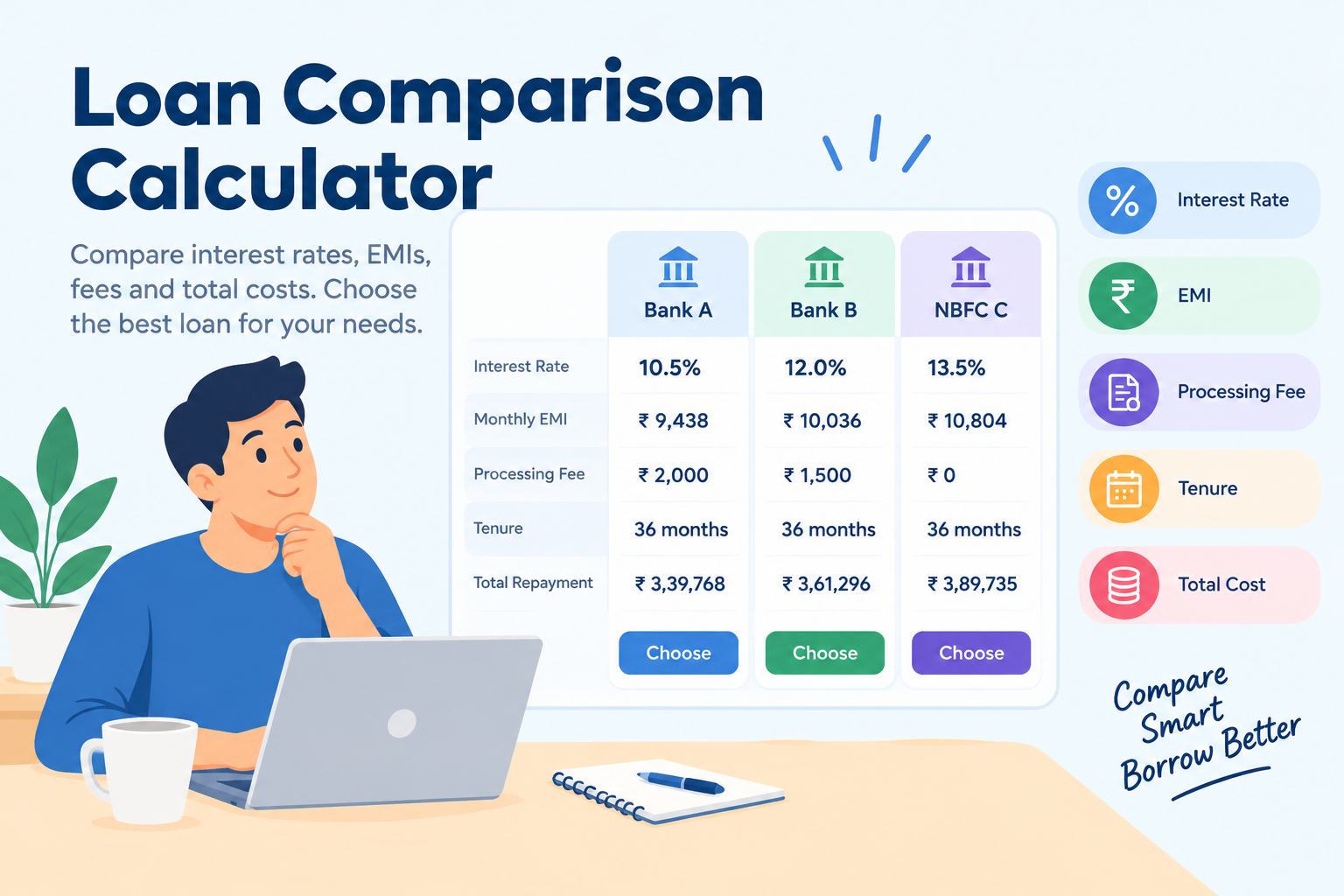
The following table uses an illustrative standard EMI calculation, a 36-month tenure, and excludes fees and other charges.
| Details | Loan A | Loan B | Loan C |
|---|---|---|---|
| Loan amount | ₹3,00,000 | ₹3,00,000 | ₹3,00,000 |
| Annual interest rate | 11% | 12.5% | 14% |
| Tenure | 36 months | 36 months | 36 months |
| Estimated monthly EMI | ₹9,822 | ₹10,036 | ₹10,253 |
| Estimated total repayment | ₹3,53,600 | ₹3,61,300 | ₹3,69,100 |
| Estimated total interest | ₹53,600 | ₹61,300 | ₹69,100 |
Figures are rounded estimates for illustration, not actual lender quotations. Fees, rate structures, and lender-specific calculations may change the final cost.
What Does This Comparison Show?
In this example, Loan A has the lowest estimated EMI and total interest because it has the lowest interest rate, while the loan amount and tenure remain the same.
Loan C has a higher estimated monthly payment and total interest.
However, if Loan A has substantially higher fees or less suitable repayment conditions, its overall advantage may be smaller.
Important: Compare the APR, processing fees, total repayment, and contract conditions before deciding which offer is best for you.
Loan Comparison Calculator: What Factors Should You Compare?
1. Interest Rate
The interest rate determines how much interest is charged on the outstanding principal.
A lower rate can reduce the cost of borrowing when other factors remain comparable.
Before comparing rates, check whether they are fixed or floating and confirm how the lender calculates interest.
2. Monthly EMI
EMI is the amount you pay every month towards the principal and interest.
Choose a repayment amount that leaves enough room in your budget for essential expenses and savings.
A lower EMI is not always evidence of a cheaper loan because the repayment period may be longer.
3. Loan Tenure
Loan tenure is the period over which you repay the borrowed money.
| Tenure | General Effect |
|---|---|
| Short tenure | Higher EMI, generally lower total interest |
| Medium tenure | Moderate EMI and interest cost |
| Long tenure | Lower EMI, generally higher total interest |
The actual result depends on the interest rate, repayment structure, and fees.
4. Processing Fee
Some lenders charge a processing fee for evaluating and processing a loan application.
Check whether the fee is a fixed amount or a percentage of the loan and whether applicable taxes are added.
A loan with a slightly lower interest rate may be less attractive if its fees are significantly higher.
5. Annual Percentage Rate (APR)
APR helps borrowers understand the annualised cost of borrowing, including relevant charges covered by the applicable calculation rules.
For eligible loans, the lender's Key Facts Statement should provide important loan information, including APR where required.
Read the APR and the underlying fee details carefully rather than relying only on the advertised interest rate.
6. Total Repayment Amount
The total repayment amount represents the scheduled EMI payments over the full loan term.
For a more complete cost comparison, also account for applicable charges that are not already included in those payments.
7. Prepayment and Foreclosure Conditions
If you may repay the loan early, check the lender's applicable prepayment or foreclosure terms.
These conditions can affect the amount you pay if you close the loan before the scheduled end date.
Applicable charges and restrictions vary by product, lender, and relevant regulations.
8. Repayment Flexibility
Check whether the lender offers suitable repayment options, clear statements, and an accessible process for resolving issues.
A loan's convenience and contract terms can matter alongside its financial cost.
Loan Comparison Calculator for Different Loan Types
A comparison calculator can support decisions across several types of borrowing.
Personal Loan Comparison
Personal loans are commonly used for expenses such as medical bills, education, travel, and home repairs.
Compare interest rates, processing fees, repayment tenure, EMI, and total repayment.
Home Loan Comparison
For home loans, compare interest rates, tenure, processing charges, applicable legal or valuation fees, and whether the rate is fixed or floating.
Because home loans often involve large amounts and long repayment periods, small differences in rates can have a substantial effect on total interest.
Education Loan Comparison
For education loans, check the interest rate, repayment start date, any moratorium period, eligible expenses, and applicable fees.
Do not compare only the monthly instalment if repayment starts after a period of study or a grace period.
Vehicle Loan Comparison
For vehicle loans, compare the interest rate, down payment, processing charges, repayment tenure, and total repayment.
Also check whether the quoted loan amount and any bundled charges are comparable across offers.
Business Loan Comparison
Business loans may have different repayment structures and eligibility requirements.
Compare interest, fees, repayment frequency, collateral requirements, and any conditions linked to the business or its cash flow.
Note: Different loan products may use different pricing and repayment structures. Use a calculator designed for the relevant loan type whenever possible.
Loan Comparison Calculator vs EMI Calculator
A loan EMI calculator and a loan comparison calculator serve related but different purposes.
| Feature | Loan EMI Calculator | Loan Comparison Calculator |
|---|---|---|
| Main purpose | Estimates repayment for one loan | Compares multiple loan offers |
| EMI calculation | Yes | Usually |
| Interest comparison | Possible through repeated calculations | Yes, side by side |
| Processing fee comparison | Only if supported | Often available in advanced tools |
| Total repayment comparison | Usually | Usually |
| APR comparison | Depends on the tool | Depends on the tool |
| Helps evaluate multiple offers | Requires manual comparison | Designed for comparison |
Use an EMI calculator when you want to estimate the instalment for one loan.
Use a loan comparison calculator when you want to evaluate several offers before choosing one.
How to Choose the Right Loan Using a Comparison Calculator
Follow these practical steps before accepting a loan.
1. Compare Similar Offers
Enter the same loan amount and tenure for each offer when comparing interest rates.
This makes it easier to identify the effect of different pricing and fees.
2. Check the Total Cost
Do not choose a loan based only on its advertised interest rate.
Review the total repayment, APR, processing fees, and other applicable charges.
3. Check Your Monthly Budget
Make sure the EMI fits your income after accounting for existing loan payments and essential expenses.
Avoid borrowing an amount that leaves you financially stretched.
4. Review the Official Documents
Read the KFS, sanction letter, and loan agreement.
Confirm the interest rate, repayment schedule, fees, late-payment terms, and other conditions before accepting the offer.
5. Verify the Lender
Check that the lender is a legitimate bank or regulated financial institution, as applicable.
If a digital platform helps arrange a loan, verify the identity of the actual lender and the platform's relationship with that lender.
6. Apply Only When Ready
Use the calculator to shortlist suitable offers, then review each lender's eligibility requirements.
Provide accurate information during the application process and avoid submitting applications indiscriminately.
Common Mistakes to Avoid When Comparing Loans
Borrowers may make costly decisions when they focus on only one part of a loan offer.
Avoid these mistakes:
-
Looking only at interest rates: Fees and other charges may change the total cost.
-
Choosing the lowest EMI automatically: A longer tenure may increase total interest.
-
Ignoring the APR: The interest rate alone may not represent the complete borrowing cost.
-
Overlooking processing fees: Upfront charges can affect the amount you receive.
-
Using different loan amounts: This can make comparisons misleading.
-
Ignoring repayment conditions: Prepayment, late-payment, and other terms may matter.
-
Trusting estimated results as final offers: A calculator cannot guarantee approval or the final interest rate.
-
Ignoring affordability: Even a comparatively low-cost loan may be unsuitable if the EMI is too high for your budget.
Benefits of Using an Online Loan Comparison Calculator
An online loan comparison calculator can make the initial research process simpler.
Saves Time
You can estimate and compare multiple offers without calculating each EMI manually.
Improves Cost Awareness
It helps you understand how interest rates, loan tenure, and fees can affect repayment.
Supports Budget Planning
Estimated monthly EMIs help you assess whether a loan may fit your current income and expenses.
Makes Comparisons Easier
A side-by-side view makes differences between loan offers easier to identify.
Helps You Ask Better Questions
After comparing the numbers, you can ask lenders about fees, APR, eligibility, prepayment rules, and repayment flexibility.
Is a Loan Comparison Calculator Accurate?
A loan comparison calculator can provide useful estimates when you enter accurate information and the calculator uses the correct repayment formula.
However, its results may not match the final loan offer in every case.
Differences can arise from:
-
Incorrect or outdated interest-rate information
-
Processing fees or taxes not included in the calculation
-
Different interest calculation methods
-
Variable interest rates
-
Insurance or other applicable charges
-
Changes in the approved loan amount or tenure
-
Special repayment conditions
For a more reliable comparison, use the actual terms quoted by each lender.
Remember: A calculator estimates costs; it does not approve loans, confirm eligibility, or guarantee a particular interest rate.
Important RBI Guidance for Comparing Loans in India
The Reserve Bank of India (RBI) has issued guidance on loan disclosures, including the use of the Key Facts Statement for applicable loans and the disclosure of APR and other important terms.
For digital lending, RBI guidance highlights the importance of understanding the loan's overall cost and reviewing the KFS before proceeding.
Before accepting an offer, read the lender's official documents and check that the disclosed charges and repayment conditions are clear.
For more information, consult these official resources:
Regulatory requirements can differ according to the loan product and applicable rules. Refer to the latest RBI directions and your lender's official documentation.
How Vizzve Financial Can Help Borrowers
Understanding loan offers before applying is an important step in responsible borrowing.
Vizzve Financial can be included in your research when exploring personal-loan information and loan-related resources.
Before proceeding with any loan offer, verify the actual lender, eligibility criteria, interest rate, APR, processing fees, repayment terms, and applicable charges.
Visit the official website at www.vizzve.com to explore available information and services.
Always review the terms of the specific loan product before submitting an application. Approval, interest rates, and loan amounts depend on the relevant lender's criteria.
Frequently Asked Questions (FAQs)
1. What is a loan comparison calculator?
A loan comparison calculator is an online tool that helps borrowers compare loan offers using details such as interest rates, EMI, tenure, fees, and total repayment.
2. How does a loan comparison calculator work?
You enter the details of two or more loan offers. The calculator estimates the repayments and displays the results so you can compare their costs.
3. Can I compare personal loans online?
Yes. You can compare personal loans online using a calculator or comparison table. Review interest rates, fees, APR, tenure, eligibility, and repayment conditions before choosing an offer.
4. Is the loan with the lowest interest rate always the best option?
No. A lower interest rate may reduce interest costs, but processing fees, other charges, repayment conditions, and affordability can affect which loan is more suitable.
5. Can a loan comparison calculator calculate EMI?
Most loan comparison calculators include an EMI estimate for each loan offer. The result depends on the loan amount, interest rate, tenure, and calculation method.
6. What details do I need to compare loans?
You generally need the loan amount, annual interest rate, tenure, processing fees, and other applicable charges. APR and the official repayment schedule can provide additional information.
7. Does a loan comparison calculator include processing fees?
Some calculators include processing fees and other charges, while basic calculators may not. Check the tool's features and account for any excluded fees separately.
8. What is the difference between a loan comparison calculator and an EMI calculator?
An EMI calculator estimates the monthly instalment for a particular loan. A loan comparison calculator is designed to compare multiple offers and may include additional cost information.
9. Can I compare loans with different tenures?
Yes. You can compare different tenures, but remember that a longer tenure generally lowers the EMI while increasing the total interest paid. Compare both monthly affordability and total cost.
10. Can salaried employees use a loan comparison calculator?
Yes. Salaried employees can use one to estimate repayments and compare loan offers. Actual eligibility depends on the lender's requirements, income, existing obligations, credit profile, and other factors.
11. Can self-employed people use a loan comparison calculator?
Yes. Self-employed applicants can use the calculator to compare estimated borrowing costs. Approval requirements may differ depending on the lender and loan product.
12. Does a loan comparison calculator guarantee loan approval?
No. A calculator provides estimates and does not guarantee eligibility, approval, disbursement, or a particular interest rate.
13. What is APR, and why is it important when comparing loans?
APR represents an annualised measure of borrowing cost under the applicable calculation rules. It can help borrowers compare loan offers more meaningfully than comparing advertised interest rates alone.
14. How can I reduce the total cost of a personal loan?
Compare offers, review fees, choose a suitable tenure, and avoid borrowing more than necessary. Check the lender's early-repayment conditions before making additional payments or closing the loan early.
15. Where can I find reliable information before choosing a loan?
Start with the lender's official website and loan documents. Review the KFS, sanction letter, repayment schedule, and applicable RBI guidance before accepting an offer.
Published on : 26th October
Published by : Bhargavi
www.vizzve.com || www.vizzveservices.com
Follow us on social media: Facebook || Linkedin || Instagram
🛡 Powered by Vizzve Financial
RBI-Registered Loan Partner | 10 Lakh+ Customers | ₹600 Cr+ Disbursed