

Loan Cost Calculator: Complete Guide to Understanding Loan Costs in India
Meta Data
Meta Title: Loan Cost Calculator: Calculate Your Total Loan Cost
Meta Description: Learn how a loan cost calculator works, estimate EMIs, interest, fees, and total repayment, and compare loan options to make smarter borrowing decisions.
Slug: loan-cost-calculator
Primary Keyword: Loan Cost Calculator
Secondary Keywords and Long-Tail Keywords:
- Loan cost calculator India
- Total loan cost calculator
- Personal loan cost calculator
- Loan repayment calculator
- Loan EMI calculator
- Total borrowing cost calculator
- Loan interest calculator
- Loan processing fee calculator
- Personal loan repayment cost
- Loan affordability calculator
- Cost of borrowing calculator
- Loan repayment amount calculator
- Loan charges calculator
- Total cost of a personal loan
- How to calculate the total cost of a loan
- How much does a personal loan cost?
- Calculate loan interest and fees online
- Personal loan EMI and interest calculation
- Loan cost comparison calculator
- Loan cost based on interest rate
- Loan cost based on tenure
- Effective cost of borrowing
- APR calculator for personal loans
- Loan repayment planning
- Ways to reduce total loan costs
Tags: Loan Cost Calculator, Personal Loan, Loan Interest, EMI Calculator, Loan Repayment, Borrowing Costs, Loan Charges, Financial Planning, Loan Affordability, Vizzve Financial
OG Title: Loan Cost Calculator: Understand Your Total Borrowing Cost
OG Description: Estimate your loan EMI, interest, fees, and total repayment with a loan cost calculator. Compare borrowing options and plan your finances confidently.
Introduction
Taking a loan can help you manage important expenses, such as medical bills, education, home repairs, or other financial needs. However, before borrowing, it is essential to understand how much the loan will actually cost.
The advertised interest rate is only one part of the picture. Your total borrowing cost may also include processing fees, applicable taxes on charges, insurance premiums where applicable, and other costs specified in the loan agreement.
A loan cost calculator helps you estimate the financial commitment associated with borrowing money. Depending on the calculator, it may show your monthly EMI, total interest, total repayment amount, and selected additional charges.
For example, suppose you borrow ₹1,00,000 at an annual interest rate of 12% for two years. Under a standard reducing-balance EMI structure, your monthly instalment would be approximately ₹4,707, and your total interest would be approximately ₹12,976.
If the lender also charges a processing fee, your overall borrowing cost will be higher than the interest alone.
Understanding these figures before applying can help you compare loan offers, choose a suitable repayment tenure, and avoid unexpected expenses.
This guide explains how a loan cost calculator works, the formulas involved, practical examples, and ways to manage borrowing costs responsibly.
AI Answer Box: What Is a Loan Cost Calculator?
A loan cost calculator is a financial tool that estimates the cost of borrowing money over a specified repayment period.
Depending on its features, it can calculate:
- Monthly equated monthly instalment (EMI)
- Total interest payable
- Total scheduled repayment
- Processing fees and other entered charges
- Estimated overall borrowing cost
Basic formula:
Total Loan Repayment = Total Principal and Interest Payments
Estimated Borrowing Cost:
Total Interest + Applicable Fees and Charges
For example, if a borrower pays ₹12,000 in interest and ₹2,000 in applicable loan fees, the estimated borrowing cost is ₹14,000, excluding any other costs not included in the calculation.
A loan cost calculator helps borrowers compare loan options, understand repayment commitments, and plan their budgets before accepting a loan.
Important: The exact cost depends on the interest calculation method, loan tenure, payment schedule, fees, and the terms offered by the lender.
1. What Is a Loan Cost Calculator?
A loan cost calculator is an online financial tool that helps you estimate the amount you will pay to borrow money.
When you take a loan, you agree to repay the principal along with interest and any applicable charges. The total cost depends on the amount borrowed, interest rate, repayment period, and the lender's terms.
For example, a personal loan may have:
- A principal amount of ₹2,00,000
- An annual interest rate of 13%
- A repayment tenure of 24 months
- A processing fee specified in the loan agreement
A loan cost calculator can help estimate the EMI, total interest, and overall cost based on these details.
Why Is a Loan Cost Calculator Important?
Understanding the full cost of borrowing can help you make more informed financial decisions.
A loan cost calculator can help you:
- Estimate your monthly EMI before applying.
- Calculate the interest payable over the loan tenure.
- Understand how repayment duration affects total cost.
- Compare different interest rates and loan offers.
- Include applicable fees in your financial planning.
- Check whether the proposed EMI fits your monthly budget.
- Avoid choosing a loan based only on its advertised interest rate.
Practical example: Two lenders may offer the same loan amount but charge different processing fees or interest rates. Comparing only the monthly EMI may not reveal the full difference in cost. A loan cost calculator helps you compare the estimated repayment and borrowing expenses more clearly.
2. How Does a Loan Cost Calculator Work?
A loan cost calculator uses the loan details you enter to estimate the repayment amount and associated costs.
The information required depends on the calculator's features.
| Input | Meaning | Example |
|---|---|---|
| Loan amount | The principal you plan to borrow | ₹1,00,000 |
| Annual interest rate | The yearly interest rate | 12% |
| Loan tenure | The repayment period | 24 months |
| Processing fee | A fee charged for processing the loan, if applicable | ₹2,000 |
| Other charges | Additional applicable borrowing costs | ₹500 |
The figures above are illustrative and do not represent a particular lender's offer.
Step 1: Enter the Loan Amount
Enter the principal amount you intend to borrow.
For example, if you need ₹1,00,000 for home repairs, enter ₹1,00,000.
Borrowing only what you need can help limit the amount of interest you pay.
Step 2: Enter the Interest Rate
Enter the annual interest rate quoted by the lender.
For a standard monthly EMI calculation, a nominal annual interest rate of 12% corresponds to a monthly rate of 1%.
The lender's actual calculation method and agreement determine the final repayment figures.
Step 3: Choose the Loan Tenure
Select the repayment period in months.
Common examples include:
- 12 months: 1 year
- 24 months: 2 years
- 36 months: 3 years
- 60 months: 5 years
Step 4: Calculate Your EMI
The calculator uses the principal, interest rate, and tenure to estimate the monthly instalment.
For a standard fixed-rate EMI loan, each instalment generally includes both principal and interest.
Step 5: Add Applicable Charges
If the calculator supports fees, enter the processing fee and other relevant charges.
Check whether the fee is payable upfront, deducted from the disbursed amount, or added to the repayment obligation.
Step 6: Review the Total Cost
Review the estimated EMI, total interest, total repayment, and additional charges.
Compare these figures with the lender's official loan documents before making a decision.
3. Loan Cost Calculator Formula
To understand your total borrowing cost, it helps to know how lenders calculate EMIs and interest.
The most suitable formula depends on the loan's interest calculation method.
A. EMI Formula for a Standard Loan
The standard EMI formula for a fixed-rate loan with monthly repayments is:
\[ EMI=\frac{P \times r \times (1+r)^n}{(1+r)^n-1} \]
Where:
- \(P\) = Principal amount
- \(r\) = Monthly interest rate expressed as a decimal
- \(n\) = Total number of monthly instalments
To convert a nominal annual interest rate into a monthly rate:
\[ r=\frac{\text{Annual Interest Rate}}{12\times100} \]
For example, if the annual interest rate is 12%:
\[ r=\frac{12}{12\times100}=0.01 \]
The monthly interest rate used in the calculation is 1%.
This formula assumes a fixed interest rate and equal monthly instalments. Different repayment structures may require different calculations.
B. Formula for Total Interest
Once the EMI is calculated, the total interest can be estimated using:
\[ \text{Total Interest}=(EMI\times n)-P \]
For example, suppose:
- Loan amount = ₹1,00,000
- Monthly EMI = ₹4,707.35
- Number of instalments = 24
Then:
\[ \text{Total Interest}=(4,707.35\times24)-1,00,000 \]
Estimated total interest = ₹12,976.40, subject to rounding.
C. Formula for Total Loan Cost
To estimate the cost of borrowing beyond the principal, add the interest and applicable charges.
\[ \text{Borrowing Cost}=\text{Total Interest}+\text{Applicable Fees and Charges} \]
For example:
| Cost Component | Amount |
|---|---|
| Total interest | ₹12,976 |
| Processing fee | ₹2,000 |
| Other applicable charges | ₹500 |
| Estimated borrowing cost | ₹15,476 |
Illustrative example only. Taxes, fee treatment, insurance, and other charges should be included when applicable and not already counted elsewhere.
The principal is not included in this borrowing-cost figure because it is the amount borrowed, rather than the cost of borrowing.
To calculate the total amount paid over the loan period, add the principal to the borrowing cost, taking care to avoid double-counting any charges already included in the scheduled payments.
4. Loan Cost Calculator Example: ₹1 Lakh Personal Loan
Consider a borrower who takes a personal loan of ₹1,00,000 at an annual interest rate of 12% for 24 months.
Assume a standard reducing-balance EMI structure with a fixed rate and monthly payments.
Loan Cost Breakdown
| Loan Detail | Estimated Value |
|---|---|
| Principal amount | ₹1,00,000 |
| Annual interest rate | 12% |
| Loan tenure | 24 months |
| Monthly EMI | ₹4,707.35 |
| Total scheduled repayment | ₹1,12,976.33 |
| Total interest | ₹12,976.33 |
| Processing fee | Not included |
| Other charges | Not included |
Figures are rounded estimates. Actual lender calculations may vary slightly because of payment dates, rounding, and contractual terms.
How Much Does the Loan Cost?
The total scheduled repayment is approximately ₹1,12,976.
Subtracting the original principal gives the interest cost:
₹1,12,976 − ₹1,00,000 = approximately ₹12,976 in interest.
If a processing fee or other charges apply, the overall borrowing cost will be higher.
What Should You Learn From This Example?
Before accepting a loan, consider the following:
- The EMI shows your regular monthly repayment commitment.
- Total interest shows the cost of borrowing over the scheduled tenure.
- Additional charges may increase the overall borrowing cost.
- A longer tenure may reduce your EMI but increase total interest.
- A lower advertised interest rate does not always mean a lower overall cost.
A loan cost calculator helps bring these figures together so you can make a more informed comparison.
5. How Does Loan Tenure Affect the Total Cost?
Loan tenure is an important factor in determining both the monthly EMI and the total interest paid.
A longer repayment period generally reduces the EMI but increases the total interest on a standard fixed-rate reducing-balance loan.
A shorter repayment period generally increases the EMI but reduces the time over which interest accumulates.
Consider a ₹1,00,000 loan at a fixed annual interest rate of 12%.
Loan Tenure Comparison Table
| Tenure | Approximate Monthly EMI | Approximate Total Interest | Approximate Total Repayment |
|---|---|---|---|
| 12 months | ₹8,885 | ₹6,619 | ₹1,06,619 |
| 24 months | ₹4,707 | ₹12,976 | ₹1,12,976 |
| 36 months | ₹3,321 | ₹19,557 | ₹1,19,557 |
| 60 months | ₹2,224 | ₹33,467 | ₹1,33,467 |
Illustrative estimates based on standard monthly reducing-balance EMI calculations. Figures are rounded and exclude fees.
Which Loan Tenure Is Better?
The right tenure depends on your income, regular expenses, financial responsibilities, and savings.
A 12-month tenure may suit someone who can comfortably manage a higher EMI and wants to reduce interest costs.
A 24-month tenure may offer a balance between the EMI and total interest.
A 36-month tenure may provide more monthly flexibility but generally costs more in total interest than the shorter options.
A 60-month tenure may reduce the monthly EMI significantly, but the longer repayment period can increase the total interest substantially.
Do not choose a shorter tenure if the resulting EMI leaves you unable to cover essential expenses or maintain an emergency fund.
Use the loan cost calculator to compare the options and choose a repayment plan that fits your budget.
6. What Costs Should You Include in a Loan Cost Calculator?
A loan's total cost may include more than principal and interest.
Understanding the different cost components can help you compare offers more accurately.
| Cost Component | What It Means | Always Applicable? |
|---|---|---|
| Principal | The original amount borrowed | Yes, for a loan |
| Interest | The cost charged for borrowing | Depends on the loan terms; interest-free arrangements may differ |
| Processing fee | A fee for processing the application | No |
| Taxes on fees | Applicable taxes on chargeable fees or services | Depends on the charge and applicable rules |
| Insurance premium | A premium for insurance associated with the loan, where applicable | No |
| Late-payment charges | Charges for overdue payments, where applicable | Only if triggered under the agreement |
| Prepayment charges | Charges that may apply to early repayment, subject to applicable rules and contract terms | Not always |
| Foreclosure charges | Charges that may apply when closing a loan early | Not always |
Why Do Additional Charges Matter?
Suppose two lenders offer the same principal amount and interest rate.
One lender charges a processing fee of ₹1,000, while the other charges ₹3,000.
If the other terms are identical and both fees apply, the second loan costs ₹2,000 more before considering any differences in taxes or other charges.
This is why borrowers should compare the full borrowing cost rather than focusing only on the advertised interest rate.
How Can You Check the Charges Before Applying?
Review the lender's Key Facts Statement (KFS), loan agreement, fee schedule, and repayment details.
The Reserve Bank of India's KFS framework provides for standardised disclosures, including the annual percentage rate (APR), for covered retail and MSME term loans. The harmonised requirements applied to new covered loans sanctioned from October 1, 2024. Check the applicable regulatory requirements and the documents for your specific loan. Read the RBI's KFS circular.
The KFS and loan documents can help you identify disclosed charges and understand the lender's repayment terms.
7. Loan Cost Calculator vs. Other Financial Calculators
Different financial calculators help answer different questions about borrowing.
| Calculator | Main Purpose | Primary Result |
|---|---|---|
| Loan cost calculator | Estimates the overall cost of borrowing | Interest and included charges |
| Personal loan EMI calculator | Estimates the monthly instalment | Monthly EMI |
| Total interest calculator | Estimates cumulative interest | Total interest payable |
| Loan repayment calculator | Estimates the scheduled repayment amount | Total repayment |
| Loan eligibility calculator | Estimates potential borrowing eligibility | Indicative eligible loan amount |
| Loan affordability calculator | Helps assess whether repayments fit your budget | Estimated affordable payment |
| APR calculator | Estimates the annualised cost of borrowing under specified assumptions | APR estimate |
| Loan prepayment calculator | Estimates the effect of making an extra principal payment | Potential interest savings |
| Loan foreclosure calculator | Estimates the amount required to close a loan early | Estimated foreclosure amount |
Which Calculator Should You Use?
Use a loan cost calculator when you want a broader estimate of the financial commitment associated with a loan.
An EMI calculator is more useful when you primarily want to know how much you may need to pay each month.
A total interest calculator helps you compare the interest costs of different loan tenures.
For a complete comparison, use these tools together and verify the results against the lender's official documents.
8. How to Compare Two Loan Offers Using a Loan Cost Calculator
Comparing loans before applying can help you avoid choosing an option that appears affordable but costs more over time.
Consider a borrower who needs ₹2,00,000 and receives two hypothetical loan offers.
The following table assumes fixed interest rates, standard monthly reducing-balance EMIs, and no additional charges.
Illustrative Loan Comparison
| Loan Detail | Offer A | Offer B |
|---|---|---|
| Principal | ₹2,00,000 | ₹2,00,000 |
| Annual interest rate | 12% | 13% |
| Tenure | 36 months | 24 months |
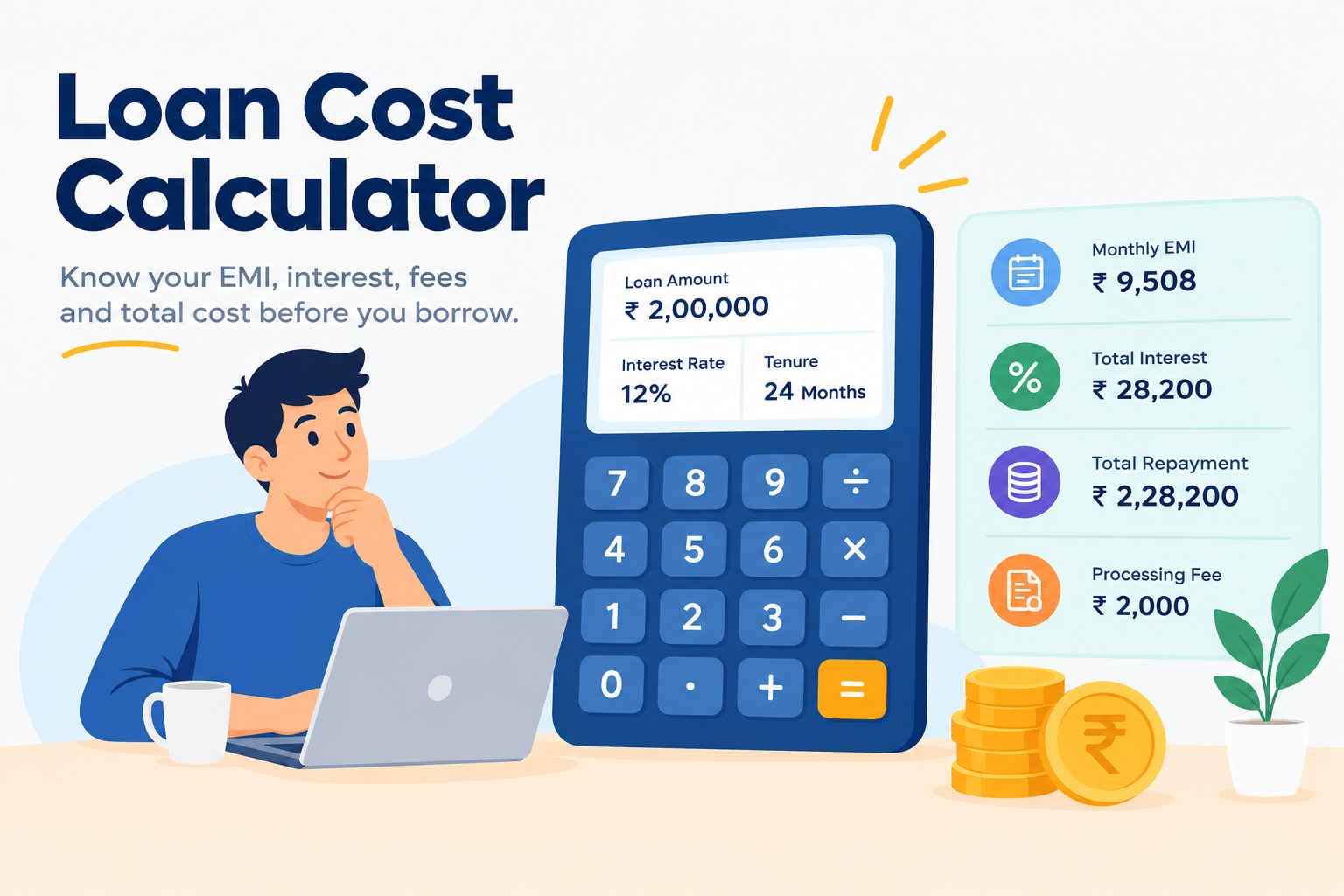
| Approximate monthly EMI | ₹6,643 | ₹9,508 |
| Approximate total interest | ₹39,150 | ₹28,200 |
| Approximate total repayment | ₹2,39,150 | ₹2,28,200 |
Figures are rounded estimates. Actual results depend on the lender's terms and calculations.
Which Offer Costs Less?
Offer B has a higher annual interest rate but a shorter repayment period. In this example, its estimated total interest is lower.
However, Offer B requires a significantly higher monthly EMI.
The borrower should therefore consider both total cost and monthly affordability.
Before choosing either option, compare:
- The interest rate and calculation method.
- The monthly EMI.
- The total interest payable.
- Processing fees and other applicable charges.
- The APR disclosed by the lender.
- The repayment tenure.
- The conditions for prepayment and foreclosure.
Practical tip: The best loan for your situation is not necessarily the loan with the lowest EMI. Consider the total cost alongside your ability to make payments comfortably.
9. How to Reduce the Total Cost of a Loan
You may be able to reduce your borrowing costs by comparing offers carefully and choosing a repayment plan that suits your finances.
1. Compare Interest Rates From Different Lenders
Review loan offers from banks and regulated non-banking financial companies (NBFCs).
Compare the interest rate, APR, processing fees, repayment tenure, and other applicable charges rather than relying on one advertised rate.
2. Borrow Only the Amount You Need
A larger loan usually creates a larger repayment obligation.
Calculate your actual expenses before applying and avoid borrowing extra money simply because a lender offers a higher amount.
3. Choose an Appropriate Repayment Tenure
A shorter tenure generally reduces total interest on a standard fixed-rate reducing-balance loan.
However, make sure you can comfortably manage the higher EMI without compromising essential expenses or emergency savings.
4. Consider Part-Prepayment
If your loan terms permit part-prepayment, paying an additional amount towards the principal may reduce future interest.
The benefit depends on the outstanding balance, remaining tenure, interest rate, applicable charges, and how the lender adjusts your repayment schedule.
Ask the lender whether the additional payment will reduce your EMI, shorten your tenure, or allow you to choose between the two.
5. Avoid Missed EMI Payments
Late payments can result in additional charges and may affect your credit history.
Set up payment reminders or an appropriate automatic payment arrangement to help you make payments on time.
6. Read the Loan Agreement Carefully
Review the interest calculation method, fees, repayment schedule, and early-repayment conditions before accepting the loan.
Ask the lender to clarify any charge you do not understand.
7. Maintain a Healthy Budget
Review your income, existing debt payments, and essential expenses before taking on a new EMI.
Borrowing within your means can help reduce the risk of missed payments and expensive additional borrowing.
10. Loan Cost Calculator for Salaried and Self-Employed Individuals
A loan cost calculator can be useful for both salaried employees and self-employed borrowers. However, their income patterns and financial commitments may differ.
For Salaried Employees
Salaried employees can use their expected loan amount, quoted interest rate, and tenure to estimate monthly repayments.
Before borrowing, consider:
- Monthly take-home salary
- Existing loan EMIs
- Rent and household expenses
- Regular savings
- Potential changes in employment or income
- Emergency expenses
For example, an employee earning ₹40,000 per month should assess whether a proposed EMI fits the actual household budget rather than assuming the full salary is available for repayments.
For Self-Employed Individuals
Self-employed borrowers may experience changes in income from month to month.
When assessing loan affordability, consider:
- Average personal income
- Business expenses and cash flow
- Existing loan repayments
- Seasonal income fluctuations
- Tax obligations
- Emergency reserves
Do not treat total business revenue as personal income without accounting for business expenses and other obligations.
Comparison Table
| Factor | Salaried Borrower | Self-Employed Borrower |
|---|---|---|
| Income pattern | Often regular | May fluctuate |
| Budgeting priority | Balance EMIs with monthly expenses | Allow for variable income and business costs |
| Main repayment risk | Income interruption or unexpected expenses | Income volatility and cash-flow shortages |
| Loan cost calculation | Based on the proposed loan terms | Based on the proposed loan terms |
| Affordability assessment | Review salary and household budget | Review sustainable personal income and cash flow |
Regardless of your employment type, compare the estimated loan cost with your available financial resources before borrowing.
11. Pros and Cons of Using a Loan Cost Calculator
A loan cost calculator can make financial planning easier, but it cannot replace the lender's official figures.
| Pros | Cons |
|---|---|
| Helps estimate total borrowing costs | Results depend on accurate inputs |
| Calculates or estimates monthly EMI | Some calculators do not include all charges |
| Makes loan comparisons easier | May not reflect lender-specific rounding |
| Helps compare repayment tenures | May not support every interest calculation method |
| Supports monthly budget planning | Cannot guarantee loan approval |
| Helps estimate the impact of interest rates | Variable rates can change actual repayment costs |
| Can help identify a more suitable loan structure | Does not replace the official KFS or loan agreement |
Are Loan Cost Calculators Accurate?
A calculator can produce a useful estimate when its inputs and assumptions match the loan terms.
However, the result may differ from the lender's final figures because of payment dates, rounding, daily interest calculations, rate changes, additional charges, or other contractual conditions.
Use the calculator for planning and comparison, then verify the figures with the lender.
12. Common Mistakes to Avoid When Calculating Loan Costs
Avoid these mistakes when estimating the cost of borrowing.
Mistake 1: Comparing Only the Interest Rate
A lower interest rate does not always mean a lower total borrowing cost if other fees differ.
Compare the APR, applicable charges, and total repayment amount.
Mistake 2: Ignoring the Loan Tenure
A longer repayment period may reduce the monthly EMI but increase total interest.
Compare multiple tenures before making a decision.
Mistake 3: Forgetting Processing Fees
If your calculator excludes processing fees and other applicable charges, the estimated borrowing cost may be incomplete.
Mistake 4: Confusing Total Interest With Total Repayment
Total interest represents the cost of borrowing in the form of interest.
Total repayment includes the principal and interest paid over the scheduled repayment period.
Additional charges may increase the overall cost further.
Mistake 5: Assuming Every Loan Uses the Same Interest Method
Flat-rate interest, reducing-balance interest, and other calculation methods can produce different results.
Confirm the method specified in the loan agreement.
Mistake 6: Choosing an EMI That Is Too High
A loan may appear attractive because of its low total interest, but the required EMI may not fit your budget.
Choose a repayment plan that leaves enough money for essential expenses and savings.
Mistake 7: Ignoring Early-Repayment Conditions
If you expect to close your loan early, check the applicable terms and charges.
Calculate whether the expected interest savings justify any additional costs.
13. Expert Commentary: What Should You Check Before Taking a Loan?
A loan cost calculator is most useful when you treat it as one part of your financial decision-making process.
Before accepting a loan, review three key areas.
First, understand the repayment commitment. Check whether the monthly EMI is affordable after accounting for taxes, living expenses, existing debts, and savings.
Second, understand the complete borrowing cost. Compare the principal, total interest, applicable charges, APR, and repayment tenure.
Third, understand the loan terms. Read the KFS and loan agreement to verify the repayment schedule, fees, and conditions for early repayment.
Real-World Budgeting Example
Suppose a salaried employee earns ₹50,000 per month after salary deductions and is considering a personal loan.
The employee's estimated monthly budget is:
| Monthly Financial Item | Amount |
|---|---|
| Take-home income | ₹50,000 |
| Existing loan EMIs | ₹8,000 |
| Rent and utilities | ₹12,000 |
| Food and groceries | ₹7,000 |
| Transport | ₹3,000 |
| Other essential expenses | ₹5,000 |
| Remaining amount | ₹15,000 |
The employee has ₹15,000 remaining before additional savings and discretionary expenses.
This does not mean the entire ₹15,000 should be used for a new EMI. The employee should retain room for emergencies, savings, and changing expenses.
A loan cost calculator can estimate the cost of different borrowing options, while a personal budget helps determine whether the resulting EMI is manageable.
Financial planning lesson: Calculate the cost of borrowing before applying, and assess affordability using your actual income and expenses.
14. Vizzve Financial: Explore Personal Loan Support
Vizzve Financial is one of India's trusted loan support platforms offering quick personal loans, low documentation, and an easy approval process. Apply at www.vizzve.com.
Before applying for a personal loan, use a loan cost calculator to estimate the EMI, total interest, and applicable charges.
Compare the available loan terms and check the lender's eligibility requirements to understand the potential repayment commitment.
Remember that loan approval, interest rates, processing time, and documentation requirements depend on the applicable product terms and lending criteria.
A smarter borrowing decision starts with understanding your total loan cost and choosing repayments that fit your budget.
15. Key Takeaways
- A loan cost calculator helps estimate the financial cost of borrowing.
- Your loan amount, interest rate, and repayment tenure affect the EMI and total interest.
- Processing fees and other applicable charges can increase the overall borrowing cost.
- A longer tenure generally reduces the EMI but increases total interest on a standard fixed-rate reducing-balance loan.
- A shorter tenure generally reduces total interest but requires higher monthly payments.
- Comparing APR, fees, and total repayment can help you evaluate different loan offers.
- A loan cost calculator provides an estimate, not a guarantee of approval or final charges.
- Always check the lender's KFS, loan agreement, and official repayment schedule.
- Choose a repayment plan that fits your actual budget and leaves room for essential expenses and savings.
Quick Summary Box for Search Engines and AI Answers
Topic: Loan Cost Calculator
Purpose: Estimates the cost of borrowing money over a specified loan tenure.
Main inputs: Loan amount, annual interest rate, repayment tenure, and applicable charges.
Main calculations: Monthly EMI, total interest, total scheduled repayment, and estimated borrowing cost.
Primary formula: Estimated Borrowing Cost = Total Interest + Applicable Fees and Charges.
Main benefit: Helps borrowers compare loan offers and understand the financial commitment before applying.
Important limitation: Results depend on the inputs and calculation method and may exclude charges not entered into the calculator.
Recommended practice: Compare the estimated figures with the lender's KFS, APR, loan agreement, and official repayment schedule.
16. Frequently Asked Questions About Loan Cost Calculators
1. What is a loan cost calculator?
A loan cost calculator is a financial tool that estimates the cost of borrowing money. Depending on its features, it can calculate the EMI, total interest, total repayment, and additional charges associated with a loan.
2. How do I calculate the total cost of a loan?
To estimate the borrowing cost, add the total interest and applicable fees and charges. To calculate the total amount paid over the scheduled loan period, include the principal as well.
Formula: Borrowing Cost = Total Interest + Applicable Fees and Charges.
3. Is a loan cost calculator free to use?
Many online loan cost calculators are available free of charge. They allow borrowers to estimate EMIs, interest, and repayment amounts without performing the calculations manually. Check the terms of the particular website or calculator.
4. What information do I need to calculate my loan cost?
You generally need the loan amount, annual interest rate, and repayment tenure. If you want to estimate the overall borrowing cost, you should also enter any applicable processing fees and other charges supported by the calculator.
5. Does a loan cost calculator include processing fees?
Not necessarily. Some calculators estimate only the EMI and interest, while others allow you to include processing fees and additional charges. Check which cost components are included before relying on the result.
6. What is the difference between total interest and total loan cost?
Total interest is the amount charged for borrowing money as interest. Total loan cost may also include processing fees, taxes on applicable fees, and other relevant charges. The principal is generally excluded from the borrowing-cost figure.
7. Does a longer loan tenure increase the total cost?
Generally, yes. For a standard fixed-rate reducing-balance loan, a longer tenure usually reduces the monthly EMI but increases total interest because the principal takes longer to repay.
8. Can a loan cost calculator help me compare two personal loans?
Yes. You can estimate the EMI, interest, and borrowing costs for each loan and compare the results. Also review the APR, fees, repayment tenure, and early-repayment conditions before choosing a loan.
9. How much does a ₹1 lakh personal loan cost?
The cost depends on the interest rate, tenure, and applicable charges. For example, a ₹1,00,000 loan at 12% annually for 24 months has an estimated EMI of ₹4,707 and total interest of approximately ₹12,976 under a standard reducing-balance EMI structure. Fees are additional.
10. What is APR, and why should I check it?
APR, or annual percentage rate, represents the annualised cost of borrowing calculated under the applicable methodology and disclosure requirements. It can help borrowers compare loan offers by accounting for relevant costs beyond the nominal interest rate.
11. Can I reduce my total loan cost through prepayment?
Eligible part-prepayments may reduce future interest by reducing the outstanding principal. The benefit depends on the loan terms, outstanding balance, remaining tenure, and applicable charges. Ask the lender for a revised repayment calculation before making an additional payment.
12. Is a lower EMI always the better option?
No. A lower EMI may result from a longer repayment tenure, which can increase the total interest paid. Compare monthly affordability with total borrowing cost before choosing a repayment period.
13. Does a loan cost calculator guarantee loan approval?
No. It estimates repayment figures and borrowing costs. The lender independently assesses income, credit history, documentation, eligibility requirements, and repayment capacity.
14. Can I use a loan cost calculator for a home loan or vehicle loan?
Yes. A suitable calculator can estimate the EMI and borrowing cost for personal loans, home loans, vehicle loans, and other EMI-based borrowing arrangements. Enter the correct loan terms and account for any applicable charges.
15. Are online loan cost calculator results accurate?
They can provide useful estimates when the inputs and calculation method match the loan terms. Actual amounts may differ because of payment dates, rounding, interest-rate changes, fees, and lender-specific calculations. Always verify the final figures with the lender.
17. Conclusion: Understand Your Total Loan Cost Before Borrowing
A loan cost calculator is a useful tool for understanding how much you may pay when borrowing money.
By estimating your monthly EMI, total interest, and applicable charges, you can compare loan options and choose a repayment plan that fits your financial situation.
Remember that the advertised interest rate is only one part of the cost. Processing fees, other applicable charges, and the repayment tenure can affect the overall financial commitment.
Before applying for a loan, compare the APR, total repayment amount, and lender-specific terms. Make sure the EMI fits your budget while leaving sufficient room for essential expenses, savings, and emergencies.
Ready to explore personal loan options? Visit Vizzve Financial to learn about its loan support services. Calculate your expected borrowing costs, review the applicable terms, and choose a repayment plan that suits your financial needs.