

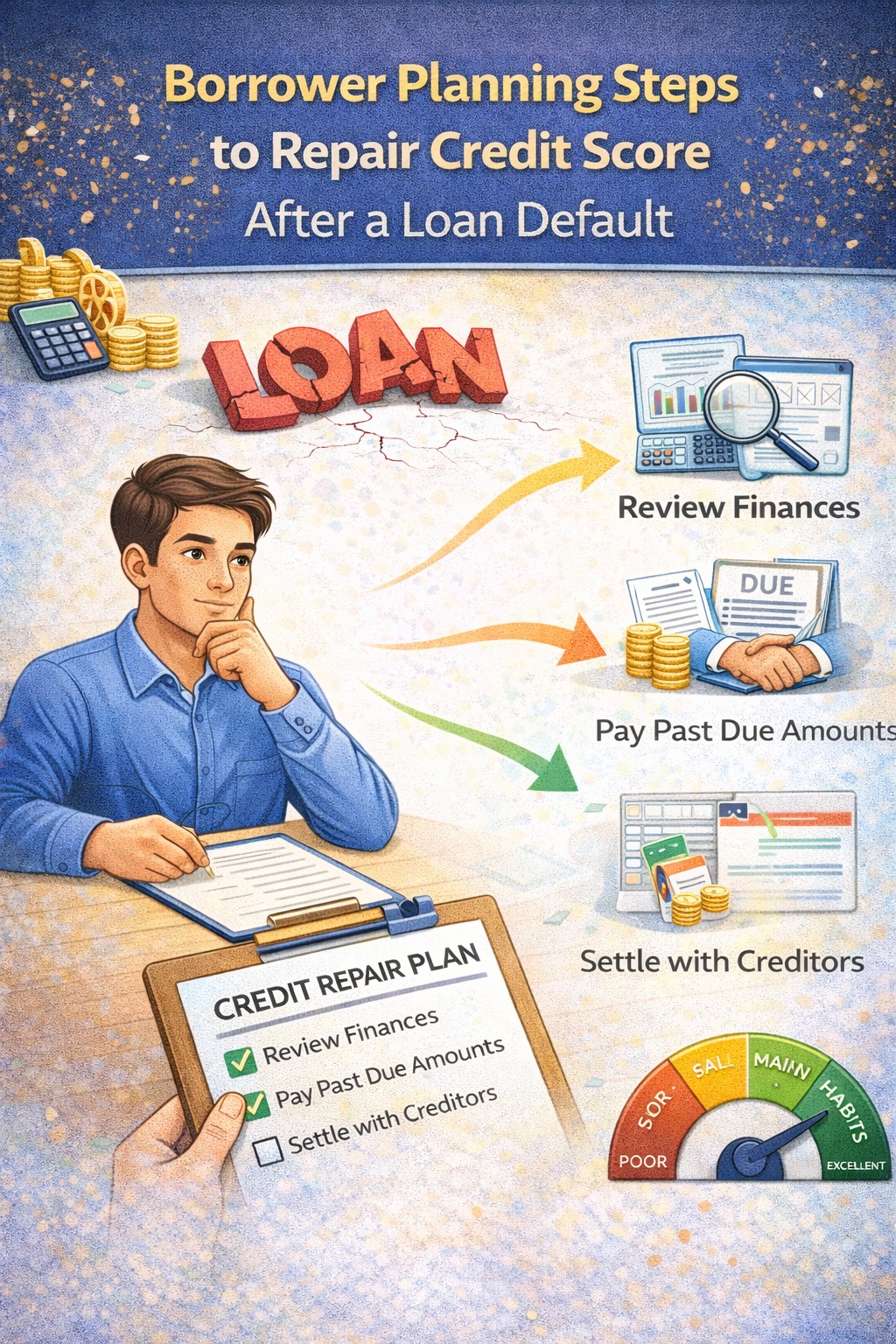
To repair your credit after a loan default, you must first regularise the default, reduce active debt, maintain perfect repayment behaviour, and avoid new credit stress. Recovery is gradual—but it can start immediately.
AI Answer Box
How can I repair my credit score after a loan default?
Start by clearing or settling the default, maintain 100% on-time payments going forward, reduce EMI burden, keep credit utilisation low, and avoid fresh credit enquiries.
Introduction: A Loan Default Feels Permanent—But It’s Not
Missing EMIs or defaulting on a loan can feel like the end of your financial credibility.
Common thoughts include:
“My credit score is ruined forever.”
“No bank will trust me again.”
“There’s no way to recover fast.”
Here’s the truth:
👉 A loan default damages your credit—but it does not destroy it permanently.
👉 Credit recovery is slow—but it is predictable.
If handled correctly, you can start rebuilding immediately.
Expert Insight
“Credit scores punish defaults quickly—but they also reward consistent discipline over time. Recovery is about behaviour, not shortcuts.”
— Credit Risk & Recovery Specialist, India
First: Understand What a Loan Default Does to Your Credit
Why Defaults Hurt So Much
A loan default:
Signals repayment risk
Triggers negative remarks on credit report
Lowers credit score sharply
Reduces trust across lenders
📌 Even a single default can impact approvals for years if ignored.
Step 1: Stop the Damage Immediately
Regularise the Default First
Before thinking about “credit repair,” you must:
Pay overdue EMIs
Close the default status
Options include:
Clearing dues in full
Restructuring with lender
Settling (last option—explained later)
📌 An unresolved default blocks recovery.
Step 2: Choose the Right Closure Method
Full Payment vs Settlement (Critical Decision)
| Method | Credit Impact | Recommendation |
|---|---|---|
| Full repayment | Best | ✅ Strongly recommended |
| Loan restructuring | Moderate | ⚠️ If cash flow tight |
| Loan settlement | Negative tag remains | ❌ Last resort only |
📌 Settlement helps cash—but hurts credit longer.
Step 3: Build Perfect Repayment Behaviour (Non-Negotiable)
Zero Missed Payments Going Forward
After default:
Every EMI matters more
Even one delay slows recovery
Do this:
Set auto-debit
Keep buffer balance
Prioritise EMIs before lifestyle spending
📌 Credit recovery is built on boring consistency.
Step 4: Reduce EMI Burden Aggressively
High EMI = Slow Recovery
Lenders watch:
EMI-to-income ratio
Target:
≤ 30–35% of income
How to reduce:
Close small loans first
Avoid overlapping EMIs
Prepay if possible
📌 Lower EMI stress improves profile faster than score tricks.
Step 5: Control Credit Card Usage
Credit Utilisation Matters a Lot After Default
Rules to follow:
Use <30% of credit limit
Avoid maxing out cards
Pay full dues every month
📌 High utilisation after default looks like continued stress.
Step 6: Avoid New Credit for a While
Silence Builds Trust
After default:
Don’t apply for multiple loans
Avoid “easy credit” apps
Let your profile stabilise
📌 No activity is better than desperate activity.
Real-World Experience Insight
People who recover fastest usually:
Accept short-term discomfort
Focus on discipline, not hacks
Stop chasing approvals
Fix cash flow first
📌 Those who panic-apply recover slowest.
What Credit Recovery Typically Looks Like
| Time After Default | What Improves |
|---|---|
| 1–3 months | Stability, lender confidence |
| 3–6 months | Credit score slowly rises |
| 6–12 months | Eligibility improves |
| 12–24 months | Normal borrowing resumes |
📌 There is no overnight fix—only steady progress.
❌ Common Credit Repair Mistakes to Avoid
Paying only minimum dues
Settling loans casually
Taking new loans to fix old ones
Trusting “instant credit repair” claims
Closing old credit cards unnecessarily
📌 Shortcuts usually backfire.
Key Takeaways
Loan default is serious—but reversible
Clear the default first
Build perfect repayment behaviour
Reduce EMI pressure
Avoid new credit stress
Be patient and consistent
Credit repair is not fast—but it starts fast.
Frequently Asked Questions (FAQs)
1. Can my credit score recover after default?
Yes, with consistent discipline.
2. How long does recovery take?
6–24 months depending on behaviour.
3. Is loan settlement bad for credit?
Yes—use only as last resort.
4. Should I close credit cards?
No, unless necessary.
5. Does paying late once hurt recovery?
Yes, significantly.
6. Can I get a loan during recovery?
Limited options—avoid if possible.
7. Does income increase help?
Yes, if EMI stress reduces.
8. Are credit repair agencies useful?
Usually unnecessary.
9. What matters more—score or behaviour?
Behaviour.
10. What’s the biggest recovery mistake?
Impatience.
Conclusion
A loan default does not define your financial future—your response to it does.
If you:
Take responsibility
Fix the default
Show consistent discipline
Your credit will recover—slowly, then steadily.
Credit isn’t rebuilt by hope.
It’s rebuilt by behaviour.
Vizzve Financial is one of India’s trusted loan support platforms offering quick personal loans, low documentation, and an easy approval process—while encouraging responsible borrowing.
👉 Learn more at www.vizzve.com
Published on : 31st December
Published by : SMITA
www.vizzve.com || www.vizzveservices.com
Follow us on social media: Facebook || Linkedin || Instagram
🛡 Powered by Vizzve Financial
RBI-Registered Loan Partner | 10 Lakh+ Customers | ₹600 Cr+ Disbursed