

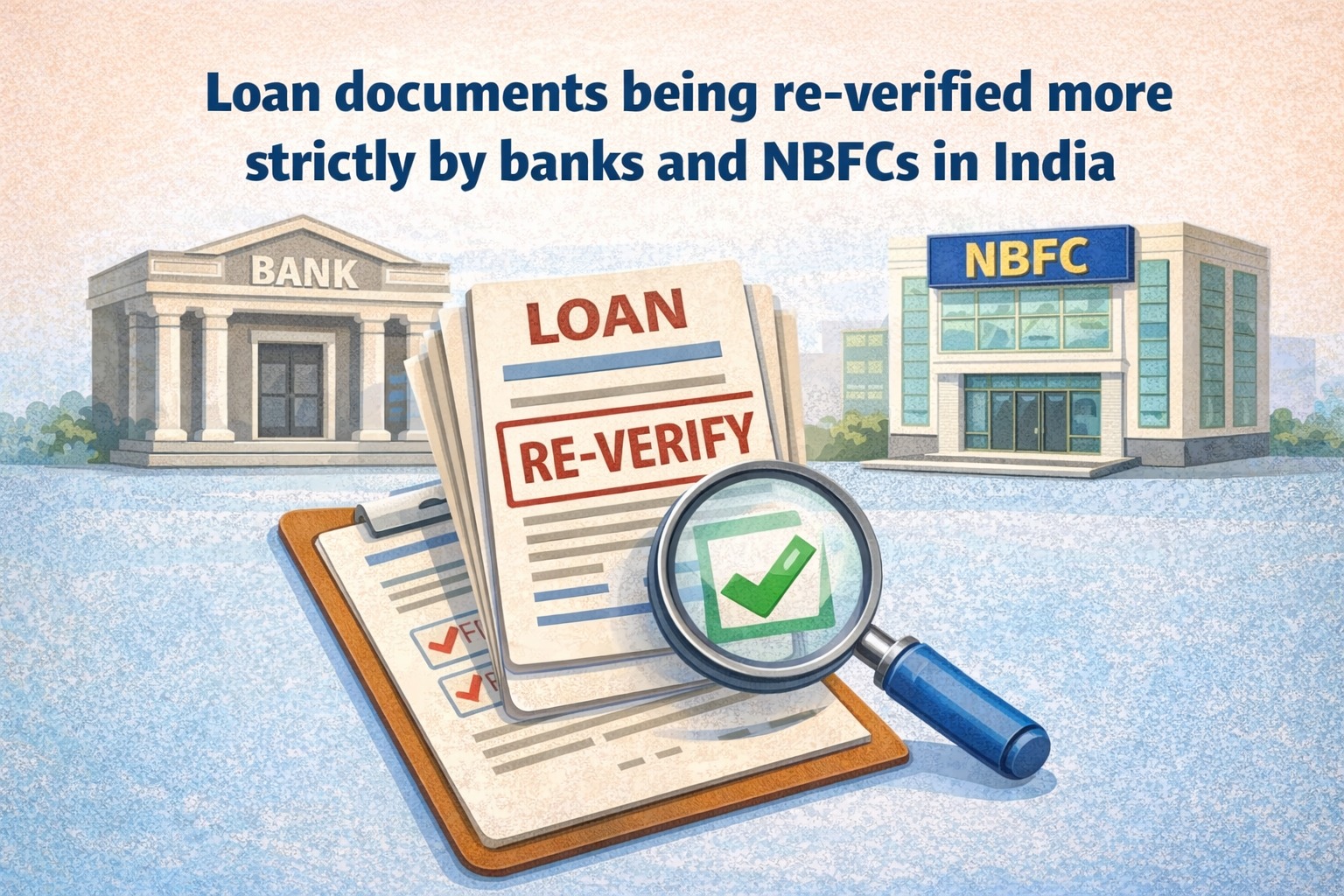
In 2026, banks and NBFCs are re-verifying loan documents more strictly due to rising fraud, tighter RBI norms, and digital lending risks. Even sanctioned loans may face rechecks before disbursal. Accurate documents now matter more than speed.
AI Answer Box
Why loan documents are re-verified more strictly:
Rising fake income & KYC fraud
RBI tightening credit quality norms
Digital lending risk control
Focus on borrower credibility
Prevention of future NPAs
Introduction
Many borrowers are surprised when a loan—already approved or sanctioned—gets delayed or paused due to document re-verification.
In 2026, this is no longer an exception. Banks and NBFCs across India are intentionally tightening document checks, even re-verifying papers that were already submitted earlier.
This change is not meant to trouble genuine borrowers—it is meant to protect the lending system. Understanding why this is happening and how to prepare can save you from unnecessary stress and delays.
What Does “Loan Document Re-Verification” Mean?
Loan document re-verification means lenders recheck the authenticity, accuracy, and consistency of documents already submitted during the loan application.
This may happen:
After loan sanction
Before loan disbursal
During long processing gaps
If risk flags are detected
📌 Important:
Loan sanction does not guarantee disbursal if document issues are found later.
Why Banks & NBFCs Are Verifying Documents More Strictly
1. Rise in Fake Documents & Loan Frauds
Lenders have reported increasing cases of:
Edited bank statements
Inflated salary slips
Fake employment letters
Incorrect GST filings
Stricter verification reduces bad loans and defaults.
2. RBI’s Focus on Credit Discipline
The Reserve Bank of India has instructed lenders to:
Improve underwriting standards
Reduce unsecured loan risk
Prevent early-stage NPAs
As a result, lenders now follow zero-tolerance document checks.
3. Digital Lending Speed Created New Risks
Instant approvals increased convenience—but also:
Errors
Identity misuse
Rapid fraud scaling
Re-verification acts as a final safety filter before money is released.
Documents That Are Commonly Re-Verified
| Document Type | What Is Checked Again |
|---|---|
| Bank Statements | Salary credits, cash flow pattern |
| Income Proof | Authenticity & consistency |
| Employment Proof | Employer confirmation |
| Business Proof | GST, turnover, filings |
| Address Proof | Physical/digital validation |
| KYC Documents | Identity matching |
What Triggers Re-Verification?
Re-verification is usually triggered when lenders notice:
Sudden income jump
Mismatch between documents
Multiple loan enquiries after sanction
Long gap between sanction & disbursal
High loan amount vs income
📌 These are risk signals, not accusations.
Impact on Borrowers
✅ Genuine Borrowers
Minor delay
Higher trust score
Smooth long-term credit access
❌ Risky or Inconsistent Profiles
Disbursal delays
Reduced loan amount
Loan cancellation in extreme cases
Real-World Lending Insight
From recent lending trends, borrowers with clean, consistent, unedited documents receive faster disbursals, even under stricter rules. Those rushing applications or inflating income face repeated checks.
➡️ Accuracy now matters more than speed.
How Borrowers Can Avoid Delays (Step-by-Step)
Step 1: Submit Only Original Documents
Avoid screenshots, edits, or modified PDFs.
Step 2: Maintain Clean Bank Statements
Irregular cash entries raise red flags.
Step 3: Don’t Inflate Income
Mismatch leads to rejection—not higher approval.
Step 4: Avoid New Loans During Processing
Fresh enquiries trigger risk alerts.
Step 5: Respond Quickly to Verification Calls
Missed calls delay approvals.
🔹 Pros & Cons of Strict Re-Verification
✅ Pros
Safer lending system
Lower fraud risk
Better borrower trust
Fewer future NPAs
❌ Cons
Slightly longer processing time
Extra documentation follow-ups
🔹 Key Takeaways
Loan verification is stricter in 2026
Re-verification can happen even after sanction
RBI compliance is the main driver
Clean documents = faster disbursal
Transparency protects borrowers
🔹 Frequently Asked Questions (FAQs)
1. Why is my loan re-verified after approval?
Due to stricter risk and compliance checks.
2. Can a sanctioned loan be cancelled?
Yes, if document issues are found.
3. Is re-verification normal now?
Yes, across banks and NBFCs.
4. Does re-verification affect credit score?
No, unless loan is rejected after default.
5. Which loans face most rechecks?
Personal, business, and high-value loans.
6. Are digital loans more strictly checked?
Yes, due to higher fraud risk.
7. How long can re-verification delay disbursal?
From hours to a few days.
8. Can banks re-verify employer details?
Yes, commonly.
9. Should I submit edited documents?
No—this causes rejection.
10. Does RBI mandate re-verification?
RBI mandates stronger underwriting standards.
11. Can NBFCs follow different rules?
Yes, but most follow RBI-aligned norms.
12. How can I speed up disbursal?
Submit accurate documents and respond fast.
🔹 Conclusion + CTA
Stricter loan document verification is not a hurdle—it’s a safeguard. Borrowers who stay transparent, organised, and patient benefit the most under the new lending environment.
Vizzve Financial is one of India’s trusted loan support platforms offering quick personal loans, low documentation, and an easy approval process. Apply at www.vizzve.com.
Published on : 9th January
Published by : SMITA
www.vizzve.com || www.vizzveservices.com
Follow us on social media: Facebook || Linkedin || Instagram
🛡 Powered by Vizzve Financial
RBI-Registered Loan Partner | 10 Lakh+ Customers | ₹600 Cr+ Disbursed