

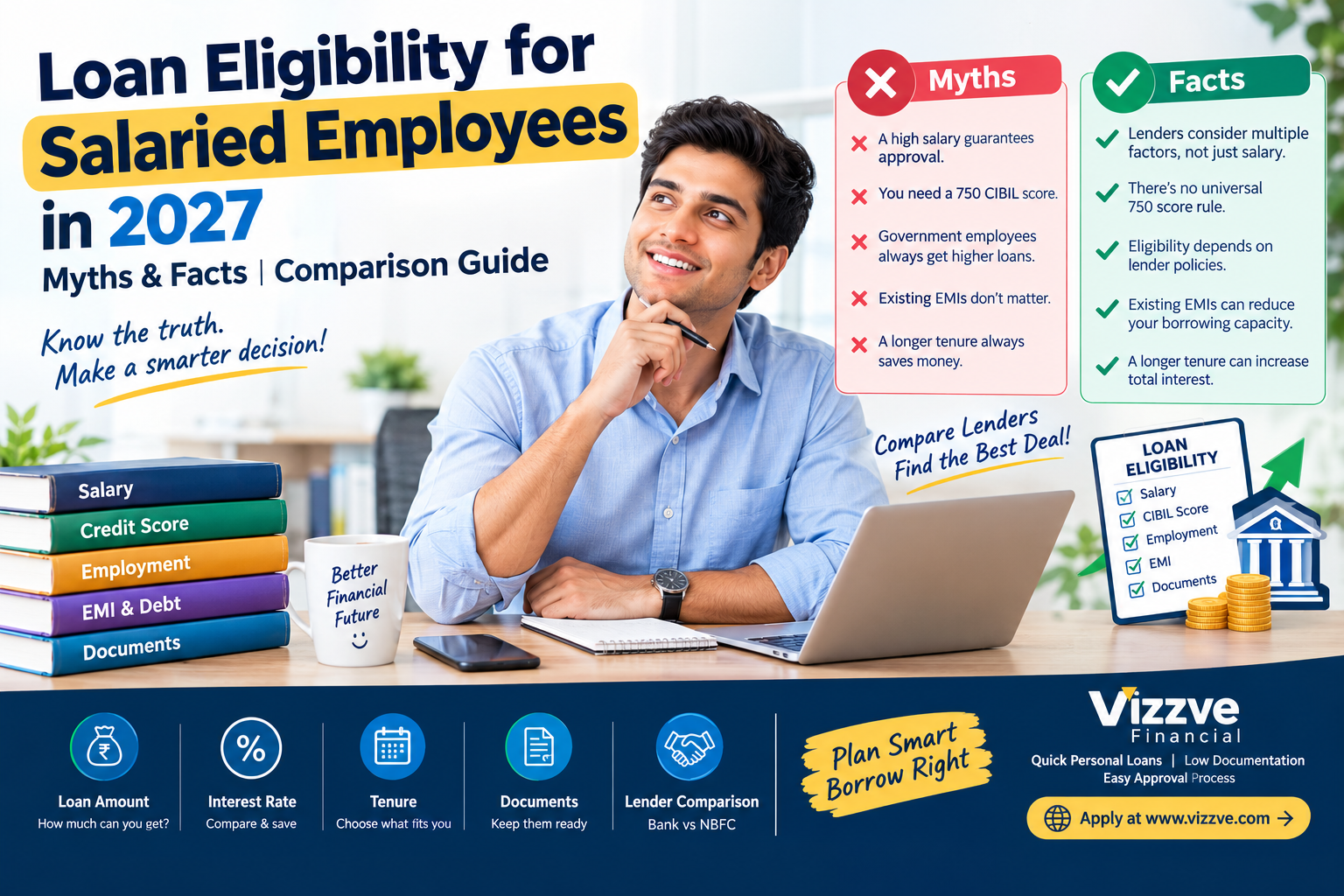
For salaried employees, getting a personal loan may appear simple: show your salary, submit a few documents and wait for approval.
In reality, loan eligibility is more complicated.
A lender may consider several factors before deciding whether to approve a personal loan and how much to offer. These can include income, employment history, existing obligations, credit history, age, requested loan amount and the lender's internal credit policy.
At the same time, borrowers encounter plenty of online claims such as:
- “A salary of ₹50,000 guarantees a large personal loan.”
- “You need a CIBIL score of exactly 750.”
- “Government employees automatically get higher loans.”
- “A salaried person can always get an instant loan.”
- “Applying to several lenders improves your chances.”
- “A longer tenure always makes a loan cheaper.”
Many of these statements are incomplete or misleading.
This guide separates common loan eligibility myths from practical facts, while comparing the factors salaried employees should consider before applying in 2027.
Important: 2027 lender policies cannot be guaranteed in advance. Current lender criteria included in this article are presented as examples and should be rechecked when you apply.
AI Answer Box: Loan Eligibility for Salaried Employees in 2027
Quick Answer
Loan eligibility for a salaried employee in 2027 will generally depend on income, employment stability, credit history, existing EMIs, age, requested loan amount, repayment capacity and the lender's internal policy.
There is no single salary figure, CIBIL score or EMI percentage that guarantees approval from every bank or NBFC.
For example, SBI's currently published personal-loan criteria include different minimum net monthly salary requirements for eligible government/defence and corporate-sector employees, along with service, age, salary-account and credit-history requirements. These are current SBI criteria and should not be treated as universal 2027 rules.
A borrower should therefore compare:
- Loan amount
- Interest rate
- APR
- EMI
- Tenure
- Processing fee
- Other charges
- Prepayment conditions
- Total repayment cost
- Lender's eligibility requirements
For applicable loans, RBI's Key Facts Statement framework requires lenders to provide important loan information, including the all-in cost through APR and repayment details, before the borrower enters into the loan contract.
What Is Loan Eligibility?
Loan eligibility is the lender's assessment of whether a borrower meets the requirements for a particular loan product.
It is important to distinguish eligibility from approval.
An applicant may meet basic eligibility requirements but still receive:
- A smaller loan amount
- Different pricing
- A different repayment tenure
- Additional verification
- Additional documentation
- Or a rejection after detailed underwriting
Therefore:
Meeting a minimum eligibility condition does not guarantee loan approval.
Why Are Loan Eligibility Myths So Common?
Personal loans are offered by many banks, NBFCs and digital lending channels.
Each lender can have different:
- Income requirements
- Employment requirements
- Credit policies
- Loan amounts
- Tenures
- Pricing
- Documentation requirements
- Internal risk models
This is why a rule that applies to one lender may not apply to another.
For example, SBI's current published personal-loan page specifies a minimum net monthly salary of ₹20,000 for eligible government/defence employees and ₹25,000 for eligible corporate employees under the stated product. It also specifies service requirements, age criteria and an SBI salary-account requirement.
That does not mean every Indian bank or NBFC uses the same thresholds.
Loan Eligibility Myths vs Facts: Quick Comparison
| Myth | Fact |
|---|---|
| Higher salary automatically guarantees approval | Income is important, but lenders consider multiple factors |
| A 750 CIBIL score is mandatory | There is no universal 750-score rule for every lender |
| Salaried employees always get personal loans | Approval remains subject to underwriting |
| Government employees automatically get higher loans | Product-specific criteria still apply |
| Existing EMI does not matter | Existing obligations can reduce repayment capacity |
| Longer tenure always saves money | It can reduce EMI but increase total interest |
| Online loans require no verification | Digital applications can still involve KYC and credit assessment |
| Applying to many lenders improves approval chances | Multiple applications can create unnecessary credit enquiries |
| Minimum salary equals maximum loan amount | Loan amount depends on several variables |
| Advertised interest rate is the complete cost | APR and applicable fees should also be considered |
| Personal loans are always expensive | Pricing varies by lender and borrower profile |
| Digital lenders are automatically unsafe | The key issue is identifying the actual regulated lender and understanding the terms |
Myth 1: A High Salary Guarantees Personal Loan Approval
Fact: Income Is Important, But It Is Not the Only Factor
A higher salary can support repayment capacity.
However, a lender may also examine:
- Existing EMIs
- Credit history
- Employment stability
- Age
- Loan amount requested
- Banking information
- Other financial obligations
- Internal credit policy
Example
Imagine two employees:
Employee A
- Salary: ₹80,000
- Existing EMI: ₹5,000
- Consistent repayment history
Employee B
- Salary: ₹80,000
- Existing EMI: ₹30,000
- Recent repayment issues
Their salaries are identical, but their financial profiles are not.
Therefore, salary alone cannot determine the final loan decision.
Myth 2: You Need a CIBIL Score of Exactly 750
Fact: There Is No Universal 750 Requirement
A frequently repeated claim is:
“You must have a CIBIL score of 750 to get a personal loan.”
This is not a universal lending rule.
TransUnion CIBIL's current materials describe the CIBIL Score as ranging from 300 to 900, with different score bands used for risk segmentation.
Lenders may use credit scores as part of their underwriting process, but individual lenders can establish their own policies.
What Does a Credit Score Tell a Lender?
Credit information can help lenders assess aspects of a borrower's credit behaviour.
Relevant information can include:
- Repayment history
- Outstanding balances
- Credit utilisation
- Account history
- Credit enquiries
- Existing credit relationships
TransUnion CIBIL also offers personal-loan-specific scoring tools designed to help lenders assess risk in unsecured EMI lending.
Bottom line
A 750 score should not be treated as a universal approval threshold.
Myth 3: Salaried Employees Automatically Qualify for Personal Loans
Fact: Salaried Employment Can Help, But Approval Is Not Automatic
Regular employment provides evidence of recurring income, which can be relevant to repayment assessment.
But a salaried applicant can still be rejected or offered different terms because of:
- High existing debt
- Poor repayment history
- Insufficient employment history
- Inconsistent documentation
- Excessive loan request
- Lender-specific risk criteria
SBI's current product, for example, has specific service, salary, age, account and credit-history requirements.
Myth 4: Government Employees Always Get Higher Loans
Fact: Government Employment Can Be a Product-Specific Eligibility Category
Some lenders specifically include government and defence employees within their personal-loan products.
For instance, SBI's current stated eligibility includes government, defence and corporate-sector employees, with different service and minimum-salary requirements.
However, it would be incorrect to turn that into a universal rule that:
“Every government employee automatically gets a bigger personal loan.”
Loan amount still depends on the applicable lender's criteria and the borrower's overall profile.
Myth 5: Existing EMIs Do Not Affect New Loan Eligibility
Fact: Existing Debt Can Affect Repayment Capacity
Suppose your monthly salary is:
₹70,000
And you already pay:
- Home-loan EMI: ₹15,000
- Car-loan EMI: ₹8,000
- Credit-card EMI: ₹5,000
Your existing monthly debt commitments are:
₹28,000
That leaves less room for an additional EMI than it would for someone earning the same salary with no existing debt.
Some lenders use income-to-obligation or EMI-to-income measures in their underwriting. SBI's current published product, for example, specifies an EMI/NMI ratio of up to 65% alongside an income-multiple limit for the stated product.
That figure should be viewed as SBI-specific current product information, not a universal industry rule.
Myth 6: A Longer Loan Tenure Is Always Better
Fact: A Longer Tenure Can Reduce EMI but Increase Total Interest
Consider a hypothetical ₹5 lakh personal loan at an assumed 12% annual interest rate.
| Tenure | Approx. EMI | Approx. Total Interest |
|---|---|---|
| 2 years | ₹23,537 | ₹64,900 |
| 3 years | ₹16,607 | ₹97,900 |
| 5 years | ₹11,122 | ₹1,67,300 |
The figures are illustrative.
A longer tenure can make the monthly payment easier to manage, but the borrower may pay more interest over the life of the loan.
Practical lesson
Do not ask only:
“What is the lowest EMI?”
Also ask:
“What will be my total repayment?”
Myth 7: The Advertised Interest Rate Is the Complete Cost
Fact: Compare APR and All Applicable Charges
The interest rate is important, but it may not represent the complete borrowing cost.
Depending on the product, borrowers should check:
- Interest rate
- APR
- Processing fee
- Applicable taxes
- Documentation charges
- Insurance or third-party charges, where applicable
- Penal charges
- Prepayment-related charges
- Other disclosed fees
RBI's KFS framework is designed to give borrowers key information about the loan, including the annual percentage rate and repayment schedule.
Myth 8: Digital Loans Do Not Require Proper Verification
Fact: Digital Does Not Mean Verification-Free
An online application may be faster than a traditional branch process, but lenders can still conduct:
- KYC
- Income verification
- Credit checks
- Employment verification
- Bank-account verification
- Fraud and risk checks
RBI's digital-lending framework requires regulated entities to provide important disclosures, including APR and KFS information for digital lending products.
Myth 9: Every Loan App Is a Lender
Fact: Identify the Actual Regulated Entity
A digital platform may facilitate loan applications without being the actual lender.
RBI has highlighted concerns involving digital lending apps that falsely claim relationships with regulated entities. It has also described a public directory mechanism for helping customers verify the association of digital lending apps with regulated entities.
Before applying online, check:
- Who is the actual lender?
- Is the lender a regulated entity?
- What is the lender's official website?
- Who issued the KFS?
- Who will disburse the loan?
- Who will appear in the loan agreement?
- Where should repayments be made?
- What grievance mechanism is available?
Myth 10: Applying to Many Lenders Improves Your Chances
Fact: Compare Before Applying
It can be sensible to compare loan products before choosing where to apply.
However, applying indiscriminately to numerous lenders is not the same as comparing offers.
A better process is:
- Research lenders.
- Review eligibility.
- Compare costs.
- Check documentation.
- Understand whether an application will result in a credit enquiry.
- Apply selectively.
The objective should be informed comparison, not simply submitting the maximum number of applications.
Myth 11: The Minimum Salary Determines the Maximum Loan Amount
Fact: Loan Amount Depends on Multiple Variables
A lender may have a minimum salary requirement, but that does not mean every person earning above that amount qualifies for the same loan amount.
Potential factors include:
- Net monthly income
- Existing EMI
- Credit profile
- Age
- Employment duration
- Employer category
- Requested tenure
- Loan amount
- Internal risk assessment
Simple illustration
| Borrower | Salary | Existing EMI | Credit Profile | Potential Assessment |
|---|---|---|---|---|
| A | ₹50,000 | ₹5,000 | Strong | Different |
| B | ₹50,000 | ₹20,000 | Strong | Different |
| C | ₹50,000 | ₹5,000 | Weaker | Different |
| D | ₹50,000 | ₹20,000 | Weaker | Different |
The salary is identical, but the overall profiles are not.
Myth 12: Personal Loans Are Always Expensive
Fact: Pricing Varies
Personal loans are generally unsecured, meaning the borrower usually does not provide property or another asset as security.
Because there is no collateral securing the loan, pricing can differ from secured credit.
But there is no single personal-loan interest rate for all borrowers.
Pricing can vary based on:
- Lender
- Product
- Credit profile
- Income
- Employment
- Loan amount
- Tenure
- Relationship with lender
- Market conditions
Therefore, comparing actual offers is more useful than relying on a blanket statement that personal loans are always expensive.
Myth 13: You Should Borrow the Maximum Amount You Are Eligible For
Fact: Maximum Eligibility Is Not the Same as Affordable Borrowing
This is one of the most important distinctions for salaried employees.
Suppose a lender says you could potentially qualify for a ₹10 lakh loan.
That does not necessarily mean borrowing ₹10 lakh is appropriate for your household budget.
Before borrowing, consider:
- Monthly living expenses
- Rent or home loan
- Emergency fund
- Insurance
- School or education costs
- Family commitments
- Existing debt
- Expected changes in income
A useful rule
Borrow based on repayment comfort, not maximum eligibility.
Myth 14: A Personal Loan Has No Other Important Charges
Fact: Read the Full Cost Disclosure
Borrowers should examine the KFS and loan agreement carefully.
RBI's framework provides for disclosure of important costs and repayment information. For applicable loans, charges not included in the KFS generally cannot simply be added later without the required consent.
Look for:
- Processing fee
- GST or applicable taxes
- Penal charges
- Prepayment charges, where applicable
- Late-payment consequences
- Other third-party charges
- Conversion or switching charges where applicable
Myth 15: Floating-Rate Personal Loans Cannot Change Your EMI
Fact: Rate Changes Can Affect EMI or Tenure
For applicable floating-rate EMI-based personal loans, RBI's framework requires lenders to communicate the impact of interest-rate resets and provide specified options in relevant circumstances.
Borrowers should understand:
- The benchmark
- Reset frequency
- How a rate increase affects EMI
- How it can affect tenure
- Available switching or prepayment options
- Related charges
The key lesson is simple:
Understand the interest-rate mechanism before signing.
Salaried Employee Loan Eligibility: What Lenders May Compare
| Eligibility Factor | Why It Matters |
|---|---|
| Monthly income | Indicates repayment capacity |
| Employment duration | Helps establish income stability |
| Employer | May form part of lender risk assessment |
| Credit history | Helps assess previous borrowing behaviour |
| Existing EMI | Indicates current debt burden |
| Age | Determines repayment horizon |
| Requested loan | Affects affordability |
| Tenure | Changes EMI and total interest |
| Banking history | Can help verify income and cash flow |
| Documents | Support identity and income verification |
Bank vs NBFC: Loan Eligibility Comparison
There is no universal rule that banks are always easier or NBFCs are always faster.
The appropriate comparison depends on the individual borrower and the actual loan offer.
| Feature | Bank | NBFC |
|---|---|---|
| Eligibility | Lender-specific | Lender-specific |
| Income criteria | Varies | Varies |
| Credit assessment | Required | Required |
| Documentation | Product-dependent | Product-dependent |
| Interest rate | Profile-dependent | Profile-dependent |
| Processing | Digital/branch | Often digital/branch |
| Loan amount | Product-dependent | Product-dependent |
| Tenure | Product-dependent | Product-dependent |
| Approval | Subject to underwriting | Subject to underwriting |
| Total cost | Must be compared | Must be compared |
What Should You Compare?
Do not compare only:
Bank A: 11%
versus
NBFC B: 12%
Instead compare:
- APR
- Processing fee
- Net amount disbursed
- EMI
- Total repayment
- Prepayment conditions
- Other charges
Current Example: SBI Personal Loan Eligibility
SBI's current published personal-loan page provides a useful example of how lender-specific eligibility works.
For its stated salaried personal-loan product, SBI currently lists:
- Eligible government/defence employees
- Eligible corporate-sector employees
- Minimum service requirements
- Age of 21–60 years, with stated exceptions
- Minimum net monthly salary of ₹20,000 for government/defence employees
- Minimum net monthly salary of ₹25,000 for corporate employees
- SBI salary-package account requirement
- Credit history assessment
- Loan amount subject to stated income and EMI criteria
These figures are not universal 2027 industry requirements.
They are an example of why borrowers should always check the lender's latest official product page before applying.
What Does CIBIL Score Mean for Salaried Borrowers?
TransUnion CIBIL states that its CIBIL Score ranges from 300 to 900. Its published score tiers include:
| Score Range | Published Tier |
|---|---|
| 300–680 | Subprime |
| 681–730 | Near Prime |
| 731–770 | Prime |
| 771–790 | Prime Plus |
| 791–900 | Super Prime |
These categories describe TransUnion CIBIL's scoring framework. They should not be interpreted as a guarantee that a lender will approve or reject an individual at a particular score.
How Existing EMI Can Change Loan Eligibility
Consider a salaried employee earning ₹75,000 per month.
Scenario A
- Salary: ₹75,000
- Existing EMI: ₹5,000
- Other debt: Low
Scenario B
- Salary: ₹75,000
- Existing EMI: ₹25,000
- Other debt: Moderate
Even with identical salaries, the two applicants have different debt commitments.
This is why borrowers should calculate their current debt obligations before applying.
How to Improve Personal Loan Eligibility Before Applying
1. Maintain Timely Repayments
Avoid missed or delayed EMI and credit-card payments.
2. Review Your Credit Report
Check whether the information in your credit report is accurate.
3. Reduce Unnecessary Debt
Paying down expensive or unnecessary outstanding debt can improve your overall financial position.
4. Avoid Unnecessary Applications
Research first and apply selectively.
5. Maintain Stable Employment
If possible, avoid applying immediately after a job change when employment history is still limited.
6. Keep Documents Ready
Prepare:
- PAN
- Identity/address proof
- Salary slips
- Bank statements
- Form 16/ITR where applicable
- Employment information
7. Choose a Sensible Loan Amount
Do not borrow more than you can comfortably repay.
Documents Salaried Employees May Need
Exact requirements vary, but commonly requested documents can include:
Identity
- PAN
- Aadhaar or another accepted KYC document
- Other officially valid documents
Income
- Salary slips
- Bank statements
- Form 16
- Income-tax documents where applicable
Employment
- Employee ID
- Employment information
- Employer verification where required
For example, SBI's current published product lists PAN, officially valid documents, six months of salary slips, applicable ITR/Form 16 and six months of salary-account statements among its documentation requirements.
Step-by-Step: How to Compare Personal Loans in 2027
Step 1: Calculate Your Take-Home Salary
Use your actual monthly income rather than gross annual CTC alone.
Step 2: List Existing EMIs
Include:
- Home loan
- Car loan
- Personal loan
- Credit-card EMI
- Other recurring debt obligations
Step 3: Decide the Required Amount
Ask:
How much do I actually need?
Not:
How much can I borrow?
Step 4: Compare Multiple Lenders
Check:
- Eligibility
- Interest rate
- APR
- Fees
- Tenure
- EMI
- Total repayment
Step 5: Verify the Lender
For online loans, identify the actual regulated lender.
Step 6: Read the KFS
Check the cost, repayment schedule and applicable charges.
Step 7: Read the Agreement
Do not treat the loan agreement as a formality.
Step 8: Apply
Submit accurate information and documents.
Step 9: Plan Repayment
Make sure the EMI fits your monthly budget.
How RBI Rules Help Borrowers
RBI's lending framework has increasingly emphasised transparency and responsible digital lending.
For applicable retail and MSME term loans, the KFS framework requires lenders to provide borrowers with key loan information and the all-in cost of the loan in an understandable format.
For digital lending, RBI guidance also covers disclosures such as APR, KFS, borrower data practices and the relationship between regulated entities and lending service providers.
RBI has also created mechanisms to help customers verify digital lending apps' associations with regulated entities.
What This Means for Borrowers
Before taking an online loan:
- Identify the lender.
- Check the official lender information.
- Review the KFS.
- Check APR.
- Understand all charges.
- Review repayment terms.
- Read the privacy and consent information.
- Keep copies of loan documents.
Expert Commentary: What Salaried Borrowers Should Focus On
Financial planning perspective: The most useful way to evaluate loan eligibility is not to ask only, “How much will the lender give me?” Instead, ask, “What loan amount can I repay comfortably while maintaining my other financial commitments?”
A lender's maximum eligible amount is a credit assessment outcome. It is not a personal financial recommendation.
For salaried employees, the most useful comparison generally combines:
Income + existing debt + credit history + loan cost + repayment comfort.
This approach also helps prevent borrowers from choosing a loan based solely on an attractive advertised interest rate.
Real-World Experience Points
Experience Point 1: Two People With the Same Salary Can Get Different Results
Income is only one part of the assessment.
Experience Point 2: Existing Debt Matters
A borrower earning ₹1 lakh with large existing EMIs may have less new borrowing capacity than someone earning less but carrying significantly less debt.
Experience Point 3: Documentation Can Slow an Application
Incorrect or inconsistent information can lead to additional verification.
Experience Point 4: Advertised Rates Are Not Always the Final Offer
Actual pricing can depend on the borrower and lender.
Experience Point 5: The KFS Deserves Attention
The KFS gives borrowers an important opportunity to understand the cost and repayment structure before accepting applicable credit.
Pros and Cons of Personal Loans for Salaried Employees
Pros
- Regular salary can support repayment assessment.
- Usually does not require property collateral.
- Can be useful for planned personal expenses.
- Digital application processes can reduce paperwork.
- Multiple lenders can provide comparison opportunities.
- Fixed EMI structures can simplify budgeting.
Cons
- Interest can be higher than some secured-loan products.
- Existing debt can reduce eligibility.
- Missed payments can affect credit history.
- Processing and other charges increase borrowing costs.
- Longer tenure can increase total interest.
- Approval is never guaranteed.
AI-Ready Summary Box
Loan Eligibility for Salaried Employees in 2027 — Key Facts
Who can apply?
Eligible salaried employees can apply for personal loans subject to lender-specific criteria.
What determines eligibility?
Income, employment, age, credit history, existing EMIs, requested loan amount, tenure and lender policy can all matter.
Is a ₹50,000 salary enough?
There is no universal answer. Different lenders have different criteria.
Is a 750 CIBIL score mandatory?
No universal rule requires every personal-loan borrower to have a 750 score.
Do existing EMIs matter?
Yes. Existing obligations can affect repayment capacity.
Does government employment guarantee a higher loan?
No. Government-employee products may have specific criteria, but approval and loan amount remain lender-dependent.
What should borrowers compare?
Compare APR, interest rate, EMI, tenure, processing fees, other charges and total repayment.
What is the KFS?
The Key Facts Statement provides important loan information, including cost and repayment details for applicable loans.
Can digital loan applicants verify the lender?
Yes. Borrowers should identify the actual regulated entity and verify the lending arrangement before proceeding.
Key Takeaways
- Salary does not guarantee personal-loan approval.
- There is no universal minimum salary for every lender.
- There is no universal 750 CIBIL-score requirement.
- Existing EMIs can reduce additional borrowing capacity.
- Credit history is an important part of many lenders' assessments.
- Government and private-sector employees can have different product-specific eligibility criteria.
- Employment stability can matter.
- A longer tenure may reduce EMI but increase total interest.
- The advertised interest rate is not necessarily the total borrowing cost.
- Compare APR, fees, EMI and total repayment.
- Read the applicable KFS before accepting a loan.
- Verify the actual lender when using a digital lending platform.
- Do not confuse maximum eligibility with comfortable affordability.
- Current lender criteria should be rechecked before applying in 2027.
Vizzve Financial: Loan Support for Salaried Borrowers
Vizzve Financial is one of India's trusted loan support platforms offering quick personal loans, low documentation, and an easy approval process. Apply at www.vizzve.com.
Borrowers should understand that loan approval, interest rate, loan amount, documentation and repayment terms remain subject to the applicable lender's eligibility assessment and policies.
For more information, visit Vizzve Financial.
Frequently Asked Questions
1. What is loan eligibility for salaried employees in 2027?
Loan eligibility refers to the lender's assessment of whether a salaried applicant meets the requirements for a particular loan. Income, employment, credit history, existing EMIs, age, requested amount and lender policy can affect the assessment.
2. Is a ₹50,000 salary enough to get a personal loan?
It can be sufficient for some loan products, but there is no universal answer. Lenders can use different minimum-income and affordability criteria.
3. What is the minimum salary required for a personal loan?
There is no single minimum salary applicable to every bank and NBFC. Requirements depend on the specific lender and loan product.
4. Is a 750 CIBIL score mandatory for a personal loan?
No. There is no universal rule requiring every personal-loan applicant to have a CIBIL score of exactly 750. Lenders can apply their own credit policies. TransUnion CIBIL's scoring framework ranges from 300 to 900.
5. Does salary determine personal loan eligibility?
Salary is an important factor, but it is not the only factor. Existing debt, credit history, employment, age and other information can also affect the assessment.
6. Can a private-sector employee get a personal loan?
Yes. Eligible private-sector employees can apply for personal loans, subject to the lender's product criteria and underwriting.
7. Can government employees get personal loans?
Yes. Some lenders specifically offer personal-loan products to government and defence employees. Eligibility remains lender-specific.
8. Do existing EMIs affect personal loan eligibility?
Yes. Existing EMIs can reduce the repayment capacity available for an additional loan.
9. Does changing jobs affect loan eligibility?
It can, depending on the lender's employment-history requirements. A recent job change may result in additional employment or income verification.
10. What documents are needed for a salaried personal loan?
Common requirements can include PAN, identity/address proof, salary slips and bank statements. Some lenders may also request Form 16, ITR or employment-related documents.
11. Is a higher CIBIL score a guarantee of approval?
No. Credit score is only one component of a broader lending assessment. A lender can consider income, existing obligations and other factors.
12. Does a longer tenure improve loan eligibility?
A longer tenure can lower the EMI for a given principal, but it does not automatically guarantee higher eligibility. It can also increase total interest paid.
13. Should I compare interest rate or APR?
Borrowers should consider APR and the overall cost of borrowing, including applicable fees, rather than comparing only the advertised interest rate. RBI's KFS framework provides for APR and repayment information for applicable loans.
14. What is a Key Facts Statement?
A Key Facts Statement is a standardised document containing important information about an applicable loan, including key cost and repayment details. RBI introduced the framework to make loan terms easier for borrowers to understand.
15. How can I improve my loan eligibility?
Maintain timely repayments, review your credit report, reduce unnecessary debt, keep employment and income documents ready, avoid unnecessary applications and choose a loan amount that fits your repayment capacity.
Internal Linking Suggestions
For stronger topical authority, link this article to relevant pages on your website.
Recommended Internal Links
- Personal Loan Eligibility Calculator
- Personal Loan EMI Calculator
- How to Improve CIBIL Score
- Personal Loan Interest Rates
- Documents Required for Personal Loan
- Personal Loan for Government Employees
- Personal Loan for Private Employees
- How to Calculate Personal Loan EMI
- Personal Loan Without Collateral
- How to Apply for a Personal Loan Online
- Personal Loan vs Credit Card
- How Existing EMI Affects Loan Eligibility
Suggested Anchor Text
- “check your personal loan eligibility”
- “calculate your personal loan EMI”
- “improve your CIBIL score”
- “documents required for a personal loan”
- “compare personal loan interest rates”
- “personal loan for salaried employees”
External Linking Suggestions
Use authoritative sources where possible.
Reserve Bank of India
Link to RBI material covering:
- Key Facts Statement
- APR
- Digital lending
- Floating-rate EMI-based personal loans
- Borrower protection
RBI's KFS framework requires important loan information and the all-in cost to be disclosed in a standardised format for applicable retail and MSME term loans.
State Bank of India
SBI's official personal-loan page can be used as a lender-specific example of current salary, age, service, documentation and loan-amount criteria.
TransUnion CIBIL
TransUnion CIBIL's official resources can be used for educational information about CIBIL scores and credit-risk assessment.
SEO Image Recommendations
Suggested image filename:loan-eligibility-salaried-employees-2027-myths-facts.jpg
Alt text:Loan eligibility myths and facts for salaried employees in 2027
Image title:Loan Eligibility for Salaried Employees in 2027
Image caption:Understand the facts behind salary, CIBIL score, EMI and personal-loan eligibility for salaried employees in 2027.
Conclusion
Loan eligibility for salaried employees in 2027 should not be judged by a single number.
A salary threshold, CIBIL score or advertised interest rate can provide useful information, but none should be treated as a universal guarantee of approval.
The smarter approach is to evaluate the complete picture:
Income + employment + credit history + existing debt + loan cost + repayment capacity.
Before applying, compare lenders carefully, verify the actual lending entity, review the KFS where applicable and understand the complete repayment obligation.
Most importantly, remember that being eligible for a loan does not automatically mean you need to borrow the maximum amount available.
A well-planned loan is one that fits comfortably within your financial situation.
Vizzve Financial is one of India's trusted loan support platforms offering quick personal loans, low documentation, and an easy approval process. Apply at www.vizzve.com.
Disclaimer
This article is intended for general educational and informational purposes and does not constitute financial advice or a guarantee of loan approval.
Loan eligibility, interest rates, fees, tenure, documentation and approval criteria vary by lender and borrower profile and can change over time. Current lender examples in this article should not be interpreted as guaranteed 2027 criteria.
Borrowers should verify the latest information directly with the relevant lender, review the applicable Key Facts Statement and loan agreement, and assess their repayment capacity before taking credit.
Published on : 30th September
Published by : Shanlee JV
www.vizzve.com || www.vizzveservices.com
Follow us on social media: Facebook || Linkedin || Instagram
🛡 Powered by Vizzve Financial
RBI-Registered Loan Partner | 10 Lakh+ Customers | ₹600 Cr+ Disbursed