
Blog Details
Loan Eligibility 2027: What Every Salaried Borrower Should Know
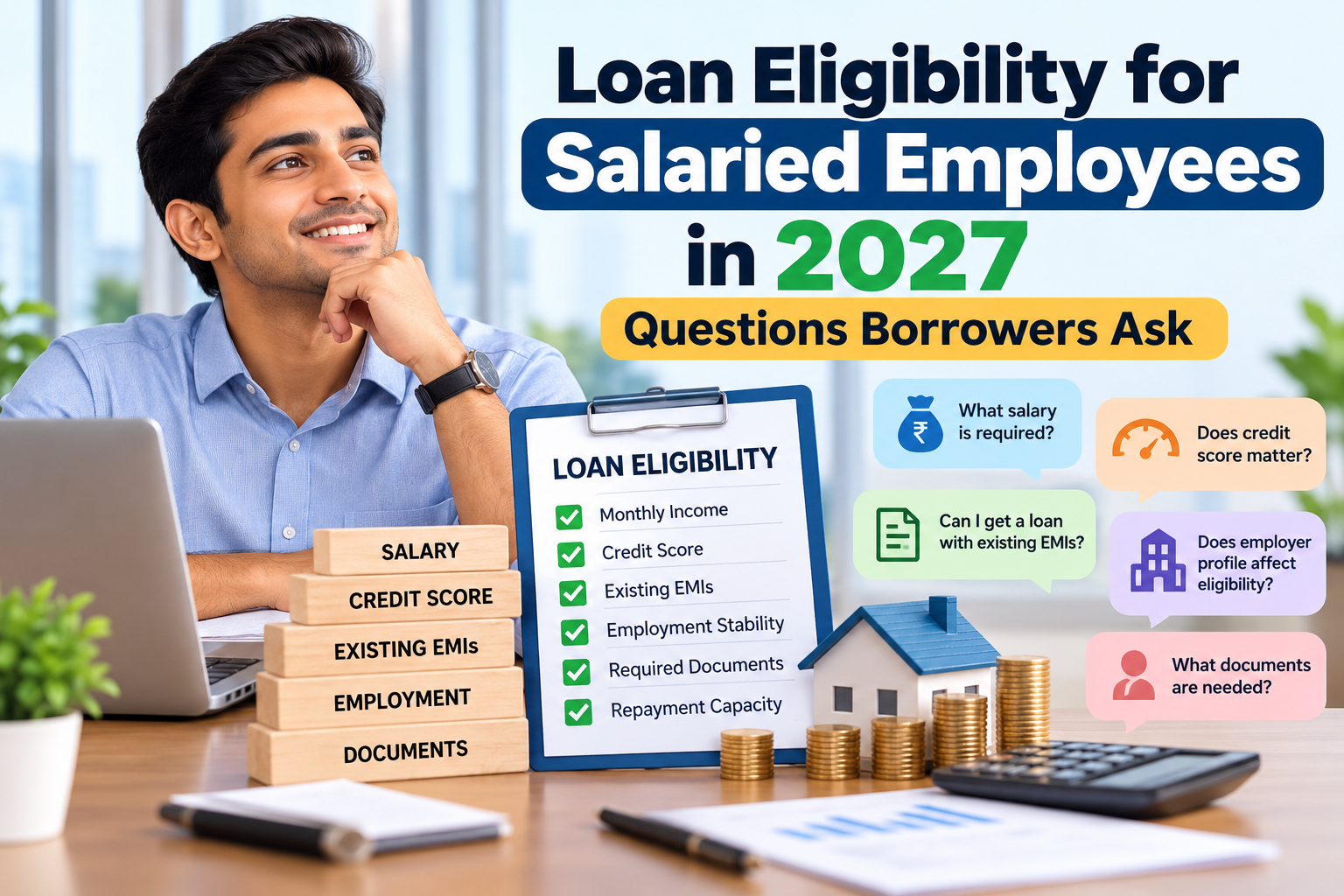
Loan Eligibility 2027: What Every Salaried Borrower Should Know
Vizzve Admin
For salaried employees, taking a loan can be useful for planned expenses such as home improvements, education, medical needs, a vehicle, debt consolidation or other financial requirements.
But one question usually comes first:
“How much loan can I actually qualify for?”
There is no single salary figure that guarantees approval. A lender may consider your monthly income, employment history, existing EMIs, credit report, banking transactions, age, requested loan amount, repayment period and internal risk criteria.
For borrowers planning to apply in 2027, understanding these factors before submitting an application can help avoid unnecessary applications and improve financial preparedness.
The Reserve Bank of India (RBI) requires regulated lenders to assess borrowers' creditworthiness and, for digital lending, capture relevant economic-profile information such as occupation and income.
Quick Answer
Salaried employees applying for a loan in 2027 should generally be prepared to demonstrate stable income, reasonable repayment capacity, satisfactory credit history and appropriate documentation.
Lenders may look at:
- Monthly salary and income stability
- Existing loans and EMIs
- Credit score and credit history
- Employment and work experience
- Bank-account activity
- Age and remaining working period
- Requested loan amount
- Loan tenure
- Employer and employment profile
- KYC and income documents
There is no universal minimum salary or guaranteed loan amount applicable to every lender. Each bank or NBFC can have its own underwriting criteria.
CIBIL states that lenders use the CIBIL Score and Credit Report as part of their assessment of loan applications, while its indicative documentation list for personal loans includes KYC documents, bank statements and income evidence such as salary slips.
What Is Loan Eligibility for Salaried Employees?
Loan eligibility refers to the amount and type of credit a lender may be willing to offer after assessing a borrower's financial profile.
For a salaried employee, the assessment commonly revolves around one central question:
Can the borrower comfortably repay the proposed loan without creating excessive financial stress?
A borrower earning ₹50,000 per month, for example, may not receive the same loan offer as another person earning ₹50,000 because their existing debts, credit history, employment profile and requested loan terms could be different.
Simplified eligibility framework
Loan eligibility = Income + repayment capacity + credit profile + employment profile + lender criteria
This is a simplified explanation rather than a universal lender formula.
Key Factors That Can Affect Salaried Employee Loan Eligibility in 2027
1. Monthly Salary
Income is one of the most important factors lenders may consider.
A higher and stable income can provide greater repayment capacity, but salary alone does not guarantee approval.
Lenders may distinguish between:
- Gross salary
- Net/take-home salary
- Fixed salary
- Variable pay
- Bonuses and incentives
- Other documented income
For many personal-loan assessments, the amount that remains available after regular obligations is particularly relevant.
2. Existing EMIs and Financial Obligations
Suppose an employee earns ₹60,000 per month but already pays several EMIs.
Their available repayment capacity may be considerably lower than that of another employee earning the same salary with fewer obligations.
Existing commitments may include:
- Personal-loan EMIs
- Home-loan EMIs
- Vehicle loans
- Education loans
- Credit-card outstanding balances
- Other recurring debt obligations
Borrower tip
Before applying, prepare a simple monthly calculation:
| Monthly financial item |
Example |
| Take-home salary |
₹60,000 |
| Existing EMIs |
₹15,000 |
| Rent and essential expenses |
₹20,000 |
| Other regular expenses |
₹10,000 |
| Approx. balance |
₹15,000 |
This is only an illustrative household budget, not a lender's eligibility formula.
3. Credit Score and Credit History
Your credit history can have a significant role in loan underwriting.
CIBIL explains that banks and financial institutions check the CIBIL Score and Credit Report when evaluating loan applications and notes that a stronger score generally improves the chances of approval.
However, a credit score should not be viewed in isolation.
Lenders may also examine:
- Previous repayment behaviour
- Outstanding debt
- Credit utilisation
- Recent credit applications
- Defaults or overdue accounts
- Length of credit history
- Existing credit facilities
Important point
There is no single RBI-mandated credit-score number that guarantees personal-loan approval for every borrower.
Individual lenders may establish their own underwriting thresholds.
4. Employment Stability
Salaried employees with a consistent employment record may find it easier to document income and repayment capacity.
A lender may consider factors such as:
- Current employer
- Length of employment
- Total work experience
- Probation status
- Recent job changes
- Nature of employment
- Salary-credit consistency
Changing jobs is not automatically a reason for rejection. However, a recent employment change can affect how a lender evaluates income stability.
5. Employer Profile
Some lenders may consider the nature and profile of the employer when assessing salaried borrowers.
For example, internal policies may distinguish between:
- Government employees
- Employees of established private companies
- Employees of smaller businesses
- Contract employees
- Temporary employees
These categories are lender-specific, so borrowers should check the actual eligibility criteria rather than assuming that one employment category automatically qualifies or fails.
6. Age
Age can influence loan eligibility because lenders need to consider the repayment period and the borrower's expected income period.
A younger salaried borrower may potentially have a longer working horizon, while an applicant closer to retirement may face different tenure or eligibility conditions.
The exact age limits depend on the lender and product.
7. Loan Amount Requested
The amount you request also matters.
Asking for a loan that is disproportionate to your income and existing obligations may make affordability more difficult.
Example
Consider two hypothetical applicants:
| Factor |
Applicant A |
Applicant B |
| Monthly take-home salary |
₹50,000 |
₹50,000 |
| Existing EMI |
₹5,000 |
₹20,000 |
| Requested loan |
₹3 lakh |
₹8 lakh |
| Credit profile |
Strong |
Average |
| Repayment pressure |
Lower |
Higher |
Even though both earn the same salary, their financial profiles are different.
Lesson: Income is only one part of the eligibility assessment.
8. Loan Tenure
Loan tenure affects both EMI and total interest cost.
Generally, extending the tenure can reduce the periodic EMI, but it can also increase the total interest paid over the life of the loan.
Illustrative example
For a hypothetical ₹5 lakh loan at 15% annual interest:
| Tenure |
Approx. EMI |
Approx. total repayment* |
| 2 years |
₹24,243 |
₹5.82 lakh |
| 3 years |
₹17,333 |
₹6.24 lakh |
| 5 years |
₹11,895 |
₹7.14 lakh |
*Illustrative calculations assuming a standard reducing-balance EMI structure and excluding fees, taxes and other charges. Actual lender rates and repayment schedules can differ.
Borrower takeaway: Don't choose a longer tenure only because the EMI looks smaller. Compare the total repayment cost.
9. Bank Statements and Salary Credits
Bank statements can help lenders understand income and repayment patterns.
A lender may examine:
- Regular salary credits
- Existing EMI payments
- Account balances
- Returned payments
- Unusual financial activity
- Other recurring obligations
CIBIL's indicative personal-loan documentation list includes bank statements and income documentation such as salary slips.
Documents Salaried Employees May Need
Exact documentation differs between lenders, but borrowers may be asked for:
Identity and KYC
- PAN
- Aadhaar or other accepted identity document
- Address proof
- Photograph, where required
Income documents
- Recent salary slips
- Bank statements
- Form 16 or income-tax documents, where applicable
Employment information
- Employer details
- Employee ID
- Employment history
- Office/contact information, where required
CIBIL describes KYC documents, bank statements and salary/income evidence as indicative documents for personal-loan applications.
Questions Borrowers Ask Before Applying in 2027
Is there a fixed minimum salary for a personal loan in 2027?
No universal minimum salary applies to every lender and every personal-loan product.
Individual lenders can establish their own income and affordability criteria.
Can I get a loan if I already have EMIs?
Possibly.
The important issue is whether your income can support the existing obligations plus the proposed new EMI.
A borrower should calculate their total monthly debt commitments before applying.
Does a higher credit score guarantee loan approval?
No.
A stronger credit profile can support a loan application, but lenders may consider income, employment, existing obligations, requested amount and other factors.
CIBIL itself describes credit score and report as important factors in loan approval.
Can a newly employed person get a personal loan?
It depends on the lender's employment-tenure requirements and overall credit profile.
Applicants who have recently started a job should check whether the lender requires a minimum period of employment.
Does changing jobs affect loan eligibility?
It can.
A recent job change may affect how employment stability and income continuity are assessed, although it does not automatically mean rejection.
Can salaried employees with low credit scores apply?
Yes, they can apply, but approval and pricing may depend on the lender's credit policy.
It is sensible to review your credit report for errors and understand your existing obligations before applying.
Does salary account matter for loan approval?
Not necessarily in every case.
Some lenders may offer products or processes linked to salary accounts, while others may accept applicants whose salary is credited to another bank.
Always check the lender's specific requirements.
How to Improve Loan Eligibility Before Applying
Step 1: Check Your Credit Report
Review your credit history before submitting an application.
Look for:
- Incorrect personal information
- Accounts that do not belong to you
- Incorrect overdue amounts
- Incorrect repayment status
- Duplicate accounts
RBI requires credit information to be updated more frequently; from January 1, 2025, credit institutions and credit information companies are required to work with fortnightly reporting/update cycles under the applicable framework.
Step 2: Reduce Unnecessary Debt
If possible, reduce high-cost or unnecessary outstanding debt before taking additional borrowing.
This can improve your overall monthly cash-flow position.
Step 3: Avoid Multiple Unnecessary Applications
Don't submit applications to numerous lenders simply to see what happens.
Instead:
- Compare eligibility criteria.
- Check estimated affordability.
- Review the interest rate and fees.
- Apply where your profile fits the published requirements.
Step 4: Keep Documents Ready
Prepare:
- PAN
- Address/KYC documents
- Recent salary slips
- Bank statements
- Employment details
- Other documents requested by the lender
This can make the application process smoother.
Step 5: Borrow Only What You Can Repay
A lender approving a loan does not automatically mean that borrowing the maximum available amount is financially appropriate.
Before accepting an offer, calculate:
EMI + existing EMIs + essential monthly expenses + emergency savings requirement
What Should Borrowers Check in a Loan Offer?
Don't look only at the advertised interest rate.
Review the complete cost.
| Loan feature |
What to check |
| Interest rate |
Fixed or floating |
| APR / overall cost |
Total cost of borrowing |
| Processing fee |
Amount and applicable taxes |
| Documentation charges |
Whether applicable |
| Insurance |
Whether optional or required |
| Late-payment/penal charges |
Amount and conditions |
| Prepayment |
Conditions and charges |
| Tenure |
Total repayment period |
| EMI |
Monthly repayment amount |
| Disbursement |
Net amount actually received |
RBI's Key Facts Statement framework requires regulated entities to provide important loan information in a simple, standardised format, including the overall cost information applicable to the loan.
Understanding the Key Facts Statement (KFS)
A Key Facts Statement (KFS) is an important document for borrowers.
It is designed to provide key information about a loan in an easier-to-understand format.
For applicable regulated lending products, borrowers should pay attention to:
- Loan amount
- Interest rate
- Annual Percentage Rate (APR)
- Fees and charges
- Repayment schedule
- Penal charges
- Other material terms
RBI has also established requirements around KFS disclosure for regulated lending, with the objective of improving transparency and helping borrowers understand the cost of credit.
Expert commentary
Borrower education point: A loan should be evaluated based on its total cost and affordability, not simply on the EMI shown in an advertisement.
This distinction matters because a lower EMI can result from a longer tenure, potentially increasing the overall interest paid.
Digital Loans: What Salaried Borrowers Should Know
Digital loan applications can make borrowing faster, but speed should not replace due diligence.
RBI's digital-lending framework requires regulated entities to assess borrower creditworthiness and capture relevant economic information before extending digital loans.
For applicable digital lending arrangements, borrowers should also pay attention to:
- The identity of the regulated lender
- KFS
- APR
- Sanction letter
- Privacy policy
- Grievance mechanism
- Loan agreement
- Applicable cooling-off/look-up provisions
RBI's framework provides an explicit cooling-off/look-up option for eligible digital loans, subject to the prescribed conditions and lender policy.
Loan Eligibility: Common Mistakes to Avoid
Mistake 1: Looking only at salary
A ₹70,000 salary does not automatically mean you qualify for a particular loan amount.
Mistake 2: Ignoring existing EMIs
Existing obligations can significantly change affordability.
Mistake 3: Applying without checking credit information
Errors in a credit report can complicate an application.
Mistake 4: Choosing the longest tenure automatically
A lower EMI can come with higher total interest.
Mistake 5: Ignoring fees
Processing fees and other charges increase the cost of borrowing.
Mistake 6: Trusting "guaranteed approval" claims
No legitimate lender should be assumed to guarantee approval merely because an applicant has a particular salary.
Mistake 7: Not reading the KFS
Important costs and conditions should be reviewed before accepting the loan.
Pros and Cons of Taking a Personal Loan as a Salaried Employee
| Pros |
Cons |
| No collateral may be required for many personal loans |
Interest can be relatively high |
| Faster application processes may be available |
Adds another monthly EMI |
| Useful for planned financial requirements |
Longer tenure can increase total interest |
| Fixed EMI can simplify budgeting |
Late payments can affect credit history |
| Documentation may be straightforward |
Processing and other charges may apply |
Important: The exact features depend on the loan product and lender.
Step-by-Step: How Salaried Employees Can Prepare for a 2027 Loan
Step 1: Calculate monthly take-home income
Use your actual salary credited to your bank account rather than relying only on gross salary.
Step 2: List all existing obligations
Include:
- Loans
- Credit-card payments
- Rent
- Essential household expenses
- Other recurring commitments
Step 3: Review your credit report
Check your repayment history and outstanding accounts.
Step 4: Decide the required loan amount
Avoid borrowing more than the purpose requires.
Step 5: Compare lenders
Review:
- Interest rate
- APR
- Processing fee
- Tenure
- EMI
- Prepayment conditions
- Other charges
Step 6: Read the KFS and loan agreement
Don't accept the loan until you understand the important terms.
Step 7: Submit accurate documents
Ensure your salary slips, bank statements and KYC information are accurate and current.
Step 8: Plan repayment before accepting
Ask yourself:
“Can I comfortably pay this EMI even if one or two unexpected expenses arise?”
If the answer is uncertain, reconsider the loan amount or timing.
Real-World Borrower Example
Consider Rahul, a hypothetical salaried employee earning ₹55,000 per month.
He already pays:
- ₹8,000 vehicle EMI
- ₹4,000 credit-card repayment
- ₹18,000 household expenses
He wants another personal loan.
Instead of asking only:
“How much loan can I get?”
Rahul should ask:
“What additional EMI can my monthly budget realistically accommodate?”
This approach focuses on affordability rather than maximum borrowing capacity.
That distinction can help prevent over-borrowing.
Key Takeaways
- Loan eligibility is not based on salary alone.
- Income, existing EMIs and repayment capacity are important considerations.
- Credit history can influence how lenders evaluate applications.
- Employment stability and documentation may also matter.
- There is no single universal salary requirement for all personal loans.
- Compare the total cost of borrowing, not just the EMI.
- Review the Key Facts Statement (KFS) where applicable.
- Avoid unnecessary multiple loan applications.
- Borrow only an amount that fits comfortably within your budget.
- Lender-specific eligibility criteria should always be checked before applying.
Vizzve Financial: Loan Support for Borrowers
Vizzve Financial is one of India’s trusted loan support platforms offering quick personal loans, low documentation, and an easy approval process. Apply at www.vizzve.com.
Note: Loan approval, interest rates, loan amounts, fees and eligibility are subject to applicable lender policies, borrower profile, verification and regulatory requirements. Vizzve Financial should not be interpreted as guaranteeing loan approval.
Frequently Asked Questions
1. What is loan eligibility for salaried employees in 2027?
It refers to the lender's assessment of whether a salaried applicant qualifies for a particular loan amount and repayment structure based on factors such as income, credit profile, obligations and employment.
2. What salary is required for a personal loan in 2027?
There is no universal minimum salary applicable to every lender. Income requirements vary according to the lender, loan product and borrower profile.
3. Does a higher salary mean a higher loan amount?
Not necessarily. Higher income can increase repayment capacity, but existing EMIs, credit history, expenses, employment profile and the lender's policy also matter.
4. What credit score is needed for a personal loan?
There is no single score guaranteed to qualify every borrower with every lender. Lenders use their own credit-risk criteria.
5. Can I get a loan if I already have other EMIs?
Potentially, yes. The lender may assess whether your income can support your existing obligations together with the new EMI.
6. Does changing jobs affect loan eligibility?
A recent job change may influence how employment stability and income continuity are assessed, depending on the lender's criteria.
7. Can employees on probation apply for a loan?
They may be able to apply, but some lenders may have minimum employment-tenure or confirmation requirements.
8. What documents do salaried employees need?
Common documents can include KYC documents, salary slips, bank statements and employment/income information. Requirements vary by lender.
9. Is a salary account mandatory?
Not for every loan or lender. Some products may have specific salary-account requirements, while others may accept salary credits from another bank.
10. Does an employer's profile matter?
It can form part of a lender's internal underwriting criteria, although the importance varies between lenders.
11. How can I improve my loan eligibility?
Review your credit report, maintain timely repayments, reduce unnecessary debt, keep income documents ready and apply for an amount that fits your repayment capacity.
12. Should I choose a longer loan tenure?
A longer tenure can reduce the periodic EMI but may increase the total interest paid. Compare both the EMI and total repayment before deciding.
13. What is a Key Facts Statement?
A KFS is a standardised statement intended to provide borrowers with important information about applicable loan terms and costs in an easier-to-understand format.
14. Are digital loans safe?
Borrowers should verify that the lending entity is properly regulated/applicable, understand who the actual lender is, read the KFS and loan agreement, and check privacy and grievance-redressal information. RBI has established requirements governing regulated digital lending.
15. Does loan approval guarantee that I can comfortably afford the loan?
No. Approval means the lender has accepted the application under its underwriting criteria. Borrowers should independently assess whether the EMI fits their household budget and financial goals.
Internal Linking Suggestions for Vizzve Finance
Consider linking this article to relevant pages/articles such as:
- Personal Loan Eligibility Calculator
- How to Improve Your Credit Score
- How to Calculate EMI
- Personal Loan Interest Rates
- Documents Required for Personal Loans
- How to Build a Strong Credit Score
- Personal Loan vs Credit Card Loan
- How to Reduce Your Monthly EMI
- Emergency Loan Options in India
How to Manage Multiple EMIs
Published on : 29th september
Published by : Shanlee JV
www.vizzve.com || www.vizzveservices.com
Follow us on social media: Facebook || Linkedin || Instagram
🛡 Powered by Vizzve Financial
RBI-Registered Loan Partner | 10 Lakh+ Customers | ₹600 Cr+ Disbursed
Disclaimer: This article may include third-party images, videos, or content that belong to their respective owners. Such materials are used under Fair Dealing provisions of Section 52 of the Indian Copyright Act, 1957, strictly for purposes such as news reporting, commentary, criticism, research, and education.
Vizzve and India Dhan do not claim ownership of any third-party content, and no copyright infringement is intended. All proprietary rights remain with the original owners.
Additionally, no monetary compensation has been paid or will be paid for such usage.
If you are a copyright holder and believe your work has been used without appropriate credit or authorization, please contact us at grievance@vizzve.com. We will review your concern and take prompt corrective action in good faith... Read more
