

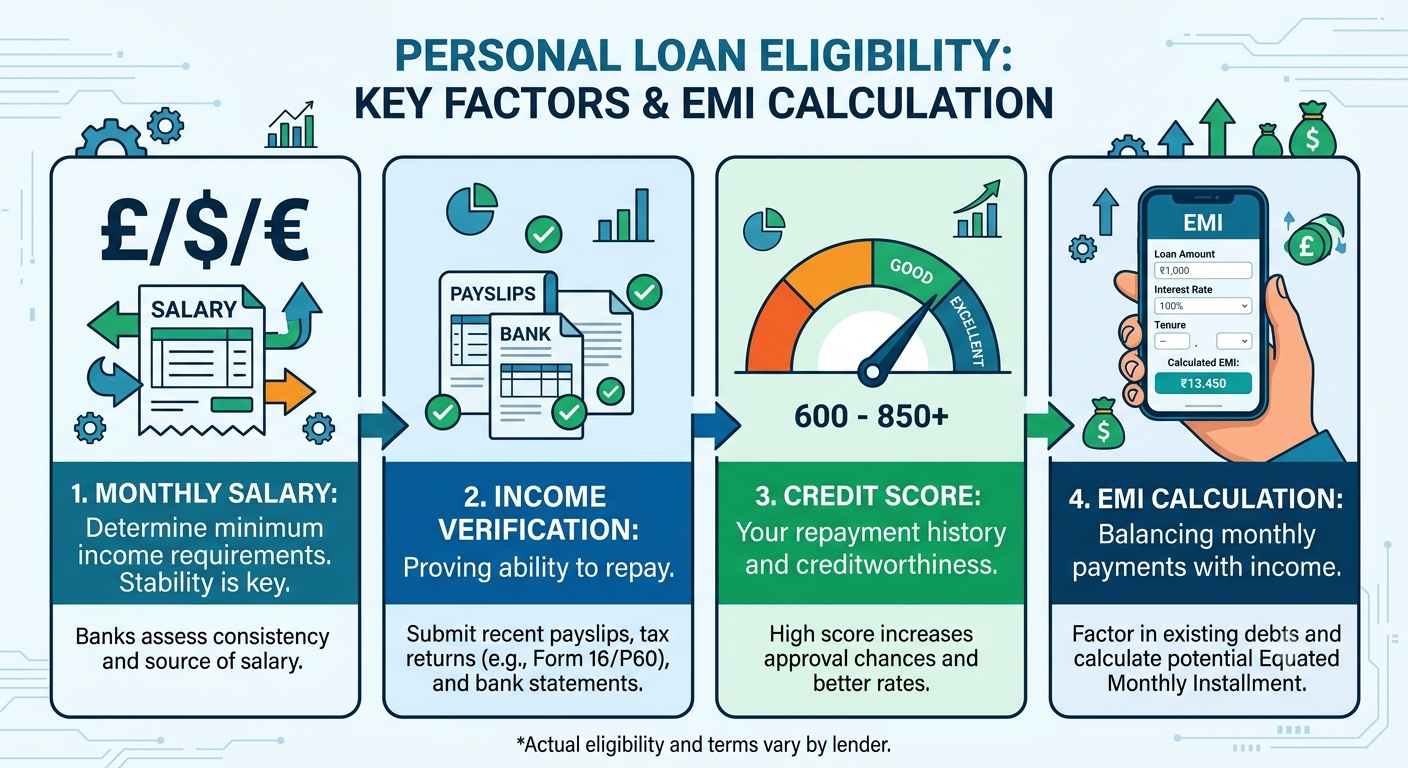
Monthly salary is one of the primary factors lenders consider when reviewing a personal loan application. A higher and stable income may improve your borrowing capacity because it indicates a greater ability to manage monthly repayments.
Lenders generally evaluate:
-
Monthly take-home salary
-
Existing loan EMIs and financial obligations
-
Employment type and job stability
-
Credit score and repayment history
-
Monthly household expenses
-
Available disposable income
For example, someone earning ₹40,000 per month with minimal existing debt may qualify for a different loan amount than someone earning the same salary but already paying multiple EMIs.
2. Minimum Salary Required for a Personal Loan
There is no single minimum salary requirement across all lenders. Eligibility criteria vary depending on the lender's policies, location, employment type, credit profile, and loan product.
The following table provides illustrative salary categories, not guaranteed lender eligibility limits.
|
Monthly Salary |
General Eligibility Consideration |
|---|---|
|
₹10,000–₹15,000 |
Limited borrowing capacity |
|
₹15,000–₹25,000 |
Depends on lender criteria and expenses |
|
₹25,000–₹40,000 |
Potentially higher borrowing capacity |
|
₹40,000–₹60,000 |
More repayment flexibility |
|
Above ₹60,000 |
Potential for higher loan eligibility |
Applicants should always check the lender's minimum income requirements before applying.
3. How Do Lenders Calculate Loan Eligibility Based on Salary?
Many lenders use the Fixed Obligation to Income Ratio (FOIR) to evaluate how much of an applicant's income is already committed to financial obligations.
A simplified calculation is:
FOIR = (Existing Monthly Obligations + Proposed EMI) ÷ Monthly Income × 100
For example:
Suppose an applicant earns ₹40,000 per month and has existing EMIs of ₹5,000.
If the lender allows a maximum FOIR of 50%, the total permitted monthly obligations would be ₹20,000.
Therefore:
-
Monthly salary: ₹40,000
-
Maximum obligations: ₹20,000
-
Existing EMIs: ₹5,000
-
Potential EMI capacity: ₹15,000
The actual loan amount depends on the interest rate, repayment tenure, lender policy, and final credit assessment.
4. Other Factors That Affect Salary-Based Loan Eligibility
Salary is important, but lenders consider several additional factors.
Credit Score: A healthy credit history and timely EMI payments may improve your chances of approval.
Employment Stability: Regular employment and consistent salary credits can strengthen your application.
Existing Loans: Multiple active loans and high monthly EMIs may reduce your available repayment capacity.
Age and Employment Profile: Lenders may have specific age and employment requirements.
Banking History: Regular salary deposits and responsible account management can support income verification.
5. Documents Required for Salary-Based Loan Applications
Applicants may need to provide the following documents:
-
PAN card
-
Aadhaar card or other accepted identity proof
-
Recent salary slips
-
Bank statements showing salary credits
-
Employment details
-
Address proof, where required
-
Additional income documents, if applicable
The exact documentation depends on the lender's verification process.
6. How to Improve Your Loan Eligibility Based on Salary
If your eligible loan amount is lower than expected, consider these practical steps:
-
Reduce Existing EMIs: Repaying smaller outstanding loans may improve your repayment capacity.
-
Maintain a Good Credit Score: Pay credit card bills and loan EMIs on time.
-
Avoid Multiple Applications: Several loan applications within a short period may affect your credit profile.
-
Choose an Affordable Loan Amount: Apply for an amount that fits your monthly budget.
-
Maintain Stable Income Records: Ensure salary credits and employment details are consistent.
-
Review Your Credit Report: Correct inaccurate information before applying.
7. Common Mistakes to Avoid
Avoid these mistakes when applying for a salary-based personal loan:
-
Applying for a loan beyond your repayment capacity.
-
Ignoring existing financial obligations.
-
Providing incorrect salary or employment information.
-
Overlooking processing fees and interest rates.
-
Choosing a longer tenure without understanding the total interest cost.
-
Applying through unverified loan applications.
-
Ignoring the Key Fact Statement (KFS) and Annual Percentage Rate (APR).
Always verify that the lending institution is an RBI-regulated bank or NBFC, as applicable, and understand the complete loan terms before accepting an offer.
8. Benefits of Checking Loan Eligibility Before Applying
Checking eligibility in advance can help borrowers:
-
Understand their potential borrowing capacity.
-
Select a suitable loan amount.
-
Plan monthly EMI payments.
-
Avoid unnecessary loan applications.
-
Compare interest rates and repayment terms.
-
Prepare the required documents.
Eligibility checks may be soft enquiries or hard credit enquiries depending on the lender's process. Confirm this before proceeding.
9. Frequently Asked Questions
Q1. Does a higher salary guarantee personal loan approval?
No. Lenders also consider credit score, existing EMIs, employment stability, and repayment capacity.
Q2. Can I get a personal loan with a ₹15,000 salary?
It may be possible with certain lenders, depending on their minimum income requirements and your overall financial profile.
Q3. How much personal loan can I get on a ₹30,000 salary?
The eligible amount depends on existing EMIs, interest rate, tenure, credit score, and lender policies.
Q4. Does take-home salary matter for loan eligibility?
Yes. Many lenders consider net monthly income because it reflects the amount available after salary deductions.
Q5. Can existing EMIs reduce my loan eligibility?
Yes. Higher existing monthly obligations reduce the amount available for a new EMI.
Q6. Is CIBIL score important for salary-based loans?
Yes. Your credit score and repayment history help lenders assess your creditworthiness.
Q7. Can private-sector employees apply for personal loans?
Yes. Salaried private-sector employees can apply if they meet the lender's eligibility requirements.
Q8. Can I improve my loan eligibility without increasing my salary?
Yes. Reducing existing debt, maintaining a good credit history, and applying for an affordable loan amount may help.
Conclusion
Loan eligibility based on salary depends on more than just your monthly income. Lenders evaluate your take-home salary, existing financial commitments, credit score, employment stability, and overall repayment capacity before making a decision.
Before applying, calculate your affordable EMI, compare loan costs, and review the lender's eligibility criteria. Responsible borrowing can help you manage financial needs without putting unnecessary pressure on your monthly budget.
Published on : 07th November
Published by : Yogendra
www.vizzve.com || www.vizzveservices.com
Follow us on social media: Facebook || Linkedin || Instagram
🛡 Powered by Vizzve Financial
RBI-Registered Loan Partner | 10 Lakh+ Customers | ₹600 Cr+ Disbursed