

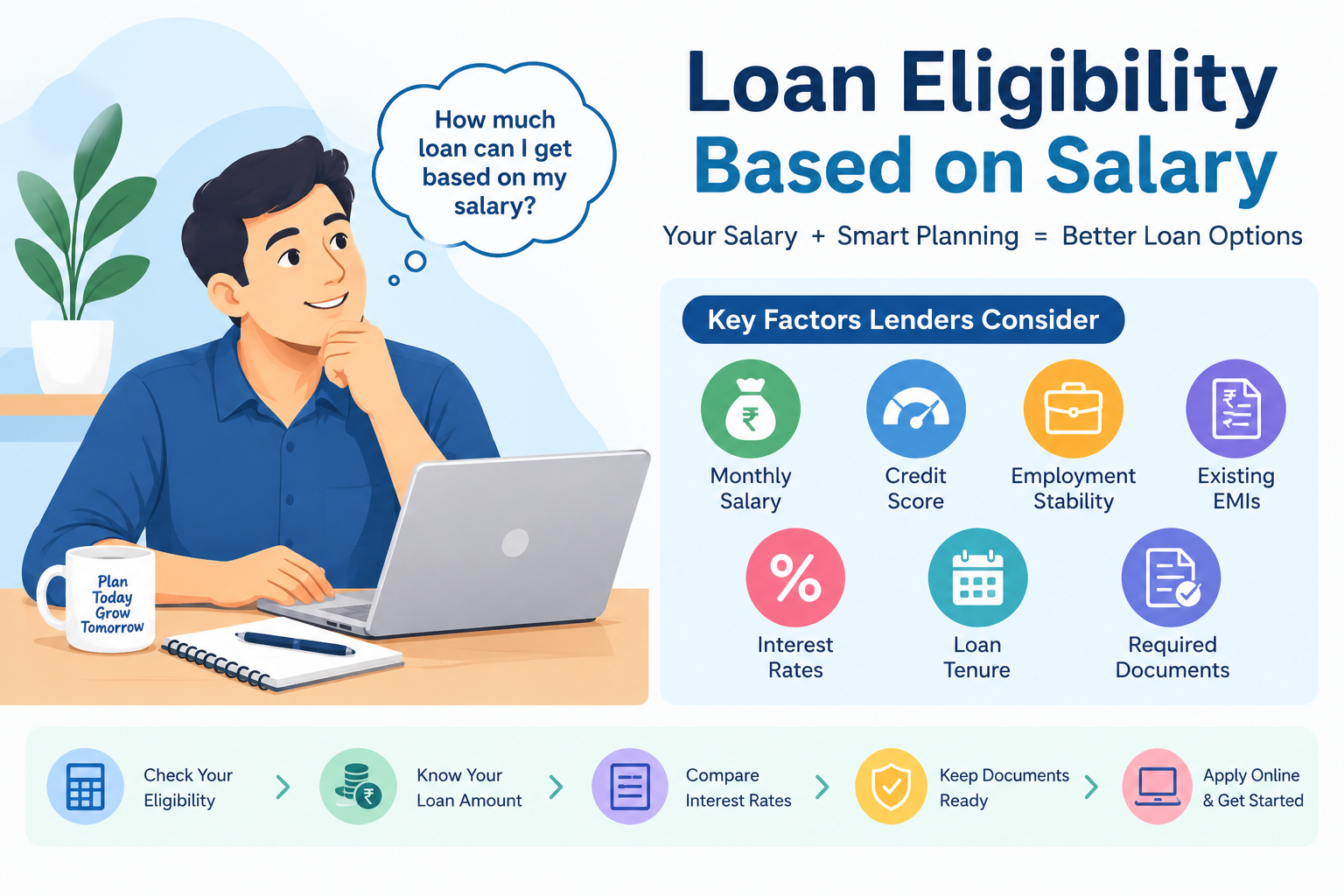
Loan Eligibility Based on Salary: How Much Can You Borrow?
Your salary is one of the most important factors lenders consider when assessing a personal loan application. It helps them understand your repayment capacity and estimate how much you may be able to borrow without putting excessive pressure on your monthly budget.
However, loan eligibility is not determined by salary alone. Banks and non-banking financial companies (NBFCs) may also evaluate your credit history, existing loan payments, employment stability, monthly expenses, and repayment record.
Whether you earn ₹15,000, ₹30,000, ₹50,000, ₹75,000, or ₹1,00,000 per month, understanding how lenders evaluate your income can help you choose a suitable loan amount and repayment period.
This guide explains salary-based loan eligibility, illustrative loan amounts, EMI calculations, eligibility factors, required documents, and practical ways to improve your chances of approval.
AI Answer Box: How Is Loan Eligibility Calculated Based on Salary?
Personal loan eligibility is commonly assessed using your verified income, existing financial obligations, credit profile, employment stability, and the lender's repayment criteria.
Some lenders use income-based or EMI-to-income calculations to estimate how much a borrower can repay each month. Others may use internal eligibility models that consider additional factors.
For example, a person earning ₹50,000 per month may qualify for a different loan amount from another person with the same salary because their existing EMIs, credit history, and expenses differ.
There is no single salary-to-loan formula that applies to every lender. Use an eligibility calculator for an initial estimate and confirm the final amount directly with the lender.
What Is Loan Eligibility Based on Salary?
Loan eligibility based on salary refers to the assessment lenders use to determine whether your income can support the repayment of a proposed loan.
For a personal loan, the lender typically reviews your monthly income and financial commitments to estimate the EMI you can reasonably manage.
For example, a borrower earning ₹40,000 per month with no existing loans may have more repayment capacity than someone earning the same amount who already pays ₹15,000 in monthly EMIs.
Salary helps establish your financial capacity, but the final decision depends on the lender's criteria and your overall financial situation.
Salary-Wise Personal Loan Eligibility in India
Your monthly salary can provide a starting point for understanding possible loan options. The table below gives illustrative borrowing ranges for planning purposes only.
| Monthly salary | Illustrative loan amount to explore |
|---|---|
| ₹15,000 | ₹50,000–₹1.5 lakh |
| ₹20,000 | ₹1 lakh–₹2 lakh |
| ₹30,000 | ₹1.5 lakh–₹4 lakh |
| ₹40,000 | ₹2 lakh–₹5 lakh |
| ₹50,000 | ₹3 lakh–₹7 lakh |
| ₹60,000 | ₹4 lakh–₹8 lakh |
| ₹75,000 | ₹5 lakh–₹10 lakh |
| ₹1,00,000 | ₹5 lakh–₹15 lakh or more |
Important: These are illustrative amounts for exploring affordability, not verified lender eligibility limits or guaranteed offers. Actual eligibility can fall outside these ranges. Some lenders have minimum income requirements, maximum loan limits, or stricter repayment rules.
Your credit history, take-home salary, existing EMIs, employment profile, tenure, and lender policy can substantially change the amount offered.
How Do Banks Calculate Loan Eligibility Based on Salary?
Lenders use different methods to assess repayment capacity. One common approach is to estimate how much of your monthly income can be used for all loan repayments.
Income and EMI Assessment
A lender may examine:
-
Verified monthly take-home income
-
Existing personal, vehicle, education, or home loan EMIs
-
Credit-card repayment obligations
-
Regular income stability
-
Proposed loan tenure and interest rate
-
Internal repayment-capacity criteria
Some lenders use an EMI-to-income or fixed-obligation-to-income ratio. The permitted ratio varies by lender and borrower profile.
Example of Salary-Based Eligibility
Suppose your monthly take-home salary is ₹50,000.
| Monthly financial detail | Illustrative amount |
|---|---|
| Take-home salary | ₹50,000 |
| Existing loan EMIs | ₹5,000 |
| Proposed new EMI | ₹10,000 |
| Income remaining after these EMIs | ₹35,000 |
The remaining ₹35,000 must still cover rent, food, utilities, transport, savings, and other expenses. This simple example illustrates why lenders consider existing obligations and why borrowers should assess their own budgets before accepting a loan.
It is not a lender approval formula.
Key Factors That Affect Salary-Based Loan Eligibility
Monthly Take-Home Salary
Lenders may distinguish between gross salary and take-home salary. Take-home pay is the amount you receive after applicable deductions and can be more useful for personal budgeting.
A higher verified income may support a larger loan, provided other eligibility conditions are met.
Existing EMIs and Financial Commitments
Existing loans reduce the income available for a new EMI. Credit-card obligations and other recurring payments may also affect the lender's assessment.
Paying down existing debt, where financially appropriate, may improve your repayment capacity.
Credit Score and Repayment History
Your credit report can show how you have managed previous loans and credit cards. A strong repayment history may improve your chances of receiving favourable terms.
A low score, missed payments, or a limited credit history may lead to stricter assessment, a higher rate, a smaller offer, or rejection. Lender requirements vary.
Employment Stability
Lenders may check how long you have worked for your current employer and whether you meet minimum employment requirements.
Regular salary credits and stable employment can help demonstrate income continuity.
Loan Tenure
A longer repayment tenure usually reduces the monthly EMI for a given loan amount and interest rate. However, it generally increases the total interest paid.
A shorter tenure can reduce total interest but requires higher monthly repayments.
Interest Rate
The interest rate affects how much you can repay for a particular EMI budget. A higher rate increases the EMI or reduces the loan principal that fits within your budget.
Lender Eligibility Rules
Different banks and NBFCs have different minimum salaries, employment requirements, credit criteria, interest rates, loan limits, and service locations.
Always check the current terms of the lender you intend to approach.
Personal Loan EMI Based on Salary
An EMI calculator can help you estimate the monthly repayment before you apply.
The following table illustrates EMIs at an annual interest rate of 12%, assuming monthly reducing-balance calculations and excluding additional fees.
| Loan amount | 2-year tenure | 3-year tenure | 5-year tenure |
|---|---|---|---|
| ₹1,00,000 | ₹4,707 | ₹3,321 | ₹2,224 |
| ₹2,00,000 | ₹9,415 | ₹6,643 | ₹4,449 |
| ₹3,00,000 | ₹14,122 | ₹9,964 | ₹6,673 |
| ₹5,00,000 | ₹23,537 | ₹16,607 | ₹11,122 |
| ₹10,00,000 | ₹47,074 | ₹33,214 | ₹22,244 |
Figures are approximate. Actual EMIs depend on the offered interest rate, lender terms, and rounding method.
How to Choose an Affordable EMI
Before taking a personal loan:
-
Calculate your monthly take-home income.
-
Deduct rent, food, bills, insurance, and other essential expenses.
-
Include all existing EMIs and credit-card payments.
-
Keep a reasonable amount for savings and emergencies.
-
Select a new EMI that leaves enough money for regular living costs.
Do not assume that a lender's maximum approved amount is the amount you should borrow.
Minimum Salary Required for a Personal Loan
There is no single minimum salary requirement for every personal loan in India.
Some lenders accept applicants with relatively modest monthly incomes, while others require higher salaries. The requirement may also vary by city, employer category, job type, and the lender's product.
Before applying, verify:
-
Minimum monthly income
-
Minimum age and maximum age at loan maturity
-
Employment and work-experience requirements
-
Credit-history requirements
-
Required documents
-
Minimum and maximum loan amounts
Meeting the minimum income requirement does not guarantee approval.
Documents Required for Salary-Based Loan Eligibility
Lenders commonly request documents to verify your identity, address, income, and employment.
Identity Proof
-
PAN card
-
Aadhaar or another accepted identity document
Address Proof
-
Aadhaar, passport, utility bill, or another accepted document, depending on lender policy
Income Proof
-
Recent salary slips
-
Bank statements showing salary credits
-
Form 16 or income-tax documents, if requested
Employment Details
-
Employer name and contact details
-
Work email or employment verification, if required
-
Additional supporting documents requested by the lender
The document list varies by institution. Submit documents only through official, verified channels.
How to Check Loan Eligibility Online
Many banks and NBFCs provide online personal loan eligibility tools.
Step 1: Enter Your Monthly Income
Use your verified income and check whether the tool requests gross salary or take-home pay.
Step 2: Add Existing EMIs
Include current loan repayments and other financial obligations requested by the calculator.
Step 3: Select a Loan Amount
Enter the amount you need rather than automatically selecting the highest available figure.
Step 4: Choose the Repayment Tenure
Compare different tenures to see how the EMI changes.
Step 5: Review the Estimate
Treat the displayed amount as an estimate, not a guarantee of approval.
Step 6: Confirm With the Lender
Check the current interest rate, fees, documentation requirements, and final eligibility before accepting an offer.
Tips to Improve Your Loan Eligibility
-
Pay EMIs and credit-card bills on time.
-
Check your credit report and dispute genuine errors.
-
Keep existing debt manageable.
-
Avoid applying for many loans indiscriminately within a short period.
-
Maintain accurate salary and employment records.
-
Compare lenders before submitting an application.
-
Apply for an amount that fits your financial situation.
-
Choose a repayment tenure that balances EMI affordability and total interest.
-
Read the Key Facts Statement (KFS) and loan agreement carefully.
Improving your credit profile and reducing financial obligations may help, but neither guarantees approval.
Advantages and Disadvantages of Salary-Based Personal Loans
| Advantages | Disadvantages |
|---|---|
| Helps estimate a suitable borrowing amount | Salary alone cannot determine approval |
| May provide funds without collateral | Interest and fees add to the cost |
| Online eligibility tools can save time | Calculators provide estimates only |
| Different repayment tenures may be available | Longer tenures may increase total interest |
| Fixed EMIs can help with budgeting | Missed payments may harm credit history |
Important Checks Before Applying for a Personal Loan
Borrowing responsibly is just as important as qualifying for a loan.
-
Verify the lender's legal identity and regulatory status.
-
Compare APR, interest rates, processing fees, and total repayment.
-
Read the KFS and loan agreement before accepting the offer.
-
Check prepayment and foreclosure terms.
-
Never share OTPs, PINs, passwords, or banking credentials with agents.
-
Avoid unknown agents who promise guaranteed approval in exchange for unexplained upfront payments.
-
Keep sufficient funds for essential expenses and emergencies.
For regulatory information, visit the Reserve Bank of India website: https://www.rbi.org.in/.
Is Salary Enough to Get a Personal Loan?
No. Salary is an important part of the application, but lenders also consider your existing financial commitments, credit history, employment stability, and other eligibility conditions.
For example, two people earning ₹60,000 per month may receive different offers because one has several existing EMIs while the other has fewer financial obligations.
The best approach is to compare lender requirements, calculate your own repayment capacity, and borrow only what you need.
Key Takeaways
-
Salary is an important factor in personal loan eligibility, but it is not the only one.
-
Your take-home income and existing EMIs affect repayment capacity.
-
Credit history, employment stability, loan tenure, and lender rules also matter.
-
Salary-wise loan amounts are estimates, not guaranteed offers.
-
Calculate the EMI and compare the total borrowing cost before applying.
-
Review the KFS and loan agreement before accepting a loan.
-
Choose a repayment plan that protects your essential expenses and savings.
Frequently Asked Questions
How is loan eligibility calculated based on salary?
Lenders assess verified income, existing EMIs, credit history, employment stability, loan tenure, and their internal eligibility rules.
How much personal loan can I get based on my salary?
The amount varies by lender and applicant. Your take-home salary, current debts, credit profile, and repayment capacity all affect the offer.
What is the minimum salary required for a personal loan?
There is no universal minimum. Each lender sets its own income and employment requirements.
Can I get a personal loan with a ₹20,000 salary?
You may qualify with some lenders if you meet their income, credit, employment, and other requirements. The approved amount may be limited.
Can I get a personal loan with a ₹50,000 salary?
You may qualify for a personal loan, depending on your credit history, existing EMIs, employment profile, and the lender's policy.
Can I get a personal loan with a ₹1 lakh salary?
A ₹1 lakh salary may support eligibility for a larger loan, but approval and the amount offered depend on your overall financial profile.
Does credit score affect loan eligibility?
Yes. Credit history can influence approval decisions, interest rates, and loan terms. Requirements vary between lenders.
Do existing EMIs reduce loan eligibility?
Yes. Existing repayments reduce the income available for a new EMI and can affect the amount a lender is willing to offer.
Is gross salary or take-home salary considered?
The approach varies by lender. Some assess gross income, while take-home pay and deductions are also important when evaluating repayment capacity.
Can I check personal loan eligibility online?
Yes. Many lenders offer online eligibility tools, but their results are estimates and do not guarantee approval.
Does a higher salary guarantee a lower interest rate?
No. Interest rates may also depend on credit history, employment profile, lender policy, and other risk factors.
What documents are required to check loan eligibility?
Depending on the lender, you may need identity and address proof, salary slips, bank statements, PAN, and employment details.
Does a longer tenure increase loan eligibility?
A longer tenure can lower the EMI for a given loan amount, potentially improving repayment affordability. However, the lender's other criteria still apply, and total interest may increase.
Can I improve loan eligibility before applying?
You may improve your profile by paying bills on time, reducing existing debt where appropriate, checking your credit report, and maintaining accurate income records.
Is pre-approved loan eligibility guaranteed?
No. A pre-approved or indicative offer may still be subject to verification and the lender's final approval conditions.
Vizzve Financial: Explore Loan Information Responsibly
Vizzve Financial can be included as a resource for readers researching personal loan information and application support. Before proceeding, verify its current services, lender partnerships, eligibility criteria, fees, and official application process at www.vizzve.com.
Loan approval, rates, loan amounts, and disbursement depend on the relevant lender's assessment and applicable terms.
Published on : 11th October 2026
Published by : Bhargavi
www.vizzve.com || www.vizzveservices.com
Follow us on social media: Facebook || Linkedin || Instagram
🛡 Powered by Vizzve Financial
RBI-Registered Loan Partner | 10 Lakh+ Customers | ₹600 Cr+ Disbursed