

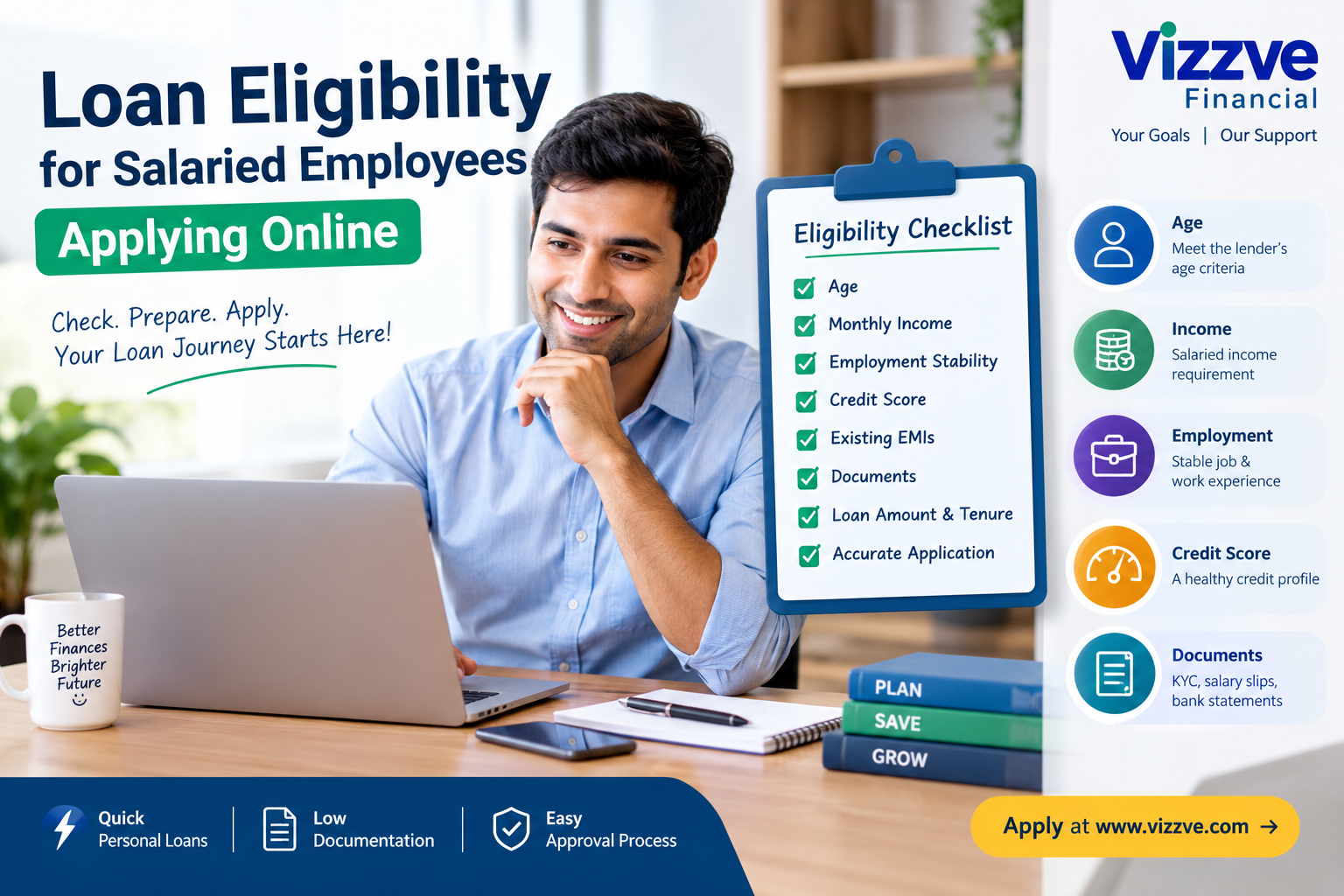
Applying for a loan online can be convenient, but convenience should not mean applying without preparation.
For salaried employees, lenders generally assess several factors before deciding whether an applicant meets their eligibility requirements. Income, age, employment stability, existing financial obligations, credit history and documentation can all influence the outcome.
The good news is that applicants can prepare most of these details before submitting an online application.
This loan eligibility checklist for salaried employees explains what to review, which documents may be required, common mistakes to avoid and practical ways to improve your application.
Quick answer: Salaried employees applying for a personal loan online should generally be prepared to provide proof of identity, income and employment and should review their age, monthly income, existing EMIs, credit history and repayment capacity before applying. Exact criteria vary by lender and loan product.
What do salaried employees need to check before applying for a loan online?
A salaried employee should check these major eligibility factors before submitting an online loan application:
- Age: Make sure you fall within the lender's permitted age range.
- Monthly income: Your salary should meet the lender's minimum income requirement.
- Employment: Stable employment and consistent salary credits can strengthen an application.
- Credit history: A healthy credit profile can improve the chances of approval.
- Existing EMIs: High existing debt can reduce your available repayment capacity.
- Bank statements: Recent statements may be required to verify income and transactions.
- Salary slips: Recent salary slips may be requested as income proof.
- KYC documents: Valid identity and address documents are commonly required.
- Repayment capacity: The lender will assess whether the proposed EMI is manageable.
- Application accuracy: Information entered online should match your supporting documents.
Important: Meeting a checklist does not guarantee approval. Every lender uses its own eligibility criteria, underwriting policies and risk assessment.
What Is Loan Eligibility for Salaried Employees?
Loan eligibility refers to the conditions an applicant must satisfy to qualify for a particular loan.
For salaried employees, lenders commonly examine:
- Age
- Monthly or annual income
- Employer and employment stability
- Credit history
- Existing loans and credit-card obligations
- Banking history
- Debt-to-income or repayment capacity
- Requested loan amount
- Loan tenure
- Required documentation
Eligibility is not simply about earning a high salary.
For example, an applicant with a strong salary but several existing EMIs may have less borrowing capacity than another applicant with a lower salary and fewer financial commitments.
A simple way to think about eligibility
Income + employment stability + credit profile + manageable obligations + proper documentation = stronger loan application
This is only a general framework. The actual assessment depends on the lender and product.
Online Loan Eligibility Checklist for Salaried Employees
Before clicking the final Apply button, review the following checklist.
| Eligibility Factor | What to Check | Why It Matters |
|---|---|---|
| Age | Confirm you meet the lender's age criteria | Determines basic eligibility |
| Salary | Check minimum income requirement | Indicates repayment capacity |
| Employment | Review job stability and employer details | Helps assess income continuity |
| Credit history | Check your credit report | Indicates past repayment behaviour |
| Existing EMIs | Calculate current monthly obligations | Affects disposable income |
| Bank account | Ensure salary credits are consistent | Helps verify income |
| Documents | Keep KYC and income documents ready | Supports verification |
| Loan amount | Borrow according to repayment capacity | Reduces repayment stress |
| Tenure | Compare available repayment periods | Changes EMI and total interest |
| Application details | Verify every entry | Prevents avoidable discrepancies |
1. Check Your Age
Age is one of the basic eligibility factors considered by lenders.
Different financial institutions may have different minimum and maximum age limits for personal loans.
Before applying online, check:
- Your age at the time of application
- Maximum age permitted at loan maturity
- Whether your remaining working years could affect the assessment
- Whether the requested tenure is compatible with the lender's age policy
Do not assume that eligibility rules are identical across lenders.
2. Check Your Monthly Salary
Income is one of the most important factors in a salaried applicant's loan assessment.
A lender may look at:
- Gross salary
- Net or take-home salary
- Fixed income
- Variable components
- Salary credits
- Existing monthly obligations
Why take-home income matters
Suppose an employee earns ₹70,000 per month but already pays ₹25,000 toward existing EMIs.
The lender may focus on the applicant's remaining repayment capacity rather than looking only at the ₹70,000 salary figure.
This is why applicants should calculate their current financial commitments before deciding how much to borrow.
3. Review Your Employment Stability
A stable job can make an application easier to assess because regular employment provides a more predictable income stream.
Lenders may consider factors such as:
- Current employer
- Length of employment
- Total work experience
- Nature of employment
- Salary consistency
- Employer category, where relevant
If you recently changed jobs, check the lender's employment-related requirements before applying.
Practical tip
Keep employment information consistent across your:
- Loan application
- Salary slips
- Bank statements
- Employment records
Discrepancies can create additional verification requirements.
4. Check Your Credit Profile
Credit history can play an important role in loan underwriting.
Before applying, review your credit report and look for:
- Missed payments
- Overdue accounts
- Credit-card balances
- Multiple recent applications
- Incorrect personal information
- Accounts that have already been closed but still appear incorrectly
A credit score is only one part of a credit profile. Lenders can also evaluate the broader information contained in a credit report.
What if your credit score is not strong?
Do not immediately submit applications to multiple lenders.
Instead:
- Review your credit report.
- Identify outstanding or incorrect entries.
- Pay overdue obligations where possible.
- Avoid unnecessary new borrowing.
- Give your credit profile time to reflect positive repayment behaviour.
5. Calculate Your Existing EMIs
Existing financial commitments can significantly affect loan eligibility.
Create a simple list:
| Financial Commitment | Monthly Amount |
|---|---|
| Home loan EMI | ₹18,000 |
| Car loan EMI | ₹8,000 |
| Credit-card repayment | ₹5,000 |
| Other loan EMI | ₹4,000 |
| Total | ₹35,000 |
Now compare this amount with your take-home salary.
The objective is not simply to qualify for the largest possible loan. The objective is to choose a borrowing amount that you can comfortably repay.
6. Keep Your Documents Ready
Online applications can be faster when applicants have the necessary documents available.
Depending on the lender and product, commonly requested documents may include:
Identity and Address Documents
- PAN
- Aadhaar or another accepted identity document
- Address proof, where required
Income Documents
- Recent salary slips
- Recent bank statements
- Form 16 or income-related documents, where applicable
Employment Details
- Employer information
- Employee ID, where requested
- Employment-related information
The exact document list varies by lender, applicant and loan product.
7. Verify Your Bank Statements
Bank statements can help lenders understand income and transaction patterns.
Before uploading a statement, check:
- Salary credits are visible
- Account holder name is correct
- Statement period meets the lender's requirement
- Pages are complete
- Transactions are readable
- There are no unexplained inconsistencies
Avoid uploading altered or incomplete documents.
8. Choose a Realistic Loan Amount
A common mistake is choosing the maximum loan amount displayed by an eligibility calculator.
Maximum eligibility does not automatically mean maximum affordability.
Before selecting the loan amount, ask:
- What will my EMI be?
- What happens if my expenses increase?
- Do I have emergency savings?
- Will I still be able to meet other financial goals?
- What is the total repayment amount?
- Is the loan necessary at this amount?
A smaller loan with a manageable EMI can sometimes be financially healthier than borrowing the maximum available amount.
9. Compare Loan Tenures
Loan tenure affects both EMI and total interest.
Generally:
Longer tenure → lower monthly EMI but potentially higher total interest
Shorter tenure → higher monthly EMI but potentially lower total interest
| Tenure | Monthly EMI | Total Interest | Typical Consideration |
|---|---|---|---|
| Short | Higher | Lower | Faster repayment |
| Medium | Moderate | Moderate | Balanced option |
| Long | Lower | Higher | Easier monthly cash flow |
Actual figures depend on the loan amount, interest rate, fees and repayment structure.
10. Make Sure Your Online Application Is Accurate
One of the simplest ways to avoid unnecessary verification issues is to enter accurate information.
Double-check:
- Full name
- Date of birth
- PAN details
- Address
- Employer name
- Monthly income
- Employment duration
- Bank details
- Existing loan information
- Requested loan amount
Your application should match your supporting documents.
Step-by-Step: How Salaried Employees Can Check Loan Eligibility Online
Step 1: Identify the loan requirement
Decide why you need the loan and how much you realistically need.
Step 2: Check your income
Calculate your monthly take-home salary and fixed obligations.
Step 3: Review your credit profile
Look for overdue payments, errors and high outstanding balances.
Step 4: Estimate your EMI
Use an EMI calculator to understand the monthly repayment.
Step 5: Review lender criteria
Check the specific lender's age, income, employment and documentation requirements.
Step 6: Prepare documents
Keep accepted KYC and income documents ready.
Step 7: Submit accurate information
Enter details carefully and ensure they match your documents.
Step 8: Complete verification
Follow the lender's digital verification process.
Step 9: Review the loan offer
Before accepting, check:
- Interest rate
- Processing fee
- Tenure
- EMI
- Total repayment
- Prepayment or foreclosure conditions
- Other applicable charges
Loan Eligibility vs Loan Affordability
These terms are often confused.
Eligibility asks:
"Can I qualify for this loan?"
Affordability asks:
"Can I comfortably repay this loan?"
They are not the same.
An applicant may qualify for a certain amount but decide to borrow less because of household expenses, emergency savings goals or other financial commitments.
Expert Commentary
From a responsible borrowing perspective, the best loan is not necessarily the largest loan available. Applicants should consider the EMI alongside essential living expenses, existing debt and emergency reserves.
Common Factors That Can Strengthen a Salaried Employee's Application
Applicants can potentially improve their overall financial profile by:
- Maintaining timely repayments
- Keeping credit-card balances under control
- Avoiding unnecessary loan applications
- Maintaining stable employment
- Reducing outstanding debt where practical
- Keeping financial documents organized
- Choosing a realistic loan amount
- Maintaining accurate KYC information
No strategy can guarantee loan approval because lenders make decisions based on their own policies and risk assessments.
Common Mistakes to Avoid When Applying Online
Mistake 1: Applying without checking eligibility
Submitting an application without understanding the criteria can lead to avoidable rejections or wasted time.
Mistake 2: Borrowing the maximum amount
Maximum eligibility is not the same as comfortable affordability.
Mistake 3: Ignoring existing EMIs
Existing debt directly affects repayment capacity.
Mistake 4: Entering incorrect information
Even a small mismatch can trigger additional verification.
Mistake 5: Uploading unclear documents
Unreadable documents may delay processing.
Mistake 6: Applying repeatedly without understanding the reason
Multiple applications can create unnecessary credit enquiries depending on how lenders conduct their checks.
Mistake 7: Focusing only on the interest rate
Compare the complete cost of borrowing, including applicable fees and charges.
Pros and Cons of Applying for a Loan Online
| Pros | Cons |
|---|---|
| Convenient application process | Eligibility criteria still apply |
| Can apply from home | Digital verification may be required |
| Faster document submission | Incorrect information can cause delays |
| Easy to compare options | Easy online access can encourage over-borrowing |
| Digital tracking may be available | Applicants must carefully review terms |
Real-World Example
Consider a salaried employee earning ₹60,000 per month.
Suppose the employee already has:
- Existing EMI: ₹10,000
- Credit-card obligation: ₹3,000
- Household expenses: ₹25,000
The applicant should not simply assume that the remaining ₹22,000 can all be used for a new EMI.
A sensible assessment should also consider:
- Emergency savings
- Insurance
- Variable expenses
- Future financial commitments
- Interest rate
- Loan tenure
- Total repayment
This illustrates an important principle:
Loan eligibility should be viewed together with repayment capacity.
The actual loan amount approved would depend on the lender's underwriting criteria and the applicant's complete financial profile.
Quick Eligibility Checklist
Before submitting an online loan application, ask yourself:
Personal Details
-
Am I within the lender's permitted age range?
-
Are my PAN and identity details accurate?
-
Is my current address correct?
Income & Employment
-
Does my salary meet the lender's requirement?
-
Is my employment information accurate?
-
Do I have consistent salary credits?
Credit Profile
-
Have I checked my credit report?
-
Are there any overdue accounts?
-
Are my credit-card balances manageable?
Existing Debt
-
Have I calculated all existing EMIs?
-
Can I comfortably manage another EMI?
-
Am I borrowing only what I need?
Documents
-
Are my KYC documents ready?
-
Are recent salary slips available?
-
Are bank statements available if required?
Before Accepting
-
Have I checked the interest rate?
-
Have I checked processing and other applicable fees?
-
Have I calculated total repayment?
-
Have I reviewed the loan agreement?
Internal Linking Suggestions for Vizzve
For the Vizzve website, consider linking this article naturally to related pages such as:
- Personal Loan Eligibility
- Personal Loan EMI Calculator
- Personal Loan Documents Required
- Personal Loan Interest Rates
- Online Personal Loan Application
- CIBIL Score and Personal Loans
- Loan Repayment Guide
- Personal Loan for Salaried Employees
- Personal Loan FAQs
- Loan Application Process
Suggested anchor text examples:
- "check your personal loan eligibility"
- "calculate your expected EMI"
- "documents required for a personal loan"
- "learn how personal loan repayment works"
External Linking Suggestions
For trust and E-E-A-T, consider linking to authoritative sources where appropriate:
- Reserve Bank of India (RBI): Banking and lending regulations, consumer awareness and financial information.
- TransUnion CIBIL: Credit-report and credit-score information.
- UIDAI: Aadhaar-related identity information.
- Income Tax Department: PAN and tax-related information.
Always link to the relevant official page rather than an unrelated homepage where possible.
Key Takeaways
- Loan eligibility depends on more than salary.
- Age, employment, income, credit history and existing obligations can all matter.
- Keep your KYC and income documents ready before applying online.
- Review your credit report before submitting an application.
- Calculate existing EMIs before choosing a new loan amount.
- Do not confuse maximum eligibility with comfortable affordability.
- Compare the complete cost of borrowing rather than looking only at the headline interest rate.
- Always verify the lender's current eligibility criteria because requirements can change.
- Never share OTPs, passwords or sensitive banking credentials with unauthorized parties.
- Read the loan agreement and applicable charges before accepting an offer.
Vizzve Financial: Make Your Loan Journey Simpler
Vizzve Financial is one of India’s trusted loan support platforms offering quick personal loans, low documentation, and an easy approval process. Apply at www.vizzve.com.
Before applying, review the applicable eligibility requirements and understand the terms, fees and repayment obligations associated with the loan.
Frequently Asked Questions
1. What is loan eligibility for salaried employees?
Loan eligibility refers to the conditions a salaried applicant needs to meet to qualify for a particular loan. These can include age, income, employment, credit history, existing obligations and documentation.
2. Can salaried employees apply for a personal loan online?
Yes. Many lenders provide online application facilities for eligible salaried applicants. The process and verification requirements vary by lender.
3. What salary is required for a personal loan?
There is no single salary applicable to every lender. Minimum income requirements vary depending on the lender, loan product, location and applicant profile.
4. Is a good credit score necessary for an online loan?
A healthy credit profile can improve the strength of an application, but lenders may consider several factors beyond a credit score.
5. What documents are required for salaried employees?
Depending on the lender, applicants may need identity and address proof, PAN, salary slips, bank statements and employment-related information.
6. Do existing EMIs affect loan eligibility?
Yes. Existing EMIs and other financial obligations can affect an applicant's repayment capacity and therefore the amount they may qualify for.
7. Can I check my loan eligibility before applying?
Many lenders and financial platforms provide eligibility tools or calculators. These are generally indicative, while final approval depends on the lender's assessment.
8. Does salary account history matter?
Consistent salary credits can help verify income. A lender may review bank statements or other income documents as part of its assessment.
9. Can I apply for a loan after changing jobs?
Possibly, but employment tenure requirements vary. Applicants should check the specific lender's current eligibility criteria.
10. Does applying online guarantee faster approval?
Not necessarily. Online applications can simplify submission and verification, but processing time depends on the lender, documentation and verification requirements.
11. Can I get a loan if I already have other loans?
Possibly. The lender may assess your existing obligations, income and repayment capacity before deciding whether additional borrowing is appropriate.
12. How can I improve my loan eligibility?
You can work on maintaining timely repayments, reducing unnecessary debt, keeping credit utilization manageable, maintaining accurate records and choosing a realistic loan amount.
13. Is the maximum eligible loan amount the amount I should borrow?
No. Maximum eligibility and affordability are different. Borrow only an amount that fits comfortably within your repayment capacity.
14. What should I check before accepting an online loan?
Review the interest rate, EMI, tenure, processing fee, other applicable charges, total repayment, repayment conditions and the complete loan agreement.
15. Is online loan approval guaranteed if I meet the checklist?
No. A checklist can help you prepare, but meeting general criteria does not guarantee approval. Final decisions depend on the lender's assessment and current policies.
Conclusion
Checking loan eligibility before applying online can make the borrowing process more organized and reduce avoidable mistakes.
For salaried employees, the most important preparation steps are straightforward: verify income, review employment details, check your credit profile, calculate existing obligations, organize documents and choose a loan amount that you can realistically repay.
The right approach is not simply to ask, "How much loan can I get?"
Published on : 04th October
Published by : Shanlee JV
www.vizzve.com || www.vizzveservices.com
Follow us on social media: Facebook || Linkedin || Instagram
🛡 Powered by Vizzve Financial
RBI-Registered Loan Partner | 10 Lakh+ Customers | ₹600 Cr+ Disbursed