

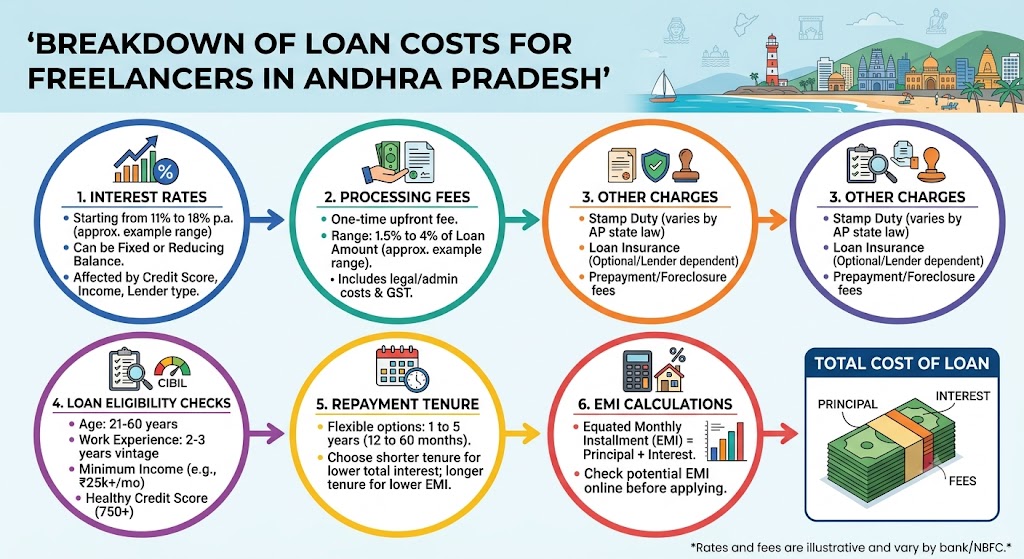
Freelancers in Andhra Pradesh may need loans to manage personal expenses, purchase equipment, cover business costs or handle temporary gaps between client payments. However, before applying, it is important to understand not only the eligibility requirements but also the total cost of borrowing.
Unlike salaried employees, freelancers may have fluctuating monthly income. Lenders may assess bank statements, income tax returns (ITRs), credit history and existing EMIs to determine eligibility. The interest rate, fees and repayment terms offered can also vary according to the lender and the applicant’s financial profile.
This guide explains the main costs freelancers should consider before choosing a personal loan.
1. What Determines Loan Eligibility for Freelancers?
Lenders generally review several factors before approving a loan:
-
Monthly income: Average earnings and consistency of client payments.
-
Credit score: Previous repayment history and outstanding credit.
-
Bank statements: Evidence of income and financial activity.
-
ITR documents: Support for declared income, where required.
-
Existing EMIs: Current financial obligations.
-
KYC documents: Identity and address verification.
-
Repayment capacity: Whether the proposed EMI fits the borrower’s budget.
There is no single income level or credit score that guarantees approval for every freelancer. Each lender follows its own eligibility criteria.
2. Main Costs of a Freelancer Loan
When comparing loans in Andhra Pradesh, look beyond the advertised interest rate.
| Cost component | What it means |
|---|---|
| Interest | The cost charged for borrowing money |
| Processing fee | A fee for processing the application |
| GST on applicable fees | Tax charged on eligible services and fees |
| Annual Percentage Rate (APR) | Annualised borrowing cost calculated under applicable rules |
| Late-payment charges | Charges that may apply when repayments are overdue |
| Foreclosure or prepayment charges | Charges that may apply when repaying early, subject to applicable rules and loan terms |
| Other disclosed fees | Additional charges specified in the loan documents |
The exact amount depends on the lender, loan product and applicable terms. Review the Key Facts Statement (KFS), where applicable, to understand the disclosed costs before accepting a loan.
3. Example: Understanding the Cost of a Personal Loan
Suppose a freelancer applies for a loan of ₹1,00,000. The following is an illustrative example to explain how the interest rate and tenure affect repayments.
<text color="secondary" size="sm">Illustrative estimates only; assumes a fixed interest rate, monthly reducing balance and no additional fees. Actual lender calculations may differ.</text>
| Loan details | Example A | Example B |
|---|---|---|
| Loan amount | ₹1,00,000 | ₹1,00,000 |
| Annual interest rate | 12% | 18% |
| Repayment tenure | 12 months | 12 months |
| Approximate monthly EMI | ₹8,885 | ₹9,168 |
| Approximate total repayment | ₹1,06,620 | ₹1,10,016 |
| Approximate interest cost | ₹6,620 | ₹10,016 |
The example shows that a higher interest rate can increase the total cost of borrowing, even when the loan amount and tenure remain the same.
Before accepting an offer, compare the APR, processing fee and other charges as well as the EMI.
4. How Loan Tenure Affects the Cost
A longer repayment period can reduce the monthly EMI, but it may increase the total interest paid.
For example, a freelancer choosing a longer tenure may find the monthly instalment easier to manage during low-income months. However, the borrower could pay more interest over the life of the loan.
Choose a tenure that balances affordability with the total repayment cost. Avoid selecting a long tenure based only on a lower EMI.
5. How Freelancers Can Manage Loan Costs
Maintain Clear Income Records
Keep bank statements, invoices, client contracts and relevant tax documents organised. Clear records may help lenders assess your financial profile.
Improve Your Credit History
Pay existing EMIs and credit card bills on time. A stronger credit history may help with eligibility, although it does not guarantee a lower rate or approval.
Borrow Only What You Need
A smaller loan can reduce the amount of interest payable. Calculate the actual expense before deciding how much to borrow.
Compare Multiple Offers Carefully
Compare interest rates, APR, processing fees, tenure and total repayment. Apply selectively rather than submitting unnecessary applications to many lenders.
Keep a Repayment Buffer
Freelance income can change from month to month. Set aside funds for essential expenses and loan payments so that a delayed client payment does not immediately create repayment difficulties.
6. Common Cost Mistakes to Avoid
Freelancers should avoid these common mistakes:
-
Choosing a loan based only on the advertised interest rate.
-
Ignoring processing fees and applicable taxes.
-
Borrowing more than their income can support.
-
Selecting a tenure without checking total interest.
-
Overlooking late-payment and prepayment conditions.
-
Accepting an offer without reading the loan agreement and KFS.
-
Paying suspicious agents who promise guaranteed approval.
Verify the actual lender before submitting financial documents or accepting funds.
7. Loan Safety for Freelancers in Andhra Pradesh
Before applying, check that the lender is legitimate and that the loan terms are clearly disclosed. Review the lender’s official website or application, read its privacy information and provide only the information required through authorised channels.
Never share your OTP, UPI PIN, ATM PIN or banking password with a loan agent or suspicious app.
For official information about lending and digital lending safeguards, visit the Reserve Bank of India.
Frequently Asked Questions
1. What costs should freelancers check before taking a loan?
Check the interest rate, APR, processing fees, applicable taxes, EMI, total repayment and any late-payment or prepayment charges.
2. Do freelancers pay higher interest rates than salaried employees?
Not necessarily. Rates depend on the lender, loan product, credit profile, income assessment and other eligibility factors.
3. Does a higher credit score guarantee a lower interest rate?
No. A stronger credit history may help, but the lender considers other factors before deciding the rate and terms.
4. Can a freelancer get a loan without a salary slip?
Some lenders may accept bank statements, ITRs, invoices or other income documents instead. Requirements vary.
5. Is a longer loan tenure cheaper?
It may lower the monthly EMI, but the total interest paid can be higher. Compare both the EMI and total repayment.
6. Where can freelancers check official digital lending guidance?
The Reserve Bank of India website provides official regulatory information and guidance on digital lending.
Published on : 12th October 2026
Published by : Shibam nath
www.vizzve.com || www.vizzveservices.com
Follow us on social media: Facebook || Linkedin || Instagram
🛡 Powered by Vizzve Financial
RBI-Registered Loan Partner | 10 Lakh+ Customers | ₹600 Cr+ Disbursed
#FreelancerLoan #LoanEligibility #AndhraPradesh #AndhraPradeshFinanc