

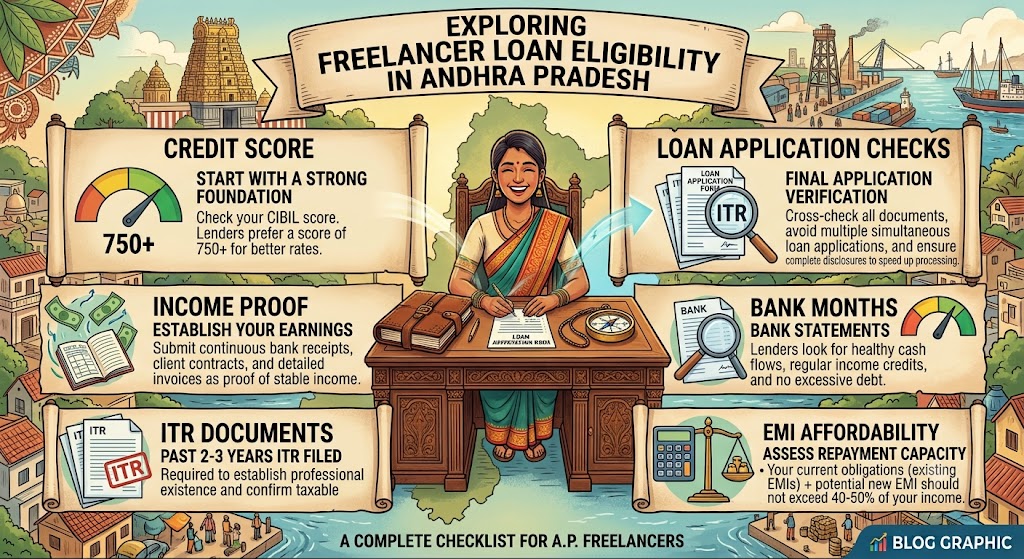
Freelancers in Andhra Pradesh often have questions about personal loan eligibility, income proof, credit scores, required documents and repayment terms. Unlike salaried employees, freelancers may receive payments from different clients, and their monthly income can vary depending on projects and contracts.
Whether you work as a software developer, graphic designer, content writer, digital marketer, consultant or independent professional, understanding the loan application process can help you prepare better and make informed borrowing decisions.
This guide answers common questions about loan eligibility for freelancers in Andhra Pradesh, including documentation, approval factors, costs and digital loan safety.
1. Can Freelancers in Andhra Pradesh Apply for a Personal Loan?
Yes. Freelancers may apply for personal loans if they meet the lender's eligibility requirements.
Lenders may consider factors such as:
-
Age and residential details
-
Freelance work experience
-
Average monthly income
-
Credit history and repayment behaviour
-
Existing loans and EMIs
-
Bank statements and income documents
-
Overall repayment capacity
Eligibility criteria vary between banks and NBFCs. Meeting the basic requirements does not guarantee loan approval.
2. What Documents Do Freelancers Need for Loan Approval?
The documents required depend on the lender and the loan product. Commonly requested documents may include:
| Document | Why it may be required |
|---|---|
| PAN | Identity and financial verification |
| Accepted KYC document | Identity and address verification |
| Bank statements | Review of income and transactions |
| Income Tax Returns (ITRs) | Evidence of reported income, where required |
| Client invoices or contracts | Supporting evidence of freelance work |
| Business or professional records | Additional verification, where applicable |
Prepare accurate and up-to-date documents before applying. Submit them only through the verified lender's official website or authorized application.
3. Can Freelancers Get a Loan Without a Salary Slip?
Yes, some lenders may consider freelancers without traditional salary slips.
Depending on the lender's policy, alternative income evidence may include bank statements, ITRs, invoices, contracts or client payment records.
However, not every lender accepts the same documents. Check the specific requirements before submitting an application.
Tip: Keep your freelance income records organized and use a bank account that clearly reflects your client payments whenever practical.
4. What Credit Score Is Required for Freelancer Loans?
There is no single credit score that guarantees approval for every freelancer.
Lenders may assess your credit score alongside repayment history, existing debt, income stability and other eligibility factors. Their minimum requirements can differ.
To strengthen your credit profile:
-
Pay existing EMIs and credit-card bills on time.
-
Review your credit report for genuine errors.
-
Avoid taking unnecessary debt.
-
Limit applications that you do not intend to pursue.
-
Keep track of your outstanding balances.
A strong credit history may help your application, but it does not guarantee approval or a particular interest rate.
5. Do Freelancers Need ITR for Loan Approval?
Some lenders may request Income Tax Returns to understand a freelancer's reported earnings, particularly when income is irregular or needs additional verification.
Other lenders may accept alternative or additional evidence, depending on their policies.
Before applying, confirm whether ITRs are mandatory for your chosen loan product. Never submit altered income documents or inaccurate information to improve your chances of approval.
6. Does Irregular Freelance Income Affect Loan Eligibility?
It can. Freelancers may earn more in some months and less in others, so lenders may examine income patterns rather than relying on a single payment.
They may review bank transactions, income records and existing financial obligations to assess whether repayments are manageable.
To prepare:
-
Maintain records of payments from different clients.
-
Estimate your average income across several months.
-
Set aside money for taxes and essential expenses.
-
Build emergency savings where possible.
-
Avoid choosing an EMI based only on your best earning month.
A realistic income estimate can also help you decide how much you can afford to borrow.
7. How Do Existing EMIs Affect Freelancer Loan Eligibility?
Existing EMIs can reduce the amount available for a new monthly repayment.
For example, if your average monthly income is ₹60,000 and your existing loan EMIs total ₹15,000, you should account for those repayments alongside living expenses, taxes and business costs before considering another loan.
Lenders may also apply their own debt and affordability criteria.
Tip: Calculate your current obligations and proposed EMI before applying. Do not assume that the maximum amount offered by a lender is necessarily affordable.
8. How Long Does Loan Approval Take for Freelancers?
Processing times vary by lender, loan product and the completeness of the application.
Some digital applications may receive an initial decision quickly, while others require additional checks, income verification or document review.
Delays may occur when:
-
KYC details do not match.
-
Income documents are incomplete.
-
Bank transactions require clarification.
-
Additional verification is necessary.
-
The lender needs more information to assess repayment capacity.
An instant notification should not automatically be treated as final approval or a guarantee of disbursal.
9. Are Online Loan Apps Safe for Freelancers?
Online loans can be convenient, but borrowers should verify the actual lender and understand how their information will be used.
Before applying:
-
Identify the bank or NBFC providing the loan.
-
Verify the lender through official sources.
-
Review the app's privacy policy and permissions.
-
Check the interest rate, APR and applicable charges.
-
Read the Key Facts Statement (KFS) and loan agreement.
-
Save copies of important loan documents.
Never share OTPs, UPI PINs, ATM PINs or internet-banking passwords with an agent or suspicious application.
For regulatory information, consult the Reserve Bank of India at https://www.rbi.org.in/.
10. What Charges Should Freelancers Check Before Accepting a Loan?
Do not compare loan offers using only the monthly EMI. Review the complete borrowing cost.
| Loan term | What to check |
|---|---|
| Interest rate | The rate and whether it is fixed or variable |
| APR | The annualized cost of borrowing |
| Processing fee | Applicable fee and taxes |
| EMI | Monthly repayment amount |
| Tenure | Total repayment period |
| Late-payment charges | Charges applicable to missed payments |
| Prepayment terms | Conditions and applicable charges |
| Total repayment | The overall amount payable |
For covered digital loans, the applicable RBI framework requires important loan information, including APR, to be disclosed through the prescribed process and KFS.
Read the terms before accepting the offer.
11. What Should Freelancers Do If Their Loan Application Is Rejected?
A rejection does not necessarily mean that you can never qualify for a loan.
First, review any reason provided by the lender. Then consider whether the issue relates to credit history, existing EMIs, income documentation, KYC mismatches or lender-specific eligibility requirements.
Practical steps include:
-
Check your credit report.
-
Correct genuine errors in your records.
-
Organize income and bank documents.
-
Review your existing debt burden.
-
Confirm the lender's eligibility requirements.
-
Avoid immediately submitting multiple applications without understanding the problem.
Apply again only when you have addressed the relevant issue and are comfortable with the repayment terms.
12. Can Freelancers Apply for a Loan Without Collateral?
Some personal loans are unsecured, meaning they do not require property or another asset as collateral. However, approval depends on the lender's criteria and the applicant's financial profile.
An unsecured loan is not automatically available to every freelancer, and it may carry a different interest rate from a secured loan.
Always check the actual product terms rather than relying on advertising claims.
13. How Can Freelancers Improve Their Loan Eligibility?
Freelancers can prepare their applications by focusing on financial consistency and accurate documentation.
-
Maintain a good repayment record: Pay existing credit obligations on time.
-
Organize income evidence: Keep bank statements, invoices and relevant tax records ready.
-
Manage existing debt: Consider your current EMIs before taking on another repayment.
-
Apply selectively: Compare lenders and eligibility criteria before applying.
-
Choose a realistic loan amount: Borrow according to your needs and repayment capacity.
-
Verify every offer: Review the APR, fees, tenure and loan agreement.
These steps may improve the quality of your application, but no method guarantees approval.
Published on : 13th October 2026
Published by : Shibam nath
www.vizzve.com || www.vizzveservices.com
Follow us on social media: Facebook || Linkedin || Instagram
🛡 Powered by Vizzve Financial
RBI-Registered Loan Partner | 10 Lakh+ Customers | ₹600 Cr+ Disbursed