

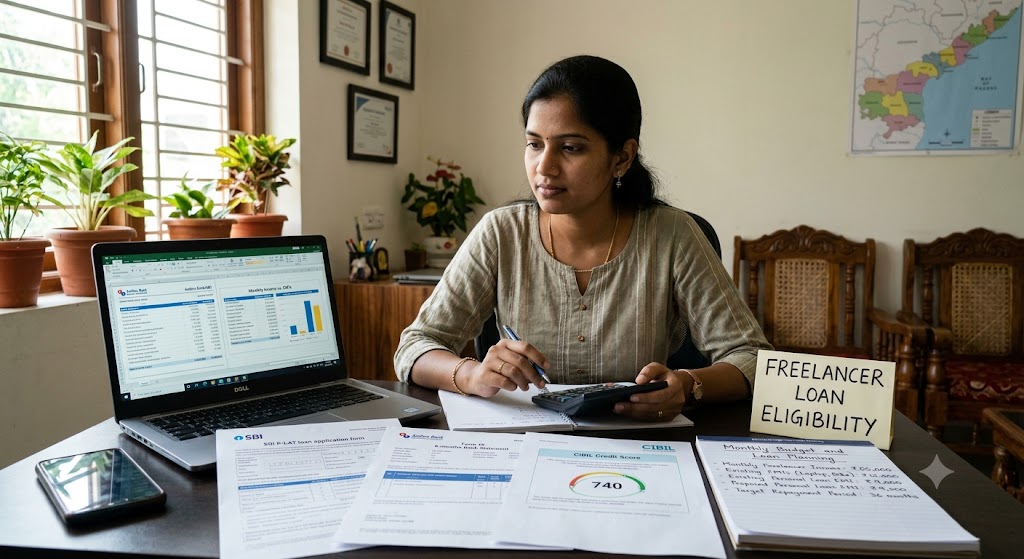
Freelancers in Andhra Pradesh often have questions about personal loan eligibility because their income may change from month to month. Unlike salaried employees who usually receive a fixed salary, freelancers may earn money through client projects, contracts, consulting assignments and digital services.
Whether you are a graphic designer in Visakhapatnam, a software developer in Vijayawada, a content writer in Guntur or an independent consultant working remotely, understanding how lenders assess your financial profile can help you prepare a stronger loan application.
In this guide, we explain freelancer loan eligibility through a practical example, including income verification, credit history, existing EMIs, documentation and repayment affordability.
What Determines Loan Eligibility for Freelancers?
Before reviewing the example, it helps to understand the factors lenders may consider.
-
Monthly income: Average earnings and the consistency of client payments.
-
Credit history: Previous loan repayments, credit-card usage and outstanding balances.
-
Existing EMIs: Current financial obligations that affect repayment capacity.
-
Income documentation: Bank statements, ITRs, invoices or other accepted records.
-
KYC verification: PAN and other accepted identity documents.
-
Loan amount and tenure: Whether the proposed repayment fits the borrower's financial position.
Eligibility criteria vary by bank and non-banking financial company (NBFC). Meeting some or all of these conditions does not guarantee approval.
Real-World Example: A Freelancer Applying for a Personal Loan
Consider a hypothetical freelancer named Ravi who lives in Vijayawada, Andhra Pradesh. He works as a freelance graphic designer and receives payments from several clients.
Ravi wants a personal loan to upgrade his computer and manage a few professional expenses.
The following figures are illustrative, not actual lender eligibility rules or a guarantee of approval.
Ravi's Financial Profile
| Financial detail | Illustrative amount |
|---|---|
| Average monthly income | ₹60,000 |
| Existing monthly EMI | ₹8,000 |
| Essential monthly expenses | ₹25,000 |
| Proposed new loan EMI | ₹7,000 |
| Remaining amount after these expenses and EMIs | ₹20,000 |
The remaining amount is calculated as ₹60,000 − ₹8,000 − ₹25,000 − ₹7,000 = ₹20,000, before accounting for any other expenses or irregular costs.
This calculation helps Ravi understand whether the proposed EMI appears manageable. A lender will conduct its own assessment and may consider other financial details.
Step 1: Ravi Organizes His Income Documents
Because Ravi does not receive a traditional salary slip, he prepares the documents that may help demonstrate his earnings.
These could include:
-
Recent bank statements showing client payments
-
Client invoices and payment records
-
Freelance contracts, where available
-
Income Tax Returns (ITRs), if required
-
PAN and other accepted KYC documents
Ravi checks that his application details match his supporting records. Consistent and accurate documentation may reduce avoidable verification delays.
Step 2: The Lender Reviews His Credit Profile
The lender may review Ravi's credit history to understand how he has managed previous borrowing.
Factors may include repayment history, outstanding debt, credit accounts and recent credit enquiries.
If Ravi has paid his existing EMIs on time, that may support his application. However, a good credit score alone does not guarantee approval.
Before applying, freelancers can check their credit reports and address genuine errors where possible.
Step 3: The Lender Assesses Existing EMIs
Ravi already pays ₹8,000 every month toward an existing loan. If he takes the proposed loan, his combined monthly EMIs would become ₹15,000.
That is ₹8,000 + ₹7,000 = ₹15,000.
The lender may compare his income and existing obligations with the proposed repayment to assess affordability. Ravi should also consider whether his earnings could fall during a period with fewer client projects.
Practical lesson: A freelancer should not choose an EMI based only on a high-income month. Planning around a realistic average and keeping emergency savings can help manage irregular earnings.
Step 4: The Lender Verifies KYC and Other Information
Ravi submits his documents through the lender's verified website or authorized application.
Depending on the lender's process, additional checks may be required to confirm his identity, bank information, occupation or income.
He avoids sharing OTPs, UPI PINs, ATM PINs or internet-banking passwords with agents or unknown applications.
He also verifies the actual bank or NBFC providing the loan rather than relying only on the app's name or advertising.
Step 5: Ravi Compares the Loan Costs
Suppose Ravi receives a loan offer. Before accepting it, he should review more than the monthly EMI.
| Loan detail | What Ravi should check |
|---|---|
| Interest rate | The applicable rate and conditions |
| APR | The annualized borrowing cost |
| Processing fee | Applicable fees and taxes |
| Loan tenure | How long repayments will continue |
| Monthly EMI | Whether it remains affordable |
| Late-payment charges | Costs if a payment is missed |
| Prepayment terms | Applicable conditions and charges |
| Total repayment | The complete amount payable |
For covered digital loans, the applicable Reserve Bank of India (RBI) framework requires key loan information, including the Annual Percentage Rate (APR), to be disclosed through the prescribed process and Key Facts Statement (KFS).
Ravi should read the KFS and loan agreement before accepting the offer.
Would Ravi Qualify for the Loan?
Ravi has several details that a lender can assess: documented freelance income, existing EMI information and supporting KYC records. His proposed EMI also appears manageable in the simplified household-budget calculation above.
However, we cannot conclude that Ravi will be approved. The final decision depends on the lender's eligibility policy, verification results, credit assessment and other relevant factors.
A different freelancer with the same monthly income might receive a different decision because their credit history, existing debt, documentation or chosen loan product differs.
Lessons Other Freelancers in Andhra Pradesh Can Learn
1. Keep Income Records Organized
Maintain bank statements, client invoices, contracts and tax records where applicable. Clear documentation can help explain income received from different clients.
2. Review Your Credit Report
Check your credit history before applying and address genuine inaccuracies. Make repayments on time to help maintain a healthy credit profile.
3. Calculate Your Realistic Repayment Capacity
Deduct existing EMIs, essential expenses and other regular obligations from a realistic estimate of income. Remember that freelance earnings may fluctuate.
4. Compare Lenders Carefully
Check eligibility criteria, interest rates, APR, fees, tenure and total repayment. Avoid choosing a lender solely because it advertises quick approval.
5. Borrow Only What You Need
A larger loan can increase the EMI and total repayment burden. Choose an amount that fits your needs and finances rather than simply accepting the highest offer.
6. Protect Your Financial Information
Verify the lender and use authorized channels to submit documents. Never share banking PINs or passwords with loan agents.
For regulatory information, visit the official Reserve Bank of India website: https://www.rbi.org.in/.
Frequently Asked Questions
1. Can freelancers in Andhra Pradesh apply for personal loans?
Yes. Freelancers may apply if they meet the lender's eligibility requirements. Approval depends on factors such as income, credit history, existing debt and documentation.
2. Can a freelancer apply without a salary slip?
Some lenders accept alternative income evidence, such as bank statements, ITRs, invoices or client payment records. Requirements vary by lender.
3. Does freelance income need to be the same every month?
Not necessarily. Lenders may assess income patterns and supporting records, but their methods and eligibility criteria differ.
4. Does a good credit score guarantee approval?
No. A credit score is one factor among several. Income, existing EMIs, KYC verification and lender-specific policies can also affect the decision.
5. How can freelancers estimate whether an EMI is affordable?
Calculate realistic income after essential expenses and existing debt repayments. Consider income fluctuations and emergency savings before committing to another EMI.
6. What documents might freelancers need?
Depending on the lender, these may include PAN, accepted KYC documents, bank statements, ITRs, invoices and client payment records.
7. What should freelancers check before accepting a digital loan?
Verify the actual lender, review the KFS and loan agreement, compare APR and fees, and confirm that the EMI and total repayment fit the budget.
Published on : 14th October 2026
Published by : Shibam nath
www.vizzve.com || www.vizzveservices.com
Follow us on social media: Facebook || Linkedin || Instagram
🛡 Powered by Vizzve Financial
RBI-Registered Loan Partner | 10 Lakh+ Customers | ₹600 Cr+ Disbursed