

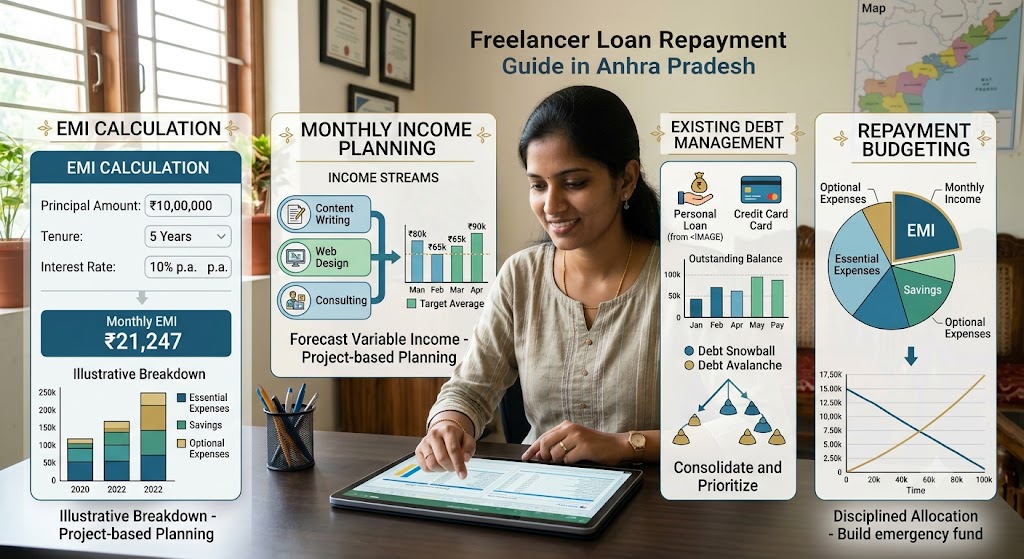
Freelancers in Andhra Pradesh often experience changes in monthly income because payments depend on client projects, contracts and completed assignments. If you are planning to take a personal loan, understanding repayment terms is just as important as checking your eligibility.
Whether you work in software development, graphic design, content writing, digital marketing, consulting or another freelance profession, a suitable repayment plan can help you manage loan instalments without putting unnecessary pressure on your finances.
This guide explains how freelancers can plan loan repayments, calculate affordable EMIs, manage irregular income and avoid common borrowing mistakes.
1. Understand Your Loan Repayment Obligations
Before accepting a loan, understand how much you need to repay and when each instalment is due.
Important loan details include:
-
Loan amount: The amount borrowed from the lender.
-
Interest rate: The rate charged on the outstanding loan.
-
EMI: The monthly instalment, generally covering principal and interest.
-
Loan tenure: The period over which you repay the loan.
-
Processing fee: Any applicable fee and taxes.
-
Late-payment charges: Charges that may apply when payments are delayed.
-
Prepayment terms: Conditions and applicable charges, if any, for repaying early.
Read the Key Facts Statement (KFS), where applicable, and the loan agreement before accepting the offer. Do not judge a loan only by its advertised EMI.
2. Calculate an EMI You Can Afford
Freelancers should calculate their repayment capacity using realistic income estimates rather than relying on their highest-earning month.
Consider this hypothetical example of a freelancer living in Vijayawada, Andhra Pradesh.
| Monthly financial detail | Amount |
|---|---|
| Average freelance income | ₹60,000 |
| Existing loan EMIs | ₹8,000 |
| Essential living expenses | ₹25,000 |
| Proposed new loan EMI | ₹7,000 |
| Amount remaining | ₹20,000 |
The remaining amount is ₹60,000 − ₹8,000 − ₹25,000 − ₹7,000 = ₹20,000, before other expenses, taxes or irregular costs not included above.
This simple calculation helps the borrower evaluate affordability. It does not guarantee that a lender will approve the loan, and the actual budget should include all relevant expenses.
Practical tip: If your income changes significantly from month to month, test whether you can manage the EMI during a low-income period.
3. Build a Repayment Plan Around Irregular Income
Unlike salaried employees, freelancers may not receive payments on a fixed date. A client might pay after a project milestone, while another payment could be delayed.
To manage this uncertainty:
Maintain a Monthly Budget
List essential expenses, existing EMIs, business costs, taxes and savings. Determine how much remains available for a new repayment.
Create an EMI Reserve
Where possible, keep money set aside for upcoming instalments. An emergency reserve can help you manage temporary gaps between client payments.
Track Client Payments
Maintain a record of invoices, expected payment dates and amounts received. This can make it easier to forecast cash flow.
Avoid Depending on One Client
If practical, diversify your client base. Relying on one major client may make repayment more difficult if that client stops assigning work or delays payment.
4. Choose a Suitable Loan Tenure
Loan tenure affects both the monthly EMI and the total interest paid.
-
A shorter tenure generally results in a higher EMI but may reduce the total interest paid.
-
A longer tenure generally lowers the EMI but can increase the total interest paid.
The actual figures depend on the interest rate, loan amount and applicable terms.
Choose a tenure that fits your realistic income and repayment capacity. Do not select a longer tenure automatically just because the EMI looks smaller.
5. Compare the Total Cost Before Accepting a Loan
A loan with a low advertised interest rate may still include fees or other costs. Compare offers carefully.
| Factor | What to check |
|---|---|
| Interest rate | The applicable rate and whether it can change |
| APR | Annualized cost of borrowing |
| Processing fee | Fee amount and applicable taxes |
| EMI | Monthly payment amount |
| Tenure | Total repayment period |
| Late-payment charges | Applicable charges and conditions |
| Prepayment terms | Conditions and charges, where applicable |
| Total repayment | Overall amount payable over the loan term |
For covered digital loans, the applicable Reserve Bank of India (RBI) framework requires key loan information, including the Annual Percentage Rate (APR), to be disclosed through the prescribed process and Key Facts Statement (KFS).
Always read the KFS and loan agreement before accepting the offer.
6. What Should You Do If a Client Delays Payment?
A delayed client payment can disrupt a freelancer's cash flow, but ignoring an approaching EMI may make the situation worse.
Consider these steps:
-
Review your available savings and upcoming essential expenses.
-
Follow up professionally with the client about the overdue invoice.
-
Contact your lender promptly if you believe you may miss an instalment.
-
Ask the lender whether any available repayment options apply to your situation.
-
Keep records of lender communications and any agreed arrangements.
Do not assume that a lender will automatically extend the due date or waive charges. Get any revised repayment arrangement confirmed through official channels.
Avoid taking another high-cost loan simply to cover an existing EMI without carefully assessing the consequences.
7. How Can Freelancers Avoid Missed EMIs?
Good repayment habits can help freelancers protect their financial position.
-
Set reminders before each due date.
-
Maintain sufficient funds in the repayment account.
-
Review automatic debit arrangements.
-
Keep track of every active loan and EMI.
-
Avoid borrowing more than necessary.
-
Pay existing credit obligations on time.
-
Contact the lender early if repayment becomes difficult.
Missed payments may lead to applicable charges and may affect your credit history. The consequences depend on the loan agreement and the lender's reporting practices.
8. Can Early Repayment Help Freelancers?
Making additional repayments or closing a loan early may reduce future interest in some circumstances. However, the benefit depends on the outstanding balance, loan terms and any applicable prepayment charges.
Before making an early repayment:
-
Request the current outstanding amount.
-
Check the lender's prepayment conditions.
-
Compare any applicable charges with the potential interest savings.
-
Obtain confirmation when the loan is fully repaid.
-
Keep the closure statement or other relevant proof.
Do not use all your emergency savings to close a loan if doing so would leave you unable to manage essential expenses or future instalments.
9. Loan Repayment Safety Checklist
Before accepting a loan, confirm that:
-
The actual bank or NBFC has been verified.
-
Your income and existing debt have been assessed realistically.
-
The EMI fits your budget, including low-income months.
-
The interest rate, APR and fees are clearly disclosed.
-
You have reviewed the KFS and loan agreement.
-
The repayment date and method are clear.
-
You understand the consequences of missed payments.
-
You have saved the lender's official contact and grievance details.
Never share OTPs, UPI PINs, ATM PINs or internet-banking passwords with loan agents or suspicious apps.
For official regulatory information, visit the Reserve Bank of India website: https://www.rbi.org.in/.
Frequently Asked Questions
1. How should freelancers in Andhra Pradesh plan loan repayments?
Estimate average income, deduct essential expenses and existing EMIs, and check whether the new instalment remains manageable during low-income months.
2. Should freelancers choose a shorter or longer loan tenure?
Choose a tenure based on affordability and total borrowing cost. Shorter tenures generally mean higher EMIs but potentially lower total interest, while longer tenures generally reduce EMIs but may increase total interest.
3. What happens if a freelancer misses an EMI?
The lender may apply charges under the loan agreement, and the missed payment may affect the borrower's credit history. Contact the lender promptly if repayment becomes difficult.
4. Can irregular income affect loan repayment?
Yes. Fluctuating income can make it harder to maintain regular instalments, so budgeting and maintaining an EMI reserve can help.
5. Is it a good idea to take another loan to pay an EMI?
Not necessarily. A new loan can increase overall debt and costs. Evaluate alternatives and contact your current lender before taking additional borrowing.
6. Can freelancers repay a loan early?
Early repayment may be possible, subject to the loan terms and applicable rules. Check the outstanding balance, prepayment conditions and potential savings before proceeding.
7. What should borrowers check before accepting a digital loan?
Verify the actual lender, review the APR and applicable charges, read the KFS and loan agreement, and ensure that repayment is affordable.
Published on : 14th October 2026
Published by : Shibam nath
www.vizzve.com || www.vizzveservices.com
Follow us on social media: Facebook || Linkedin || Instagram
🛡 Powered by Vizzve Financial
RBI-Registered Loan Partner | 10 Lakh+ Customers | ₹600 Cr+ Disbursed