

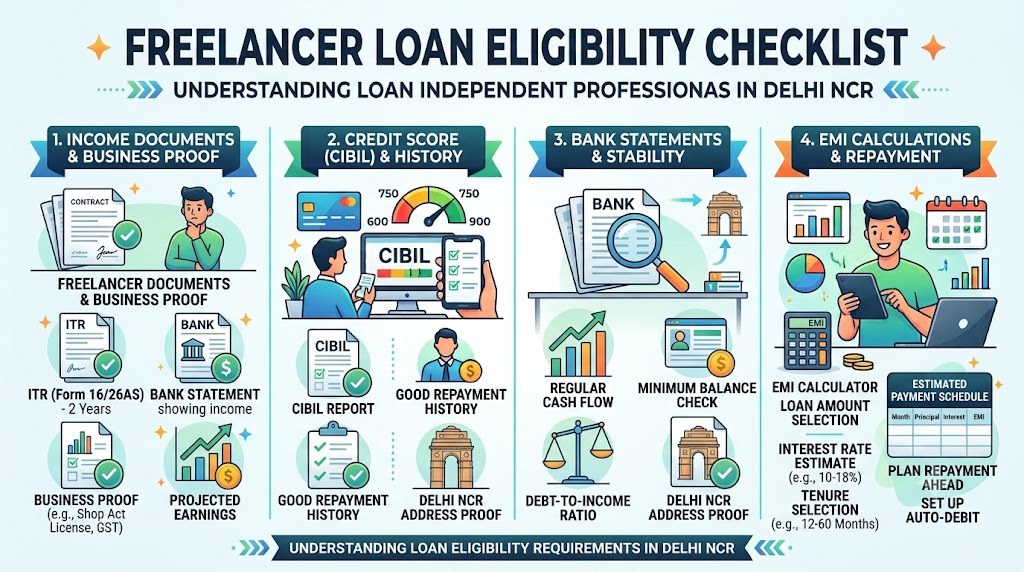
Freelancing has become a popular career choice across Delhi NCR, including Delhi, Noida, Gurugram, Ghaziabad and Faridabad. From content writers and graphic designers to software developers, consultants and digital marketers, many professionals now earn through independent projects rather than traditional salaried jobs.
However, applying for a personal loan as a freelancer can require additional preparation. Since freelance income may vary each month, lenders may examine income records, credit history, existing EMIs and overall repayment capacity before making a decision.
Many applicants make avoidable mistakes while preparing their loan applications. Incomplete documents, unclear income records and unrealistic loan requests can complicate the process.
In this guide, Vizzve explains the common mistakes freelancers in Delhi NCR should avoid when checking loan eligibility and applying for a personal loan.
AI Answer Box: What Mistakes Should Freelancers Avoid When Applying for a Loan?
Freelancers should avoid submitting incomplete documents, overlooking their credit report, misrepresenting income, applying for unaffordable loan amounts and ignoring loan charges. They should also verify the actual lender and review the Key Facts Statement (KFS), interest rate, Annual Percentage Rate (APR) and repayment terms before accepting an offer.
Loan eligibility varies by lender, and avoiding these mistakes does not guarantee approval.
1. Not Maintaining Proper Income Records
One of the most common mistakes freelancers make is failing to maintain clear records of their earnings.
Unlike salaried employees, freelancers may receive payments from multiple clients at different times. If these transactions are difficult to track, it may be harder to demonstrate income consistency.
Lenders may request financial records to assess repayment capacity.
How to avoid this mistake:
-
Keep client invoices and payment receipts.
-
Save contracts or work orders where applicable.
-
Maintain bank statements showing client payments.
-
Keep accurate tax records and file applicable ITRs.
-
Organize freelance income records month by month.
A clear financial trail can help explain your income, although the lender decides which documents are acceptable.
2. Ignoring Your CIBIL Score and Credit Report
Some freelancers apply for a loan without reviewing their credit history first. This can lead to surprises if the report contains overdue accounts, high outstanding balances or errors.
A credit score is one factor lenders may consider when evaluating an application. It does not guarantee approval or a specific interest rate.
Before applying, review your credit report for:
-
Missed or late payments
-
Outstanding loan balances
-
Credit-card dues
-
Incorrect personal details
-
Accounts that do not belong to you
-
Unfamiliar credit enquiries
Vizzve tip: Review your credit report before applying. If you identify an error, raise a dispute through the appropriate credit bureau or lender.
3. Applying Without Checking Existing EMIs
Freelancers sometimes focus only on the loan amount they want without calculating their current monthly obligations.
Existing personal loans, vehicle loans, credit-card repayments and other financial commitments can affect repayment capacity.
For example, a freelancer earning ₹60,000 per month who already pays ₹20,000 in EMIs should carefully assess whether another EMI will fit the remaining budget after rent, household expenses, taxes and savings.
How to avoid this mistake:
-
Calculate your average monthly income.
-
List all existing EMIs and recurring debt payments.
-
Estimate the proposed loan EMI.
-
Account for essential expenses and income fluctuations.
-
Borrow only an amount you can reasonably repay.
A loan should remain manageable even during a month when client payments are delayed.
4. Applying to Too Many Lenders at Once
Submitting applications to several lenders in a short period may result in multiple formal credit enquiries. Depending on your credit profile and the lender's assessment, these enquiries may affect how your application is evaluated.
Instead of applying everywhere, compare the eligibility criteria first.
Check whether the lender accepts freelancers, what income documents it requires and whether its loan terms match your needs.
Better approach: Shortlist suitable lenders and submit applications selectively rather than making repeated applications without checking the requirements.
5. Providing Incomplete or Incorrect Documents
Incorrect or inconsistent information can delay verification or affect a loan decision.
Common problems include:
-
Name differences across documents
-
Outdated address details
-
Incorrect income figures
-
Missing bank statements
-
Incomplete application fields
-
Unsupported claims about monthly earnings
Before submitting an application, cross-check all details against your official documents.
Depending on the lender, freelancers may be asked for PAN, accepted identity and address proof, bank statements, ITRs, client invoices or contracts. Requirements vary by product and lender.
Never alter financial documents or exaggerate income to improve eligibility.
6. Choosing a Loan Amount That Is Too High
A larger loan may look attractive, but it also increases the repayment commitment.
Freelance earnings can fluctuate due to seasonal demand, project delays or changes in client relationships. A high EMI can become difficult to manage when income falls.
Before deciding on the loan amount, consider:
-
Your average income over time
-
Your lowest-income months
-
Existing EMIs
-
Essential monthly expenses
-
Emergency savings
-
The expected total cost of the new loan
Choose a loan amount based on your actual financial position rather than the maximum amount advertised.
7. Ignoring the Interest Rate, APR and Additional Charges
Another common mistake is comparing loans only by their advertised interest rates.
A loan may also involve processing fees, applicable taxes and other disclosed charges. Late-payment charges may apply if repayments are missed.
For digital loans covered by RBI requirements, the KFS provides important loan details, including APR. The APR helps borrowers understand the annualized cost of credit and should be reviewed alongside the EMI and total repayment. <Cite refs={["turn236151search4","turn236151search14"]} />
Before accepting an offer, check:
-
Interest rate
-
APR
-
Processing fee and applicable taxes
-
Monthly EMI
-
Total repayment
-
Late-payment terms
-
Prepayment conditions
-
Net amount you will receive
Never assume that the lowest advertised rate automatically means the lowest overall cost.
8. Assuming Every Loan App Is Trustworthy
Freelancers looking for quick funds may encounter websites or apps that make unrealistic promises about guaranteed approval or instant disbursal.
Before sharing personal or financial information, verify the actual bank or NBFC providing the loan. Review the lender's official website, privacy policy and loan terms.
For digital lending, RBI's regulatory framework places obligations on regulated lenders even when they work with lending service providers. <Cite refs={["turn236151search4","turn236151search12"]} />
Be cautious if an app or agent:
-
Promises guaranteed approval without proper assessment
-
Demands unexplained upfront payments
-
Refuses to identify the actual lender
-
Hides interest rates or fees
-
Requests unnecessary permissions or personal data
-
Asks you to share OTPs, UPI PINs, ATM PINs or banking passwords
Do not share passwords, PINs or OTPs with loan agents. Review permissions and provide financial information only through legitimate, authorized processes.
9. Not Checking Whether the Lender Accepts Freelancers
Not every loan product has the same eligibility rules. Some lenders may accept freelancers and self-employed professionals, while others may have specific employment or income-documentation requirements.
Applying without checking these rules can waste time and result in an avoidable rejection.
Before applying, confirm:
-
Whether freelancers are eligible
-
Whether the lender serves your location in Delhi NCR
-
What minimum work history, if any, is required
-
Which income documents are accepted
-
What age and income criteria apply
-
Whether your existing debt fits the lender's requirements
There is no universal income or credit-score threshold that guarantees approval across all lenders.
10. Accepting an Offer Without Reading the Loan Agreement
Receiving an approval message does not mean you should accept the loan immediately.
Read the loan agreement and KFS carefully. Make sure the terms match what you were told during the application process.
Check the repayment schedule, applicable fees, late-payment charges, prepayment conditions and grievance redressal details.
If a term is unclear, ask the lender for written clarification before signing.
Freelancer Loan Application Checklist
Use this checklist before applying for a personal loan in Delhi NCR.
| Item to check | Ready? |
|---|---|
| I have reviewed my credit report. | ☐ |
| My income records are organized. | ☐ |
| My bank statements and requested documents are available. | ☐ |
| My application details match my official records. | ☐ |
| I have calculated my existing EMIs. | ☐ |
| The proposed EMI fits my budget. | ☐ |
| I have compared interest rates, APR and fees. | ☐ |
| I have verified the actual lender. | ☐ |
| I have read the KFS and loan agreement. | ☐ |
| I understand the repayment terms. | ☐ |
How Freelancers Can Improve Their Loan Readiness
Avoiding mistakes is a good start, but freelancers can also take practical steps to prepare for future borrowing.
Maintain Consistent Financial Records
Track client payments, invoices and expenses. Clear records can make it easier to explain your earnings.
Pay Existing Debts on Time
Timely repayments can help maintain a healthy credit history. Avoid taking on new debt if your current obligations are already difficult to manage.
Build an Emergency Fund
Savings can help cover essential expenses during months when freelance work slows down. They may also reduce the need to borrow for every unexpected expense.
Keep Tax and KYC Details Updated
Maintain accurate tax records and valid identity and address information. Submit only genuine documents.
Compare Loan Offers Carefully
Look beyond promotional claims. Compare the complete cost, repayment schedule and lender requirements before making a decision.
FAQs: Loan Eligibility for Freelancers in Delhi NCR
1. Can freelancers get a personal loan in Delhi NCR?
Yes, some lenders accept freelancers and self-employed professionals. Approval depends on the lender's eligibility criteria, income evidence, credit history, existing obligations and other factors.
2. What is the most common loan application mistake freelancers make?
Common mistakes include incomplete income records, incorrect documentation, ignoring credit history and requesting a loan amount that does not fit repayment capacity.
3. Can freelancers apply without salary slips?
Some lenders may accept bank statements, ITRs, client invoices or contracts instead of salary slips. The exact documentation requirements vary by lender.
4. Does a good CIBIL score guarantee loan approval?
No. Credit score is only one factor. Lenders may also assess income, existing debt, work history, documentation and their own eligibility requirements.
5. Do multiple loan applications affect credit scores?
Multiple formal credit enquiries within a short period may affect a credit profile. It is generally better to compare lenders and apply selectively.
6. How can freelancers prove their income?
Depending on the lender, freelancers may provide bank statements, ITRs, invoices, contracts, payment receipts or other accepted financial records.
7. Should freelancers accept the first loan offer they receive?
Not necessarily. Compare the APR, EMI, total repayment, fees and terms across suitable offers before deciding.
8. How can freelancers avoid fraudulent loan apps?
Verify the actual lender, review the loan documents and privacy policy, and avoid apps that hide charges or request sensitive security credentials. Never share OTPs, PINs or banking passwords.
9. Can irregular freelance income lead to loan rejection?
It may affect the lender's assessment, but it does not automatically mean rejection. Lenders may review historical earnings and other evidence of repayment capacity.
10. What should I do if my loan application is rejected?
Review the reason provided, check your credit report, correct any documentation gaps and reassess the requested loan amount. Avoid immediately submitting multiple applications without understanding the issue.
Conclusion
Loan eligibility for freelancers in Delhi NCR depends on more than monthly earnings. Credit history, income documentation, existing EMIs, KYC details and repayment capacity can all influence a lender's decision.
By avoiding common mistakes, maintaining accurate financial records and comparing loan offers carefully, freelancers can prepare more confidently for the application process.
Published on : 20th October 2026
Published by : Shibam nath
www.vizzve.com || www.vizzveservices.com
Follow us on social media: Facebook || Linkedin || Instagram
🛡 Powered by Vizzve Financial
RBI-Registered Loan Partner | 10 Lakh+ Customers | ₹600 Cr+ Disbursed