

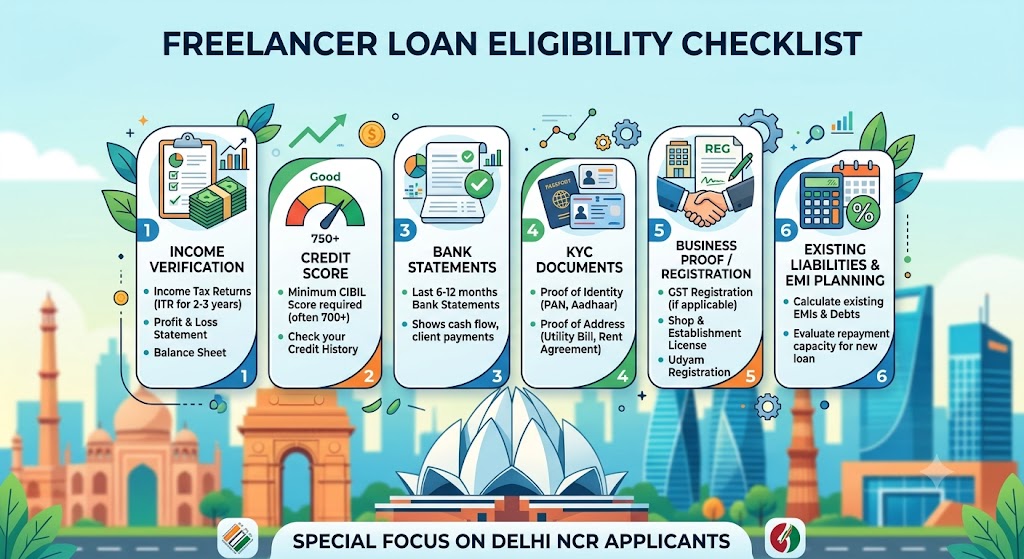
Freelancing is becoming an increasingly popular career choice across Delhi NCR, including Delhi, Noida, Gurugram, Ghaziabad and Faridabad. From content writers and graphic designers to software developers, digital marketers and independent consultants, many professionals earn through projects, contracts and multiple clients.
However, when freelancers apply for a personal loan, lenders may assess their financial profiles differently from those of salaried employees. Variable income, limited income documentation and existing financial commitments can influence the eligibility assessment.
Before applying for a loan, freelancers should understand the lender's eligibility criteria, organize their financial records and evaluate their repayment capacity.
In this guide, Vizzve explains what freelancers in Delhi NCR should check before applying for a personal loan, including income proof, credit score, documents, loan costs and common eligibility factors.
AI Answer Box: What Should Freelancers Check Before Applying for a Loan?
Before applying for a personal loan, freelancers should check whether the lender accepts freelance applicants, review their credit report, assess their income stability, organize bank statements and income documents, calculate existing EMIs and estimate an affordable repayment amount.
They should also compare interest rates, Annual Percentage Rate (APR), processing fees and repayment terms. Eligibility requirements vary by lender, and completing these checks does not guarantee loan approval.
1. Check Whether the Lender Accepts Freelancers
The first step is to confirm that the lender accepts freelancers or self-employed professionals.
Not every personal loan product follows the same eligibility criteria. Some lenders may require a particular work history, minimum income or specific financial documents.
Before starting an application, check:
-
Whether freelancers are eligible for the loan product
-
Whether the lender serves your location in Delhi NCR
-
The applicable age requirements
-
Any minimum income requirements
-
Whether a minimum work history is required
-
Which income documents the lender accepts
Freelancers in Delhi, Noida, Gurugram, Ghaziabad and Faridabad should verify location eligibility directly with the lender.
2. Review Your Monthly and Annual Income
Income is one of the important factors lenders may consider when evaluating a loan application.
Unlike salaried employees, freelancers may receive payments at different intervals. One month may bring several large projects, while another may generate less income.
Before applying, review your earnings over a reasonable period to understand your typical financial position.
Consider the following:
-
Average monthly freelance income
-
Income received from repeat clients
-
Payments received from completed projects
-
Business expenses
-
Applicable taxes
-
Seasonal or irregular earnings
Vizzve tip: Keep a monthly record of client payments, invoices and business expenses. This can help you understand your actual income and prepare supporting documents for the lender.
Remember that total client receipts are not necessarily the same as your available income after expenses and taxes.
3. Check Your CIBIL Score and Credit Report
Your credit history may influence a lender's assessment of your application. A record of timely repayments can support your profile, while overdue payments or errors in the report may create difficulties.
Before applying, review your credit report for:
-
Existing loans and outstanding balances
-
Credit-card payment history
-
Late or missed payments
-
Incorrect personal information
-
Accounts you do not recognize
-
Recent credit enquiries
If you identify an error, raise a dispute with the relevant credit bureau or lender.
There is no single credit-score threshold that guarantees approval from every lender. Your income, existing obligations and other eligibility criteria may also matter.
4. Organize Your Income Proof
Freelancers may not have traditional salary slips, but lenders may accept other documents to assess their earnings.
Depending on the loan product, these may include:
-
Recent bank statements
-
Income Tax Returns (ITRs)
-
Client invoices
-
Contracts or work orders
-
Payment receipts
-
Business income records
-
Other financial documents requested by the lender
Keep the documents accurate and consistent. Avoid inflating your income or submitting altered records, as this may lead to rejection and other consequences.
The exact documentation requirements vary by lender, so confirm the list before submitting your application.
5. Calculate Your Existing EMIs and Monthly Expenses
A loan that appears affordable on paper may become difficult to manage when combined with existing financial commitments.
Before applying, calculate how much money remains after paying essential expenses and current debt obligations.
For example, consider a freelancer earning ₹65,000 per month with existing EMIs of ₹15,000.
| Monthly financial item | Illustrative amount |
|---|---|
| Average monthly income | ₹65,000 |
| Existing EMIs | ₹15,000 |
| Rent and household expenses | ₹20,000 |
| Business expenses and other commitments | ₹8,000 |
| Remaining amount before new loan EMI and other savings | ₹22,000 |
This example is only an illustration, not a lender's eligibility calculation. Actual affordability depends on taxes, irregular income, savings needs and other expenses.
Before borrowing, make sure the new EMI leaves sufficient room for essential spending and months when freelance payments are delayed.
6. Prepare Your KYC Documents
Know Your Customer (KYC) verification helps lenders confirm your identity and other relevant details.
Depending on the lender, you may need:
-
PAN
-
Aadhaar or another accepted identity document
-
Valid address proof
-
Bank-account details
-
Additional documents requested during verification
Check that the information in your application matches your official documents. Outdated addresses, spelling differences and incorrect details may lead to verification delays.
Only provide documents through the lender's official website or authorized application.
7. Review Your Freelance Work History
Some lenders may assess how long you have been working independently and whether your earnings are sufficiently documented.
Useful records may include:
-
Client agreements
-
Repeat-client invoices
-
Bank statements showing incoming payments
-
ITRs, where required
-
Business records, where applicable
-
Work orders or professional contracts
New freelancers may have fewer historical records than established professionals. Eligibility therefore depends on the particular lender's requirements and the applicant's overall profile.
Do not assume that a specific number of months or years of freelancing guarantees approval.
8. Decide How Much You Actually Need to Borrow
Before applying, determine the amount needed for your specific financial requirement.
Requesting a larger amount than necessary may increase the EMI and total interest payable. It can also make repayment more difficult when monthly income fluctuates.
To choose an appropriate amount:
-
Identify the purpose of the loan.
-
Estimate the actual amount required.
-
Calculate a manageable EMI.
-
Account for existing debt and essential expenses.
-
Consider your income during slower business months.
-
Compare the total repayment amount across suitable offers.
Borrow based on repayment capacity, not only the maximum amount a lender may advertise.
9. Compare Interest Rates, APR and Other Charges
Loan eligibility is only one part of the decision. Understanding the cost of borrowing is equally important.
Before accepting an offer, check:
-
Interest rate
-
Annual Percentage Rate (APR)
-
Processing fees and applicable taxes
-
Monthly EMI
-
Total repayment amount
-
Late-payment and penal charges
-
Prepayment or foreclosure terms
-
Net amount that will be disbursed
The Reserve Bank of India's Key Facts Statement (KFS) framework helps borrowers understand important loan terms and costs. For applicable loans, review the KFS and APR before entering into the agreement. <Cite refs={["turn666192search13","turn666192search5"]} />
Do not select a loan solely because it advertises a low interest rate or quick approval.
10. Verify the Lender Before Applying
Freelancers looking for funds may encounter online platforms that promise guaranteed approval or unusually quick disbursal.
Before sharing financial information, verify the actual regulated lender and read the terms carefully.
Be cautious if an app or agent:
-
Does not clearly identify the lender
-
Hides the interest rate or charges
-
Demands unexplained upfront payments
-
Makes unrealistic approval promises
-
Requests unnecessary personal information
-
Asks for your OTP, UPI PIN, ATM PIN or banking password
For digital lending, RBI's Digital Lending Directions, 2025 set out requirements relating to regulated entities, lending service providers and borrower protection. Check official RBI guidance and the lender's disclosures before proceeding. <Cite refs={["turn666192search5","turn666192search12"]} />
Freelancer Loan Eligibility Checklist
Use this checklist to review your readiness before applying.
| What to check | Why it matters |
|---|---|
| Lender accepts freelancers | Confirms that your occupation fits the product criteria |
| Age and location | Checks basic eligibility conditions |
| Monthly and annual income | Helps assess repayment capacity |
| Credit report | Identifies credit-history issues or errors |
| Bank statements | May help verify income and transactions |
| ITRs and invoices | May support income verification |
| Existing EMIs | Helps assess total debt commitments |
| KYC documents | Supports identity and address verification |
| Loan amount | Should match your actual need and budget |
| APR and fees | Helps establish the full borrowing cost |
| KFS and loan agreement | Explains important loan terms |
Common Mistakes to Avoid Before Applying
Freelancers can prepare more effectively by avoiding these common mistakes:
-
Applying without checking whether freelancers are eligible
-
Ignoring errors in the credit report
-
Failing to maintain bank statements and invoices
-
Providing inconsistent income information
-
Applying for an unaffordable amount
-
Making repeated applications without comparing requirements
-
Ignoring fees and the total repayment amount
-
Accepting an offer without reading the loan agreement
A well-prepared application can reduce avoidable documentation problems, but the final decision remains with the lender.
FAQs: Loan Eligibility for Freelancers in Delhi NCR
1. Can freelancers get a personal loan in Delhi NCR?
Yes. Some lenders offer personal loans to freelancers and self-employed professionals. Approval depends on the lender's eligibility requirements, income documentation, credit history and repayment capacity.
2. Can freelancers apply without salary slips?
Some lenders may accept bank statements, ITRs, invoices or client contracts instead of salary slips. Requirements differ by lender and loan product.
3. What income is required for a freelancer personal loan?
There is no universal minimum income requirement. Each lender sets its own criteria based on the loan product and applicant profile.
4. Does a good CIBIL score guarantee loan approval?
No. A good credit score may support an application, but lenders may also consider income, existing EMIs, documents and other eligibility requirements.
5. Can new freelancers apply for a loan?
Possibly. Some lenders may require a minimum work history, while others may evaluate the available financial evidence and overall profile. Check the lender's specific rules.
6. What documents should freelancers prepare?
Commonly requested documents may include PAN, accepted identity and address proof, bank statements and income records such as ITRs, invoices or contracts.
7. Can freelancers in Noida or Gurugram apply?
They may apply if the lender serves their location and accepts their applicant profile. Eligibility conditions differ between lenders.
8. How can freelancers improve their loan eligibility?
Maintain accurate financial records, pay existing debts on time, review your credit report, organize income documents and choose an affordable loan amount. These steps may help but cannot guarantee approval.
9. Should freelancers compare loan offers before applying?
Yes. Compare eligibility criteria, APR, interest rates, fees, EMI and total repayment. This helps you evaluate both suitability and affordability.
10. What should freelancers check before accepting a loan?
Verify the lender, review the KFS and loan agreement, understand the APR and fees, and confirm that the EMI fits your budget.
Conclusion
Before applying for a personal loan, freelancers in Delhi NCR should carefully review their income, credit history, financial commitments and supporting documents. Understanding these factors can help them assess their readiness and identify possible gaps before submitting an application.
The most important steps are to confirm lender eligibility, maintain clear income records, calculate an affordable EMI and compare the complete cost of borrowing.
Published on : 21st October 2026
Published by : Shibam nath
www.vizzve.com || www.vizzveservices.com
Follow us on social media: Facebook || Linkedin || Instagram
🛡 Powered by Vizzve Financial
RBI-Registered Loan Partner | 10 Lakh+ Customers | ₹600 Cr+ Disbursed