

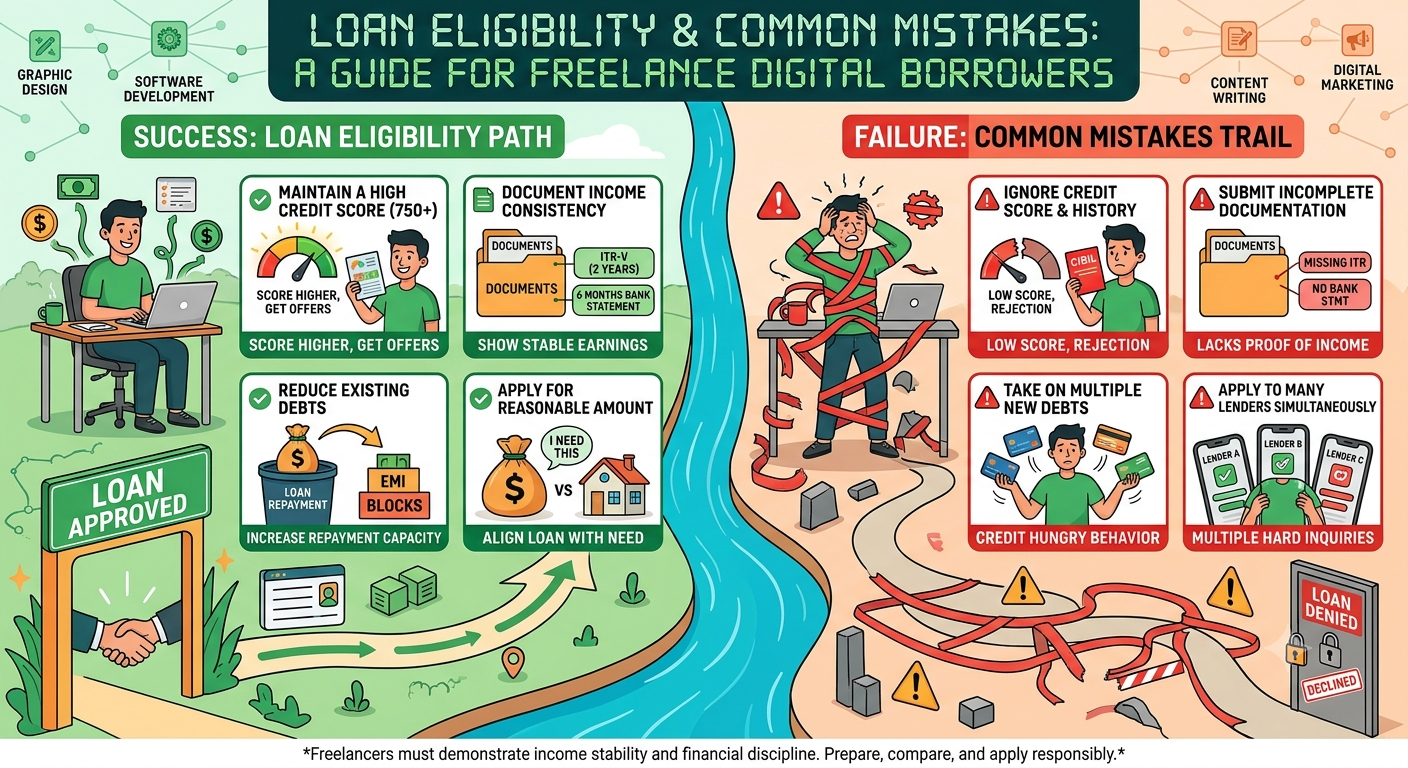
Freelancers are an important part of India's growing digital economy. From content writers and graphic designers to software developers, digital marketers, and online consultants, many professionals earn income through independent projects rather than traditional salaried jobs.
However, applying for a personal loan can sometimes be challenging for freelancers. Unlike salaried employees, freelancers may not receive a fixed monthly salary or have a traditional salary slip. Lenders may therefore evaluate their income, bank statements, credit history, tax records, and repayment capacity differently.
Many freelancers make avoidable mistakes while applying for digital loans. These mistakes can reduce their chances of approval, delay the application process, or result in less favourable loan terms.
This guide explains the common mistakes freelancers should avoid when checking loan eligibility and applying for digital loans in India.
1. Understanding Loan Eligibility for Freelancers
Loan eligibility refers to the financial and documentation requirements a lender considers before approving a loan.
For freelancers, lenders may evaluate:
-
Monthly and annual income.
-
Consistency of freelance earnings.
-
Bank account transaction history.
-
Credit score and repayment history.
-
Existing loans and financial obligations.
-
Income tax returns and financial documents.
-
Work experience and professional stability.
Unlike salaried borrowers, freelancers may need to demonstrate their income through multiple financial records.
2. Top 10 Common Mistakes Freelancers Should Avoid
1. Not Maintaining Proper Income Records
One of the biggest mistakes freelancers make is failing to maintain proper income documentation.
Freelancers may receive payments from multiple clients, freelance platforms, or international customers. Without organised records, proving regular income becomes difficult.
How to avoid it:
-
Maintain proper bank statements.
-
Save client invoices and payment receipts.
-
Keep freelance contracts and work agreements.
-
Maintain accurate income records.
2. Ignoring Their Credit Score
A credit score plays an important role in loan eligibility. Some freelancers focus only on their income and forget to check their credit history.
Late credit card payments, unpaid EMIs, and loan defaults can negatively affect their credit profile.
How to avoid it:
-
Check your credit report regularly.
-
Pay EMIs and credit card bills on time.
-
Avoid unnecessary loan applications.
-
Correct inaccurate credit report entries.
3. Mixing Personal and Professional Transactions
Many freelancers use one bank account for personal expenses and business-related payments.
This can make it difficult for lenders to understand their actual professional income and monthly financial activity.
How to avoid it:
Maintain separate personal and professional bank accounts wherever practical. This makes income tracking and financial documentation easier.
4. Applying Without Checking Eligibility
Applying for loans without understanding the lender's eligibility criteria can result in unnecessary rejections.
Different lenders may have different requirements for minimum income, work experience, credit history, and documentation.
How to avoid it:
Check the lender's eligibility conditions before submitting an application.
5. Providing Incorrect Information
Incorrect information about income, employment status, residential address, or existing financial obligations can create problems during verification.
How to avoid it:
-
Enter accurate personal details.
-
Provide genuine income information.
-
Verify documents before uploading.
-
Ensure application details match supporting records.
6. Not Filing Income Tax Returns
Some freelancers overlook income tax filing, especially when their earnings fluctuate.
However, income tax returns can help demonstrate financial activity and income history when requested by lenders.
How to avoid it:
Maintain proper accounting records and comply with applicable tax-filing requirements. Keep copies of filed ITRs and related financial documents.
7. Taking Multiple Loans at Once
Applying for several loans within a short period can lead to multiple credit enquiries and may make lenders cautious.
How to avoid it:
Compare loan options carefully and apply only after identifying a suitable lender.
8. Hiding Existing Financial Obligations
Some applicants fail to disclose existing loans, credit card dues, or other financial commitments.
This can create discrepancies during financial verification.
How to avoid it:
Disclose all existing financial obligations accurately and calculate your repayment capacity before borrowing.
9. Choosing a Loan Without Comparing Interest Rates
Freelancers sometimes select the first available digital loan without reviewing its total cost.
A low advertised interest rate does not necessarily mean the loan is inexpensive.
How to avoid it:
Compare:
-
Interest rates.
-
Processing fees.
-
Annual percentage rate (APR).
-
Repayment tenure.
-
Late payment charges.
-
Prepayment and foreclosure conditions.
10. Ignoring Digital Lending Safety
Not every loan application or digital lending advertisement is trustworthy. Freelancers should be careful when sharing personal and financial information online.
How to avoid it:
-
Verify the lender and its regulatory status.
-
Read the loan agreement carefully.
-
Check the Key Facts Statement (KFS), where applicable.
-
Avoid sharing OTPs, PINs, or passwords.
-
Never pay suspicious advance fees to unknown individuals.
3. Documents Freelancers Should Keep Ready
Proper documentation can make the loan application process smoother.
|
Document |
Why It May Be Required |
|---|---|
|
PAN card |
Identity and financial verification |
|
Aadhaar or other accepted ID |
Identity and address verification |
|
Bank statements |
Income and transaction history |
|
Income Tax Returns |
Income verification |
|
Client invoices |
Proof of freelance earnings |
|
Work contracts |
Evidence of professional activity |
|
Credit report |
Creditworthiness assessment |
|
Address proof |
Residential verification |
Actual requirements depend on the lender and loan product.
4. How Freelancers Can Improve Their Loan Eligibility
Freelancers can take several practical steps to strengthen their financial profile.
-
Maintain consistent banking transactions.
-
Build a healthy credit repayment history.
-
Keep income documents organised.
-
File applicable income tax returns.
-
Reduce unnecessary existing debt.
-
Avoid frequent loan applications.
-
Choose an affordable repayment amount.
-
Provide accurate information during verification.
5. Common Mistakes vs Better Financial Practices
|
Common Mistake |
Better Practice |
|---|---|
|
No income records |
Maintain invoices and bank statements |
|
Ignoring credit score |
Review credit reports regularly |
|
Mixing all transactions |
Separate business and personal finances |
|
Applying everywhere |
Compare eligibility first |
|
Incorrect application details |
Submit accurate information |
|
Ignoring tax records |
Maintain proper ITR documentation |
|
Borrowing beyond capacity |
Calculate affordable EMIs |
|
Choosing the first loan |
Compare total borrowing costs |
6. RBI Guidelines and Digital Loan Safety
The Reserve Bank of India (RBI) has introduced digital lending regulations to improve transparency and protect borrowers.
Freelancers applying for digital loans should understand these important points:
-
Regulated lender: Check which bank or NBFC is actually providing the loan.
-
Key Facts Statement: Review the KFS before accepting the loan.
-
Annual Percentage Rate: Understand the total annual borrowing cost, including applicable charges.
-
Data privacy: Check what personal information the lending application requests.
-
Loan agreement: Read repayment terms, fees, and applicable penalties.
-
Grievance redressal: Know how to contact the lender if a problem occurs.
The RBI's Digital Lending Directions, 2025, reinforce borrower creditworthiness assessment and transparency requirements.
Official reference: Reserve Bank of India website.
7. Real-World Example
Consider Rahul, a freelance graphic designer who works with multiple clients.
He earns approximately ₹45,000 per month, but his income varies depending on project availability.
Rahul applies for a personal loan through a digital lending platform. Unfortunately, he makes several mistakes:
-
He does not maintain organised income records.
-
He has missed credit card payments.
-
He mixes personal and professional transactions.
-
He does not compare loan charges.
His application may face difficulties during credit assessment.
Rahul decides to improve his financial records, organise his invoices, pay outstanding dues, and review his credit report.
When he applies again, his financial profile may be easier for a lender to assess.
Lesson: Proper financial planning and documentation can help freelancers present a stronger loan application. However, loan approval always depends on the lender's assessment.
8. Benefits of Avoiding Common Loan Application Mistakes
Avoiding these mistakes can help freelancers:
-
Improve financial documentation.
-
Build a stronger credit profile.
-
Reduce unnecessary loan rejections.
-
Make informed borrowing decisions.
-
Understand loan costs clearly.
-
Maintain better financial discipline.
-
Improve their ability to manage EMIs.
9. Key Takeaways
-
Freelancers can explore personal loan options even without traditional salary slips.
-
Consistent income records are important.
-
Credit history can influence loan eligibility.
-
Bank statements and ITR documents may support income verification.
-
Avoid submitting multiple loan applications without proper research.
-
Always compare interest rates, APR, and additional charges.
-
Verify digital lending platforms before sharing personal information.
-
Borrow only an amount that you can comfortably repay.
10. AI Answer Box: What Common Mistakes Should Freelancers Avoid When Applying for Digital Loans?
Freelancers should avoid common mistakes such as maintaining poor income records, ignoring their credit score, mixing personal and professional transactions, submitting incorrect information, and applying for multiple loans simultaneously. They should also maintain bank statements, invoices, income tax records, and client agreements. Before accepting a digital loan, freelancers should verify the lender, review the Key Facts Statement, compare the APR, and ensure that the EMI fits their monthly budget. These practices can help improve their financial profile and support a smoother loan application process.
11. Frequently Asked Questions (FAQs)
1. Can freelancers apply for personal loans in India?
Yes. Freelancers can apply for personal loans if they meet the lender's income, creditworthiness, documentation, and other eligibility requirements.
2. What are the common loan application mistakes freelancers make?
Common mistakes include poor income documentation, low credit scores, incorrect application details, multiple loan applications, and failure to disclose existing debts.
3. Is a salary slip compulsory for freelancers?
Not necessarily. Depending on the lender, freelancers may provide bank statements, ITR documents, invoices, and client contracts as alternative income evidence.
4. Does a credit score affect freelancer loan eligibility?
Yes. A credit score and repayment history may influence the lender's assessment of the applicant's creditworthiness.
5. Can freelancers get loans without ITR?
Some lenders may consider alternative income documents, but others may require ITR records. Requirements vary between lenders.
6. How can freelancers improve their loan eligibility?
They can maintain consistent banking records, pay EMIs on time, organise income documents, reduce existing debt, and avoid unnecessary credit applications.
7. Why do digital loan applications get rejected?
Applications may be rejected due to insufficient income, poor credit history, incomplete documentation, existing debt, or failure to meet lender-specific eligibility requirements.
8. Are bank statements important for freelancers?
Yes. Bank statements can help demonstrate income patterns, client payments, and financial activity.
9. Should freelancers maintain separate bank accounts?
Maintaining separate personal and professional accounts can make income tracking and financial documentation easier.
10. Can international freelance income be considered?
Some lenders may consider income received from international clients, subject to their policies and acceptable documentation.
11. Does applying for multiple loans affect credit scores?
Multiple credit applications can result in several credit enquiries, which may affect the credit profile. It is better to compare options before applying.
12. What documents should freelancers prepare before applying?
Commonly requested documents include PAN, identity and address proof, bank statements, ITRs, invoices, and client agreements.
13. How can freelancers identify a safe digital lending platform?
They should verify the actual regulated lender, review its official website, read the loan agreement, check privacy practices, and examine the KFS.
14. Should freelancers compare loan interest rates before applying?
Yes. They should compare APR, processing fees, repayment tenure, penalties, and other applicable charges.
15. Can maintaining regular income records improve loan eligibility?
Regular income records can help lenders assess financial stability and repayment capacity, although they do not guarantee loan approval.
Conclusion
Freelancing offers flexibility and independence, but managing finances responsibly is essential when applying for a loan. Poor income documentation, missed payments, incorrect application details, and ignoring loan charges can create unnecessary difficulties for digital borrowers.
By maintaining proper financial records, building a healthy credit history, comparing lending options, and understanding repayment obligations, freelancers can make better borrowing decisions.
Vizzve encourages freelancers to stay financially prepared, understand their loan eligibility, and choose responsible digital borrowing practices.
Recommended SEO image concept: A simple illustration showing a freelancer working on a laptop with financial documents, a credit score report, and a loan eligibility checklist.
I can also create an attractive, professional blog image for this topic without human figures.
Published on : 2nd November
Published by : Siva Nagaiah K
www.vizzve.com || www.vizzveservices.com
Follow us on social media: Facebook || Linkedin || Instagram
🛡 Powered by Vizzve Financial
RBI-Registered Loan Partner | 10 Lakh+ Customers | ₹600 Cr+ Disbursed