

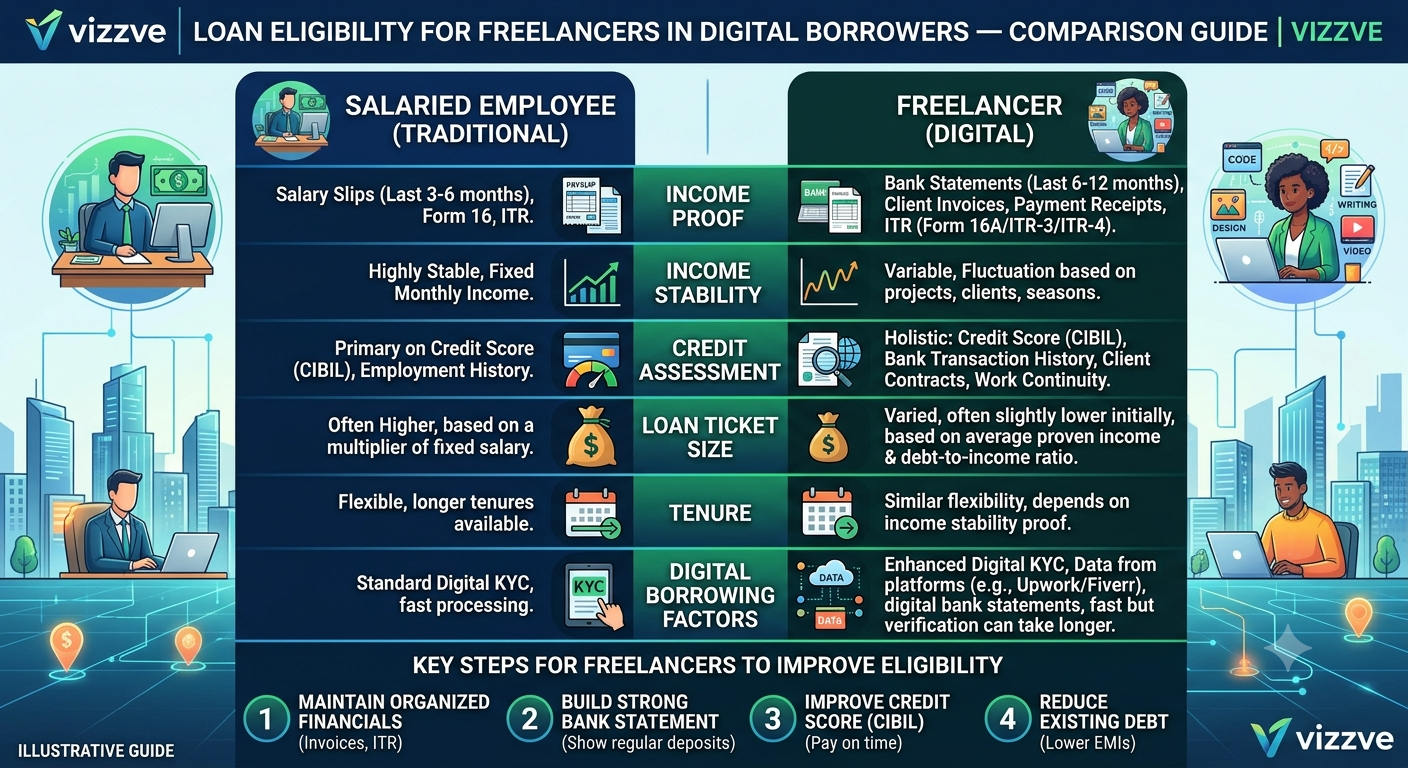
Freelancing has become an important part of India's modern working environment. Graphic designers, software developers, content writers, digital marketers, consultants and other independent professionals earn money through projects, contracts and online platforms.
However, getting a personal loan can sometimes be more complicated for freelancers than for salaried employees.
The main reason is income structure. Salaried employees generally receive fixed monthly payments, while freelancers may receive payments from multiple clients at different times.
This creates an important question:
Which personal loan option is suitable for freelancers and digital borrowers in India?
The answer depends on several factors, including monthly income, credit score, documentation, existing financial commitments, interest rates and repayment capacity.
Comparing banks, Non-Banking Financial Companies (NBFCs) and digital lending platforms can help freelancers understand the available borrowing options.
This guide explains the major differences, eligibility requirements, advantages, limitations and important checks freelancers should consider before applying for a personal loan.
3. AI Answer Box – Quick Answer
How can freelancers compare personal loan options in India?
Freelancers should compare personal loans based on eligibility requirements, interest rates, Annual Percentage Rate (APR), processing fees, income documentation, repayment tenure and lender credibility.
The three common channels to explore are:
-
Banks: May offer competitive loan terms to eligible borrowers with strong financial profiles.
-
NBFCs: May have different eligibility models and documentation requirements.
-
Digital lending platforms: Can simplify application and documentation processes, depending on the regulated lender they work with.
Before applying, freelancers should check:
-
Average monthly income.
-
CIBIL score and credit history.
-
Bank statements and ITR records.
-
Existing EMIs and financial commitments.
-
Interest rate and total borrowing cost.
-
Repayment tenure and applicable charges.
Quick takeaway: The best loan is not necessarily the one offering the highest amount. It is the one with transparent costs, suitable eligibility requirements and an EMI that comfortably fits your income.
4. Understanding Different Loan Options for Freelancers
Freelancers can explore different lending channels depending on their financial profile and borrowing requirements.
4.1 Personal Loans From Banks
Banks are one of the common options for borrowers looking for personal loans.
A freelancer may apply if they meet the bank's eligibility requirements.
Common assessment factors:
-
Average monthly income.
-
Credit score and repayment history.
-
Bank account transactions.
-
Income Tax Returns.
-
Existing financial obligations.
-
Professional experience.
Advantages:
-
Established lending institutions.
-
Clearly documented loan agreements.
-
Different repayment tenure options.
-
Access to formal customer support.
Limitations:
-
Some banks may have strict income documentation requirements.
-
Established freelance income history may be requested.
-
Approval depends on internal credit policies.
4.2 Personal Loans From NBFCs
NBFCs provide various financial products, including personal loans.
Some NBFCs may assess self-employed borrowers using income documents and banking information that differ from traditional salaried employee requirements.
Advantages:
-
Different eligibility assessment methods.
-
Multiple loan products.
-
Digital application facilities offered by some lenders.
Limitations:
-
Interest rates and fees vary.
-
Eligibility criteria differ between institutions.
-
Documentation and verification may still be extensive.
4.3 Digital Lending Platforms
Digital lending platforms provide online application and loan facilitation services.
Some platforms connect borrowers with banks or NBFCs, while others may operate as part of a regulated lender's digital lending process.
Advantages:
-
Convenient online applications.
-
Reduced paperwork in some processes.
-
Digital document submission.
-
Easier application tracking where supported.
Limitations:
-
The actual regulated lender must be identified.
-
Interest rates and charges can vary.
-
Borrowers should verify data privacy and repayment procedures.
Important: A digital lending app or Loan Service Provider (LSP) is not automatically a lender. Check which regulated bank or NBFC is responsible for the loan.
5. Bank vs NBFC vs Digital Lending Platform – Comparison Table
The following comparison explains how these three channels differ.
|
Comparison factor |
Banks |
NBFCs |
Digital lending platforms |
|---|---|---|---|
|
Loan application |
Branch or online |
Online or branch, depending on provider |
Primarily online |
|
Income verification |
Bank-specific |
NBFC-specific |
Depends on partner lender |
|
Salary slips |
Not always mandatory |
Depends on lender |
Depends on lender |
|
ITR requirements |
May be requested |
May be requested |
Depends on lender |
|
Credit assessment |
Internal credit policy |
Internal credit policy |
Underlying lender's policy |
|
Documentation |
Varies |
Varies |
Digital submission may be available |
|
Interest rate |
Offer-specific |
Offer-specific |
Depends on actual lender |
|
Customer support |
Bank channels |
NBFC channels |
Platform and lender channels |
This is a general comparison, not a ranking. A digital platform may facilitate a bank or NBFC loan rather than provide credit independently.
Which Option Should Freelancers Choose?
-
Choose a bank if its eligibility requirements and loan offer suit your financial profile.
-
Compare NBFC offers if you need to explore different self-employed borrower assessment criteria.
-
Consider a digital application channel when you prefer online convenience and can clearly identify the regulated lender.
The final decision should depend on the complete loan cost, transparency and repayment affordability.
6. Comparison of Freelancer Loan Eligibility Requirements
Not all lenders assess freelancers in the same way.
Some may consider professional experience and income consistency, while others may place greater emphasis on credit history and banking records.
|
Eligibility factor |
What lenders may examine |
Why it matters |
|---|---|---|
|
Monthly income |
Average verified earnings |
Shows earning capacity |
|
Work experience |
Freelancing history |
Helps establish professional stability |
|
CIBIL score |
Credit report |
Shows past repayment behaviour |
|
Bank statements |
Incoming payments and expenses |
Helps verify cash flow |
|
ITR documents |
Declared income |
Supports income verification |
|
Existing EMIs |
Outstanding obligations |
Helps evaluate affordability |
|
Client contracts |
Freelance assignments |
Supports professional income claims |
6.1 What Is the Importance of CIBIL Score?
A credit score is an important part of loan assessment.
According to TransUnion CIBIL, credit reports contain information about credit accounts, payment history and credit enquiries. Payment history, credit utilisation, age of credit and enquiries are among the factors affecting the credit profile.
The following table provides a general educational interpretation of credit score ranges.
|
CIBIL score range |
General interpretation |
|---|---|
|
750–900 |
Excellent |
|
650–749 |
Good to moderate |
|
550–649 |
Lower credit profile |
|
300–549 |
Poor credit profile |
Indicative ranges referenced in the Ministry of MSME's Know Your Lender guide. These are not universal lender approval cut-offs.
A higher credit score may improve the borrower's profile, but it does not guarantee loan approval.
6.2 What Income Documents Should Freelancers Compare?
Freelancers should prepare documents that establish their earnings.
|
Document |
Purpose |
|---|---|
|
Bank statements |
Shows payment transactions |
|
Income Tax Returns |
Shows declared income |
|
Client invoices |
Records professional payments |
|
Work contracts |
Supports client relationships |
|
Payment receipts |
Confirms received amounts |
|
PAN card |
Identity and financial verification |
|
Address proof |
Confirms residential details |
Different lenders may require different combinations of these documents.
7. Interest Rate Comparison – What Should Freelancers Check?
Interest rates are among the most important factors when comparing personal loans.
However, choosing a loan only because it advertises a lower interest rate can be misleading.
Borrowers should also examine the Annual Percentage Rate (APR), processing fees, taxes and other applicable charges.
7.1 Illustrative Interest Rate Comparison
Suppose a freelancer wants a personal loan of ₹2,00,000 for 24 months.
The following table shows how different illustrative interest rates affect EMI payments.
|
Annual interest rate |
Approximate monthly EMI |
Approximate total interest |
|---|---|---|
|
12% |
₹9,415 |
₹25,960 |
|
14% |
₹9,603 |
₹30,472 |
|
16% |
₹9,792 |
₹35,008 |
|
18% |
₹9,985 |
₹39,640 |
Illustrative reducing-balance calculations, rounded to the nearest rupee. Excludes fees, taxes and other charges. These are not actual lender offers.
Monthly EMI for a ₹2 lakh loan over 24 months at different annual interest rates.
7.2 Why Should You Compare APR Instead of Only Interest Rates?
APR provides a broader view of the annualised borrowing cost.
Depending on the loan product and applicable rules, the disclosed cost may include interest and relevant charges.
Before accepting an offer, check:
-
Annual interest rate.
-
APR.
-
Processing fees.
-
Applicable taxes.
-
Insurance or other optional charges.
-
Late payment charges.
-
Prepayment and foreclosure conditions.
The RBI's Key Facts Statement framework requires lenders to provide important loan information, including APR and relevant charges, in a standardised format for applicable retail and MSME term loans.
8. Real-World Comparison Example: Two Freelancers Applying for Loans
Let's understand how different financial profiles may influence loan eligibility.
Consider two hypothetical freelancers, Aman and Neha.
Both want to apply for a personal loan of ₹2,00,000.
8.1 Borrower Profile Comparison
|
Financial detail |
Aman |
Neha |
|---|---|---|
|
Average monthly income |
₹65,000 |
₹45,000 |
|
Freelance experience |
4 years |
1 year |
|
CIBIL score |
770 |
680 |
|
Existing EMI |
₹5,000 |
₹10,000 |
|
Income documents |
Available |
Partially available |
|
Client payments |
Regular |
Irregular |
|
Requested loan |
₹2 lakh |
₹2 lakh |
8.2 Who May Have a Stronger Application?
Aman has a relatively stronger documented income history, higher credit score and lower existing EMI obligations.
Neha may need to strengthen her income documentation and review her current debt commitments before applying.
However, this does not mean Aman is guaranteed approval or that Neha will automatically be rejected.
The lender will evaluate both applications according to its own policies.
8.3 What Can Neha Do to Improve Her Profile?
-
Organise her bank statements.
-
Maintain complete client invoices.
-
File accurate income tax returns.
-
Reduce existing outstanding debt where possible.
-
Review her credit report.
-
Apply for a realistic loan amount.
Real-world lesson: Loan eligibility is not determined by monthly income alone. Credit history, income consistency, documentation and existing liabilities also matter.
9. Pros and Cons of Different Freelancer Loan Options
Bank Personal Loans
Pros
-
Established lending institutions.
-
Formal loan documentation.
-
Multiple banking services.
-
Transparent contractual terms.
Cons
-
Eligibility may be restrictive for some freelancers.
-
Additional income verification may be required.
-
Approval depends on the bank's credit policy.
NBFC Personal Loans
Pros
-
Different lending products.
-
Alternative income assessment methods may be available.
-
Online application facilities may be offered.
Cons
-
Interest rates vary across lenders.
-
Processing fees can differ.
-
Eligibility conditions are not uniform.
Digital Lending Platforms
Pros
-
Convenient application experience.
-
Online document submission.
-
Digital application tracking where available.
-
Potentially simpler application procedures.
Cons
-
Some platforms only facilitate loans rather than lend directly.
-
Borrowers must verify the regulated lender.
-
Data privacy and loan charges require careful review.
10. How Can Freelancers Improve Their Loan Eligibility?
Freelancers can improve their borrowing profile by maintaining organised financial records and responsible credit habits.
10.1 Maintain Consistent Income Records
Maintain a record of all professional payments received.
Useful records include:
-
Client invoices.
-
Freelance contracts.
-
Bank statements.
-
Payment receipts.
-
Annual income summaries.
10.2 Maintain a Healthy Credit Score
A good credit history can strengthen your loan application.
Consider these practices:
-
Pay existing EMIs on time.
-
Avoid unnecessary credit enquiries.
-
Keep credit card utilisation manageable.
-
Review your credit report regularly.
-
Resolve incorrect credit report entries.
10.3 File Income Tax Returns
ITR documents can help demonstrate your declared income and financial activity.
Freelancers should maintain accurate tax records and follow applicable tax regulations.
10.4 Reduce Existing Financial Obligations
High existing EMIs may reduce your repayment capacity.
Before applying for another loan, review your existing debt and calculate how much additional EMI you can reasonably afford.
10.5 Choose a Realistic Loan Amount
Avoid borrowing more than necessary.
A smaller loan with a comfortable EMI may be more suitable than a larger loan that creates repayment pressure.
11. Step-by-Step Guide to Comparing Personal Loans
Follow these steps before selecting a personal loan.
Step 1: Calculate Your Average Income
Review your freelance earnings over the previous six to twelve months, where available.
Step 2: Check Your Credit Score
Obtain your credit report and review your payment history and outstanding obligations.
Step 3: Compare Different Lenders
Explore banks and regulated NBFCs to understand their eligibility conditions and loan offers.
Step 4: Review Documentation Requirements
Check whether the lender accepts bank statements, ITRs, client invoices and contracts.
Step 5: Compare Interest Rates and APR
Compare the overall borrowing cost instead of focusing only on the advertised interest rate.
Step 6: Calculate Your EMI
Check whether the instalment is affordable during lower-income months.
Step 7: Verify the Actual Lender
Identify the bank or RBI-regulated NBFC responsible for the loan.
Step 8: Read the Loan Agreement
Review the KFS, processing fees, late payment charges, repayment schedule and foreclosure conditions.
Step 9: Apply Through an Official Channel
Submit your application through the lender's official website, branch or verified digital lending channel.
Step 10: Review the Final Offer
Accept the loan only after understanding all costs, conditions and repayment obligations.
12. Digital Lending Safety: What Should Freelancers Know?
Digital lending has made it easier to apply for financial products online. However, convenience should not replace proper verification.
The Reserve Bank of India has issued digital lending directions and related customer-protection requirements for regulated entities and their lending service providers. The framework addresses matters such as disclosures, borrower information and digital lending practices.
Important Safety Checks
|
Safety checkpoint |
What borrowers should do |
|---|---|
|
Lender verification |
Identify the regulated bank or NBFC |
|
Interest rate |
Check the actual contracted rate |
|
KFS |
Read the complete loan disclosure |
|
APR |
Compare overall borrowing costs |
|
Privacy |
Review data collection and usage policies |
|
Repayment |
Use authorised lender payment channels |
|
Customer support |
Verify official complaint details |
|
Loan agreement |
Read before accepting |
Common Digital Lending Mistakes to Avoid
-
Applying through unverified loan applications.
-
Paying advance fees to unknown personal accounts.
-
Sharing OTPs and banking passwords.
-
Ignoring the loan agreement.
-
Accepting unclear processing charges.
-
Borrowing based only on advertised approval claims.
-
Not checking who the actual lender is.
The RBI's fair lending instructions also require applicable penal charges to be reasonable and transparently disclosed in the loan agreement and relevant KFS.
13. Which Personal Loan Option Is Suitable for Different Freelancers?
Different professionals have different financial requirements.
|
Freelancer category |
Important consideration |
|---|---|
|
Graphic designers |
Project income and client invoices |
|
Content writers |
Payment history and recurring assignments |
|
Software developers |
Contract income and bank transactions |
|
Digital marketers |
Retainer income and client agreements |
|
Video editors |
Project payments and work history |
|
Consultants |
Professional contracts and declared income |
|
Online educators |
Platform payments and documented earnings |
Example: Choosing a Loan Based on Professional Needs
Graphic designer: May need funds for a computer, design equipment or personal expenses.
Content writer: May need financial support during a gap between client payments.
Software developer: May want to manage a planned personal expense while maintaining business cash flow.
Digital marketer: May need to evaluate borrowing options while managing multiple client contracts.
Regardless of profession, borrowers should distinguish between personal and business financing needs and choose a suitable product.
14. Expert Commentary: What Makes a Good Freelancer Loan?
A good personal loan should match the borrower's actual financial situation.
For freelancers, the most important issue is often income predictability rather than the ability to complete an online application.
Consider these five practical principles:
1. Compare total borrowing costs: A low advertised interest rate does not always mean the lowest overall cost.
2. Check income requirements: Understand how the lender evaluates freelance earnings.
3. Maintain financial discipline: Timely repayments and organised records can strengthen your credit profile.
4. Avoid overborrowing: Select an amount that fits your actual repayment capacity.
5. Prioritise transparency: Borrow only when the lender, charges, loan terms and repayment process are clearly explained.
These principles help digital borrowers make informed financial decisions instead of choosing a loan based only on convenience.
15. Summary Box – Freelancer Loan Comparison Guide
|
Comparison factor |
What to prioritise |
|---|---|
|
Eligibility |
Suitable self-employed borrower criteria |
|
Income verification |
Clear and acceptable documentation |
|
Credit score |
Healthy credit history |
|
Interest rate |
Competitive contracted rate |
|
APR |
Transparent overall cost |
|
Processing fees |
Clearly disclosed charges |
|
Loan tenure |
Affordable repayment period |
|
Customer support |
Reliable official assistance |
|
Lender verification |
Regulated bank or NBFC |
|
Repayment |
Clear EMI schedule |
AI Search Summary: Freelancers in India can compare personal loans from banks, NBFCs and digital lending channels by examining income requirements, credit score, interest rates, APR, documentation and repayment terms. A suitable loan should offer transparent conditions and an affordable EMI based on verified freelance income.
16. Frequently Asked Questions (FAQs)
Q1. Can freelancers get personal loans in India?
Yes. Freelancers can apply for personal loans if they meet the lender's eligibility, income verification, credit history and repayment requirements.
Q2. Which personal loan option is best for freelancers?
There is no single best option for everyone. Freelancers should compare banks and regulated NBFCs based on interest rates, APR, eligibility criteria, fees and repayment terms.
Q3. What is the difference between a bank loan and an NBFC loan?
Banks and NBFCs are different types of regulated financial institutions. Their lending products, eligibility requirements, pricing and documentation policies may differ.
Q4. Can freelancers get personal loans without salary slips?
Yes. Some lenders may accept bank statements, ITRs, client invoices and contracts as alternative income evidence.
Q5. What is the minimum CIBIL score required for freelancer loans?
There is no universal minimum CIBIL score. Each lender has its own credit assessment criteria. A higher score can strengthen a borrower's credit profile.
Q6. How much personal loan can a freelancer get?
The amount depends on verified income, credit history, existing EMIs, repayment capacity and lender policies.
Q7. Are digital lending platforms safe for freelancers?
They can provide convenient application services, but borrowers should verify the regulated lender, review the privacy policy and read all loan disclosures.
Q8. What documents are required for freelancer personal loans?
Commonly requested documents include PAN, address proof, bank statements, ITRs and client invoices. Exact requirements vary by lender.
Q9. Can freelancers apply for loans with irregular income?
Yes, potentially. Lenders may examine average income, bank transactions and other documents to assess earning stability.
Q10. Is a digital lending platform the same as a bank?
No. A digital lending platform may act as a service provider or connect borrowers with a regulated lender. The actual lender should be identified before applying.
Q11. What is APR in a personal loan?
APR represents the annualised cost of borrowing and helps borrowers understand the overall cost beyond the advertised interest rate.
Q12. Should freelancers choose a longer loan tenure?
A longer tenure generally reduces the monthly EMI but can increase total interest. The suitable tenure depends on affordability and repayment capacity.
Q13. Does applying for multiple personal loans affect CIBIL?
Multiple formal credit applications may result in several credit enquiries, which can affect the credit profile. Compare offers carefully before submitting applications.
Q14. Can a freelancer improve loan eligibility?
Yes. Maintaining regular income records, filing accurate ITRs, paying EMIs on time and reducing outstanding debt may strengthen the application.
Q15. How can freelancers choose an affordable personal loan?
Compare APR, processing fees, EMI, tenure and repayment conditions. Select a loan amount that remains manageable even during months with lower freelance income.
17. Key Takeaways
-
Freelancers can explore personal loans from banks and NBFCs.
-
Digital lending platforms may simplify the application process.
-
Always identify the actual regulated lender.
-
Compare APR instead of looking only at interest rates.
-
Maintain a healthy CIBIL score.
-
Keep bank statements, ITRs and invoices organised.
-
Check existing EMIs before borrowing.
-
Review processing fees and repayment conditions.
-
Avoid unverified lending applications.
-
Choose a loan based on repayment capacity, not the maximum available amount.
18. Why Choose Vizzve Financial?
Freelancers and digital borrowers often look for financial solutions that accommodate independent income patterns and offer a convenient application experience.
Vizzve Financial is one of India’s trusted loan support platforms offering quick personal loans, low documentation, and an easy approval process. Apply at www.vizzve.com.
Explore available loan options, review eligibility requirements and understand repayment terms before making a borrowing decision.
Loan availability, interest rates, approval and disbursement are subject to the actual lender's policies and verification.
19. Conclusion
Choosing a personal loan is an important financial decision, especially for freelancers whose monthly income may fluctuate.
Comparing banks, NBFCs and digital lending channels helps borrowers understand different application processes, eligibility requirements and borrowing costs.
However, the right loan is not necessarily the one with the lowest advertised interest rate or the fastest application process.
It is the option that provides transparent terms, reasonable borrowing costs and an EMI that fits your financial situation.
Before applying, review your income documents, credit score, existing financial commitments and repayment capacity.
Whether you are a content writer, graphic designer, software developer, consultant or digital marketer, responsible loan comparison can help you make better financial decisions.
Published on : 4th November
Published by : Siva Nagaiah K
www.vizzve.com || www.vizzveservices.com
Follow us on social media: Facebook || Linkedin || Instagram
🛡 Powered by Vizzve Financial
RBI-Registered Loan Partner | 10 Lakh+ Customers | ₹600 Cr+ Disbursed