

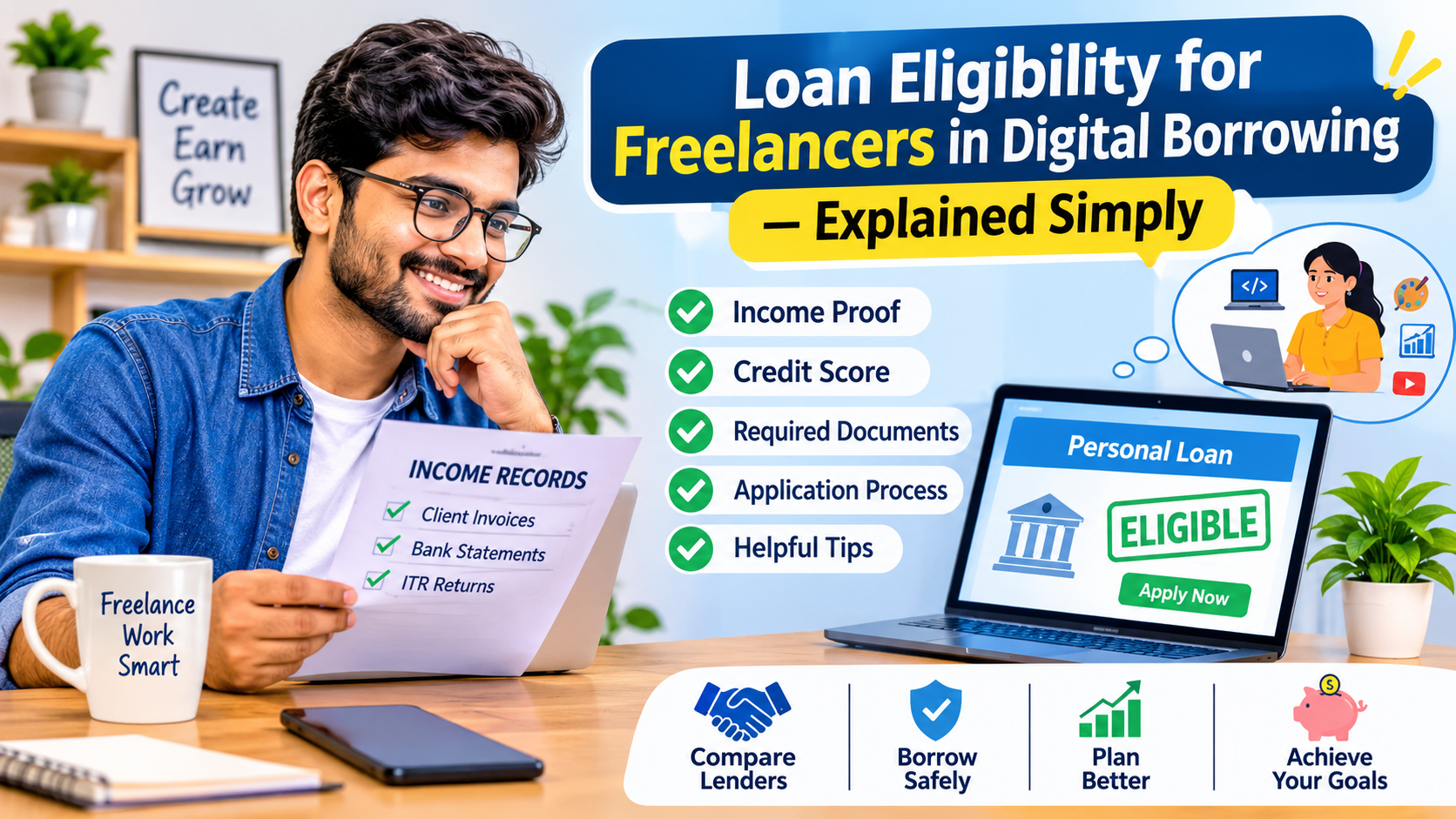
Freelancing has become a popular career choice in India. Many people now earn money through online projects, content writing, graphic designing, website development, digital marketing, online consulting, and other digital services.
Unlike salaried employees, freelancers may not receive a fixed monthly salary. Their income often depends on client payments, completed projects, and contracts. Because of this, getting a personal loan can sometimes be challenging.
However, freelancers and digital borrowers can also apply for personal loans through banks and NBFCs, subject to eligibility requirements.
Understanding loan eligibility helps freelancers prepare their financial documents, maintain a good credit score, and make better borrowing decisions.
This blog explains freelancer loan eligibility, income requirements, documents, application procedures, benefits, and common challenges in simple language.
1. What Is Loan Eligibility for Freelancers?
Loan eligibility refers to the financial and personal conditions an applicant must meet to qualify for a loan.
For freelancers, lenders may evaluate:
-
Monthly or annual income.
-
Consistency of client payments.
-
Credit score and repayment history.
-
Existing loans and EMIs.
-
Bank statements and income tax returns.
-
Freelance work experience.
-
Overall repayment capacity.
For example, a freelance graphic designer earning ₹45,000 per month may qualify for a personal loan if their financial records and credit profile satisfy the lender's requirements.
2. Who Are Digital Borrowers?
Digital borrowers are individuals who use online platforms and digital financial services to apply for and manage loans.
They may include:
-
Freelancers and independent professionals.
-
Digital marketers.
-
Content creators.
-
Website developers.
-
Online tutors.
-
Remote professionals.
-
E-commerce sellers.
-
Online consultants.
-
Independent service providers.
Digital lending allows eligible applicants to complete many loan application and verification activities online.
3. Basic Eligibility Criteria for Freelancers
The eligibility criteria differ between banks and NBFCs.
|
Eligibility factor |
General requirement |
|---|---|
|
Age |
Must meet the lender's age criteria |
|
Income |
Verifiable professional earnings |
|
Credit score |
Healthy credit history preferred |
|
Work experience |
Evidence of ongoing freelance activity |
|
Bank statements |
Income and transaction records |
|
Existing loans |
Manageable EMI obligations |
|
KYC |
Valid identity and address proof |
There is no universal minimum income or credit score applicable to every freelancer loan.
4. Documents Required for Freelancer Loans
Freelancers can provide alternative income documents instead of salary slips.
|
Document |
Why it is required |
|---|---|
|
PAN Card |
Identity and financial verification |
|
Aadhaar or accepted ID |
KYC verification |
|
Bank statements |
Income verification |
|
Income Tax Returns |
Proof of declared income |
|
Client invoices |
Evidence of freelance earnings |
|
Work agreements |
Professional activity verification |
|
GST returns |
Business income verification, where applicable |
Lenders may request additional documents depending on the loan product.
5. How Is Freelancer Income Calculated?
Lenders may examine the applicant's average income over a specific period.
For example:
|
Income source |
Monthly earnings |
|---|---|
|
Content writing |
₹15,000 |
|
Graphic designing |
₹12,000 |
|
Digital marketing |
₹18,000 |
|
Total |
₹45,000 |
The lender may consider income consistency, business expenses, existing EMIs, and repayment capacity before deciding the eligible loan amount.
6. Factors That Affect Freelancer Loan Eligibility
Credit score: A healthy credit history can improve the chances of loan approval.
Income stability: Regular payments from clients help demonstrate financial stability.
Work experience: A documented freelance work history can support the application.
Existing financial obligations: Multiple outstanding loans may reduce repayment capacity.
Banking history: Clear transactions and identifiable client payments make income verification easier.
7. How to Improve Loan Eligibility
Freelancers can follow these practical steps:
-
Maintain a healthy credit score.
-
Pay existing EMIs on time.
-
File applicable income tax returns.
-
Keep bank statements organised.
-
Maintain client invoices and agreements.
-
Reduce unnecessary outstanding debt.
-
Avoid multiple loan applications within a short period.
-
Apply for an affordable loan amount.
8. Step-by-Step Loan Application Process
-
Check your loan eligibility.
-
Compare banks and NBFCs.
-
Prepare the required documents.
-
Complete the online application.
-
Submit your income and KYC documents.
-
Complete lender verification.
-
Review the loan agreement.
-
Receive the loan amount after approval.
9. Benefits of Digital Loans for Freelancers
-
Convenient online applications.
-
Digital document submission.
-
Less need for physical branch visits.
-
Easy application tracking.
-
Opportunity to compare different lenders.
-
Access to financial services through digital platforms.
However, digital applications do not guarantee instant approval.
10. Common Challenges Faced by Freelancers
|
Challenge |
Possible solution |
|---|---|
|
Irregular income |
Maintain income records |
|
No salary slips |
Provide invoices and bank statements |
|
Low credit score |
Improve repayment discipline |
|
Multiple client payments |
Maintain transaction records |
|
Limited work experience |
Build a documented work history |
|
Existing debt |
Reduce outstanding liabilities |
11. Important Safety Tips for Digital Borrowers
Before accepting a digital loan:
-
Verify the bank or NBFC providing the loan.
-
Check the lender's official website.
-
Read the Key Facts Statement (KFS).
-
Compare the Annual Percentage Rate (APR).
-
Understand processing fees and penalties.
-
Review data privacy permissions.
-
Never share OTPs, passwords, or UPI PINs.
The RBI's Digital Lending Directions, 2025 provide a regulatory framework for digital lending and borrower protection.
12. Freelancer Loans vs Salaried Personal Loans
|
Feature |
Freelancers |
Salaried employees |
|---|---|---|
|
Income source |
Multiple clients |
Employer |
|
Income pattern |
May fluctuate |
Usually fixed |
|
Income proof |
ITR and invoices |
Salary slips |
|
Work proof |
Client agreements |
Employment documents |
|
Bank records |
Client payments |
Salary credits |
|
Loan assessment |
Income consistency |
Salary stability |
Both freelancers and salaried employees can qualify for personal loans depending on the lender's policies.
13. Real-World Example
Consider Rahul, a freelance digital marketing professional earning ₹55,000 per month from different clients.
He wants a personal loan of ₹2 lakh to purchase professional equipment.
Before applying, Rahul:
-
Checks his credit score.
-
Organises six months of bank statements.
-
Collects client invoices.
-
Reviews existing EMI obligations.
-
Compares available loan offers.
His documented income may support his application, but final approval depends on the lender's assessment.
14. Key Takeaways
-
Freelancers can apply for personal loans without traditional salary slips.
-
Regular income records help establish repayment capacity.
-
ITRs, invoices, and bank statements are useful documents.
-
Credit score influences loan eligibility.
-
Digital lending offers convenient application facilities.
-
Borrowers should compare interest rates and total loan costs.
-
Responsible borrowing supports long-term financial stability.
15. Frequently Asked Questions
1. Can freelancers get personal loans in India?
Yes. Freelancers can apply for personal loans if they satisfy the lender's eligibility requirements.
2. Can I get a loan without salary slips?
Yes. Lenders may accept bank statements, ITRs, invoices, and client agreements.
3. Is CIBIL score important for freelancers?
Yes. A healthy credit score and good repayment history can improve loan approval chances.
4. Can digital marketers apply for personal loans?
Yes. Digital marketers with verifiable income can apply.
5. What documents are required for freelancer loans?
Common documents include PAN, identity proof, bank statements, ITRs, and client invoices.
6. Can freelancers apply for loans online?
Yes. Many banks and NBFCs offer online loan applications.
7. Does irregular income affect loan eligibility?
Yes. Income fluctuations may affect the lender's assessment of repayment capacity.
8. Can newly started freelancers get loans?
They can apply, but limited income history may make approval more difficult.
9. Can freelancers with international clients apply?
Yes. International earnings may be considered if acceptable supporting records are available.
10. Can freelancers get unsecured personal loans?
Yes. Some lenders offer unsecured personal loans to eligible freelance professionals.
11. How can freelancers improve loan eligibility?
They can maintain a good credit score, organise income records, and reduce existing debt.
12. Are digital loans safe?
They can be safe when borrowers use legitimate lending platforms and verify the regulated lender.
Conclusion
Loan eligibility for freelancers and digital borrowers is becoming increasingly important in India's growing digital economy.
Although freelancers may not receive fixed monthly salaries, they can demonstrate financial stability through bank statements, income tax returns, client invoices, and payment records.
By maintaining a good credit history, preparing financial documents, and choosing affordable loan options, freelancers can improve their borrowing readiness.
Digital borrowing can provide convenient access to financial services when used responsibly.
Published on : 1st November
Published by : Siva Nagaiah K
www.vizzve.com || www.vizzveservices.com
Follow us on social media: Facebook || Linkedin || Instagram
🛡 Powered by Vizzve Financial
RBI-Registered Loan Partner | 10 Lakh+ Customers | ₹600 Cr+ Disbursed