

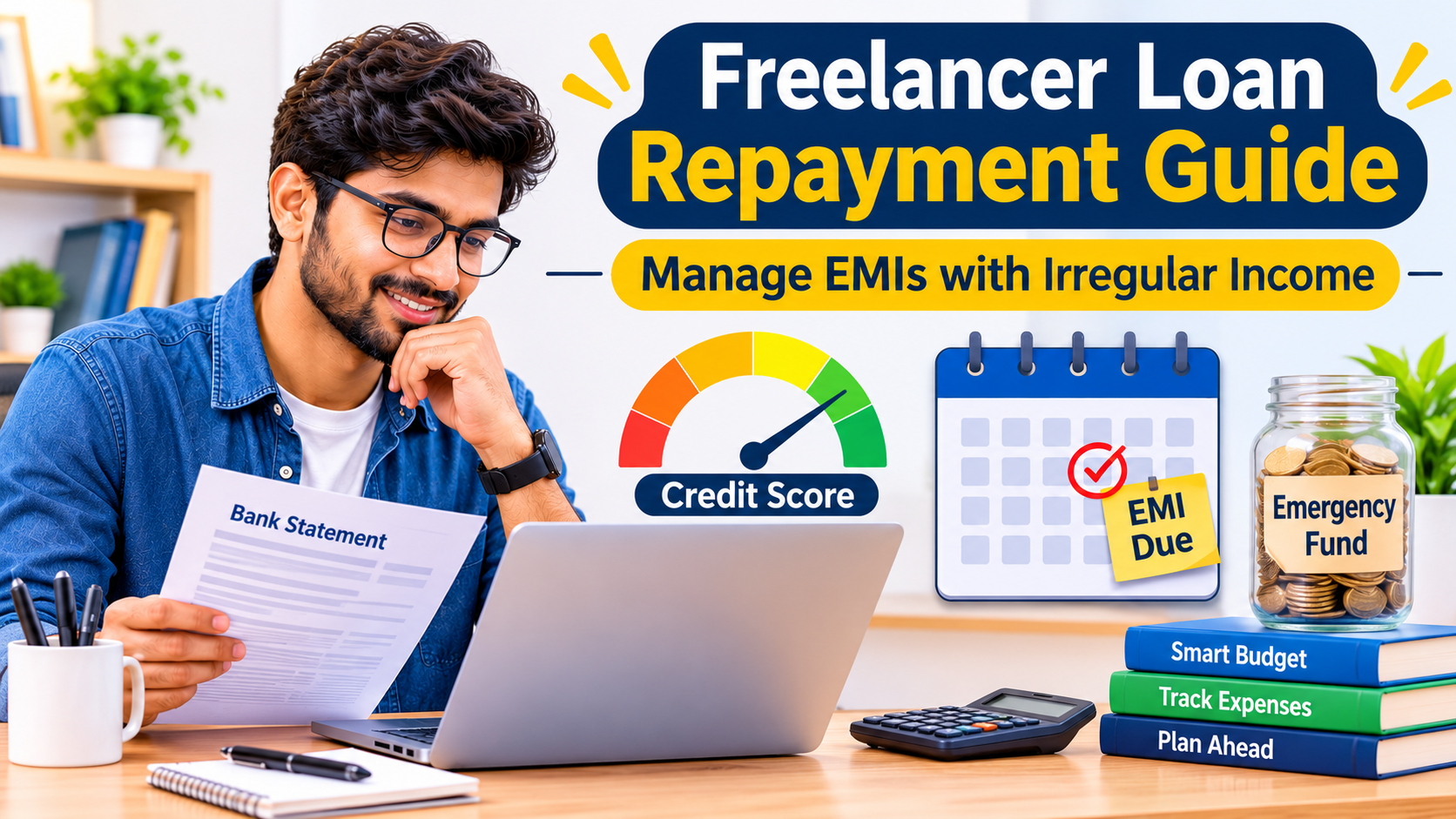
Freelancing offers independence, flexible working hours and opportunities to earn from multiple clients. However, managing money can become challenging when monthly income changes from one month to another.
Unlike salaried employees, freelancers may not receive a fixed salary on a particular date. Payments can depend on project completion, client approvals, contract terms and payment schedules.
This income pattern makes personal loan repayment an important part of financial planning.
For example, a freelancer earning ₹70,000 in one month may earn only ₹40,000 the following month. Even when income decreases, the monthly loan EMI remains payable according to the loan agreement.
This is why freelancers should understand their repayment capacity before borrowing.
A proper repayment strategy can help digital borrowers manage EMIs, avoid unnecessary penalties, maintain a healthy credit profile and protect their financial stability.
This guide explains how freelancers can repay personal loans, calculate monthly EMIs, manage irregular income and avoid common repayment mistakes.
3. AI Answer Box – Quick Answer
How can freelancers manage personal loan repayments?
Freelancers can manage personal loan repayments by calculating their affordable EMI, maintaining an emergency fund, planning monthly expenses and setting aside money whenever client payments are received.
The most important repayment practices include:
-
Calculate your average monthly income.
-
Choose an affordable loan amount.
-
Maintain savings for at least a few months of essential expenses and EMIs, if possible.
-
Set automatic EMI reminders or payment instructions.
-
Keep track of loan due dates.
-
Avoid taking unnecessary additional debt.
-
Pay EMIs on time to protect your credit history.
Quick answer: Freelancers should plan loan repayments around their average income rather than their highest-earning month. A realistic budget and emergency savings can help manage EMIs even when freelance income fluctuates.
4. Why Is Loan Repayment Planning Important for Freelancers?
Loan repayment planning is especially important for people who earn through independent projects.
A salaried employee may receive a fixed monthly salary, but a freelancer's income can vary depending on client requirements and project availability.
Without proper planning, even a manageable EMI can become difficult during a low-income month.
4.1 Managing Irregular Monthly Income
Freelancers should avoid planning loan repayments based only on their highest monthly earnings.
For example:
|
Month |
Freelance income |
|---|---|
|
January |
₹65,000 |
|
February |
₹45,000 |
|
March |
₹55,000 |
|
April |
₹35,000 |
|
May |
₹70,000 |
|
June |
₹50,000 |
|
Total |
₹3,20,000 |
Average monthly income:
A freelancer should use a realistic income estimate and account for business expenses, taxes and essential household costs before deciding on an EMI.
4.2 Avoiding Missed EMI Payments
Missing an EMI can create additional financial pressure.
Possible consequences include:
-
Late payment or penal charges, where applicable.
-
Additional interest on overdue amounts under the loan agreement.
-
Negative impact on credit history.
-
Collection and recovery follow-ups.
-
Difficulty obtaining future credit.
The Reserve Bank of India requires regulated lenders to disclose applicable penal charges and their reasons in the loan agreement and relevant Key Facts Statement.
4.3 Maintaining a Healthy Credit Score
Your repayment behaviour is an important part of your credit history.
Paying EMIs on time can help maintain a healthy credit profile, while repeated missed payments can make future borrowing more difficult.
Freelancers should regularly review their credit reports and check whether repayments are correctly reflected.
5. How to Calculate Personal Loan EMI for Freelancers
Before applying for a loan, freelancers should understand how much they need to pay every month.
An EMI consists of two components:
-
Principal repayment.
-
Interest charged by the lender.
The EMI depends on the loan amount, interest rate and repayment tenure.
5.1 Personal Loan EMI Formula
The standard EMI formula is:
Where:
-
P = Principal loan amount.
-
R = Monthly interest rate.
-
N = Number of monthly instalments.
5.2 Example of EMI Calculation
Suppose a freelancer takes a personal loan of ₹1,50,000.
|
Loan detail |
Value |
|---|---|
|
Loan amount |
₹1,50,000 |
|
Annual interest rate |
14% |
|
Loan tenure |
24 months |
|
Approximate monthly EMI |
₹7,201 |
|
Approximate total repayment |
₹1,72,824 |
|
Approximate total interest |
₹22,824 |
Illustrative reducing-balance calculation. Figures are rounded and exclude processing fees, taxes and other charges.
5.3 EMI Comparison Based on Loan Tenure
Consider the same ₹1,50,000 loan at an illustrative 14% annual interest rate.
|
Tenure |
Approximate EMI |
Approximate total interest |
|---|---|---|
|
12 months |
₹13,469 |
₹11,628 |
|
18 months |
₹9,278 |
₹17,004 |
|
24 months |
₹7,201 |
₹22,824 |
|
36 months |
₹5,127 |
₹34,572 |
Illustrative figures only. Actual lender quotes may differ.
What does this comparison show?
-
Shorter tenure means higher monthly EMI but generally lower total interest.
-
Longer tenure means lower monthly EMI but generally higher total interest.
-
The best option depends on the borrower's income stability and repayment capacity.
6. Practical EMI Planning Example for a Freelancer
Consider Rahul, a freelance web developer who earns an average of ₹60,000 per month.
He wants to take a personal loan for professional equipment and other planned expenses.
His financial situation is as follows:
|
Financial detail |
Monthly amount |
|---|---|
|
Average freelance income |
₹60,000 |
|
Household expenses |
₹20,000 |
|
Existing EMI |
₹5,000 |
|
Business expenses |
₹8,000 |
|
Estimated remaining income |
₹27,000 |
Rahul is considering an additional loan with a monthly EMI of ₹7,200.
His revised monthly budget would look like this:
|
Expense |
Amount |
|---|---|
|
Average income |
₹60,000 |
|
Household expenses |
₹20,000 |
|
Business expenses |
₹8,000 |
|
Existing EMI |
₹5,000 |
|
New EMI |
₹7,200 |
|
Remaining amount |
₹19,800 |
Rahul still has an estimated ₹19,800 remaining after these listed expenses.
However, he should also account for taxes, insurance, irregular expenses and savings before deciding whether the loan is affordable.
Rahul's monthly repayment snapshot
₹19,800
Estimated remaining amount after the listed expenses and EMIs
Average monthly income
₹60,000
Total monthly EMIs
₹12,200
Other listed expenses
₹28,000
Practical lesson: Do not use your entire remaining income for loan repayment. Freelancers should retain enough money for emergencies and periods when client payments are delayed.
7. Best Loan Repayment Strategies for Freelancers
A repayment strategy helps borrowers stay organised and avoid financial stress.
7.1 Follow the Income-Based Budgeting Method
Instead of following a fixed budget based on your best month, prepare a budget using conservative average income.
Allocate money towards:
-
Essential household expenses.
-
Business operating costs.
-
Existing EMIs.
-
New loan EMIs.
-
Tax obligations.
-
Emergency savings.
7.2 Create an EMI Reserve Fund
An EMI reserve is money kept separately to pay loan instalments when freelance income is delayed.
For example, if your monthly EMI is ₹8,000, try to build a reserve covering three to six instalments, if affordable.
|
Monthly EMI |
Three-month reserve |
Six-month reserve |
|---|---|---|
|
₹5,000 |
₹15,000 |
₹30,000 |
|
₹8,000 |
₹24,000 |
₹48,000 |
|
₹10,000 |
₹30,000 |
₹60,000 |
|
₹12,000 |
₹36,000 |
₹72,000 |
|
₹15,000 |
₹45,000 |
₹90,000 |
This is an illustrative savings target, not a mandatory requirement.
7.3 Set Automatic Payment Reminders
Freelancers often manage several client deadlines and project responsibilities.
An EMI reminder can help prevent accidental late payments.
Useful practices include:
-
Set reminders three days before the due date.
-
Maintain sufficient bank balance.
-
Check auto-debit instructions.
-
Review EMI deductions after payment.
-
Save loan payment receipts.
7.4 Make Part-Prepayments When Financially Comfortable
When a freelancer receives a large client payment, they may consider making an additional loan repayment.
Part-prepayment can reduce the outstanding principal and potentially reduce total interest.
Before proceeding, check:
-
Whether part-prepayment is permitted.
-
Applicable charges, if any.
-
Minimum prepayment amount.
-
Whether the lender reduces EMI or tenure.
-
The financial benefit compared with keeping the money as savings.
7.5 Avoid Taking Multiple Loans
Taking multiple loans to manage existing repayments can create a debt cycle.
Before applying for another loan, evaluate whether the additional EMI is genuinely affordable.
8. What Happens If a Freelancer Misses an EMI?
A missed EMI should be addressed quickly rather than ignored.
The lender may follow the procedures stated in the loan agreement.
Possible Consequences
1. Late or penal charges
Applicable charges may be levied according to the lender's disclosed policy and contractual terms.
2. Credit history impact
Delayed or missed repayments may be reported to credit information companies and affect your credit profile.
3. Recovery communication
The lender may contact the borrower regarding overdue payments.
4. Future borrowing difficulties
Repeated defaults may affect eligibility for future credit.
What Should You Do After Missing an EMI?
-
Check your loan account immediately.
-
Contact the lender through official channels.
-
Confirm the outstanding amount and applicable charges.
-
Arrange payment as soon as possible.
-
Request clarification if the payment was deducted but not credited.
-
Keep proof of payment and communication.
The RBI's fair lending framework requires penal charges to be transparently disclosed and not treated as additional penal interest.
Important: Know Your Digital Lending Repayment Rights
Under the RBI Digital Lending Directions, 2025, loan repayments are generally required to flow directly between the borrower's bank account and the regulated lender's bank account, without a third-party pass-through account.
Always use the official repayment channel shown in your loan agreement or lender application.
9. Pros and Cons of Different Loan Repayment Strategies
|
Repayment strategy |
Advantages |
Limitations |
|---|---|---|
|
Monthly budgeting |
Improves financial control |
Requires regular tracking |
|
EMI reserve fund |
Provides a safety buffer |
Requires savings discipline |
|
Automatic payment |
Reduces missed-payment risk |
Needs sufficient bank balance |
|
Part-prepayment |
Can reduce interest costs |
Terms and charges may apply |
|
Shorter tenure |
Generally lowers total interest |
Higher monthly EMI |
|
Longer tenure |
Lower monthly EMI |
Generally increases total interest |
Which Repayment Strategy Is Better?
For freelancers with variable income, a combination of monthly budgeting, an EMI reserve and automatic reminders can be useful.
Part-prepayment can be considered when sufficient emergency savings are already available.
10. Step-by-Step Guide to Managing Loan Repayments
Step 1: Calculate Your Average Monthly Income
Review at least six months of income records where available.
Step 2: Identify Your Essential Expenses
List rent, food, electricity, internet, insurance and business expenses.
Step 3: Calculate Existing EMIs
Include all current loan and credit repayment obligations.
Step 4: Select an Affordable EMI
Choose an instalment that you can manage even during lower-income months.
Step 5: Create an EMI Reserve
Set aside savings to manage repayment obligations during delayed client payments.
Step 6: Automate Payment Reminders
Use your banking application or calendar to track due dates.
Step 7: Monitor Your Loan Account
Check payment confirmations, outstanding principal and repayment statements.
Step 8: Review Your Credit Report
Check whether repayments are correctly reported and raise disputes if you identify errors.
11. How Can Freelancers Maintain a Good CIBIL Score Through Repayment?
Credit score management is an important part of responsible borrowing.
For freelancers who may need financial support in the future, maintaining a positive credit history can be beneficial.
11.1 Pay EMIs Before the Due Date
Make payments on time rather than waiting until the last day.
11.2 Keep Credit Card Utilisation Under Control
Avoid using a large portion of your available credit limit unnecessarily.
11.3 Avoid Frequent Loan Applications
Multiple credit applications within a short period may result in several hard enquiries.
11.4 Check Your Credit Report Regularly
Review your credit report to identify:
-
Incorrect overdue amounts.
-
Incorrectly reported missed payments.
-
Closed loans showing as active.
-
Unrecognised credit enquiries.
-
Incorrect personal or account details.
11.5 Track Payment Updates
According to TransUnion CIBIL, payment updates from lenders typically take around 15–30 days to appear in the credit report.
If a payment is not reflected after the expected reporting period, contact the lender and raise a dispute where appropriate.
12. Important Financial Tips for Digital Borrowers
Digital borrowing is convenient, but freelancers should carefully evaluate loan terms before accepting an offer.
The RBI issued the Reserve Bank of India (Digital Lending) Directions, 2025, on May 8, 2025, covering digital lending activities and borrower protection.
Follow these financial safety practices:
-
Verify the actual bank or RBI-regulated NBFC.
-
Read the Key Facts Statement (KFS).
-
Compare the Annual Percentage Rate (APR).
-
Understand the repayment schedule.
-
Check applicable penal charges.
-
Read prepayment and foreclosure conditions.
-
Avoid suspicious loan applications.
-
Never share your OTP, PIN or banking password.
-
Make repayments through official lender channels.
What Should You Compare Before Choosing a Loan?
|
Loan feature |
Why it matters |
|---|---|
|
Interest rate |
Determines borrowing cost |
|
APR |
Reflects the overall annualised cost |
|
Processing fee |
Adds to initial expenses |
|
Loan tenure |
Determines repayment period |
|
EMI amount |
Affects monthly cash flow |
|
Late payment charges |
Important if payments are delayed |
|
Prepayment conditions |
Helps evaluate early repayment options |
13. Summary Box – Freelancer Loan Repayment Guide
|
Important question |
Quick answer |
|---|---|
|
How should freelancers plan EMIs? |
Based on conservative average income |
|
Should freelancers maintain emergency savings? |
Yes, where financially possible |
|
Can irregular income affect repayment? |
Yes, especially during low-income months |
|
How can missed EMIs be avoided? |
Use reminders and maintain sufficient balance |
|
Can early repayment reduce interest? |
Potentially, subject to lender terms |
|
Does EMI payment affect CIBIL? |
Yes, repayment history is relevant |
|
What happens after missing an EMI? |
Charges and credit-reporting consequences may apply |
|
Should freelancers take multiple loans? |
Only after carefully assessing affordability |
AI Search Summary: Freelancers should manage personal loan repayments through realistic budgeting, EMI reserve savings, automatic reminders and timely payments. Choosing a loan based on average income rather than peak earnings can help reduce repayment stress and maintain a healthy credit profile.
14. Expert Commentary – Responsible Repayment for Freelancers
The biggest repayment challenge for freelancers is not necessarily earning less money. It is managing the difference between when money is earned and when it is received.
For example, a freelancer may complete a ₹40,000 project in one month but receive payment 30 days later.
Meanwhile, the EMI due date remains unchanged.
This creates a cash-flow challenge.
Here are five practical recommendations:
1. Maintain a separate EMI account. Transfer the EMI amount into a separate savings account when client payments arrive.
2. Plan for delayed invoices. Do not depend on a single client payment to cover an upcoming instalment.
3. Keep business and personal expenses organised. This makes it easier to calculate the actual income available for repayment.
4. Avoid overborrowing. A lower loan amount may be easier to manage during financially difficult periods.
5. Review your finances every month. Recalculate your budget whenever income, expenses or existing loan obligations change.
These practices can help freelancers build a more sustainable repayment routine.
15. Frequently Asked Questions (FAQs)
Q1. How can freelancers repay personal loans in India?
Freelancers can repay personal loans by maintaining a monthly budget, setting aside EMI funds, tracking due dates and paying through the lender's authorised repayment channels.
Q2. Can freelancers manage EMIs with irregular income?
Yes. They can use average income calculations, emergency savings and separate EMI reserves to manage repayments during low-income months.
Q3. What is the best repayment strategy for freelancers?
A combination of conservative budgeting, automatic payment reminders, emergency savings and timely EMI payments is a practical approach.
Q4. How is personal loan EMI calculated?
EMI is calculated using the loan principal, monthly interest rate and repayment tenure. The EMI includes both principal and interest.
Q5. What happens if a freelancer misses an EMI?
The lender may apply disclosed charges, report the repayment delay to credit information companies and initiate recovery communication according to applicable rules and the loan agreement.
Q6. Can freelancers repay their loans early?
Many lenders permit prepayment or foreclosure subject to applicable terms and charges. Borrowers should check their loan agreement before making an early repayment.
Q7. Does paying EMIs on time improve CIBIL scores?
Timely repayment supports a healthy credit history and can contribute positively to a credit score.
Q8. How much emergency savings should freelancers maintain?
A useful starting target is three to six months of essential expenses and loan EMIs, depending on financial circumstances and affordability.
Q9. Can freelancers change their EMI due date?
Some lenders may allow a due-date change, but it depends on their policies and loan agreement. Contact the lender to confirm availability.
Q10. Can a freelancer have multiple personal loans?
Yes, subject to lender eligibility. However, multiple loans increase financial obligations and may create repayment difficulties.
Q11. Does a delayed client payment affect loan repayment?
Yes. Delayed payments can create cash-flow problems. Freelancers should maintain an EMI reserve to reduce this risk.
Q12. Can freelancers use extra income to reduce loan interest?
They may consider part-prepayment or foreclosure if permitted by the lender. Check applicable charges and conditions before proceeding.
Q13. How can digital borrowers avoid late EMI payments?
Set payment reminders, maintain sufficient account balance, monitor automatic deductions and keep a repayment calendar.
Q14. Does missing one EMI affect my credit score?
A missed or delayed payment may be reported and can negatively affect your credit history. Contact the lender promptly and resolve the overdue amount.
Q15. How can freelancers maintain financial stability while repaying loans?
Maintain emergency savings, track monthly income, control expenses, avoid unnecessary debt and choose EMIs that remain affordable during low-income periods.
16. Key Takeaways
-
Plan loan repayments using average monthly income.
-
Calculate EMI affordability before borrowing.
-
Keep an emergency fund for delayed client payments.
-
Pay loan instalments on time.
-
Use automatic reminders to avoid missed due dates.
-
Understand interest rates, APR and penal charges.
-
Consider early repayment only after checking lender terms.
-
Review your CIBIL report regularly.
-
Avoid taking unnecessary additional loans.
-
Borrow only what you can comfortably repay.
17. Why Choose Vizzve Financial?
Freelancers and digital borrowers need financial support that considers their independent income patterns and repayment capacity.
Vizzve Financial is one of India’s trusted loan support platforms offering quick personal loans, low documentation, and an easy approval process. Apply at www.vizzve.com.
Explore available personal loan options and understand the eligibility requirements before applying.
Always review the actual lender's interest rate, APR, processing charges, repayment tenure and loan agreement. Approval and disbursement are subject to the lender's verification and policies.
18. Conclusion
Managing personal loan repayments can be challenging for freelancers because their income may change every month.
However, proper financial planning can make repayment more organised and manageable.
By maintaining an EMI reserve, calculating an affordable instalment, monitoring client payments and paying on time, freelancers can reduce financial pressure and build a responsible credit history.
Whether you are a graphic designer, content writer, software developer, consultant or digital marketer, a suitable repayment strategy can help you balance professional expenses and personal financial commitments.
Plan your borrowing wisely and explore financial support with Vizzve Financial at www.vizzve.com.
Published on : 4th November
Published by : Siva Nagaiah K
www.vizzve.com || www.vizzveservices.com
Follow us on social media: Facebook || Linkedin || Instagram
🛡 Powered by Vizzve Financial
RBI-Registered Loan Partner | 10 Lakh+ Customers | ₹600 Cr+ Disbursed