

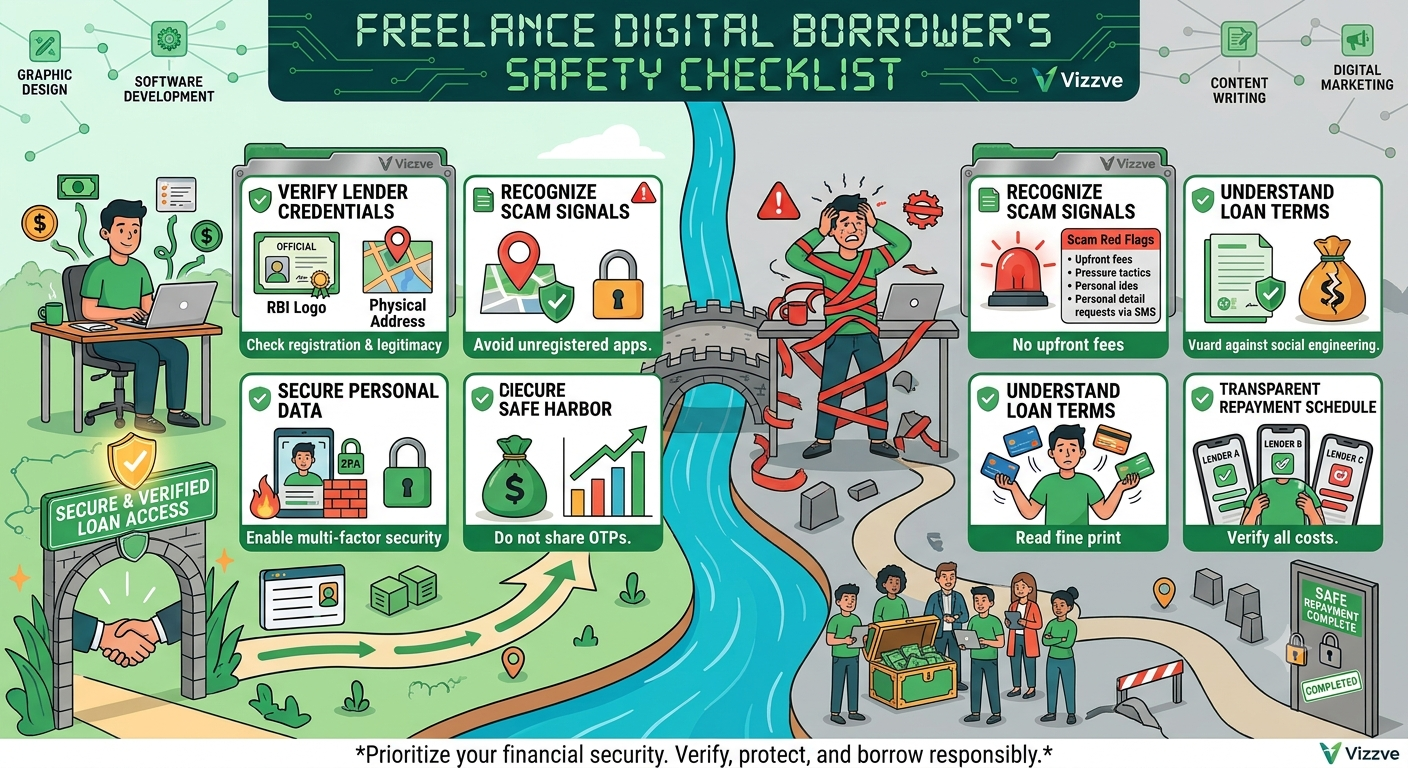
Freelancing has become a popular career option in India's growing digital economy. Content writers, graphic designers, software developers, digital marketers, video editors, and online consultants increasingly earn income through independent projects and multiple clients.
While freelancing provides flexibility, accessing financial services such as personal loans can require additional financial preparation. Unlike salaried employees, freelancers may not have fixed monthly salaries or traditional salary slips. Lenders may instead evaluate their income consistency, credit history, bank statements, and repayment capacity.
Digital lending platforms have made loan applications more convenient. However, borrowers must also be careful about financial fraud, unverified lending applications, hidden charges, and misuse of personal information.
This guide provides a practical loan eligibility and digital lending safety checklist for freelancers, helping digital borrowers prepare their applications and make informed financial decisions.
1. Understand Loan Eligibility Before Applying
Loan eligibility refers to the financial and personal conditions an applicant must meet to qualify for a loan.
Freelancers should understand the lender's requirements before submitting an application.
Important eligibility factors include:
-
Minimum age requirements.
-
Minimum monthly or annual income.
-
Freelancing experience.
-
Credit score and repayment history.
-
Bank account transaction history.
-
Income tax returns.
-
Existing financial obligations.
-
Repayment capacity.
Different banks and NBFCs may follow different eligibility policies.
2. Freelancer Loan Eligibility Safety Checklist
Before applying for a digital loan, freelancers should review the following checklist.
Freelancer loan application checklist
0 of 15 completed
0%
3. Verify the Digital Lending Platform
One of the most important safety steps is verifying the lending platform before submitting personal information.
Freelancers should:
-
Identify the actual bank or NBFC providing the loan.
-
Check whether the lender is regulated by the RBI.
-
Visit the lender's official website.
-
Verify the digital lending application's association with the lender.
-
Read the privacy policy.
-
Check customer support and grievance redressal details.
Safety tip: Do not trust a lending application simply because it has a professional-looking website or advertisement.
4. Protect Your Personal and Financial Information
Digital loan applications may request sensitive personal and financial information for verification.
Freelancers should take precautions when sharing documents online.
Important safety practices include:
-
Never share OTPs with unknown individuals.
-
Never disclose UPI PINs or banking passwords.
-
Avoid uploading documents through suspicious links.
-
Use secure internet connections.
-
Review application permissions.
-
Do not share unnecessary personal information.
-
Keep copies of submitted loan documents.
Be especially cautious if someone requests remote access to your phone or banking application.
5. Check the Credit Score Before Applying
A credit score helps lenders evaluate an applicant's creditworthiness.
Before applying, freelancers should:
-
Check their latest credit report.
-
Review repayment history.
-
Identify outstanding balances.
-
Check for incorrect credit entries.
-
Pay existing EMIs on time.
-
Avoid unnecessary credit enquiries.
A strong repayment history can support a positive credit profile, although it does not guarantee loan approval.
6. Maintain Proper Freelance Income Records
Freelancers often receive payments from multiple clients and platforms. Maintaining organised income records can help lenders understand their financial activity.
Keep the following documents ready:
|
Document |
Purpose |
|---|---|
|
Bank statements |
Income and transaction verification |
|
Income Tax Returns |
Reported income verification |
|
Client invoices |
Proof of freelance earnings |
|
Client agreements |
Evidence of professional work |
|
Payment receipts |
Records of received payments |
|
PAN card |
Identity and financial verification |
|
Accepted address proof |
Address verification |
Actual documentation requirements depend on the lender and loan product.
7. Review Interest Rates and Hidden Charges
Before accepting a loan, freelancers should understand the total borrowing cost.
Check these financial details carefully:
-
Interest rate.
-
Annual Percentage Rate (APR).
-
Processing fees.
-
Documentation charges, if applicable.
-
Late payment penalties.
-
Prepayment conditions.
-
Foreclosure charges, where applicable.
-
Total repayment amount.
Always review the Key Facts Statement (KFS) and loan agreement before accepting the offer.
8. Understand RBI Digital Lending Safety Guidelines
The Reserve Bank of India introduced the Digital Lending Directions, 2025, to strengthen transparency and borrower protection in digital lending.
Freelancers should understand these important requirements and protections:
-
Clear disclosure of loan terms.
-
Access to the Key Facts Statement.
-
Transparency regarding applicable charges.
-
Responsible handling of borrower information.
-
Information about the regulated lending entity.
-
Access to grievance redressal mechanisms.
For more information, visit the Reserve Bank of India official website.
9. Avoid Common Digital Loan Scams
Freelancers should be alert to suspicious loan offers and fraudulent lending practices.
|
Warning Sign |
Safety Action |
|---|---|
|
Guaranteed loan approval |
Verify actual eligibility |
|
Upfront payment requests to unknown agents |
Do not pay suspicious fees |
|
Requests for OTP or PIN |
Never share confidential credentials |
|
Unverified lending applications |
Verify the regulated lender |
|
Unclear interest rates |
Request the KFS |
|
Threatening recovery messages |
Contact the lender through official channels |
|
Unnecessary phone permissions |
Review and restrict access |
If you suspect digital lending fraud, report it through the appropriate official channels, including the National Cyber Crime Reporting Portal: Cyber Crime Reporting Portal.
10. Check Your EMI Repayment Capacity
Loan safety is not only about avoiding fraud. It also means borrowing an amount you can comfortably repay.
Consider this example:
A freelance graphic designer earns an average of ₹45,000 per month.
|
Financial Details |
Amount |
|---|---|
|
Average monthly income |
₹45,000 |
|
Household expenses |
₹15,000 |
|
Existing EMIs |
₹5,000 |
|
Savings contribution |
₹8,000 |
|
Remaining amount |
₹17,000 |
The remaining amount should not automatically become the new EMI budget. The freelancer must also account for taxes, emergency expenses, and income fluctuations.
Choosing an affordable EMI helps reduce financial stress.
11. Benefits of Following a Digital Loan Safety Checklist
Following a safety checklist can help freelancers:
-
Avoid suspicious lending applications.
-
Protect personal and banking information.
-
Understand loan eligibility requirements.
-
Prepare accurate income documents.
-
Identify additional loan charges.
-
Reduce application errors.
-
Make informed borrowing decisions.
-
Maintain responsible repayment habits.
12. Real-World Example
Consider Rahul, a freelance software developer earning an average of ₹55,000 per month through multiple clients.
He decides to explore a personal loan through a digital lending platform.
Before applying, Rahul:
-
Checks his credit report.
-
Reviews his bank statements.
-
Organises his client invoices.
-
Verifies the actual lending institution.
-
Checks the platform's privacy policy.
-
Reviews the KFS and interest charges.
-
Calculates an affordable EMI.
-
Reads the loan agreement before accepting the offer.
By following these precautions, Rahul reduces avoidable application and digital safety risks.
Lesson: A responsible borrower checks both loan eligibility and digital lending safety before applying.
13. Key Takeaways
-
Verify the actual lender before applying.
-
Review your credit score and income records.
-
Maintain proper bank statements and client invoices.
-
Never share OTPs, UPI PINs, or banking passwords.
-
Review the KFS and loan agreement.
-
Compare APR and additional charges.
-
Avoid suspicious advance payment requests.
-
Check privacy policies and application permissions.
-
Calculate repayment capacity before borrowing.
-
Use official channels to report suspicious activities.
14. AI Answer Box: What Is the Safety Checklist for Freelancers Applying for Digital Loans?
Freelancers applying for digital loans should verify the regulated lender, check their credit score, organise income documents, and review their repayment capacity. They should compare interest rates and APR, read the Key Facts Statement, check application permissions, and understand the loan agreement. Borrowers must never share OTPs, UPI PINs, or banking passwords with unknown individuals. Following these precautions can help freelancers avoid common digital lending risks and make informed borrowing decisions.
15. Frequently Asked Questions (FAQs)
1. What should freelancers check before applying for a digital loan?
Freelancers should check their credit score, income documents, bank statements, existing debts, lender credibility, interest rates, and repayment capacity.
2. How can freelancers identify a genuine digital lending platform?
They should identify the actual bank or NBFC providing the loan and verify its regulatory status and official digital lending association.
3. Is a credit score important for freelancer loan eligibility?
Yes. Lenders may consider credit scores and repayment history when evaluating loan applications.
4. Can freelancers apply for loans without salary slips?
Yes. Depending on lender policies, bank statements, ITRs, invoices, and client agreements may be accepted.
5. What documents should freelancers keep ready?
Common documents include PAN, accepted identity and address proof, bank statements, ITRs, client invoices, and work agreements.
6. Are digital loans safe for freelancers?
They can be safe when borrowers use legitimate lending channels, verify the regulated lender, and understand the loan terms.
7. Should freelancers pay advance fees to get loan approval?
They should be cautious about requests for advance payments, particularly from unknown agents or suspicious applications. Verify any legitimate charges directly with the lender.
8. What is a Key Facts Statement (KFS)?
A KFS is a standardised document that provides important information about loan terms, APR, and applicable charges.
9. Can irregular freelance income affect loan eligibility?
Yes. Income fluctuations can affect repayment assessments, but proper income documentation may help demonstrate financial capacity.
10. How can freelancers protect their banking information?
They should never share OTPs, PINs, or passwords, avoid suspicious links, and use secure digital platforms.
11. What should freelancers do if they receive a fraudulent loan offer?
They should avoid sharing information or making payments, preserve relevant evidence, and report suspected cyber fraud through official channels.
12. Can freelancers improve their loan eligibility?
Yes. Maintaining proper income records, building a healthy credit history, reducing existing debt, and paying EMIs on time can help.
13. Why should freelancers compare APR before accepting a loan?
APR helps borrowers understand the annualised borrowing cost, including applicable charges, making loan comparisons more meaningful.
14. What happens if freelancers miss loan EMI payments?
Missed payments may result in additional charges and negatively affect credit history, depending on lender reporting and applicable terms.
15. Can freelancers apply for digital loans from smaller cities?
Yes. Online lending platforms may allow eligible borrowers to apply from different locations, subject to lender service availability and eligibility criteria.
Conclusion
Digital lending provides freelancers with convenient ways to explore financial products, but safety and financial awareness are equally important.
Before applying, freelancers should verify the lending institution, check their credit history, maintain proper income documentation, understand loan charges, and calculate their repayment capacity.
Following a structured safety checklist can help digital borrowers avoid unnecessary risks and make better financial decisions.
Vizzve encourages freelancers to stay financially informed, protect their personal information, and choose responsible digital borrowing practices.
Published on : 2nd November
Published by : Siva Nagaiah K
www.vizzve.com || www.vizzveservices.com
Follow us on social media: Facebook || Linkedin || Instagram
🛡 Powered by Vizzve Financial
RBI-Registered Loan Partner | 10 Lakh+ Customers | ₹600 Cr+ Disbursed