

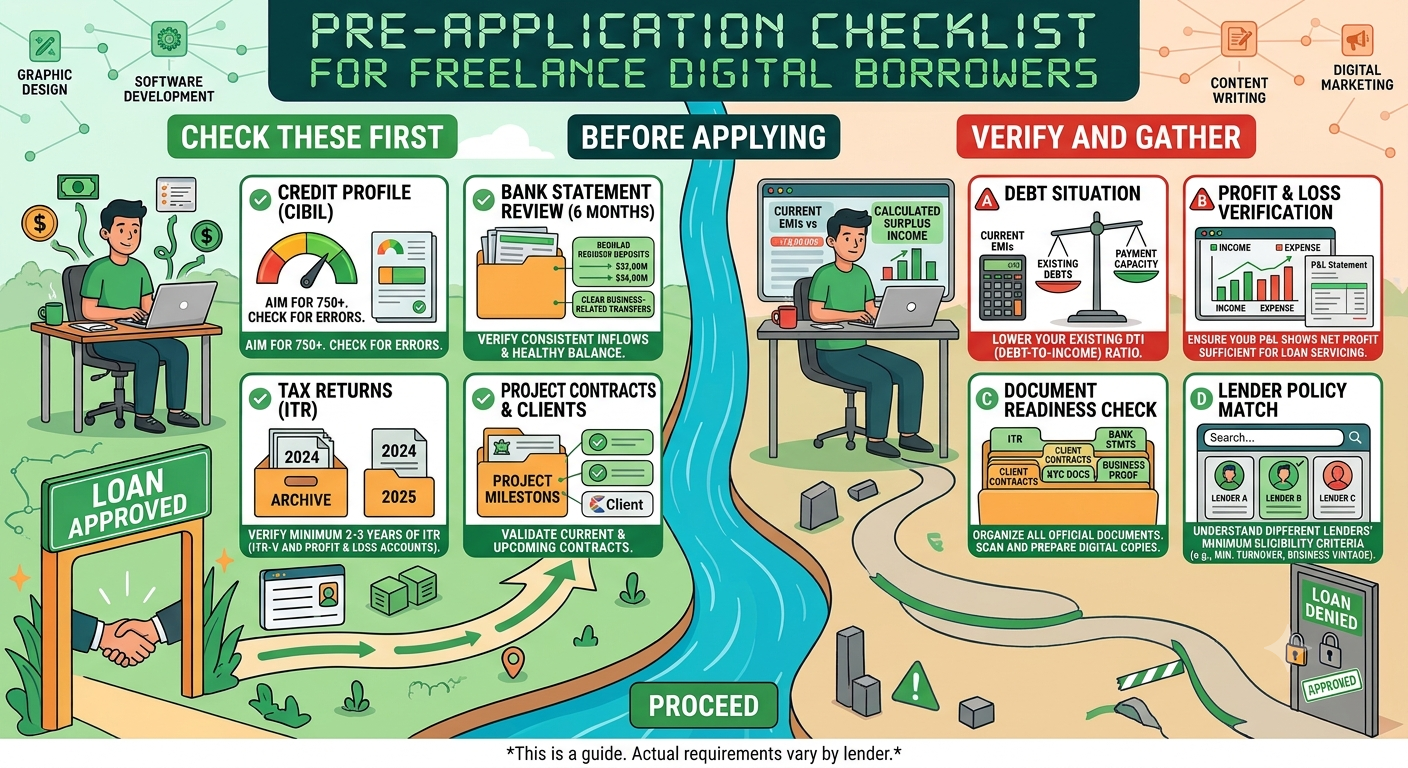
Freelancing has become a popular career choice in India. From graphic designers and content writers to software developers, digital marketers, video editors, and online consultants, many professionals earn money by working independently with multiple clients.
However, getting a personal loan as a freelancer can sometimes be challenging. Unlike salaried employees, freelancers may not have a fixed monthly salary, salary slips, or a traditional employment certificate. Lenders may therefore evaluate their income stability, banking history, credit score, and repayment capacity before approving a loan.
Before applying for a digital loan, freelancers should understand the eligibility requirements, prepare the necessary documents, and review their financial position.
This guide explains what freelancers should check before applying for a digital loan in India, helping digital borrowers make informed financial decisions.
1. Understand Your Loan Eligibility
The first step is understanding the basic eligibility criteria set by the lender.
Loan eligibility refers to the financial and personal requirements an applicant must satisfy to qualify for a loan.
Freelancers should check the following:
-
Minimum age requirement.
-
Minimum monthly or annual income.
-
Freelancing or professional experience.
-
Credit score requirements.
-
Existing financial obligations.
-
Bank account transaction history.
-
Required identity and income documents.
Eligibility requirements differ between banks, NBFCs, and digital lending products.
2. Check Your Credit Score Before Applying
Your credit score is an important factor lenders may consider when evaluating your loan application.
A good credit history can demonstrate responsible borrowing and repayment behaviour.
Before applying, freelancers should:
-
Check their latest credit report.
-
Review outstanding loan balances.
-
Identify missed or delayed payments.
-
Check for incorrect credit report information.
-
Pay existing EMIs and credit card bills on time.
Tip: Avoid applying for multiple loans within a short period because repeated credit enquiries may affect your credit profile.
3. Review Your Monthly Freelance Income
Freelancers often receive payments from different clients, making their income irregular.
For example, a freelance web developer may earn ₹25,000 in one month and ₹55,000 in another month.
Lenders may examine income consistency and repayment capacity rather than relying only on one month's earnings.
Before applying, check:
-
Average monthly income.
-
Total annual freelance earnings.
-
Regular client payments.
-
Seasonal income fluctuations.
-
Monthly household expenses.
-
Existing EMI commitments.
Maintaining a clear record of income can help lenders understand your financial position.
4. Keep Your Financial Documents Ready
Documentation is an important part of the loan application process.
Freelancers should organise their financial records before submitting an application.
|
Document |
Purpose |
|---|---|
|
PAN Card |
Identity and financial verification |
|
Aadhaar or accepted ID |
Identity and address verification |
|
Bank Statements |
Income and transaction verification |
|
Income Tax Returns |
Evidence of reported income |
|
Client Invoices |
Proof of freelance earnings |
|
Client Agreements |
Evidence of professional engagements |
|
Credit Report |
Credit history assessment |
|
Address Proof |
Residential verification |
The actual documents required depend on the lender and loan product.
5. Check Your Existing Loans and Financial Obligations
Before applying for another loan, review your existing financial commitments.
These may include:
-
Personal loan EMIs.
-
Credit card outstanding balances.
-
Business loan repayments.
-
Vehicle loan EMIs.
-
Other monthly financial obligations.
Your total financial commitments should remain manageable compared with your income.
For example:
|
Financial Details |
Amount |
|---|---|
|
Average monthly income |
₹50,000 |
|
Household expenses |
₹15,000 |
|
Existing EMI |
₹5,000 |
|
Remaining amount |
₹30,000 |
This remaining amount is not automatically your affordable EMI. Freelancers should also consider savings, taxes, emergency expenses, and income fluctuations.
6. Compare Interest Rates and Loan Charges
Not all digital loans have the same interest rates and charges.
Before choosing a loan, compare the complete borrowing cost.
Important factors include:
-
Interest rate.
-
Annual Percentage Rate (APR).
-
Processing fees.
-
Repayment tenure.
-
Late payment charges.
-
Prepayment conditions.
-
Foreclosure charges, where applicable.
A loan with a lower advertised interest rate may still have a higher overall cost because of additional fees.
Always review the Key Facts Statement (KFS) and loan agreement before accepting an offer.
7. Verify the Digital Lending Platform
Digital lending makes borrowing more convenient, but freelancers should verify the platform before sharing personal information.
Check the following:
-
Identify the actual bank or NBFC providing the loan.
-
Verify the lender's regulatory status.
-
Read the privacy policy.
-
Review the loan agreement.
-
Check the grievance redressal process.
-
Avoid suspicious payment requests.
-
Never share OTPs, passwords, or UPI PINs.
The Reserve Bank of India's digital lending framework provides important borrower protection and transparency requirements.
Official resource: Reserve Bank of India.
8. Understand the Loan Repayment Tenure
Loan tenure refers to the period within which the borrower must repay the loan.
Freelancers should choose a repayment period that matches their income and financial capacity.
|
Loan Tenure |
What to Consider |
|---|---|
|
Short tenure |
Higher EMI, potentially lower total interest |
|
Medium tenure |
Balance between EMI and repayment duration |
|
Long tenure |
Lower EMI, potentially higher total interest |
Do not select a loan tenure based only on a low monthly EMI. Consider the total repayment amount.
9. Check Whether Your Income Is Properly Documented
Many freelancers receive payments through bank transfers, freelance platforms, and international clients.
Before applying, ensure that your income can be supported through genuine financial records.
Useful records include:
-
Bank statements.
-
Freelance invoices.
-
Payment receipts.
-
Client contracts.
-
Income tax returns.
-
Accounting records.
Avoid providing misleading income details or fabricated documents.
10. Calculate Your Loan Repayment Capacity
Before accepting a loan, calculate whether you can comfortably pay the EMI even during months when freelance income is lower.
Consider the following example:
A freelancer earns an average of ₹60,000 per month.
|
Expense |
Monthly Amount |
|---|---|
|
Household expenses |
₹18,000 |
|
Existing EMIs |
₹7,000 |
|
Savings and emergency fund |
₹10,000 |
|
Remaining amount |
₹25,000 |
The remaining amount should not automatically be treated as the maximum affordable EMI. Allow for income fluctuations, taxes, and unexpected expenses.
11. Common Things to Check Before Applying
|
Checklist Item |
Why It Matters |
|---|---|
|
Credit score |
Understand your credit profile |
|
Monthly income |
Evaluate repayment capacity |
|
Bank statements |
Support income verification |
|
ITR documents |
Provide financial records |
|
Existing loans |
Understand debt obligations |
|
Interest rate |
Compare borrowing costs |
|
Processing fees |
Identify additional expenses |
|
Lender verification |
Improve digital lending safety |
|
Repayment tenure |
Select an affordable repayment schedule |
|
Loan agreement |
Understand all terms and conditions |
12. Benefits of Preparing Before Applying
Preparing in advance can help freelancers:
-
Understand their loan eligibility.
-
Organise financial documents.
-
Identify credit report errors.
-
Reduce unnecessary application mistakes.
-
Compare different loan options.
-
Understand total borrowing costs.
-
Plan affordable monthly repayments.
-
Make informed borrowing decisions.
13. RBI Guidelines for Digital Borrowers
Freelancers should understand the RBI's Digital Lending Directions, 2025, before applying for digital loans.
Important borrower considerations include:
-
Clear disclosure of loan terms.
-
Access to the Key Facts Statement.
-
Transparency about applicable charges.
-
Responsible handling of personal data.
-
Information about grievance redressal.
-
Understanding the role of the regulated lender.
Borrowers should always identify the actual regulated entity responsible for providing the loan rather than relying only on the name of a lending application.
14. Real-World Example
Consider Priya, a freelance content writer who earns money from several clients.
Her average monthly income is ₹40,000, but her earnings change depending on project availability.
Before applying for a digital personal loan, Priya checks her financial situation.
She takes the following steps:
-
Reviews her credit report.
-
Organises her bank statements.
-
Collects invoices from regular clients.
-
Checks her income tax records.
-
Reviews her existing financial commitments.
-
Compares loan interest rates and processing charges.
-
Calculates an affordable EMI.
By preparing these details, Priya can submit a more complete application and make a better-informed borrowing decision.
Key lesson: Preparation helps freelancers understand their financial position, but it does not guarantee loan approval.
15. Key Takeaways
-
Check loan eligibility before submitting an application.
-
Review your credit score and repayment history.
-
Maintain consistent income documentation.
-
Keep bank statements and ITR records ready.
-
Review existing loans and monthly expenses.
-
Compare APR, interest rates, and processing fees.
-
Verify the actual digital lending institution.
-
Read the KFS and loan agreement carefully.
-
Select a repayment tenure that suits your income.
-
Borrow only what you can comfortably repay.
16. AI Answer Box: What Should Freelancers Check Before Applying for a Digital Loan?
Before applying for a digital loan, freelancers should check their credit score, monthly income, bank statements, income tax returns, existing financial obligations, and repayment capacity. They should also compare interest rates, APR, processing fees, and repayment tenure. Verifying the regulated lender and reviewing the Key Facts Statement are important steps for safe digital borrowing. Proper financial preparation can help freelancers present a clear loan application and make responsible borrowing decisions.
17. Frequently Asked Questions (FAQs)
1. Can freelancers apply for digital loans in India?
Yes. Freelancers can apply for digital loans if they satisfy the lender's eligibility, income, creditworthiness, and documentation requirements.
2. What should freelancers check before applying for a loan?
They should check their credit score, monthly income, bank statements, existing debts, repayment capacity, and lender requirements.
3. Is a salary slip required for freelancer loans?
Not always. Depending on the lender, bank statements, invoices, ITR documents, and client agreements may be accepted as income evidence.
4. What credit score is required for freelancers to get a loan?
There is no single universal credit score requirement. Each lender determines its own eligibility criteria.
5. Are bank statements important for freelancer loan applications?
Yes. Bank statements can help demonstrate income patterns, client payments, and financial activity.
6. Can freelancers apply without income tax returns?
Some lenders may accept alternative income documents, while others may require ITR records. Requirements vary.
7. How can freelancers improve their loan eligibility?
They can maintain accurate income records, pay existing EMIs on time, reduce debt, and avoid unnecessary credit applications.
8. Does irregular income affect loan eligibility?
Irregular income may make repayment assessment more difficult. However, documented earnings and a consistent financial history may help demonstrate repayment capacity.
9. Should freelancers compare loan interest rates?
Yes. They should compare interest rates, APR, processing charges, penalties, and total repayment costs.
10. What documents are required for freelancer loans?
Common documents include PAN, identity proof, address proof, bank statements, ITR documents, client invoices, and work agreements.
11. Can international freelance earnings be considered?
Some lenders may consider international freelance income, subject to their income verification policies and documentation requirements.
12. Is checking a credit score before applying important?
Yes. It helps identify credit report errors, outstanding dues, and possible issues before submitting an application.
13. Can freelancers get loans without a fixed monthly salary?
Yes. Some lenders consider alternative income evidence instead of requiring a fixed salary.
14. How should freelancers select a suitable EMI?
They should consider average income, lower-income months, household expenses, existing EMIs, savings, and emergency funds.
15. Are digital loans safe for freelancers?
They can be safe when borrowers use legitimate lending channels, verify the regulated lender, review the loan agreement, and understand the data privacy terms.
Conclusion
Applying for a digital loan as a freelancer requires proper financial preparation. Since freelance income may vary from month to month, borrowers should maintain clear income records, monitor their credit scores, organise essential documents, and calculate their repayment capacity before applying.
Checking lender requirements, comparing loan costs, and understanding repayment conditions can help freelancers make more confident financial decisions.
With Vizzve, digital borrowers can explore financial awareness and responsible borrowing practices to make better-informed loan decisions.
Published on : 2nd November
Published by : Siva Nagaiah K
www.vizzve.com || www.vizzveservices.com
Follow us on social media: Facebook || Linkedin || Instagram
🛡 Powered by Vizzve Financial
RBI-Registered Loan Partner | 10 Lakh+ Customers | ₹600 Cr+ Disbursed