

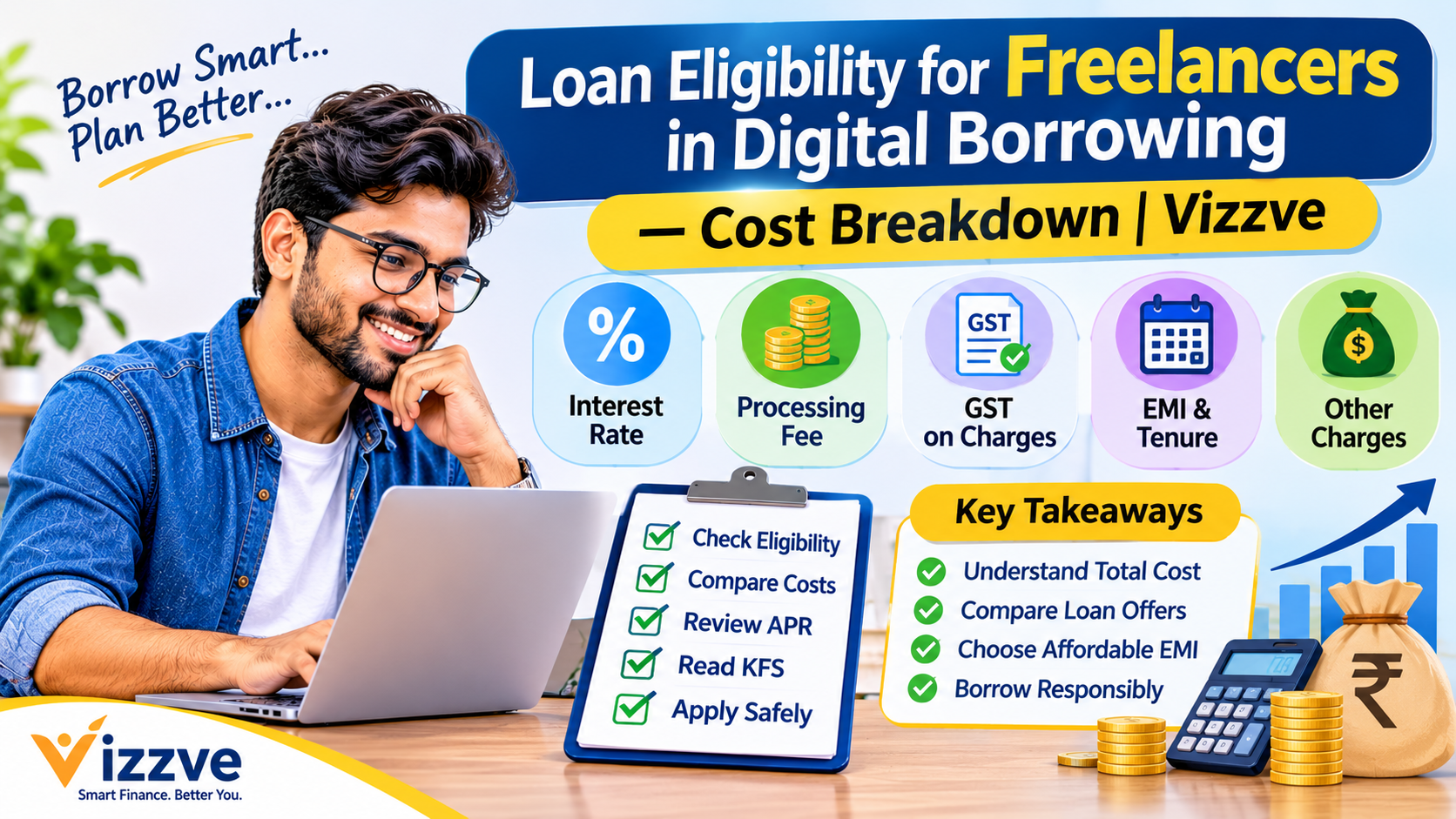
Freelancers and digital professionals often have income that changes from month to month. Designers, developers, content writers, consultants, digital marketers and independent service providers may receive payments from multiple clients or platforms.
When an unexpected expense arises, a personal loan or digital loan may appear to be a convenient option. However, checking loan eligibility is only one part of responsible borrowing. Understanding the complete cost of a loan is equally important.
A loan's actual cost may include interest, processing fees, applicable taxes, verification charges and repayment-related penalties. These costs can affect the amount received and the total amount repaid.
This guide explains the major components of a freelancer loan cost breakdown in India and how digital borrowers can compare loan offers before applying.
AI Answer Box: What Is the Cost Breakdown of a Freelancer Loan?
The cost of a freelancer loan is the total amount a borrower pays to use the loan. It generally includes the principal amount, interest, processing fees, applicable GST on taxable charges and any disclosed additional fees. Borrowers should compare the Annual Percentage Rate (APR), EMI, total repayment amount and Key Fact Statement (KFS), rather than looking only at the advertised interest rate.
1. What Determines the Cost of a Freelancer Loan?
The total cost of a loan depends on several factors. Lenders may assess the borrower's income, credit history, repayment capacity, loan amount and repayment period.
Important factors include:
-
Loan amount: A larger loan generally means a higher principal to repay.
-
Interest rate: The rate determines how much interest accumulates on the outstanding balance.
-
Loan tenure: A longer tenure may reduce the monthly EMI but can increase total interest.
-
Credit profile: Credit history and repayment behaviour may influence the offer.
-
Income stability: Regular bank credits and consistent client payments can help demonstrate repayment capacity.
-
Lender charges: Processing fees and other disclosed charges can increase the overall borrowing cost.
Actual rates, fees and eligibility conditions vary between lenders and loan products.
2. Main Components of a Freelancer Loan Cost
A. Loan Principal
The principal is the original amount borrowed from the lender.
For example, if a freelancer borrows ₹1,00,000, the principal amount is ₹1,00,000. The borrower must repay this amount along with applicable interest and charges.
B. Interest Rate
Interest is the cost charged by the lender for providing the loan.
Personal loans may use a fixed or variable interest structure, depending on the product. Many personal loans use a reducing-balance method, where interest is calculated on the outstanding principal.
Before accepting an offer, check:
-
Annual interest rate
-
Whether the rate is fixed or variable
-
Reducing-balance or flat-rate calculation
-
Total interest payable
-
Whether the rate can change during the loan period
C. Processing Fee
A processing fee is a charge that a lender may collect for processing a loan application.
It may be a fixed amount or a percentage of the sanctioned loan amount. Some lenders deduct it before disbursing the loan, while others collect it separately.
Always check the exact fee and whether it is refundable if the loan application is rejected or cancelled.
D. GST on Applicable Charges
GST may apply to taxable services and fees associated with a loan, such as processing or certain administrative charges.
Do not assume that every amount connected with a loan attracts the same tax treatment. Interest on loans is generally treated differently from taxable service fees. Check the lender's fee schedule and tax disclosure.
E. Verification or Documentation Charges
Some lenders may disclose additional charges for verification or other services, where applicable.
Digital borrowers should check whether these charges are:
-
Mandatory or optional
-
Included in the processing fee
-
Deducted from the disbursal amount
-
Separately payable
Avoid paying unexplained charges to individuals or unofficial agents.
F. Late Payment and Penal Charges
If an EMI is not paid by its due date, the lender may impose charges according to the loan agreement and applicable regulations.
Missing payments can also affect the borrower's credit history. Set reminders and maintain sufficient funds before the EMI date.
G. Prepayment or Foreclosure Charges
Some loan products may have charges or conditions for repaying the loan early. Other products may permit early repayment without a separate fee.
Review the loan agreement and KFS to understand:
-
Part-payment conditions
-
Full foreclosure conditions
-
Applicable charges
-
Minimum repayment period, if any
3. Example: Calculating the Cost of a Freelancer Loan
Consider an illustrative loan of ₹1,00,000 at an annual interest rate of 12%, calculated on a reducing balance with monthly repayments.
| Loan detail | 12-month tenure | 24-month tenure |
|---|---|---|
| Loan principal | ₹1,00,000 | ₹1,00,000 |
| Illustrative annual interest | 12% | 12% |
| Approximate monthly EMI | ₹8,885 | ₹4,707 |
| Approximate total repayment | ₹1,06,619 | ₹1,12,976 |
| Approximate total interest | ₹6,619 | ₹12,976 |
These are illustrative calculations, not lender quotations. They assume a monthly reducing-balance calculation and exclude processing fees, taxes and other charges. Actual EMI amounts may differ.
What Does This Example Show?
-
A shorter tenure generally means a higher monthly EMI.
-
A longer tenure can reduce monthly repayment pressure.
-
A longer tenure may increase the total interest paid.
-
Borrowers should compare both EMI affordability and total repayment cost.
4. Example of Processing Fee and GST
Suppose a lender charges an illustrative processing fee of 2% on a ₹1,00,000 loan.
| Component | Amount |
|---|---|
| Loan amount | ₹1,00,000 |
| Processing fee at 2% | ₹2,000 |
| Illustrative GST at 18% on the fee | ₹360 |
| Total fee and GST | ₹2,360 |
| Possible net disbursal if deducted upfront | ₹97,640 |
This example assumes the fee and GST are deducted from the sanctioned amount. Actual fee rates, tax treatment and collection methods depend on the lender and applicable rules.
The borrower may therefore receive less than the sanctioned loan amount while still being required to repay the agreed principal and interest.
5. What Is APR and Why Should Freelancers Check It?
APR stands for Annual Percentage Rate. It helps borrowers understand the annualised cost of borrowing, including applicable charges considered under the relevant calculation method.
An advertised interest rate may not show the complete cost of a loan. APR can provide a more useful basis for comparing loan offers.
Before applying, check:
-
APR mentioned in the loan disclosure
-
Interest rate and calculation method
-
Processing fee and applicable taxes
-
Total repayment amount
-
EMI schedule
-
Other charges and conditions
Compare loans using the same loan amount and repayment period wherever possible.
6. Understanding the Key Fact Statement (KFS)
A Key Fact Statement is an important document that helps borrowers understand the main terms and costs of a loan.
Before accepting a digital loan offer, review the KFS carefully.
It should help you understand important details such as:
-
Loan amount and net disbursal
-
Interest rate and APR
-
EMI amount and repayment schedule
-
Processing fees and applicable charges
-
Penal charges and default-related terms
-
Prepayment or foreclosure conditions, where applicable
-
Lender details and grievance redressal information
Do not accept a loan simply because the application process is quick. Read the disclosures and agreement first.
7. How Freelancers Can Estimate Their Loan Repayment Capacity
Freelancer income may vary because of project delays, seasonal demand or changes in client payments. Therefore, estimating repayment capacity is essential.
A practical approach is to calculate income after regular business and personal expenses.
Example:
| Monthly financial detail | Amount |
|---|---|
| Average monthly income | ₹60,000 |
| Business and work expenses | ₹10,000 |
| Household expenses | ₹20,000 |
| Existing loan EMIs | ₹5,000 |
| Remaining amount before savings and other expenses | ₹25,000 |
This remaining amount is not automatically the amount available for a new EMI. Freelancers should also account for savings, taxes, irregular expenses and months with lower income.
A sensible EMI should remain manageable even when client payments are delayed.
8. Documents That May Help Freelancers Apply for a Loan
Lenders may request documents to verify identity, address, income and repayment capacity.
Commonly requested documents include:
-
PAN card
-
Aadhaar or another accepted identity document
-
Address proof
-
Recent bank statements
-
Income tax returns, where required
-
Form 16A or other applicable income records
-
Client invoices or payment records
-
Freelance platform earnings statements
-
Business registration details, if applicable
Requirements differ by lender. Submit documents only through the lender's verified application or authorised channel.
9. How to Reduce the Overall Cost of a Freelancer Loan
Freelancers can take practical steps to manage borrowing expenses.
Compare Multiple Loan Offers
Compare interest rates, APR, processing fees, tenure and total repayment. Do not select a loan based only on the advertised EMI.
Borrow Only What You Need
A higher loan amount may increase interest and repayment obligations. Calculate the actual funding requirement before applying.
Choose a Suitable Tenure
A shorter tenure may reduce total interest but requires a higher EMI. Choose a repayment period that fits your cash flow.
Maintain a Healthy Credit History
Pay existing EMIs and credit card bills on time. Avoid unnecessary loan applications and excessive borrowing.
Keep Income Records Organised
Maintain bank statements, invoices, client agreements and tax records. These may help lenders assess freelance income.
Read the Fee Schedule
Check processing fees, applicable taxes, late-payment charges and early repayment conditions before accepting the offer.
Build an Emergency Reserve
Keep savings for unexpected expenses and periods when client payments are delayed. This can reduce the risk of missed EMIs.
10. Common Mistakes Digital Borrowers Should Avoid
| Common mistake | Why it matters | Better approach |
|---|---|---|
| Looking only at the interest rate | Other charges may increase the cost | Compare APR and total repayment |
| Ignoring the processing fee | Net disbursal may be lower | Check all deductions |
| Choosing a long tenure without calculation | Total interest may increase | Compare different tenures |
| Missing EMI dates | May result in charges and credit impact | Set payment reminders |
| Ignoring the KFS | Important terms may be overlooked | Read disclosures before acceptance |
| Borrowing more than required | Increases repayment obligations | Calculate the actual need |
| Applying through unknown links | Creates fraud and data risks | Use verified lender channels |
11. Digital Loan Safety Checklist for Freelancers
Before accepting a digital loan:
-
Verify the identity of the regulated lender.
-
Check whether the lending app or service is associated with the lender.
-
Read the KFS and loan agreement.
-
Confirm the APR, EMI and total repayment.
-
Understand all fees and deductions.
-
Check the lender's grievance redressal details.
-
Never share OTPs, passwords or banking PINs.
-
Avoid transferring money to personal accounts for loan approval.
-
Review the permissions requested by the app.
-
Keep a copy of the loan agreement and repayment schedule.
A legitimate loan application should provide clear information about the lender, costs and repayment terms.
12. Comparison: Short-Term vs Long-Term Loan Tenure
| Factor | Shorter tenure | Longer tenure |
|---|---|---|
| Monthly EMI | Usually higher | Usually lower |
| Total interest | Usually lower | May be higher |
| Repayment period | Shorter | Longer |
| Monthly cash-flow pressure | Higher | Lower |
| Overall borrowing cost | May be lower | May be higher |
The right tenure depends on the borrower's income, expenses and financial goals. Freelancers should avoid choosing a tenure only because the EMI looks smaller.
13. Real-World Example: A Freelance Designer
Consider a freelance graphic designer who earns an average of ₹55,000 per month. The designer receives payments from several clients and wants to borrow ₹1,00,000 for a new computer and work-related expenses.
Before applying, the designer:
-
Reviews average income over the previous six months.
-
Checks existing EMIs and monthly expenses.
-
Collects bank statements and client payment records.
-
Compares loan offers using APR and total repayment.
-
Checks processing fees and applicable taxes.
-
Selects a tenure with a manageable EMI.
-
Reviews the KFS and loan agreement before accepting.
This example shows why freelancers should assess the complete borrowing cost instead of focusing only on the loan amount.
14. How Vizzve Can Support Better Loan Awareness
Vizzve can help digital borrowers understand important loan-related topics, including eligibility, documentation, repayment planning and borrowing costs.
Freelancers should make informed decisions by comparing available loan terms and reviewing the lender's disclosures. Loan approval, interest rates and charges depend on the lender's policies and the applicant's financial profile.
Always verify the lender and the final loan terms before accepting an offer.
Key Takeaways
-
Loan cost includes more than the interest rate.
-
Processing fees and applicable taxes can reduce the amount received.
-
APR helps borrowers compare the overall cost of loan offers.
-
The KFS provides important information about loan terms and charges.
-
Longer tenures may reduce EMI but increase total interest.
-
Freelancers should assess income stability and repayment capacity.
-
Compare multiple offers before accepting a digital loan.
-
Avoid unverified loan apps and unexplained upfront payments.
Frequently Asked Questions (FAQs)
1. What is included in a freelancer loan cost breakdown?
It may include principal, interest, processing fees, applicable GST on taxable charges, verification fees and disclosed repayment-related charges.
2. Can freelancers apply for personal loans online?
Yes. Some lenders offer digital personal loan applications to freelancers and self-employed applicants. Eligibility and documentation requirements vary.
3. Do freelancers need income proof for a loan?
Lenders may request bank statements, income tax returns, invoices, client payment records or platform earnings statements to assess income.
4. What is the processing fee on a freelancer loan?
It is a charge that a lender may collect for processing a loan application. The amount and collection method depend on the lender.
5. Is GST charged on loan interest?
Interest on loans is generally treated differently from taxable service fees. GST may apply to certain fees, such as processing charges, depending on the applicable tax rules.
6. What is APR in a personal loan?
APR is the annualised cost of borrowing that helps borrowers understand and compare the overall cost of loan offers, including relevant charges.
7. Why is the loan amount received lower than the sanctioned amount?
A lender may deduct disclosed processing fees and applicable taxes before disbursal. Check the net disbursal amount in the loan documents.
8. Does a longer loan tenure reduce the total cost?
Not necessarily. A longer tenure may reduce the EMI but can increase the total interest paid over the repayment period.
9. How can freelancers calculate their loan EMI?
Freelancers can use a loan EMI calculator by entering the principal, annual interest rate and repayment tenure. They should also consider fees and taxes separately.
10. Can a freelancer repay a loan early?
This depends on the loan agreement and applicable rules. Check whether part-payment or foreclosure is permitted and whether charges apply.
11. What happens if a freelancer misses an EMI?
The lender may impose charges under the loan agreement, and missed payments may affect the borrower's credit history.
12. Does a good credit score guarantee loan approval?
No. A good credit score may support an application, but lenders also consider income, existing debt, repayment capacity and their own eligibility policies.
13. Are digital loans always cheaper than traditional loans?
No. Digital application processes may be convenient, but the actual cost depends on interest, APR, fees and loan conditions.
14. How can freelancers avoid hidden loan charges?
Review the KFS, loan agreement and fee schedule. Ask the lender to explain any unclear charge before accepting the offer.
15. What should freelancers check before accepting a loan?
Check the lender's identity, APR, EMI, total repayment, net disbursal, fees, penalties, prepayment terms and grievance redressal details.
Conclusion
Understanding the complete cost of a loan is essential for freelancers and digital borrowers. Interest rates, processing fees, applicable taxes, repayment tenure and other charges can all influence the total amount payable.
Before applying, compare loan offers, calculate the EMI, review the APR and read the Key Fact Statement carefully. Keep income records organised and choose a repayment plan that remains manageable even when freelance earnings fluctuate.
Responsible borrowing starts with understanding the numbers. Vizzve encourages freelancers to review loan costs carefully and make informed financial decisions.
Published on : 1st November
Published by : Siva Nagaiah K
www.vizzve.com || www.vizzveservices.com
Follow us on social media: Facebook || Linkedin || Instagram
🛡 Powered by Vizzve Financial
RBI-Registered Loan Partner | 10 Lakh+ Customers | ₹600 Cr+ Disbursed