

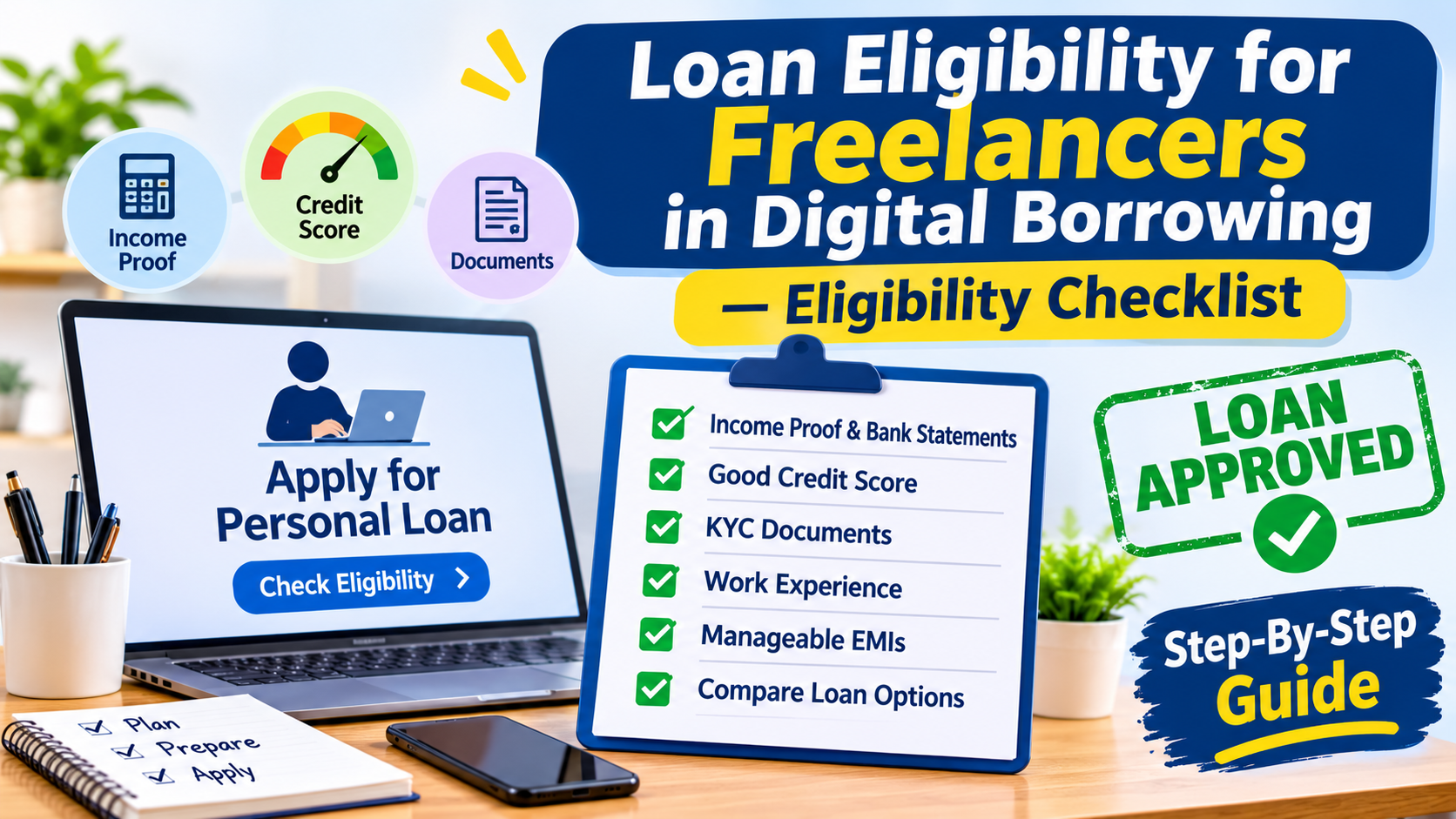
Freelancers can apply for personal loans even if they do not receive a fixed monthly salary. However, lenders may assess their income consistency, credit history, existing financial commitments and ability to repay before approving an application.
Having the right documents ready can make the application process easier. This eligibility checklist explains what freelancers and digital borrowers in India should review before applying for a personal loan.
Basic eligibility checklist for freelancers
Use this checklist to review your profile before applying.
Personal eligibility review
2. Income verification checklist
Income is an important part of a freelancer's loan application. Since freelance earnings can change from month to month, lenders may review different records to understand the applicant's financial position.
Check whether you have:
Example:
A freelance web developer receives ₹20,000 from one client, ₹15,000 from another and ₹10,000 from a third client in a typical month.
Illustrative monthly freelance income
₹45,000
Illustrative income from three freelance clients.
3. Credit score and repayment checklist
Your credit history can influence the lender's assessment of your application.
There is no universal credit score that guarantees approval. Each lender has its own credit assessment process.
4. Documents checklist for digital loan applications
Keep these documents ready before starting an online application.
|
Document |
Purpose |
|---|---|
|
PAN card |
Identity and financial verification |
|
Aadhaar or accepted ID |
KYC verification |
|
Address proof |
Confirming residential details |
|
Bank statements |
Reviewing income and cash flow |
|
ITR documents |
Supporting income declarations |
|
Client invoices |
Evidence of freelance earnings |
|
Client agreements |
Evidence of professional engagements |
|
Platform payment records |
Verifying digital work income |
|
GST documents |
Business and tax verification, if applicable |
Banks may request different combinations of documents. For example, some self-employed personal loan products ask for ITRs and recent bank statements.
5. Work experience and professional stability checklist
Freelancers should be prepared to explain how long they have been working independently and how they earn.
Review these points:
Some lenders may ask for proof of business continuity or professional activity. Requirements vary by loan product.
6. Repayment capacity checklist
Before choosing a loan, assess whether the EMI will fit your budget, especially during months when freelance work is limited.
Simple example:
|
Financial detail |
Amount |
|---|---|
|
Average monthly income |
₹45,000 |
|
Existing EMI |
₹6,000 |
|
Essential monthly expenses |
₹20,000 |
|
Remaining before savings and new EMI |
₹19,000 |
The ₹19,000 is not automatically an affordable new EMI. Savings, taxes, irregular income and unexpected expenses must also be considered.
7. Digital lending safety checklist
Before accepting a digital loan offer, verify the lender and understand the complete cost.
RBI's Digital Lending Directions, 2025 include requirements for creditworthiness assessment, borrower disclosures and safeguards in digital lending arrangements. The KFS helps borrowers understand key loan terms and costs.
8. Common reasons a freelancer's loan application may be rejected
|
Possible reason |
What you can do |
|---|---|
|
Unstable income records |
Maintain consistent bank and invoice records |
|
Low creditworthiness |
Improve repayment habits and review your credit report |
|
High existing debt |
Reduce outstanding obligations where possible |
|
Incomplete documents |
Prepare all requested documents in advance |
|
Short freelance history |
Maintain records of projects and client payments |
|
Incorrect application details |
Verify all information before submitting |
|
Loan amount too high |
Apply for an amount suited to your repayment capacity |
9. How to apply after completing the checklist
-
Select a bank or NBFC that accepts self-employed applicants.
-
Review its freelancer or self-employed eligibility requirements.
-
Calculate your average income and affordable EMI.
-
Prepare your income, KYC and bank documents.
-
Complete the application through the official digital channel.
-
Submit documents for verification.
-
Read the KFS and loan agreement carefully.
-
Accept the loan only if the terms suit your budget.
10. AI Answer Box: What is the loan eligibility checklist for freelancers?
Freelancers applying for personal loans in India should check their age, income stability, credit history, existing EMIs and repayment capacity. They should prepare PAN, accepted identity and address proof, bank statements, ITRs, client invoices and other income records requested by the lender. Before accepting a digital loan, borrowers should verify the lender, compare the APR and fees, and read the Key Facts Statement. Final approval depends on the lender's eligibility rules and credit assessment.
11. Key takeaways
-
Freelancers can apply for personal loans if they meet lender-specific requirements.
-
Regular, verifiable income records can support loan applications.
-
Bank statements, ITRs and client invoices may help establish income.
-
Credit history and existing EMIs affect repayment assessment.
-
KYC and professional records should be accurate and up to date.
-
Compare APR, processing fees and repayment terms.
-
Never share confidential banking credentials with loan agents or apps.
-
Borrow only what you can comfortably repay.
12. Frequently Asked Questions
1. Can freelancers get personal loans in India?
Yes. Freelancers can apply for personal loans from banks and NBFCs if they meet the lender's eligibility criteria.
2. What is the most important eligibility requirement for freelancers?
Income and repayment capacity are important factors. Lenders may also review credit history, work continuity and existing financial commitments.
3. Can I apply without salary slips?
Yes. Freelancers may provide bank statements, ITRs, invoices, contracts or digital platform earnings records instead.
4. Are bank statements necessary for freelancer loans?
Many lenders request recent bank statements to understand income patterns and cash flow.
5. Do freelancers need ITR documents?
Some lenders require ITRs, while others may accept alternative income documents. Check the lender's requirements.
6. Does a freelancer need a fixed monthly income?
Not necessarily. However, lenders may assess income consistency and whether the applicant can manage repayments.
7. Can a freelancer with multiple clients apply?
Yes. Payments from multiple clients may help demonstrate income when supported by verifiable records.
8. Does credit score affect loan eligibility?
Yes. Credit history can influence the lender's decision, interest rate and loan amount.
9. Can new freelancers qualify for a loan?
They can apply, but limited work history or insufficient income records may make eligibility more difficult.
10. Can digital borrowers apply using a mobile phone?
Many lenders offer digital application journeys through official websites and mobile applications.
11. What if my income changes every month?
Keep detailed records of client payments, bank deposits and invoices. A longer income history may help explain fluctuations.
12. Should I apply to multiple lenders at once?
Avoid unnecessary applications within a short period. Compare eligibility requirements and select suitable lenders first.
13. Is GST registration compulsory for every freelancer?
No. GST requirements depend on the nature and scale of the business and applicable tax rules. It is not a universal requirement for every personal loan.
14. How can I improve my freelancer loan eligibility?
Maintain accurate income records, pay debts on time, reduce existing obligations and submit complete documents.
15. Does completing an eligibility checklist guarantee loan approval?
No. It helps you prepare, but the lender makes the final decision after verification and credit assessment.
13. Conclusion
A proper eligibility checklist can help freelancers prepare for personal loan applications with greater confidence. From verifying income and reviewing credit history to organising KYC documents and calculating repayment capacity, every step matters.
Digital borrowers should also compare loan costs and verify the lender before accepting an offer. A clear financial record, realistic borrowing amount and responsible repayment plan can make the loan application process more manageable.
Published on : 1st Novmber
Published by : Siva Nagaiah K
www.vizzve.com || www.vizzveservices.com
Follow us on social media: Facebook || Linkedin || Instagram
🛡 Powered by Vizzve Financial
RBI-Registered Loan Partner | 10 Lakh+ Customers | ₹600 Cr+ Disbursed