

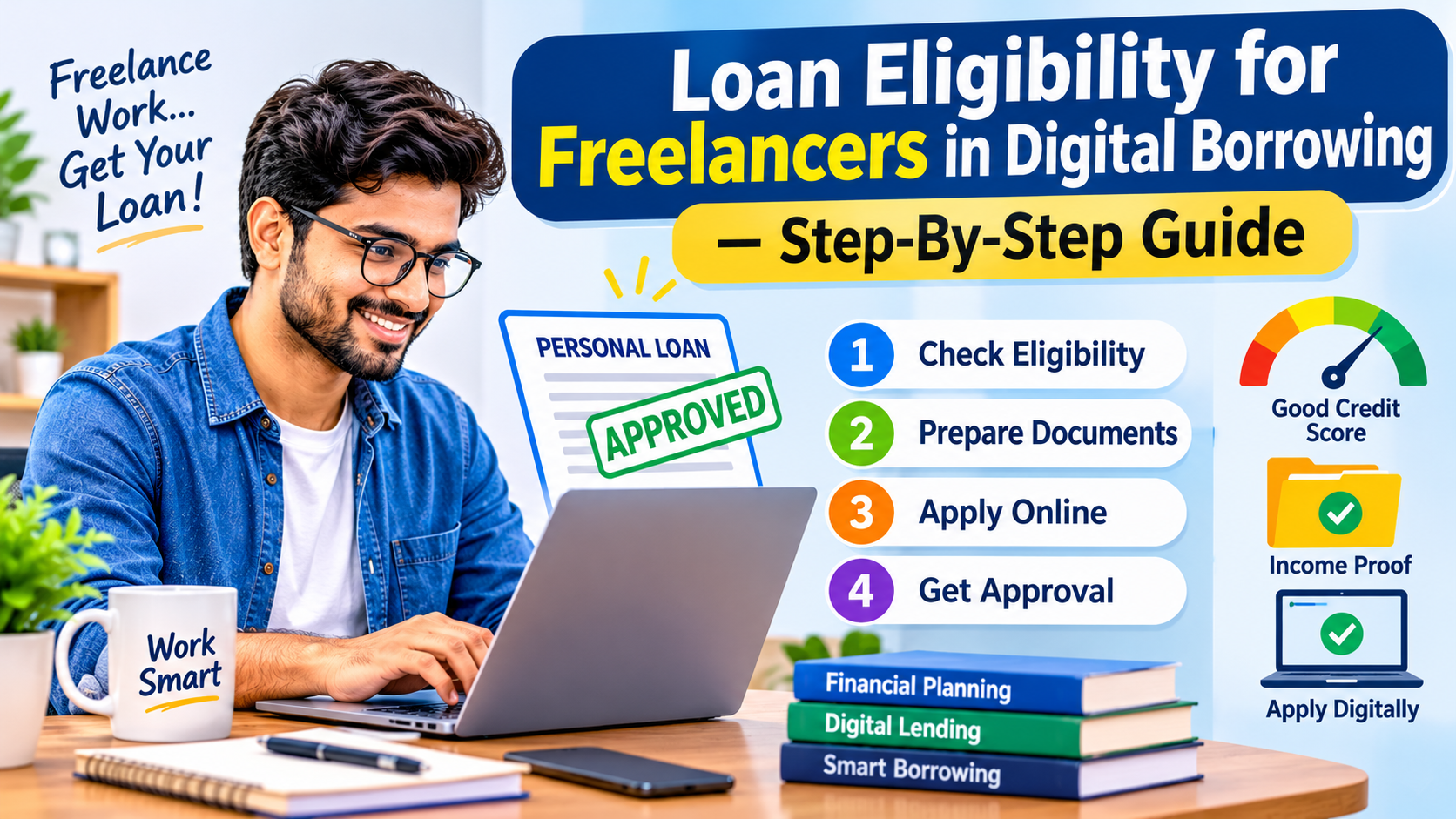
Loan eligibility refers to the conditions a lender evaluates before deciding whether an applicant can receive a loan. These conditions commonly include income, repayment capacity, credit history, age, existing debt and documentation.
Freelancers may earn money from several sources, such as:
-
Content writing and editing projects
-
Graphic design and video editing
-
Website and software development
-
Digital marketing and social media management
-
Online tutoring and consulting
-
Freelance photography and other creative services
-
Work received through digital platforms
Unlike salaried employees, freelancers may not receive a fixed salary every month. Lenders may therefore review bank statements, tax returns, business records and other evidence to understand the applicant's financial position.
2. Step-by-step guide to check loan eligibility
Follow these steps before submitting a loan application.
Step 1: Calculate your average monthly income
Start by calculating how much you earn from freelance work.
Include:
-
Payments received from clients.
-
Income from online freelance platforms.
-
Consulting or professional service fees.
-
Other regular and verifiable business income.
Review at least six months of income records to understand your average earnings. Some lenders may request a longer financial history.
Example:
|
Income source |
Monthly amount |
|---|---|
|
Content writing |
₹18,000 |
|
Graphic design |
₹12,000 |
|
Digital marketing |
₹15,000 |
|
Total monthly income |
₹45,000 |
This is an illustrative gross-income calculation. Actual income considered by a lender may be lower after business expenses, taxes and other adjustments.
Step 2: Check your credit score and repayment history
Your credit profile helps lenders understand how you have managed previous loans and credit cards.
Before applying:
-
Check your credit report.
-
Review outstanding loan balances.
-
Check whether previous EMIs were paid on time.
-
Look for incorrect entries or unfamiliar accounts.
-
Avoid submitting applications to many lenders within a short period.
A stronger credit history may improve your chances of receiving suitable loan terms. There is no single credit-score threshold that guarantees approval across all lenders.
Step 3: Review your existing EMIs and expenses
Lenders consider your existing financial commitments when assessing repayment capacity.
Calculate:
Monthly financial commitments = Existing EMIs + Other regular debt payments
Then compare these commitments with your average income and essential expenses.
For example, if your average monthly income is ₹45,000 and your existing loan EMI is ₹8,000, you should consider whether another EMI would leave enough money for rent, household expenses, taxes and business costs.
Do not choose a loan amount simply because a lender offers it.
Step 4: Check the lender's eligibility criteria
Different banks and NBFCs have different requirements for self-employed applicants and freelancers.
Common factors include:
|
Eligibility factor |
What lenders may review |
|---|---|
|
Age |
Whether the applicant falls within the lender's age limits |
|
Income |
Amount and consistency of freelance earnings |
|
Work experience |
How long the applicant has been earning independently |
|
Credit history |
Past repayment behaviour and credit report |
|
Bank statements |
Regular income credits and account activity |
|
Existing debt |
Current EMIs and repayment obligations |
|
KYC |
Identity and address verification |
Some lenders publish specific age, income or work-experience requirements. Always check the latest criteria for the particular loan product before applying.
Step 5: Prepare your income documents
Freelancers can use several types of records to demonstrate income.
Prepare documents such as:
-
Recent bank statements.
-
Income Tax Returns (ITRs), where available.
-
Client invoices and payment receipts.
-
Freelance platform earnings statements.
-
Client contracts or work agreements.
-
GST registration and returns, if applicable.
-
Financial statements, if requested by the lender.
A bank statement showing regular client payments can help explain your income pattern. Document requirements differ between lenders.
Step 6: Keep your KYC documents ready
Most digital loan applications require identity and address verification.
Commonly requested documents include:
-
PAN card.
-
Aadhaar or another accepted identity document.
-
Valid address proof.
-
Bank account details.
-
Recent photograph, if required.
-
Business or professional address proof, where applicable.
Submit documents only through the lender's official website or verified application.
Step 7: Estimate an affordable loan amount
Before applying, decide how much you actually need and what EMI you can comfortably afford.
Consider:
-
Average monthly take-home income.
-
Seasonal changes in freelance earnings.
-
Existing EMIs.
-
Household expenses.
-
Taxes and business costs.
-
Emergency savings.
Illustrative example: A freelancer earning ₹45,000 per month should not assume that the full amount is available for loan repayment. The affordable EMI depends on the person's essential expenses, existing debts and income stability.
Step 8: Compare lenders and loan offers
Do not select a loan based only on the advertised interest rate.
Compare:
|
Loan feature |
What to check |
|---|---|
|
Interest rate |
Fixed or floating, and how it is calculated |
|
APR |
Overall annual cost of borrowing |
|
Processing fee |
Amount charged for processing |
|
Loan tenure |
Total repayment period |
|
EMI |
Monthly repayment amount |
|
Late payment charges |
Cost of missing a payment |
|
Prepayment terms |
Conditions and applicable charges |
|
Disbursal |
Expected process and timeline |
Ask for the Key Facts Statement (KFS) and read it before accepting the offer. RBI's KFS framework is designed to make important loan information, including the Annual Percentage Rate (APR), easier to understand and compare.
Step 9: Submit your online application
Once you have selected a suitable lender:
-
Visit the lender's official website or verified digital platform.
-
Choose the relevant personal loan product.
-
Enter your personal and professional details.
-
Provide accurate income information.
-
Complete the required KYC process.
-
Upload the requested documents.
-
Review the loan amount, interest rate, fees and tenure.
-
Submit the application for verification.
The lender may request additional information before making a decision.
Step 10: Review approval terms before accepting
If your application is approved, carefully review the sanction details.
Check:
-
Approved loan amount.
-
Interest rate and APR.
-
Monthly EMI.
-
Repayment tenure.
-
Processing and other charges.
-
Late payment conditions.
-
Prepayment or foreclosure rules.
Accept the offer only if the repayment terms fit your budget. Approval is not a reason to borrow more than you need.
3. Documents checklist for freelancer borrowers
|
Document |
Why it may be needed |
|---|---|
|
PAN card |
Tax identity and credit verification |
|
Aadhaar or accepted ID |
Identity verification |
|
Address proof |
Residential address verification |
|
Bank statements |
Evidence of income and cash flow |
|
ITR documents |
Income and tax records |
|
Client invoices |
Proof of freelance work and billing |
|
Client agreements |
Evidence of professional engagements |
|
Platform earnings records |
Proof of online work income |
|
GST records |
Business and tax information, where applicable |
Tip: Keep digital copies clear, current and consistent. The exact list depends on the lender and the applicant's profile.
4. How to improve loan eligibility as a freelancer
Freelancers can take practical steps to strengthen their financial profile:
-
Maintain consistent income records: Keep invoices, receipts and bank credits organised.
-
Use a dedicated bank account: Separating professional transactions from personal spending can make income easier to track.
-
File income tax returns accurately: Keep tax records up to date.
-
Pay EMIs and credit card bills on time: A positive repayment record supports your credit profile.
-
Reduce existing debt: Lower outstanding obligations can improve repayment capacity.
-
Avoid unnecessary applications: Apply after checking the lender's eligibility conditions.
-
Build an emergency fund: Savings can help manage months with fewer projects.
-
Keep your details consistent: Ensure your name, PAN, address and bank details match across records.
5. Common mistakes freelancers should avoid
|
Mistake |
Better approach |
|---|---|
|
Reporting unverified income |
Use bank records, invoices and tax documents |
|
Ignoring existing EMIs |
Calculate total monthly debt commitments |
|
Applying without checking criteria |
Read the lender's eligibility requirements first |
|
Choosing only by interest rate |
Compare APR and all applicable charges |
|
Uploading unclear documents |
Submit readable and valid copies |
|
Borrowing more than required |
Select an amount based on repayment capacity |
|
Using unverified loan apps |
Confirm the regulated lender behind the offer |
6. Benefits and challenges of digital loans for freelancers
Benefits
-
Online applications can reduce paperwork and branch visits.
-
Documents can often be submitted digitally.
-
Some lenders offer faster verification journeys.
-
Loan options can be compared from different providers.
-
Applications may be convenient for people working remotely.
Challenges
-
Freelance income can fluctuate.
-
Some lenders may ask for longer income records.
-
Applicants with limited credit history may face difficulty.
-
Interest rates and loan amounts can vary by profile.
-
Fraudulent loan apps and misleading offers require caution.
7. Digital lending safety checklist
Digital convenience should not replace careful borrowing.
-
Confirm the actual bank or NBFC providing the loan.
-
Check the lender's official website and app details.
-
Read the KFS, APR, fees and repayment conditions.
-
Review the privacy policy and permissions requested.
-
Do not share OTPs, passwords, card PINs or UPI PINs.
-
Avoid paying unexplained advance fees to individuals.
-
Keep a copy of the loan agreement and repayment schedule.
The RBI's Digital Lending Directions, 2025 set requirements for regulated entities involved in digital lending, including borrower disclosures and safeguards around data collection and lending service providers.
8. Real-world example: A freelancer preparing for a loan
Consider Priya, a freelance graphic designer who earns money from three regular clients and occasional online projects.
Her average monthly income is ₹50,000. She has an existing EMI of ₹5,000 and wants to apply for a personal loan to purchase a new computer and manage a planned professional expense.
Before applying, she:
-
Reviews six months of bank statements.
-
Collects client invoices and payment records.
-
Checks her credit report.
-
Reviews her existing EMI and monthly expenses.
-
Compares loan offers and their APRs.
-
Chooses an amount that fits her expected cash flow.
This preparation may help the lender assess her application more clearly. However, the final decision depends on the lender's credit assessment and product criteria.
9. Freelancer loan eligibility: Quick comparison
|
Factor |
Salaried applicant |
Freelancer |
|---|---|---|
|
Income evidence |
Salary slips and bank credits |
Invoices, bank credits and tax records |
|
Employment evidence |
Employer details |
Client contracts or platform records |
|
Income pattern |
Usually fixed monthly salary |
May vary month to month |
|
Work continuity |
Employment history |
Freelance work history |
|
Repayment assessment |
Income and existing debt |
Income stability and existing debt |
Both groups are assessed on their ability to repay. The documents and methods used to verify income may differ.
10. AI Answer Box: How can freelancers check loan eligibility?
Freelancers in India can check loan eligibility by reviewing their average monthly income, credit history, existing EMIs and lender-specific requirements. They should prepare bank statements, ITRs, client invoices, payment records and KYC documents. Next, they can compare loan offers, review the APR and fees, and apply through the lender's official website or verified digital platform. Approval depends on the lender's assessment of income stability and repayment capacity.
11. Key takeaways
-
Freelancers may qualify for personal loans if they meet lender requirements.
-
Regular and verifiable income records are important.
-
Bank statements, ITRs and client invoices can support income verification.
-
Credit history and existing EMIs influence repayment assessment.
-
Compare APR, fees, tenure and EMI before accepting a loan.
-
Use verified lending channels and protect personal information.
-
Borrow only an amount that can be repaid comfortably.
12. Frequently Asked Questions (FAQs)
1. Can freelancers apply for personal loans in India?
Yes. Freelancers and self-employed professionals can apply for personal loans if they meet the lender's eligibility and documentation requirements.
2. Can I get a loan without a salary slip?
Yes. Freelancers may be able to provide bank statements, ITRs, client invoices, contracts or platform payment records instead of salary slips.
3. What is the minimum income required for a freelancer loan?
There is no universal minimum income. Each bank or NBFC sets its own income requirements based on the loan product.
4. Is a credit score important for freelancers?
Yes. A credit score and repayment history can influence approval decisions, interest rates and loan amounts.
5. How many months of bank statements may be required?
Some lenders may request six months of bank statements, while others may ask for a different period.
6. Can new freelancers apply for loans?
They can apply, but a short work history or limited income records may make it harder to demonstrate financial stability.
7. Are ITR documents compulsory for every freelancer loan?
Not necessarily. Requirements vary by lender. Some may accept other income records, while others may request one or more years of ITRs.
8. Can online freelancers apply for digital loans?
Yes. Freelancers earning through online platforms or remote clients can apply through digital lending channels, subject to lender requirements.
9. Does freelance income need to be deposited into a bank account?
Bank deposits provide a clear record of income. Maintaining traceable payments can make income verification easier.
10. Will existing EMIs affect freelancer loan eligibility?
Yes. Existing EMIs reduce the income available for additional repayments and may affect the loan amount offered.
11. Can freelancers with multiple clients qualify for a loan?
Yes. Income from multiple clients may be considered when it can be properly documented and verified.
12. How can I improve my chances of loan approval?
Maintain accurate income records, pay existing debts on time, reduce unnecessary borrowing and apply to lenders whose criteria match your financial profile.
13. Are digital loans safe for freelancers?
They can be safe when obtained through verified digital channels connected to regulated lenders. Always review the loan agreement, KFS, APR and privacy conditions.
14. Can I apply for a loan if my freelance income changes every month?
Yes, depending on the lender. Bank statements, tax returns and a longer record of client payments may help demonstrate your overall income pattern.
15. Does checking loan eligibility guarantee approval?
No. An eligibility check is an initial assessment. Final approval depends on document verification, credit assessment and the lender's internal policies.
13. Conclusion
Loan eligibility for freelancers in digital borrowing depends on more than just monthly earnings. Lenders may assess income consistency, credit history, existing financial commitments, work continuity and supporting documents before making a decision.
Freelancers can prepare by maintaining organised bank statements, filing accurate tax returns, keeping client invoices and checking their credit reports. Comparing lenders and understanding the complete borrowing cost can also help them make informed decisions.
A well-prepared application and a realistic repayment plan can make the borrowing process more manageable. Always choose a loan that suits your financial needs rather than borrowing more than necessary.
Published on : 1st Novmber
Published by : Siva Nagaiah K
www.vizzve.com || www.vizzveservices.com
Follow us on social media: Facebook || Linkedin || Instagram
🛡 Powered by Vizzve Financial
RBI-Registered Loan Partner | 10 Lakh+ Customers | ₹600 Cr+ Disbursed