

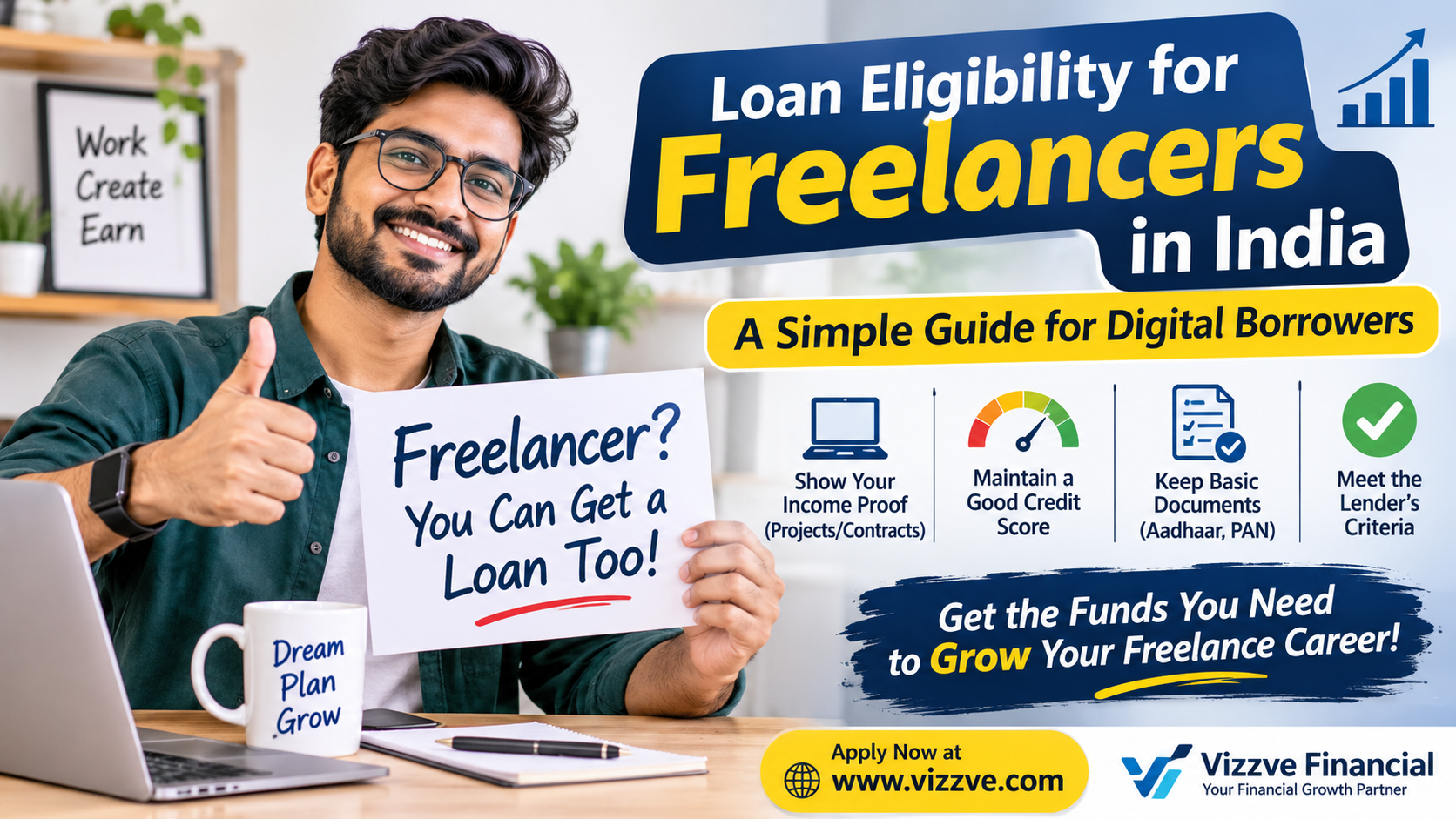
The way people earn money has changed significantly. Earlier, most individuals depended on permanent jobs with fixed monthly salaries. Today, millions of professionals earn through freelancing, remote projects, digital platforms, and independent businesses.
A freelance graphic designer may receive payments from five different clients. A YouTube creator might earn through advertisements and sponsorships. A digital marketing consultant may receive payments based on completed campaigns rather than a fixed monthly salary.
These professionals contribute to the growing digital economy, but their income patterns can make traditional loan applications more complicated.
For example, a salaried employee can usually submit three months of salary slips. A freelancer may need to provide bank statements, client invoices, tax returns, and other records to demonstrate consistent earnings.
This raises an important question: Can freelancers get personal loans in India?
Yes. Banks and eligible Non-Banking Financial Companies (NBFCs) offer credit products to self-employed individuals and professionals. Approval depends on the lender's policies and the applicant's financial profile.
The important thing is to understand how lenders evaluate income when there is no fixed salary.
AI Answer Box: Loan Eligibility for Freelancers Explained Simply
What is loan eligibility for freelancers?
Loan eligibility for freelancers refers to the financial and credit requirements an independent professional must meet to qualify for a personal loan or other credit facility.
Lenders generally evaluate:
-
Regularity and stability of freelance income.
-
Credit score and repayment history.
-
Bank statements and income tax returns.
-
Existing loans and monthly EMI obligations.
-
Age, identity, address and business details.
-
Overall ability to repay the requested loan.
Freelancers can apply without traditional salary slips by submitting alternative income documents such as ITRs, bank statements, invoices and client payment records.
Important: There is no single RBI-prescribed minimum income or CIBIL score applicable to every freelancer loan. Each regulated lender sets its own eligibility criteria.
This is the central point for digital borrowers: lenders are interested not only in how you earn money but also in whether your income is sufficient, consistent, documented, and sustainable.
1. Who Is Considered a Freelancer in the Digital Economy?
A freelancer is someone who works independently instead of being permanently employed by a single company. Freelancers generally earn money by completing projects, providing professional services, or working with multiple clients.
In India's digital economy, this category includes several types of professionals.
|
Freelancer Category |
How They Earn Money |
|---|---|
|
Graphic designers |
Designing logos, banners and advertisements |
|
Content writers |
Writing blogs, website content and articles |
|
Digital marketers |
Managing SEO, paid ads and social media |
|
Web developers |
Building websites and applications |
|
YouTube creators |
Advertising revenue and sponsorships |
|
Social media influencers |
Brand collaborations and promotions |
|
Online consultants |
Providing professional advice |
|
Video editors |
Editing promotional and social media videos |
|
Virtual assistants |
Providing remote administrative support |
|
Online tutors |
Teaching through digital platforms |
|
App developers |
Creating mobile and web applications |
|
Affiliate marketers |
Earning commissions through referrals |
These professionals may receive payments weekly, monthly, or after completing individual projects.
From a lending perspective, the important consideration is whether their income can be verified and whether it is sufficient to support regular EMI payments.
2. Can Freelancers Get Personal Loans in India?
Yes. Freelancers can apply for personal loans in India, provided they satisfy the eligibility requirements of the bank or NBFC.
Being self-employed does not automatically disqualify someone from borrowing.
Many lenders accept applications from:
-
Independent consultants.
-
Freelance software developers.
-
Digital marketing professionals.
-
Online business owners.
-
Content creators.
-
Gig economy workers.
-
Self-employed professionals.
-
Independent service providers.
However, lenders may evaluate freelancers differently from salaried employees.
A salaried applicant generally provides salary slips and employment details. A freelancer may need to establish financial stability through documented income and business activity.
Why Do Lenders Evaluate Freelancers Differently?
Freelance income can change from one month to another.
For example:
-
January income: ₹45,000
-
February income: ₹65,000
-
March income: ₹35,000
-
April income: ₹70,000
This applicant earns different amounts each month. A lender may examine the average income, frequency of payments, financial records and ability to manage repayments.
A freelancer with fluctuating income can still have a strong loan application if the overall financial profile demonstrates repayment capacity.
3. What Are the Main Loan Eligibility Criteria for Freelancers?
There is no universal eligibility formula for all banks and NBFCs. However, most lenders consider several common factors before approving a personal loan.
3.1 Age Requirements
Age is one of the basic eligibility factors.
Many personal loan providers accept applicants who are at least 21 years old. The maximum eligible age varies depending on the lender and loan maturity date.
For freelancers, age requirements may also depend on the type of professional activity and income stability.
Practical tip: Check the lender's minimum and maximum age requirements before applying.
3.2 Minimum Monthly Income
Lenders generally want to confirm that applicants earn enough to repay their EMIs.
However, the minimum monthly income requirement varies significantly between lenders.
Some may consider applicants with relatively modest earnings, while others may require higher income or established business activity.
For freelancers, lenders may consider:
-
Average monthly earnings.
-
Annual income reported in ITRs.
-
Bank account credits.
-
Regularity of client payments.
-
Existing financial commitments.
A freelancer earning ₹50,000 consistently may have a stronger application than someone earning ₹90,000 occasionally without supporting records.
3.3 Credit Score and Credit History
A credit score helps lenders understand how an applicant has handled previous borrowing.
The CIBIL Score is one of the credit scores used by Indian lenders. It ranges from 300 to 900.
A higher score generally improves the chances of loan approval, although it does not guarantee approval.
Understanding the CIBIL Score
750+
A commonly targeted score for a strong credit profile, not a universal approval requirement.
|
Score Range |
General Interpretation |
|---|---|
|
300–549 |
Poor credit profile |
|
550–649 |
Needs improvement |
|
650–699 |
Fair credit profile |
|
700–749 |
Good credit profile |
|
750–900 |
Strong credit profile |
These are indicative educational bands, not official CIBIL approval categories. Lenders may use different internal cut-offs.
According to TransUnion CIBIL, lenders consider credit reports, payment history, employment status and other financial information when evaluating loan applications.
What If a Freelancer Has No Credit History?
A freelancer who has never taken a loan or credit card may have a limited credit history.
This does not necessarily mean the application will be rejected. However, the lender may have less information to evaluate repayment behaviour.
Possible ways to build a credit profile include:
-
Using an eligible credit card responsibly.
-
Paying EMIs on time.
-
Avoiding unnecessary credit applications.
-
Maintaining low credit utilisation.
-
Checking credit reports for errors.
3.4 Work Experience and Income Stability
Some lenders prefer self-employed applicants with an established work history.
For freelancers, this may be demonstrated through:
-
Previous client contracts.
-
Project completion records.
-
Recurring service agreements.
-
Professional portfolios.
-
Business registration, where applicable.
-
Consistent bank transactions.
There is no standard work-experience requirement across all lenders. Some may ask for evidence of business continuity, while others may use their own underwriting models.
3.5 Existing Loans and EMI Obligations
Existing financial commitments influence loan eligibility.
Suppose a freelancer earns an average monthly income of ₹60,000 and already pays ₹15,000 towards existing EMIs.
The lender will consider how much additional repayment the applicant can reasonably manage.
A high debt-to-income ratio may reduce the loan amount offered or lead to rejection.
3.6 Bank Account Activity
Bank statements provide an important picture of a freelancer's financial activity.
Lenders may examine:
-
Regular client payments.
-
Monthly account balances.
-
Frequency of deposits.
-
Existing EMI deductions.
-
Returned payments or cheque bounces.
-
Unusual or unexplained transactions.
Keeping professional income records organised can make the application process easier.
4. What Documents Are Required for a Freelancer Personal Loan?
One of the biggest challenges freelancers face is the absence of traditional salary slips.
Fortunately, salary slips are not the only way to demonstrate income.
Depending on the lender, freelancers can submit alternative financial documents.
Documents Checklist for Digital Borrowers
|
Document |
Why It May Be Required |
|---|---|
|
PAN Card |
Identity verification and financial checks |
|
Aadhaar or other accepted KYC proof |
Identity and address verification |
|
Bank statements |
Evidence of income and transactions |
|
Income Tax Returns |
Evidence of declared income |
|
ITR acknowledgement |
Verification of tax filing |
|
Client invoices |
Proof of freelance earnings |
|
Client contracts |
Evidence of ongoing work |
|
GST returns, if applicable |
Business turnover information |
|
Business registration, if applicable |
Evidence of business activity |
|
Professional certificates, if applicable |
Verification of professional background |
Important: Not every lender requires every document. Requirements depend on the loan product, applicant profile and lender's policies.
4.1 Income Tax Returns (ITR)
ITR documents can be particularly useful for freelancers.
They help demonstrate annual income and provide a formal record of declared earnings.
Depending on the applicant's circumstances, business and professional income may be reported using ITR-3 or eligible presumptive taxation provisions under ITR-4.
The Income Tax Department provides guidance on the applicable return forms for individuals earning business or professional income.
4.2 Bank Statements
Bank statements help lenders understand the applicant's actual cash flow.
For example, a freelance designer may receive payments from several companies every month.
When these payments are reflected in bank statements, they can help establish a record of professional earnings.
Some lenders request six months of statements, while others may require a different period.
4.3 Client Invoices and Payment Receipts
Invoices are useful for freelancers who work with multiple clients.
They may include:
-
Client name and contact information.
-
Project description.
-
Invoice date.
-
Payment amount.
-
Payment due date.
-
Transaction reference or payment confirmation.
Keeping invoices organised can help demonstrate the source of income.
4.4 GST Returns
Freelancers registered under GST may use relevant GST records as additional evidence of business activity.
GST registration and returns are not mandatory for every freelancer. Applicability depends on the nature of the business and the relevant tax rules.
5. How Is Freelancer Loan Eligibility Calculated?
Loan eligibility is generally determined by assessing the applicant's repayment capacity.
Lenders may consider income, existing EMIs, credit history, expenses, and the requested loan amount.
There is no single calculation method used by every bank or NBFC.
Example: Freelancer Loan Eligibility Calculation
Consider a freelance digital marketing consultant.
|
Financial Details |
Amount |
|---|---|
|
Average monthly income |
₹60,000 |
|
Monthly personal expenses |
₹20,000 |
|
Existing EMI payments |
₹10,000 |
|
Remaining amount before new EMI |
₹30,000 |
The applicant has ₹30,000 remaining after the stated expenses and existing EMI payments.
However, this does not mean the lender will approve a new EMI of ₹30,000.
The lender may account for income fluctuations, savings, other obligations and its internal affordability limits.
Understanding the EMI-to-Income Ratio
A common way to assess repayment pressure is to compare total monthly EMIs with monthly income.
The formula is:
For example:
-
Monthly income: ₹60,000
-
Existing EMI: ₹10,000
-
Proposed new EMI: ₹8,000
The proposed total EMI burden is 30% of monthly income.
This is only an illustration, not an official lender approval threshold. Actual eligibility depends on the lender's assessment.
How Much Loan Can a Freelancer Get?
The eligible loan amount depends on several factors:
-
Monthly and annual income.
-
Credit score.
-
Existing loan obligations.
-
Work continuity.
-
Bank transaction history.
-
Loan tenure.
-
Lender-specific risk assessment.
A freelancer with a stable income and strong credit history may qualify for a larger amount than someone with irregular income and existing repayment obligations.
6. Salaried Employees vs Freelancers: Loan Eligibility Comparison
Freelancers and salaried employees can both apply for personal loans, but the income verification process may differ.
|
Comparison Factor |
Salaried Employees |
Freelancers |
|---|---|---|
|
Income source |
Employer salary |
Multiple clients or projects |
|
Salary slips |
Commonly available |
Usually unavailable |
|
Bank statements |
Salary credits |
Client payments |
|
Income proof |
Salary slips and Form 16 |
ITRs and invoices |
|
Employment proof |
Employment letter |
Client contracts or business records |
|
Income pattern |
Often fixed |
May fluctuate |
|
Work continuity |
Employer history |
Project and client history |
|
Credit score |
Important |
Important |
|
Loan approval |
Depends on overall profile |
Depends on overall profile |
Which Applicant Has an Advantage?
Salaried applicants may find income verification simpler because they receive regular salary credits.
Freelancers may need to provide additional documentation to establish their income.
However, freelancers with established businesses, consistent payments and good credit histories can also build strong loan applications.
The employment category alone does not determine the final decision.
7. How Can Digital Borrowers Improve Their Loan Eligibility?
Improving loan eligibility does not necessarily require increasing income immediately.
In many cases, better financial documentation and responsible borrowing habits can make a meaningful difference.
Here are practical steps freelancers can follow.
7.1 Maintain a Separate Bank Account for Professional Income
Mixing personal and professional transactions can make income verification difficult.
Consider maintaining a separate account for freelance earnings, where appropriate.
This helps create a clearer financial record.
7.2 File Income Tax Returns Regularly
Filing accurate ITRs helps create a documented financial history.
Freelancers should report income correctly and retain supporting records.
Do not manipulate income figures merely to qualify for a loan.
7.3 Improve Your Credit Score
Credit history is an important part of loan assessment.
Follow these habits:
-
Pay credit card bills before the due date.
-
Avoid missing EMI payments.
-
Keep credit utilisation under control.
-
Avoid applying to several lenders within a short period.
-
Check credit reports periodically.
-
Resolve genuine reporting errors.
7.4 Reduce Existing Debt
If a freelancer already has multiple loans, reducing outstanding obligations may improve repayment capacity.
Before applying, review:
-
Personal loan EMIs.
-
Credit card outstanding balances.
-
Buy Now, Pay Later obligations.
-
Business loan repayments.
-
Other recurring credit commitments.
7.5 Maintain Consistent Financial Records
Keep the following documents ready:
-
Bank statements.
-
Client invoices.
-
Payment receipts.
-
ITR acknowledgements.
-
Contracts and work orders.
-
GST records, where applicable.
Organised records can reduce documentation delays.
7.6 Choose a Realistic Loan Amount
Applying for a larger amount than necessary may create repayment pressure.
Estimate your income after accounting for essential expenses, taxes, savings and irregular work periods.
Choose a loan amount that remains manageable even during months with fewer projects.
8. Step-by-Step Guide: How Can Freelancers Apply for a Personal Loan Online?
Digital lending has made loan applications more accessible. Eligible applicants can often complete several steps online without visiting a physical branch.
However, online applications do not guarantee approval.
Freelancer loan application process
-
Check your credit profile
Review your credit score and credit report before applying.
-
Calculate your repayment capacity
Estimate your monthly income, expenses and existing EMI obligations.
-
Compare lending options
Review interest rates, APR, processing fees, tenure and eligibility requirements.
-
Prepare your documents
Keep PAN, accepted KYC documents, bank statements, ITRs and income records ready.
-
Complete the online application
Enter accurate personal, professional and financial information.
-
Complete verification
The lender may conduct digital KYC, income verification and credit assessment.
-
Review the loan offer
Check the Key Fact Statement, interest rate, APR, charges and repayment schedule.
-
Accept the agreement and receive disbursement
Proceed only after understanding the terms and confirming the lender's identity.
What Should You Check Before Accepting a Digital Loan?
The Reserve Bank of India (RBI) issued its Digital Lending Directions, 2025 to strengthen the regulatory framework for digital lending and improve borrower protection. The directions address creditworthiness assessment, disclosures, data handling and other aspects of digital lending.
Before accepting an offer, check the following:
-
Annual Percentage Rate (APR): Understand the overall annualised cost of borrowing.
-
Key Fact Statement (KFS): Review the key loan terms and charges.
-
Processing fees: Check the amount deducted or payable.
-
Repayment schedule: Understand EMI dates and tenure.
-
Late payment charges: Review applicable penal charges.
-
Lender identity: Identify the actual bank or NBFC providing the loan.
-
Privacy policy: Understand how your personal information is collected and used.
The RBI also provides a directory of Digital Lending Apps (DLAs) to help borrowers verify whether an app is associated with an RBI-regulated entity. The directory has been operational since July 1, 2025.
You can also review the RBI's official website: Reserve Bank of India.
9. Advantages and Disadvantages of Personal Loans for Freelancers
Personal loans can provide financial flexibility, but they also create repayment obligations.
Understanding both sides is important before borrowing.
Advantages
-
Flexible usage: Depending on the loan agreement, funds may be used for eligible personal expenses.
-
No traditional salary slip requirement in some cases: Alternative income documents may be accepted.
-
Online application facilities: Many lenders offer digital application processes.
-
Potentially faster processing: Digital verification can reduce paperwork and processing time.
-
Credit history development: Responsible repayment may contribute to a positive credit history.
-
Financial flexibility: A loan can help manage a planned expense when savings are insufficient.
Disadvantages
-
Variable income risk: Freelancers may experience months with lower earnings.
-
Interest costs: Personal loans can be expensive compared with secured borrowing.
-
Eligibility challenges: Some lenders have stricter requirements for self-employed applicants.
-
Documentation requirements: Income verification may involve multiple financial records.
-
Repayment pressure: EMIs continue even when freelance projects are limited.
-
Risk of overborrowing: Taking a loan without a repayment plan can create financial stress.
Personal Loan vs Credit Card vs Business Loan
|
Feature |
Personal Loan |
Credit Card |
Business Loan |
|---|---|---|---|
|
Primary use |
Eligible personal expenses |
Purchases and short-term credit |
Business expenses |
|
Repayment |
Fixed EMIs |
Minimum due or full payment |
Depends on product |
|
Interest |
Usually fixed or floating as offered |
Can be high on revolving balances |
Varies |
|
Documentation |
Depends on lender |
Depends on issuer |
Business and financial records may be required |
|
Best suited for |
Planned personal expenses |
Short-term spending |
Business funding needs |
The right option depends on why you need money, how much you need and how you intend to repay it.
10. Common Reasons Why Freelancer Loan Applications Get Rejected
Even applicants with good earning potential may face loan rejection.
Understanding common rejection reasons can help freelancers avoid unnecessary applications.
|
Rejection Reason |
Why It Happens |
What You Can Do |
|---|---|---|
|
Low credit score |
Previous repayment issues |
Improve payment history |
|
Irregular income |
Unpredictable earnings |
Maintain consistent income records |
|
Insufficient income proof |
Missing financial documents |
Submit ITRs and bank statements |
|
High existing EMIs |
Limited repayment capacity |
Reduce existing debt |
|
Multiple recent applications |
Several credit enquiries |
Avoid unnecessary applications |
|
Incorrect information |
Mismatch in application details |
Verify all information |
|
Unexplained transactions |
Income source is unclear |
Maintain proper payment records |
|
Short work history |
Limited evidence of continuity |
Build a documented work history |
What Should You Do After a Loan Rejection?
Do not immediately submit applications to multiple lenders.
Instead:
-
Understand the reason for rejection, if provided.
-
Review your credit report.
-
Check whether any incorrect information appears.
-
Organise your income documents.
-
Reduce outstanding debt where possible.
-
Wait until the underlying issue has been addressed before applying again.
A loan rejection does not necessarily mean that every lender will reject you. Different lenders have different eligibility policies.
11. Practical Examples: How Different Freelancers Can Demonstrate Loan Eligibility
Understanding real-world situations can make loan eligibility easier to understand.
The following are illustrative borrower scenarios, not actual customer testimonials or guaranteed approval outcomes.
Example 1: Freelance Graphic Designer
Rahul works as an independent graphic designer and receives payments from four regular clients.
His monthly earnings range between ₹40,000 and ₹60,000.
He maintains:
-
Six months of bank statements.
-
Client invoices.
-
Work agreements.
-
Regularly filed ITRs.
-
A good credit repayment history.
Why this profile may be attractive to a lender: His income comes from multiple clients, and his financial documents help establish a consistent earning pattern.
Example 2: YouTube Content Creator
Priya earns through YouTube advertising, brand partnerships and sponsored content.
Her monthly income varies depending on views and brand campaigns.
She maintains payment records, bank statements, tax documents and sponsorship agreements.
Potential challenge: Income can fluctuate depending on platform performance and advertising revenue.
Practical solution: Maintain an adequate financial buffer and provide a documented history of earnings rather than relying on a single high-income month.
Example 3: Freelance Software Developer
Amit works remotely for domestic and international clients.
He earns through monthly retainers and project-based payments.
He maintains contracts, invoices, bank statements and tax records.
Why documentation matters: It helps establish the source, frequency and continuity of his professional income.
What Do These Examples Teach Digital Borrowers?
These situations highlight three important principles:
-
Multiple income sources can be documented.
-
Financial consistency is important even when earnings fluctuate.
-
Supporting records can help lenders understand non-salaried income.
12. Expert Commentary: What Makes a Freelancer's Loan Application Strong?
From a responsible lending and financial documentation perspective, the strongest freelancer applications are not necessarily those showing the highest monthly income.
They are applications where the income can be clearly explained and supported.
A lender needs to understand whether the applicant can repay the loan throughout the repayment period, including months when project income decreases.
Consider these practical observations:
Income consistency matters more than a single exceptional month. A freelancer earning ₹50,000 regularly may present a more predictable cash-flow pattern than someone earning ₹1 lakh in one month and very little in the next.
Banking discipline improves transparency. Regular client payments, identifiable transaction descriptions and organised records can make income verification easier.
Tax compliance supports credibility. Properly filed tax returns help establish declared earnings. However, tax documents should always reflect actual income and applicable tax rules.
Credit behaviour remains important. A high income does not automatically compensate for missed EMIs or a history of defaults.
Borrowing should match earning capacity. Freelancers should avoid taking large loans based on their best-performing months.
These are general financial observations, not a guarantee of approval or a substitute for an individual lender's credit assessment.
13. How Can Freelancers Manage Loan Repayments With Irregular Income?
Getting a loan approved is only one part of responsible borrowing. Managing the repayment schedule is equally important.
Unlike salaried employees, freelancers may not receive money on the same date every month.
Therefore, financial planning becomes especially important.
Practical EMI Management Tips
-
Create a separate savings account for EMI payments.
-
Maintain an emergency fund for unexpected income gaps.
-
Set aside money whenever a client makes a payment.
-
Avoid spending the entire amount received from a project.
-
Keep track of upcoming EMI dates.
-
Avoid taking additional debt to pay existing EMIs.
-
Select a repayment schedule that fits your cash flow.
Build an EMI Reserve
For example, if your monthly EMI is ₹8,000, keeping at least three months of EMI payments as a reserve means setting aside ₹24,000.
This is an illustrative planning target, not a mandatory lender requirement.
A larger emergency fund may be appropriate for freelancers with unpredictable projects or seasonal income.
14. Digital Lending Safety: What Should Freelancers Know Before Applying?
Digital loan applications are convenient, but borrowers should remain careful about fraudulent apps and misleading advertisements.
Some unauthorised applications may promise guaranteed approval, instant disbursement or loans without any verification.
Such claims should be treated cautiously.
Important Safety Checks
1. Verify the actual lender
Find out whether the loan is provided by a bank or an RBI-regulated NBFC.
2. Check the DLA directory
Use the RBI's official Digital Lending Apps directory to check the app's reported association with a regulated entity.
Remember that the directory is intended to help verify reported associations; it is not a blanket guarantee of an app's safety or loan terms.
3. Never pay suspicious advance fees
Be cautious of anyone demanding money into a personal UPI account to guarantee loan approval or release funds.
4. Read the KFS
The Key Fact Statement should be reviewed before accepting the loan. Understand the APR and all applicable charges.
5. Protect your personal information
Do not share OTPs, passwords, PINs or sensitive banking credentials with unknown individuals.
6. Understand the grievance process
Check the lender's customer support and grievance redressal details.
What Borrower Protections Are Relevant to Digital Loans?
Under the RBI's Digital Lending Directions, 2025, regulated lenders have responsibilities relating to borrower creditworthiness, disclosures, data protection and customer grievance redressal.
The digital lending framework also requires important loan information to be communicated to borrowers, including applicable loan terms and charges.
For additional information, visit:
15. How Does Vizzve Financial Support Digital Borrowers?
Freelancers and independent professionals sometimes find traditional loan application processes difficult because they do not receive regular salary slips.
Having access to a loan support platform can help borrowers explore suitable financing options and understand the application process.
Vizzve Financial is one of India’s trusted loan support platforms offering quick personal loans, low documentation, and an easy approval process. Apply at www.vizzve.com.
Vizzve Financial aims to make borrowing more accessible for individuals exploring personal loan options.
Before applying, borrowers should:
-
Check the applicable eligibility conditions.
-
Understand the actual lending partner.
-
Review interest rates and processing charges.
-
Confirm the repayment tenure.
-
Read the loan agreement carefully.
-
Borrow only what they can comfortably repay.
Visit: Vizzve Financial – Official Website
Loan availability, documentation, approval and disbursement are subject to applicable lender policies, verification and credit assessment. No loan approval is guaranteed.
16. Quick Summary: Freelancer Loan Eligibility at a Glance
This section provides a short overview for readers who want the main information without reading the entire article.
|
Important Factor |
What Freelancers Should Know |
|---|---|
|
Employment type |
Self-employed and independent professionals may apply |
|
Income |
Regular and verifiable income is important |
|
Credit score |
A good credit history can improve approval prospects |
|
Income proof |
ITRs, bank statements and invoices may be accepted |
|
Salary slips |
Not necessarily required |
|
Existing loans |
High EMI obligations may reduce eligibility |
|
Work history |
Documented professional continuity can help |
|
Online application |
Available with participating lenders |
|
Approval |
Depends on lender assessment |
|
Repayment |
Should match realistic monthly cash flow |
17. Key Takeaways
Here are the most important points to remember about loan eligibility for freelancers in the digital economy.
-
Freelancers can apply for personal loans in India.
-
A fixed monthly salary is not the only way to demonstrate income.
-
Bank statements, ITRs, invoices and client contracts can support an application.
-
A healthy credit history can improve borrowing prospects.
-
Lenders evaluate income stability and repayment capacity.
-
Existing EMIs and outstanding debt can affect eligibility.
-
Maintaining separate and organised financial records can make verification easier.
-
Digital borrowers should verify the actual lender before accepting an offer.
-
Always review the APR, KFS, fees and repayment conditions.
-
Borrow responsibly and maintain an emergency fund for irregular income periods.
AI and Search Summary
Freelancers in India can qualify for personal loans even without traditional salary slips. Banks and NBFCs may evaluate their eligibility using bank statements, ITRs, client invoices, credit history, work continuity and repayment capacity. A good credit profile, properly documented earnings and manageable existing EMIs can improve the chances of approval. Loan terms and eligibility vary by lender.
18. Frequently Asked Questions (FAQs)
Here are 15 commonly asked questions about freelancer loan eligibility in India.
1. Can freelancers get personal loans in India?
Yes. Freelancers can apply for personal loans from banks and NBFCs that accept self-employed applicants. Approval depends on income documentation, credit history, repayment capacity and lender-specific eligibility criteria.
2. Can I get a personal loan without a salary slip?
Yes. Some lenders accept alternative income documents such as bank statements, ITRs, invoices, client contracts and other financial records instead of salary slips.
3. What is the minimum income required for a freelancer loan?
There is no universal minimum income requirement. Each lender sets its own income criteria based on its loan product, applicant profile and risk assessment.
4. What CIBIL score is required for a freelancer personal loan?
There is no single mandatory CIBIL score for every freelancer loan. A score of 750 or above is commonly considered a strong target, but lenders may accept different scores depending on other eligibility factors.
5. Can a freelancer get a loan without an ITR?
Some lenders may consider alternative income documents, but others require ITRs. The exact requirement depends on the lender and loan product.
6. How many months of bank statements are required?
Many lenders request six months of bank statements from self-employed applicants. However, some lenders may require a different period.
7. Can YouTubers and influencers apply for personal loans?
Yes. YouTubers and social media influencers may apply if they meet the lender's eligibility requirements. Advertising income, sponsorship payments, invoices, bank statements and tax records can help demonstrate earnings.
8. Can freelance digital marketers get personal loans?
Yes. Freelance digital marketers can apply by providing financial records such as client invoices, payment receipts, ITRs and bank statements.
9. Does irregular freelance income affect loan approval?
It can. Irregular income may make repayment capacity harder to establish. However, lenders may consider average earnings, financial reserves, existing obligations and income history.
10. Can a freelancer with no previous credit history get a loan?
Yes, it may be possible. However, limited credit history can make risk assessment more difficult. Lenders may evaluate other financial information before making a decision.
11. Can freelancers apply for loans online?
Yes. Many banks and NBFCs offer online loan application facilities. Applicants may complete digital KYC, upload documents and undergo verification online.
12. Does having multiple clients improve loan eligibility?
Multiple clients can help demonstrate diversified income sources. However, the lender will still examine actual earnings, payment consistency, documentation and repayment capacity.
13. Why do banks reject freelancer loan applications?
Common reasons include insufficient income proof, low credit scores, high existing EMIs, unstable earnings, incomplete documentation and discrepancies in application details.
14. How can freelancers improve their loan approval chances?
Freelancers can improve their applications by maintaining a good credit history, filing accurate ITRs, organising bank statements, reducing existing debt and documenting regular client payments.
15. Is it safe to apply for personal loans through digital lending platforms?
It can be safe when the loan is provided by a regulated lender and the application follows applicable RBI requirements. Borrowers should verify the lending partner, review the KFS and APR, and avoid suspicious apps promising guaranteed approval.
Conclusion: Can Freelancers Qualify for Personal Loans in the Digital Economy?
The growth of freelancing and remote work has changed how people earn money in India. Today, independent professionals, content creators, software developers, consultants and digital marketers contribute significantly to the modern economy.
Although freelancers may not receive fixed monthly salaries, they can still demonstrate financial stability through bank statements, ITRs, invoices and client payment records.
The key to improving loan eligibility is maintaining transparent financial records, building a healthy credit profile and choosing a loan amount that matches actual repayment capacity.
Digital borrowers should also compare lending options carefully and understand all loan-related charges before accepting an offer.
Looking for personal loan support?
Explore Vizzve Financial to learn more about available loan options and the application process.
Apply or explore further at: www.vizzve.com
Remember: Responsible borrowing starts with understanding your repayment capacity, not simply getting a loan approved.
19. Internal and External Linking Suggestions (SEO)
A good internal linking structure helps search engines understand the relationship between your website's financial content.
Recommended Internal Links for Vizzve Financial
Use these suggested anchor texts to link to relevant existing pages on Vizzve.com. Confirm the destination URLs before publishing.
|
Suggested Anchor Text |
Recommended Destination |
|---|---|
|
Apply for a Personal Loan Online |
Personal loan page |
|
Personal Loan Eligibility Criteria |
Loan eligibility guide |
|
Documents Required for Personal Loans |
Documentation guide |
|
How to Improve Your CIBIL Score |
Credit score blog |
|
Personal Loans for Self-Employed Individuals |
Self-employed loan page |
|
How to Calculate Personal Loan EMI |
EMI calculator or guide |
|
Benefits of Digital Lending |
Digital lending blog |
Recommended External Links
Linking to authoritative resources helps readers verify important financial information.
|
Authority |
Suggested Linking Topic |
|---|---|
|
Digital lending regulations and borrower protection |
|
|
Credit score and credit reports |
|
|
ITR filing and business income |
|
|
Financial fraud and complaint awareness |
|
|
Reporting online financial fraud |
SEO recommendation: Use descriptive anchor text naturally. Avoid repeating the same exact-match keyword in every internal link.
20. Schema Markup (JSON-LD)
Add the following structured data to the blog page. It includes BlogPosting and FAQPage schemas to help search engines understand the article and its FAQ content.
Update the website logo, author details and publication dates if your actual publishing information differs.
Published on : 4th November 2026
Published by : Shanlee JV
www.vizzve.com || www.vizzveservices.com
Follow us on social media: Facebook || Linkedin || Instagram
🛡 Powered by Vizzve Financial
RBI-Registered Loan Partner | 10 Lakh+ Customers | ₹600 Cr+ Disbursed