

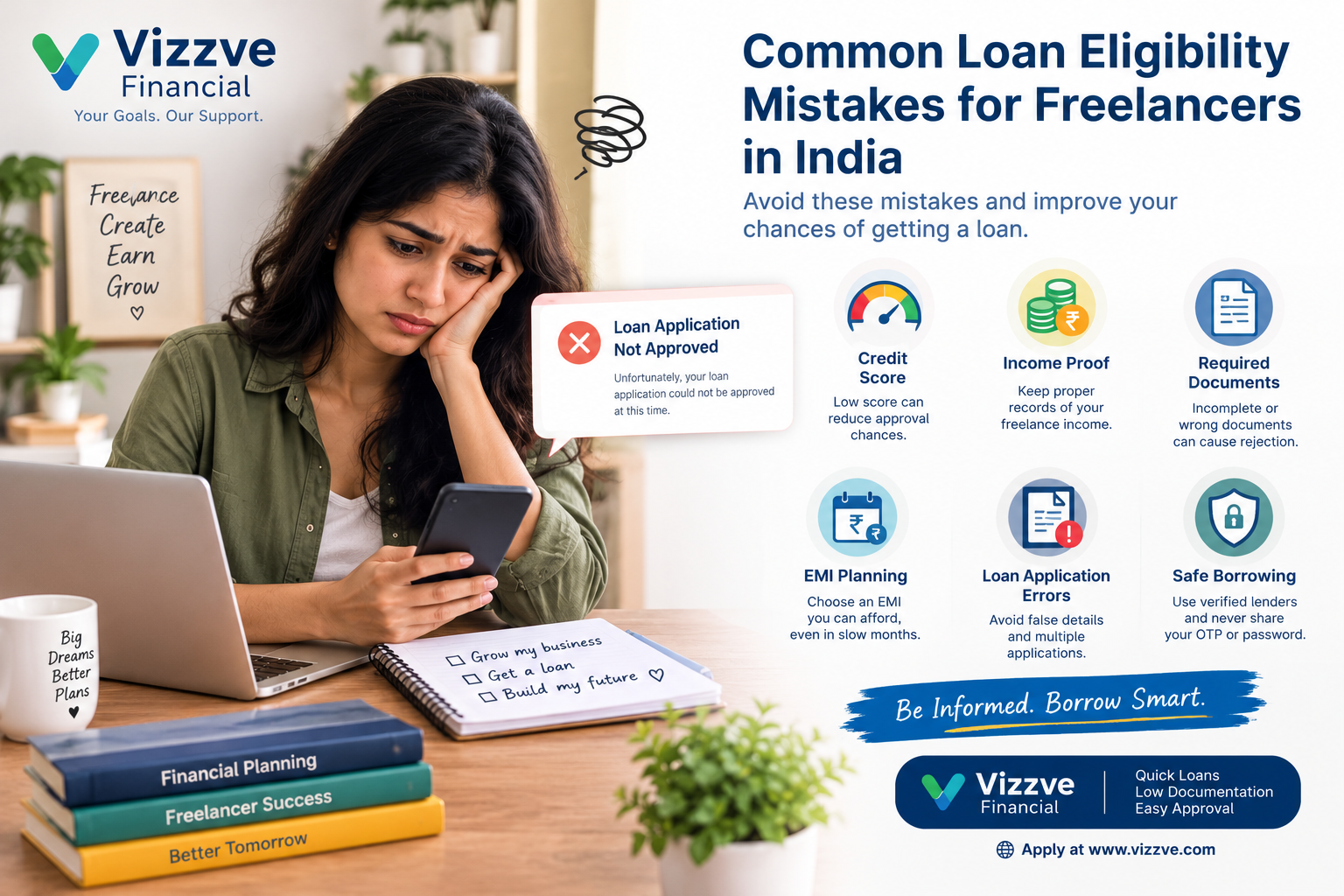
Freelancing gives people the freedom to work with different clients and earn money through their skills. However, applying for a personal loan can sometimes be difficult because freelance income may change from month to month.
Many freelancers make simple mistakes that weaken their loan applications. These include keeping poor income records, ignoring their credit reports, applying for loans without checking eligibility, and choosing EMIs they cannot comfortably afford.
The good news is that many of these mistakes can be avoided with better planning.
This guide explains the common mistakes freelancers make when applying for loans in India, how to avoid them, and what to check before submitting an application.
AI Answer Box: What Are the Common Mistakes Freelancers Make When Applying for Loans?
The most common mistakes are failing to maintain income proof, ignoring credit history, submitting incomplete documents, applying to multiple lenders without research, and borrowing more than they can repay.
Freelancers can improve their applications by maintaining clear bank records, keeping invoices and tax documents ready, checking their credit reports, and choosing a loan amount that fits their income.
Quick answer: Before applying for a personal loan, check the lender's eligibility rules, required documents, interest rate, fees, EMI, and total repayment amount. Loan approval is never guaranteed.
Key Takeaways
-
Maintain clear records of freelance income and client payments.
-
Check your credit report before applying.
-
Submit complete and accurate documents.
-
Avoid making many loan applications without comparing lenders.
-
Choose an EMI that remains manageable during low-income months.
-
Read the Key Facts Statement (KFS) before accepting a digital loan.
-
Use verified lenders and never share your banking passwords or OTPs.
Common Mistakes Freelancers Should Avoid
Not keeping proper income proof
Freelancers may receive money from several clients, sometimes through different payment methods. If income records are incomplete, it may be harder for a lender to verify earnings.
How to avoid it:
-
Keep invoices and payment receipts.
-
Use bank accounts to maintain clear records of client payments.
-
Save client contracts and work orders.
-
Keep tax returns and other income records where applicable.
Ignoring your credit score
Your credit report contains information about your borrowing and repayment history. Lenders may use it when assessing a loan application.
A low score, missed payments, or incorrect information on the report may affect the application.
How to avoid it:
-
Check your credit report before applying.
-
Pay existing EMIs and credit card bills on time.
-
Dispute incorrect entries with the relevant credit bureau.
-
Avoid unnecessary borrowing.
Applying without checking eligibility
Every lender has its own eligibility criteria. Applying without checking them can waste time and may lead to an unsuccessful application.
How to avoid it:
Read the lender's requirements for income, age, documents, credit history, and repayment capacity. Use eligibility calculators where available, but remember that estimates do not guarantee approval.
Submitting incomplete or incorrect documents
Small mistakes, such as a name mismatch, incorrect contact details, or missing bank statements, may delay verification.
How to avoid it:
-
Check all details before submitting the application.
-
Make sure uploaded documents are readable.
-
Ensure your personal details match your official records.
-
Provide accurate income information and answer questions honestly.
Never change figures or create false invoices to improve your eligibility. Incorrect information can lead to rejection and other problems.
Borrowing more than you need
A larger loan may look attractive, but it also increases repayment responsibility.
For example, a freelancer earning ₹30,000 in a low-income month may struggle with a large EMI after rent, food, taxes, and work expenses are paid.
How to avoid it: Estimate your essential expenses and existing EMIs first. Borrow only what you need and can repay comfortably.
Choosing a loan based only on the interest rate
A low advertised interest rate does not always mean the lowest total cost. Processing fees and other applicable charges may make another offer more expensive.
Compare the APR, total repayment, net amount you receive, and the terms listed in the KFS before making a decision. RBI's Digital Lending Directions, 2025, set out disclosure requirements for regulated digital lending.

Making too many loan applications
Applying to several lenders within a short period may result in multiple credit enquiries. These enquiries form part of your credit report and may be considered during credit assessment.
How to avoid it: Compare available offers and eligibility requirements first. Apply selectively rather than submitting applications everywhere.
Ignoring existing loans and credit card balances
Lenders may consider your existing EMIs and debt obligations when assessing whether you can afford another loan.
Before applying, calculate how much of your monthly income is already committed to repayments. Do not rely on your best earning month alone.
Failing to plan for irregular income
A freelancer may earn ₹50,000 in one month and much less in the next. Planning an EMI around the highest income month can create repayment problems.
How to avoid it:
-
Review income over several months.
-
Keep an emergency fund if possible.
-
Allow for essential business expenses and taxes.
-
Choose an EMI that is manageable during slower periods.
Trusting every online loan advertisement
Some websites or apps may promise guaranteed approval or demand unexplained upfront payments.
How to avoid it:
-
Verify the actual bank or NBFC providing the loan.
-
Check the platform's relationship with the lender.
-
Read the privacy policy and loan agreement.
-
Never share your OTP, PIN, or banking password.
-
Use official complaint channels if you suspect fraud.
The Government of India has highlighted the RBI's Digital Lending App directory as a resource to help consumers verify an app's claimed association with a regulated entity. The directory is an aid to verification, not a guarantee that every aspect of an app is safe.
Quick Comparison: Mistakes vs Better Practices
|
Common mistake |
Better practice |
|---|---|
|
No clear income records |
Maintain invoices and bank statements |
|
Ignoring credit history |
Review your credit report |
|
Applying without research |
Check eligibility before applying |
|
Missing documents |
Prepare a complete application |
|
Borrowing too much |
Choose an affordable loan amount |
|
Comparing only interest rates |
Compare APR and total repayment |
|
Applying everywhere |
Make selective applications |
|
No repayment plan |
Budget for low-income months |
|
Trusting guaranteed approval claims |
Verify the lender and platform |
Pros and Cons of Preparing Before Applying
|
Pros |
Cons or limitations |
|---|---|
|
Better-organised documents |
Collecting records takes time |
|
Clearer understanding of loan costs |
Comparing offers requires effort |
|
Fewer avoidable application errors |
Preparation cannot guarantee approval |
|
More realistic repayment planning |
Income may still fluctuate |
|
Better awareness of online loan risks |
Lender criteria can differ |
Preparation improves your readiness, but the final decision remains with the lender.
Step-by-Step Guide to Avoid Freelancer Loan Rejection
Organise your financial records
Collect bank statements, invoices, client payment records, and tax documents where applicable.
Review your credit report
Check repayment history, outstanding balances, and unfamiliar enquiries.
Calculate an affordable EMI
Estimate your income after essential expenses and existing debt repayments.
Compare verified lenders
Review eligibility criteria, interest, fees, APR, and repayment terms.
Check everything before accepting
Read the KFS and agreement, confirm the actual lender, and keep copies of your loan documents.
Expert Commentary: What Matters Most for Freelancer Loan Eligibility?
The most useful approach is to present a clear picture of your finances. A lender needs to assess whether your income and repayment capacity support the requested loan.
For freelancers, three habits are especially helpful:
-
Consistency: Maintain organised records that explain your income.
-
Accuracy: Make sure the information in your application matches your documents.
-
Affordability: Choose repayments based on realistic earnings, not an unusually profitable month.
A real-world example
Imagine a freelance graphic designer earns ₹40,000 in one month and ₹24,000 in another. The designer has no salary slip but keeps invoices, client contracts, and bank statements.
Instead of applying immediately for a large loan, the designer reviews income records, checks existing debt, and estimates an EMI that could remain manageable during a slower month.
This preparation gives the lender clearer information to assess. It does not guarantee approval, but it can help the applicant avoid preventable mistakes.
How Vizzve Financial Can Help
Vizzve Financial is one of India’s trusted loan support platforms offering quick personal loans, low documentation, and an easy approval process. Apply at www.vizzve.com.
Freelancers should review the available loan options, eligibility conditions, actual lending partner, required documents, and repayment terms before applying. Approval and loan costs depend on the applicable lender's policies and assessment.
Frequently Asked Questions
Can freelancers get personal loans in India?
Yes. Freelancers may qualify for personal loans if they meet the lender's income verification, credit assessment, documentation, and repayment requirements.
Why do freelancer loan applications get rejected?
Common reasons include insufficient verified income, incomplete documents, existing debt, credit history concerns, or not meeting the lender's eligibility criteria. The actual reason depends on the lender.
What documents should freelancers keep ready?
Freelancers may need PAN, identity and address proof, bank statements, client invoices, contracts, and tax returns where applicable. Requirements vary by lender.
Can I get a loan without salary slips?
Possibly. Some lenders accept alternative income evidence, such as bank statements, invoices, client contracts, or tax records. Approval depends on the lender's policies.
Does a low credit score always lead to rejection?
No. Lenders have different assessment policies, but a low score can make approval more difficult or affect the terms offered. Approval is never guaranteed.
How can freelancers improve their loan eligibility?
Maintain clear income records, pay existing debts on time, correct errors in credit reports, submit accurate documents, and apply for an amount that fits your repayment capacity.
Is applying to multiple lenders a good idea?
It is better to compare eligibility criteria and offers before applying. Multiple applications may create several credit enquiries, which lenders can consider during their assessment.
What is the biggest mistake when choosing a personal loan?
Looking only at the interest rate. Always review APR, processing fees, total repayment, net disbursement, and other applicable charges.
How much EMI should a freelancer choose?
There is no universal EMI limit suitable for everyone. Consider average income, essential expenses, existing EMIs, taxes, and the possibility of delayed client payments before deciding.
Is it safe to apply for a freelancer loan online?
It can be safe when you use a verified lender or authorised platform, review the loan documents, protect sensitive credentials, and understand all charges before accepting the offer.
Conclusion
Freelancers can improve their loan application readiness by avoiding common mistakes such as poor income records, incomplete documents, unchecked credit reports, and unrealistic repayment plans.
The best approach is simple: organise your finances, check eligibility, compare the full cost of borrowing, and choose an EMI you can manage even when income is lower.
Explore available loan support options at Vizzve Financial and review the applicable terms carefully before applying.
Published on : 19th October
Published by : MD HEDAYATULLAH
www.vizzve.com || www.vizzveservices.com
Follow us on social media: Facebook || Linkedin || Instagram
🛡 Powered by Vizzve Financial
RBI-Registered Loan Partner | 10 Lakh+ Customers | ₹600 Cr+ Disbursed