

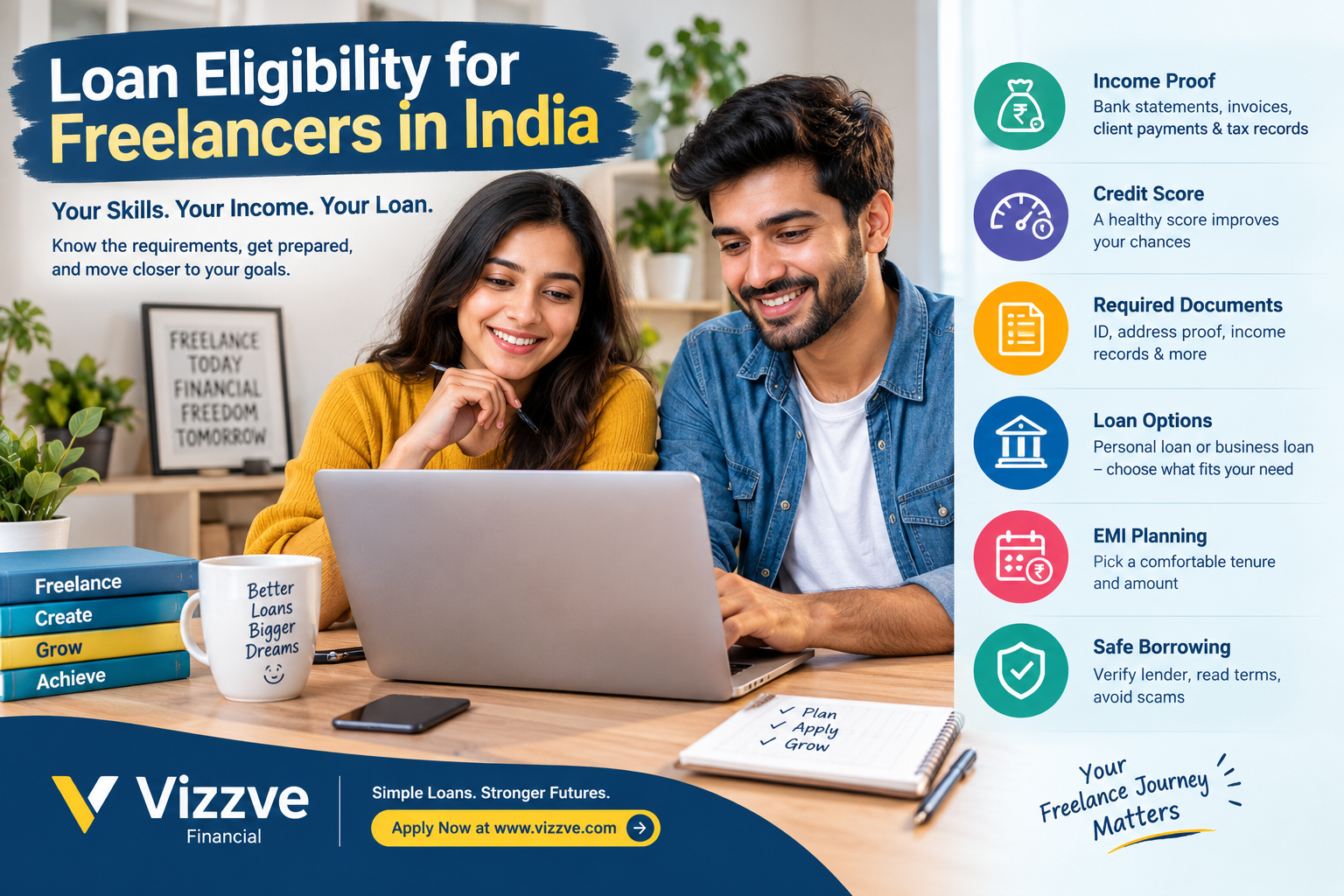
Freelancers often earn money from different clients instead of receiving a fixed monthly salary. This flexibility can make it harder to prove income when applying for a loan, but it does not automatically prevent them from getting one.
In India, freelancers may qualify for personal loans or business loans, depending on the lender’s rules, income stability, credit history, and repayment capacity.
This guide explains the main eligibility requirements, documents, costs, and application steps in simple language.
AI Answer Box: How Can Freelancers Get a Loan in India?
Freelancers can apply for a personal or business loan if they meet the lender’s eligibility requirements. Lenders may review age, income, bank statements, client payments, tax records, credit history, existing EMIs, and repayment capacity.
Freelancers can often use bank statements, invoices, client contracts, tax returns, and other accepted financial records instead of a salary slip. Requirements vary by lender, and approval is not guaranteed.
Quick answer: Keep your income records organised, maintain a healthy credit history, choose an affordable EMI, and compare the lender’s interest rate, fees, and terms before applying.
What Is Loan Eligibility for Freelancers?
Loan eligibility means the conditions a lender uses to decide whether an applicant may qualify for credit. Since freelancers do not always have a fixed salary, lenders may assess their financial records differently from those of salaried employees.
| Eligibility factor | What lenders may check |
|---|---|
| Age | Whether the applicant meets the lender’s minimum and maximum age limits |
| Income | Average earnings and ability to repay |
| Work history | Duration and consistency of freelance work |
| Bank statements | Client payments, balances, and regular expenses |
| Credit history | Previous repayments, defaults, and outstanding debt |
| Documents | Identity, address, income, and tax records |
| Existing EMIs | Whether the applicant can manage another repayment |
There is no single eligibility rule for every lender in India. Always check the requirements of the specific bank or regulated lending institution.
What Documents Do Freelancers Need for a Loan?
Freelancers may not have payslips, but they can use other documents to demonstrate their financial position.
Commonly requested documents
-
Identity proof: PAN and an accepted identity document.
-
Address proof: A document accepted by the lender for address verification.
-
Bank statements: Recent statements showing client payments and financial activity.
-
Invoices: Records of work completed and amounts billed to clients.
-
Client contracts: Agreements showing ongoing or completed projects.
-
Tax records: Income tax returns or other accepted tax documents, where applicable.
-
Business records: Registration or business-related documents if required for the loan type.
Not every lender asks for every document. Submit genuine, accurate records and never alter bank statements or invoices to improve your chances.
Can Freelancers Get a Loan Without a Salary Slip?
Yes, some lenders accept alternative income evidence because freelancers and independent professionals may not receive salary slips.
Possible alternatives include:
-
Bank statements showing incoming client payments.
-
Invoices and payment receipts.
-
Client agreements or work contracts.
-
Income tax returns, where available.
-
Other financial records accepted by the lender.
However, not needing a salary slip does not mean a loan is available without income verification. The lender may still require proof that your income is sufficient and reasonably consistent.
What Credit Score Do Freelancers Need?
A credit score helps lenders understand how an applicant has managed borrowing in the past. In India, credit information companies such as TransUnion CIBIL provide credit reports and scores.
A score of 750 or above is often considered a strong benchmark, but it is not a universal approval requirement. Some lenders use different cut-offs and assess other factors as well.
Ways to improve your credit profile
-
Pay loan EMIs and credit card bills on time.
-
Keep credit card balances manageable.
-
Avoid applying for many loans within a short period.
-
Check your credit report for errors.
-
Review overdue accounts and resolve inaccuracies through the relevant lender or credit bureau.
A strong score can help, but approval still depends on the lender’s complete assessment.
How Do Lenders Check Freelance Income?
Freelance earnings can change from month to month. A lender may therefore look beyond a single payment and review the broader pattern of income.
Income evidence that can help
Bank statements: These show when clients pay you and how your money moves.
Invoices and contracts: These help connect payments to actual work.
Tax returns: These may provide additional evidence of declared income.
Work history: A consistent record of completed projects can help explain your earning pattern.
Practical example
Suppose a graphic designer earns ₹35,000 in one month, ₹48,000 in another, and ₹42,000 in the next. Instead of relying on one month’s income, a lender may examine several months of records and other evidence to understand the applicant’s earning pattern.
This is only an illustration. Lenders can calculate eligible income differently and may not count every receipt as qualifying income.
Personal Loan vs Business Loan for Freelancers
The right loan depends on why you need the money and which products you qualify for.
| Feature | Personal loan | Business loan |
|---|---|---|
| Main purpose | Personal expenses, emergencies, or other permitted uses | Business or professional expenses |
| Income assessment | Personal income and repayment capacity | Business income and financial records |
| Documents | Personal KYC and accepted income evidence | KYC plus business-related records, as required |
| Security | Often unsecured, subject to lender terms | May be secured or unsecured |
| Suitable for | Eligible freelancers with personal borrowing needs | Eligible freelancers funding professional activities |
A business loan is not automatically cheaper than a personal loan. Compare the total cost, permitted use, repayment schedule, and eligibility conditions.
How Much Loan Can a Freelancer Get?
There is no fixed loan amount for all freelancers. The amount offered depends on the lender’s policy and your financial profile.
Lenders may consider:
-
Average eligible income.
-
Regular household and business expenses.
-
Existing loans and monthly EMIs.
-
Credit history.
-
Work stability and supporting documents.
-
The selected loan product and its limits.
Tip: Do not borrow the maximum amount offered simply because it is available. Choose an amount that fits your real budget.
Loan Interest Rates, Fees, and EMI Planning
Before accepting a loan, understand its total cost rather than looking only at the advertised interest rate.
| Cost or term | What to check |
|---|---|
| Interest rate | Whether the rate is fixed or variable, where applicable |
| Processing fee | Amount charged for processing the application |
| APR | The annualised cost of borrowing, including applicable charges |
| Loan tenure | How long you will make repayments |
| EMI | The monthly amount due |
| Late-payment charges | Charges that may apply after a missed payment |
| Foreclosure or prepayment | Conditions and charges, if applicable |
The lender’s Key Facts Statement (KFS), where required, can help you understand the loan’s key terms and annual percentage rate (APR). Read the applicable charges before signing.
How freelancers can plan EMIs
-
Estimate your average monthly income using several months of records.
-
Set aside money for taxes, essential expenses, and business costs.
-
Test whether you can pay the EMI during a low-income month.
-
Maintain an emergency reserve if possible.
-
Avoid taking a new loan just to cover an unaffordable existing EMI.
A longer tenure may reduce the monthly EMI but can increase the total interest paid. Compare the total repayment amount before deciding.
Step-by-Step Guide to Applying for a Freelancer Loan
Check your eligibility
Review the lender’s age, income, credit history, location, and other requirements before applying.
Organise your documents
Prepare your PAN, accepted identity and address documents, bank statements, invoices, contracts, and tax records where requested.
Review your credit report
Check for errors and unresolved overdue accounts. Correct inaccurate information through the appropriate channel.
Compare loan offers
Compare interest rates, APR, processing fees, repayment periods, late charges, and prepayment conditions.
Complete the application
Use the lender’s official website or authorised channel. Enter accurate information and upload only the documents requested.
Read the terms before accepting
Check the sanctioned amount, repayment schedule, fees, and total repayment obligation before agreeing to the loan.
Repay on time
Set reminders or an automatic payment arrangement where suitable. Keep enough money available for the EMI due date.
Pros and Cons of Loans for Freelancers
| Pros | Cons |
|---|---|
| May help cover planned expenses or emergencies | Approval can be difficult with inconsistent income |
| Salary slips may not always be necessary | Additional income documents may be required |
| Can help fund eligible professional needs | Interest and fees increase borrowing costs |
| Timely repayments can support credit history | Missed payments can harm credit history |
A loan can be useful when it serves a clear purpose and the repayments fit your budget. It can create financial pressure if income is unpredictable or the EMI is too high.
Common Mistakes Freelancers Should Avoid
-
Applying without checking eligibility.
-
Showing incomplete or inaccurate income information.
-
Ignoring existing EMIs while estimating repayment capacity.
-
Choosing a loan based only on the advertised interest rate.
-
Paying an unknown person who promises guaranteed approval.
-
Sharing OTPs, passwords, or banking credentials with unauthorised parties.
-
Accepting loan terms without reading the agreement and KFS where applicable.
Legitimate lending decisions depend on the lender’s assessment. Be cautious of anyone demanding an advance payment to guarantee approval.
Safe Borrowing Tips for Freelancers in India
Digital borrowing can be convenient, but borrowers should verify the lender and understand the agreement.
-
Verify the bank or NBFC involved in the loan.
-
Review the lender’s official website and grievance contact details.
-
Check who is responsible for lending if you use a loan service platform.
-
Read the privacy notice and understand what personal data is collected.
-
Review the KFS, APR, fees, and repayment schedule before accepting.
-
Borrow only what you can realistically repay.
-
Keep copies of the application, sanction terms, and loan agreement.
For current rules and borrower information, consult official Reserve Bank of India resources. Do not rely only on promotional claims or social media advertisements.
Expert Commentary and Real-World Considerations
A practical way to strengthen a freelancer loan application is to maintain clear, consistent financial records. Separate business transactions from personal spending where possible, save invoices and client agreements, and ensure that income declarations match your records.
Consider a freelance web developer whose payments arrive from several clients on different dates. A well-organised record of invoices, bank credits, expenses, and tax documents can make the income pattern easier to understand. It does not guarantee approval, but it can help support the application.
Trust note: Eligibility rules, rates, fees, and approval timelines vary by lender and can change. This article is general educational information, not a promise of approval or personalised financial advice.
Vizzve Financial: Explore Loan Support
Vizzve Financial is one of India’s trusted loan support platforms offering quick personal loans, low documentation, and an easy approval process. Apply at www.vizzve.com.
Before submitting an application, review the available product details, applicable eligibility requirements, charges, and lending partner information. Approval and final terms depend on the lender’s assessment.
Key Takeaways
-
Freelancers can qualify for loans if they meet the lender’s requirements.
-
Bank statements, invoices, client contracts, and tax records may help prove income.
-
A salary slip is not always required, but income verification usually still applies.
-
Credit history, existing EMIs, and repayment capacity can affect eligibility.
-
Compare APR, processing fees, tenure, and total repayment—not just the interest rate.
-
Verify the lender and read the terms before accepting an offer.
Frequently Asked Questions
Can freelancers get a personal loan in India?
Yes. Freelancers may qualify for personal loans if they meet the lender’s eligibility, income verification, credit history, and repayment requirements.
Can I get a loan without a salary slip?
Some lenders accept bank statements, invoices, contracts, and tax records instead. Requirements differ by lender.
What credit score is required for a freelancer loan?
There is no universal score requirement. A score around 750 or higher is often viewed positively, but lenders use different criteria and may consider other financial details.
What documents are needed for a freelancer loan?
Common documents include PAN, accepted identity and address proof, bank statements, invoices, client contracts, and tax records where required.
Can a new freelancer apply for a loan?
A new freelancer can apply, but limited income history may make eligibility harder to establish. The lender may require sufficient financial evidence or a longer record of earnings.
How do lenders calculate freelance income?
Lenders may examine bank statements, invoices, contracts, tax records, and income consistency. The method varies by lender.
Can freelancers get an online loan?
Yes, eligible freelancers may apply online through a bank, regulated lender, or authorised lending channel. Verify the actual lender and review all terms before accepting.
Is a personal loan or business loan better for freelancers?
It depends on the purpose of borrowing, the loan’s permitted use, eligibility, and total cost. Compare both options where available.
How can freelancers improve their loan eligibility?
Keep income records organised, pay existing EMIs on time, check your credit report, reduce unnecessary debt, and apply for an amount you can afford.
Is loan approval guaranteed if I have a good credit score?
No. A good credit score can help, but lenders may also assess income, existing obligations, documents, and their own eligibility rules.
Conclusion
Getting a loan as a freelancer in India is possible, even without a fixed monthly salary. The key is to demonstrate income clearly, maintain a healthy credit history, prepare the required documents, and choose a loan that fits your budget.
Compare offers carefully, verify the lender, and read the repayment terms before accepting credit. For further information about available loan support, visit www.vizzve.com.
Published on : 21th October
Published by : MD HEDAYATULLAH
www.vizzve.com || www.vizzveservices.com
Follow us on social media: Facebook || Linkedin || Instagram
🛡 Powered by Vizzve Financial
RBI-Registered Loan Partner | 10 Lakh+ Customers | ₹600 Cr+ Disbursed