

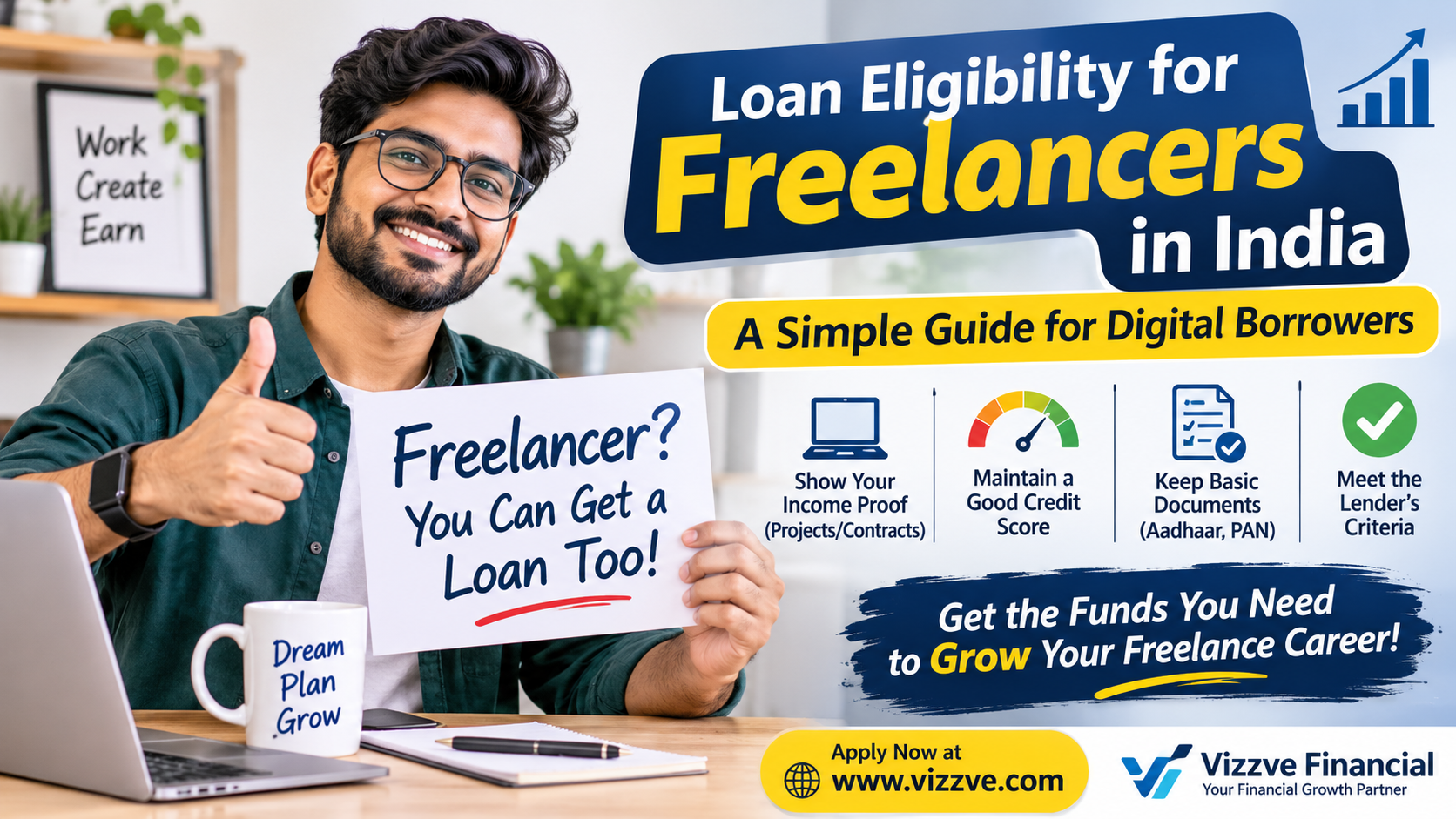
Freelancing offers flexibility, independence and the opportunity to work with clients from different locations. From graphic designers and content writers to software developers, digital marketers, consultants and online tutors, millions of professionals now earn through independent projects.
However, when freelancers need financial assistance, they may face a common challenge: proving their income.
Unlike salaried employees, freelancers usually do not receive fixed monthly salaries or traditional salary slips. Their earnings may vary depending on projects, clients, deadlines and seasonal demand. This can make the loan application process seem confusing.
The good news is that freelancers can apply for personal loans if they meet a lender's eligibility requirements and provide suitable financial documents.
This guide explains loan eligibility for freelancers in India step by step, including income requirements, credit scores, documents, application procedures and ways to improve the chances of approval.
Quick Answer: Can Freelancers Get Personal Loans in India?
Yes. Freelancers and other self-employed professionals can apply for personal loans from eligible banks and NBFCs in India.
Lenders may assess their applications using factors such as:
-
Average monthly income
-
Consistency of earnings
-
Bank account transactions
-
Income tax returns, where required
-
Credit score and repayment history
-
Existing loans and monthly EMIs
-
Age and other lender-specific conditions
A fixed salary or traditional salary slip is not the only way to demonstrate repayment capacity. Freelancers may use bank statements, invoices, client contracts, tax documents and other acceptable records.
However, eligibility criteria differ between lenders, and submitting an application does not guarantee approval.
1. Understand How Freelancer Loan Eligibility Works
Before applying, it is important to understand how lenders evaluate freelance income.
A lender generally wants to know whether you earn enough to repay the loan on time. Since freelance income can fluctuate, the lender may review your financial activity over a period rather than relying on a single month's earnings.
For example, consider two freelancers:
-
Freelancer A earns ₹60,000 every month from several regular clients.
-
Freelancer B earns ₹1,00,000 in one month but has very little income during the next two months.
Although Freelancer B earns more in one month, Freelancer A may demonstrate more predictable income.
This is why maintaining clear financial records is important.
Common factors considered by lenders include:
| Eligibility factor | What lenders may evaluate |
|---|---|
| Age | Whether you meet the lender's minimum and maximum age limits |
| Income | Your average earnings and repayment capacity |
| Work stability | How consistently you receive freelance payments |
| Credit score | Your credit history and repayment behaviour |
| Bank statements | Regular income credits and financial activity |
| Existing EMIs | Your current monthly repayment obligations |
| Documentation | Whether your identity, address and income details can be verified |
There is no single eligibility formula used by every lender. Each bank or NBFC can apply its own credit policy.
2. Check Your Average Monthly Freelance Income
Your income is one of the most important parts of a loan application.
Freelancers may receive payments from multiple clients, platforms or projects. Instead of focusing only on your highest-earning month, calculate your average income over a reasonable period.
How to calculate average monthly income
Use this simple formula:
Average Monthly Income = Total Freelance Income ÷ Number of Months
For example:
Suppose your freelance earnings over six months are:
| Month | Income |
|---|---|
| January | ₹40,000 |
| February | ₹55,000 |
| March | ₹45,000 |
| April | ₹60,000 |
| May | ₹50,000 |
| June | ₹50,000 |
| Total | ₹3,00,000 |
Average monthly income:
₹3,00,000 ÷ 6 = ₹50,000
Your average monthly freelance income is ₹50,000.
This calculation is useful for understanding your finances, but the lender may calculate eligible income differently. It may consider business expenses, income stability, taxes and other financial commitments.
Tips to maintain clear income records
-
Receive client payments through a bank account in your name.
-
Keep invoices for completed projects.
-
Save payment confirmations and client contracts.
-
Maintain records of platform earnings.
-
Separate business and personal expenses where practical.
-
File applicable income tax returns accurately.
Organised records can make income verification easier.
3. Check Your Credit Score Before Applying
Your credit score is another important part of loan eligibility.
In India, credit information companies such as TransUnion CIBIL maintain credit records and provide credit scores. A CIBIL Score generally ranges from 300 to 900.
A stronger credit profile may improve your chances of being considered for a loan. However, a good score does not automatically guarantee approval.
What affects your credit score?
Your credit profile may be influenced by:
-
Previous loan repayment history
-
Credit card payment behaviour
-
Outstanding loan balances
-
Credit utilisation
-
Number of recent credit enquiries
-
Length and type of credit history
How can freelancers improve their credit profile?
-
Pay existing loan EMIs on time.
-
Pay credit card bills by their due dates.
-
Avoid using a large portion of your available credit limit.
-
Check your credit report for incorrect information.
-
Avoid submitting multiple loan applications within a short period.
-
Resolve overdue accounts and outstanding dues.
If you have never used a formal credit product, you may have a limited credit history. Lenders can consider other information as part of their assessment, depending on their policies.
4. Prepare the Documents Required for a Freelancer Loan
Freelancers may not have salary slips, but they can provide other documents to demonstrate their identity, address, occupation and income.
The exact list depends on the lender and the loan product.
Commonly requested documents
| Document | Why it may be required |
|---|---|
| PAN Card | Identity and financial verification |
| Aadhaar or other accepted ID | Identity and address verification |
| Bank statements | Evidence of income and financial activity |
| Income Tax Returns | Supporting evidence of declared income |
| Client invoices | Records of freelance work and payments |
| Client contracts | Evidence of ongoing or completed projects |
| Platform payment statements | Records of earnings through online platforms |
| Business or professional proof | Evidence of self-employed activity, where required |
Not every lender will ask for every document. Some may request additional records, such as financial statements, GST-related documents or proof of business continuity.
What if you do not have salary slips?
Freelancers generally do not receive conventional salary slips. Instead, you can ask the lender which alternative income documents it accepts.
Depending on the lender, these may include:
-
Recent bank statements
-
Income tax returns
-
Invoices and receipts
-
Client agreements
-
Payment platform statements
-
Other verifiable income records
The key is to provide genuine, consistent and verifiable information.
5. Understand the Role of Work Experience and Income Stability
Freelancers often work with different clients, which means their income may not be identical every month.
Lenders may examine how long you have been working independently and whether your earnings show a reasonably consistent pattern.
For example:
Profile A: A freelance developer who has worked with multiple clients for two years and receives regular project payments.
Profile B: A new freelancer who started working last month and has received only one payment.
The first profile may offer more evidence of work continuity. However, the final decision depends on the lender's eligibility rules and complete financial assessment.
How to demonstrate work stability
-
Maintain a portfolio of completed projects.
-
Keep records of repeat clients.
-
Save professional agreements and work orders.
-
Maintain payment records.
-
Document your business or professional activity.
-
Keep tax and financial records updated.
These records can help explain the nature of your freelance work.
6. Calculate Your Existing EMI Obligations
Before applying for a new loan, calculate how much of your income is already committed to debt repayments.
Lenders may assess your existing EMIs to understand whether you can comfortably manage another monthly instalment.
For example:
| Financial detail | Amount |
|---|---|
| Average monthly income | ₹50,000 |
| Existing loan EMI | ₹5,000 |
| Credit card repayment commitment | ₹2,000 |
| Total existing monthly commitments | ₹7,000 |
This leaves ₹43,000 before accounting for living expenses, business costs, taxes and other financial needs.
A lender may use its own repayment-capacity or debt-obligation assessment. There is no universal EMI-to-income threshold that applies to every freelancer or lender.
Why should freelancers calculate EMIs in advance?
Freelance income can change from month to month. A loan that appears affordable during a high-income period may become difficult to repay during a slower period.
Choose an EMI that remains manageable even when your earnings temporarily decline.
7. Check Your Loan Eligibility Online
Many banks and financial institutions provide online eligibility tools or application journeys.
These tools can help applicants understand whether they may meet certain basic requirements.
Steps to check eligibility online
-
Visit the official website or application of the lender.
-
Select the relevant personal loan product.
-
Enter the requested personal details.
-
Provide your occupation and income information accurately.
-
Enter existing loan or EMI details if requested.
-
Review the preliminary eligibility result.
-
Read the lender's terms before proceeding.
Remember that an online eligibility estimate is not the same as final loan approval.
The lender may still verify your documents, credit history, income and repayment capacity.
8. Apply for a Freelancer Personal Loan Step by Step
Once you have checked your eligibility and prepared your documents, you can begin the application process.
Step 1: Identify your financial requirement
Decide how much money you actually need.
Avoid borrowing more than necessary. A smaller loan may result in a more manageable repayment obligation.
Step 2: Compare suitable lenders
Compare banks and NBFCs based on:
-
Interest rate
-
Annual Percentage Rate (APR)
-
Processing fees
-
Loan tenure
-
EMI amount
-
Prepayment and foreclosure conditions
-
Late-payment charges
-
Customer support and grievance procedures
Do not select a loan only because an advertisement promises quick approval.
Step 3: Check eligibility criteria
Review the lender's age, income, credit profile, work experience and documentation requirements.
Step 4: Complete the online application
Enter your details carefully. Ensure that your name, PAN information, bank details, address and income information are accurate.
Step 5: Submit the required documents
Upload only genuine documents through the lender's official and secure application channel.
Step 6: Complete verification
The lender may verify your identity, income, bank activity, credit history and other details.
Step 7: Read the loan offer carefully
Before accepting, review the Key Facts Statement (KFS), interest rate, APR, repayment schedule, fees and other terms.
Step 8: Accept the agreement only if comfortable
If the loan terms are suitable, complete the required acceptance and signing process.
Step 9: Track repayment dates
After disbursal, monitor your EMI schedule and maintain sufficient funds in your repayment account.
9. Understand Interest Rates, APR and Loan Costs
The advertised interest rate is not necessarily the complete cost of borrowing.
Freelancers should understand the difference between the interest rate and the Annual Percentage Rate (APR).
APR helps communicate the overall annualised cost of credit, including applicable charges as specified in the loan disclosure.
Before accepting a loan, review:
-
Interest rate and whether it is fixed or variable
-
APR
-
Processing fee
-
Applicable taxes and other charges
-
Late-payment charges
-
Penal charges
-
Prepayment or foreclosure terms
-
Total repayment amount
The Reserve Bank of India's digital lending framework requires regulated lenders to provide important loan disclosures, including a Key Facts Statement where applicable.
Never accept a loan without understanding how much you will repay in total.
10. How to Improve Your Loan Eligibility as a Freelancer
If you are planning to apply for a personal loan, a few practical steps can help strengthen your financial profile.
Maintain a separate account for freelance earnings
Using a dedicated account for professional payments can make your income records easier to understand.
Build a consistent payment history
Ask clients to pay through traceable banking channels whenever possible.
File income tax returns correctly
Accurate tax records can support your declared income, subject to the lender's documentation requirements.
Avoid unnecessary debt
Multiple outstanding loans may reduce your repayment capacity.
Pay existing EMIs on time
A consistent repayment record can support a healthier credit profile.
Keep documents organised
Maintain invoices, contracts, bank statements and payment records in a secure location.
Apply for a realistic loan amount
Your borrowing requirement should match your income and repayment capacity.
11. Common Reasons Why Freelancer Loan Applications Get Rejected
A freelancer's loan application may be declined for several reasons.
| Possible reason | What you can do |
|---|---|
| Low or limited credit history | Review your credit report and build responsible repayment habits |
| Irregular or insufficient income | Maintain clear income records over time |
| High existing EMIs | Reduce outstanding debt where possible |
| Incomplete documents | Submit the documents requested by the lender |
| Incorrect application details | Check all information before submission |
| Unverifiable income | Provide genuine bank records, invoices or tax documents |
| Frequent recent loan applications | Avoid unnecessary credit enquiries |
A rejection does not necessarily mean that you can never qualify for a loan. Review the reason, address the issue and apply again only when your financial profile is better prepared.
12. Digital Lending Safety: What Freelancers Should Check
Online loan applications can make borrowing more convenient, but digital borrowers should pay attention to safety and transparency.
The Reserve Bank of India issued the Reserve Bank of India (Digital Lending) Directions, 2025 to consolidate and strengthen requirements relating to digital lending activities by regulated entities.
Before applying through a digital lending app or platform, consider the following precautions:
-
Verify the name of the bank or NBFC actually providing the loan.
-
Check whether the app or lending service is associated with the claimed regulated lender.
-
Read the privacy policy and understand what data is collected.
-
Do not grant unnecessary permissions to access your phone.
-
Review the Key Facts Statement and APR.
-
Avoid platforms that demand suspicious advance payments.
-
Never share your OTP, PIN or banking password.
-
Read the repayment and grievance-redressal information.
-
Keep copies of the loan agreement and payment receipts.
A genuine digital loan process should provide clear information about the lender, loan terms, charges and repayment obligations.
13. Practical Example: How a Freelancer Can Prepare for a Loan
Consider Rahul, a freelance graphic designer working with clients in India and overseas.
His financial details are:
| Financial detail | Amount |
|---|---|
| Average monthly freelance income | ₹55,000 |
| Existing monthly EMI | ₹4,000 |
| Average monthly business expenses | ₹8,000 |
| Loan requirement | ₹1,00,000 |
Before applying, Rahul takes the following steps:
-
Reviews his credit report.
-
Organises six months of bank statements.
-
Collects invoices and client agreements.
-
Keeps his income tax records ready.
-
Reviews his existing financial commitments.
-
Compares available loan offers.
-
Checks the APR, fees and repayment schedule.
This preparation can make his application more organised and help the lender assess his financial profile.
Important: This is an illustrative example, not a guarantee of eligibility or approval. The actual loan decision and eligible amount depend on the lender's assessment.
14. Is a Personal Loan the Right Choice for Every Freelancer?
Not always. A personal loan can be useful when you need funds for a planned expense, but borrowing should be based on a clear repayment strategy.
Before applying, consider:
-
Is the expense necessary?
-
Can you manage the EMI during a low-income month?
-
Do you have emergency savings?
-
Are the interest rate and fees reasonable?
-
Could you meet the requirement through savings or another suitable funding option?
If your income is unpredictable, keep a financial buffer for essential expenses and repayments.
Frequently Asked Questions (FAQs)
1. Can freelancers get personal loans in India?
Yes. Freelancers can apply for personal loans from banks and NBFCs if they meet the lender's eligibility criteria and provide acceptable proof of income and identity.
2. Can I get a loan without a salary slip?
Yes. Freelancers generally do not receive salary slips. Depending on the lender, bank statements, ITRs, invoices, client contracts and platform payment records may be accepted as alternative income evidence.
3. What is the minimum income required for a freelancer loan?
There is no single minimum income requirement across all lenders. The amount depends on the lender's policy, loan product, credit profile and repayment assessment.
4. Is a CIBIL Score mandatory for freelancer loan approval?
Lenders may check your credit history and score as part of their assessment. A stronger credit profile can improve your chances, but approval also depends on income and other eligibility factors.
5. Can a beginner freelancer apply for a personal loan?
A beginner freelancer can apply, but a short work history or limited income records may make eligibility more difficult. Lenders may require evidence of income and repayment capacity.
6. Are bank statements enough to prove freelance income?
Bank statements can help demonstrate payment activity. However, some lenders may also ask for ITRs, invoices, contracts or other supporting documents.
7. Can international freelance earnings be considered?
Some lenders may consider foreign-client earnings if they can be properly documented and verified. Acceptance depends on the lender's policies and applicable requirements.
8. Do freelancers need to file ITR to get a personal loan?
Some lenders may request income tax returns, while others may accept different forms of income verification. Check the specific lender's documentation requirements.
9. Can gig workers apply for personal loans?
Yes. Delivery partners, online service providers, independent consultants and other gig workers may apply if they meet the lender's requirements and can demonstrate repayment capacity.
10. Does irregular income reduce loan eligibility?
Irregular income can make repayment capacity harder to assess. Maintaining clear records of earnings over time may help the lender understand your financial activity.
11. Can I apply for a loan if I already have an EMI?
Yes, subject to the lender's assessment. Existing EMIs are generally considered when evaluating your ability to repay another loan.
12. How can I improve my loan eligibility?
Maintain a healthy credit profile, pay existing EMIs on time, organise income documents, reduce unnecessary debt and apply for a realistic loan amount.
13. Can I apply for a personal loan online?
Many banks and NBFCs offer online application processes. Use official channels, verify the actual lender and review all loan terms before accepting an offer.
14. Does checking loan eligibility affect my CIBIL Score?
Some preliminary eligibility tools may use information without making a hard credit enquiry. However, a formal credit application may involve a credit enquiry. Check the lender's process before proceeding.
15. Is instant loan approval guaranteed for freelancers?
No. Digital applications may speed up submission and verification, but final approval depends on the lender's credit assessment and internal policies.
Key Takeaways
-
Freelancers can apply for personal loans in India.
-
A salary slip is not the only acceptable way to demonstrate income.
-
Bank statements, ITRs, invoices and client contracts may support income verification.
-
Credit history and repayment capacity are important.
-
Existing EMIs can affect how much you may qualify to borrow.
-
Eligibility requirements differ between lenders.
-
Always review the APR, KFS, fees and repayment terms.
-
Use verified digital lending channels and borrow responsibly.
Conclusion: Prepare Your Finances Before Applying
Being a freelancer does not automatically prevent you from accessing formal credit. What matters is your ability to demonstrate income, maintain a responsible credit profile and manage repayments.
By following this step-by-step guide, digital borrowers can understand the loan eligibility process, organise their financial documents and make more informed borrowing decisions.
Before applying, compare lenders, check the total cost of borrowing and choose an EMI that fits your average income rather than your best earning month.
Explore responsible digital borrowing with Vizzve Financial. Visit www.vizzve.com to learn more about financial solutions and borrowing awareness.
Disclaimer: This article is for educational and informational purposes only. Loan eligibility, documentation, interest rates, charges and approval decisions vary by lender. Always verify the latest terms directly with the regulated bank or NBFC before applying.
Published on : 4th November 2026
Published by : Shanlee JV
www.vizzve.com || www.vizzveservices.com
Follow us on social media: Facebook || Linkedin || Instagram
🛡 Powered by Vizzve Financial
RBI-Registered Loan Partner | 10 Lakh+ Customers | ₹600 Cr+ Disbursed