

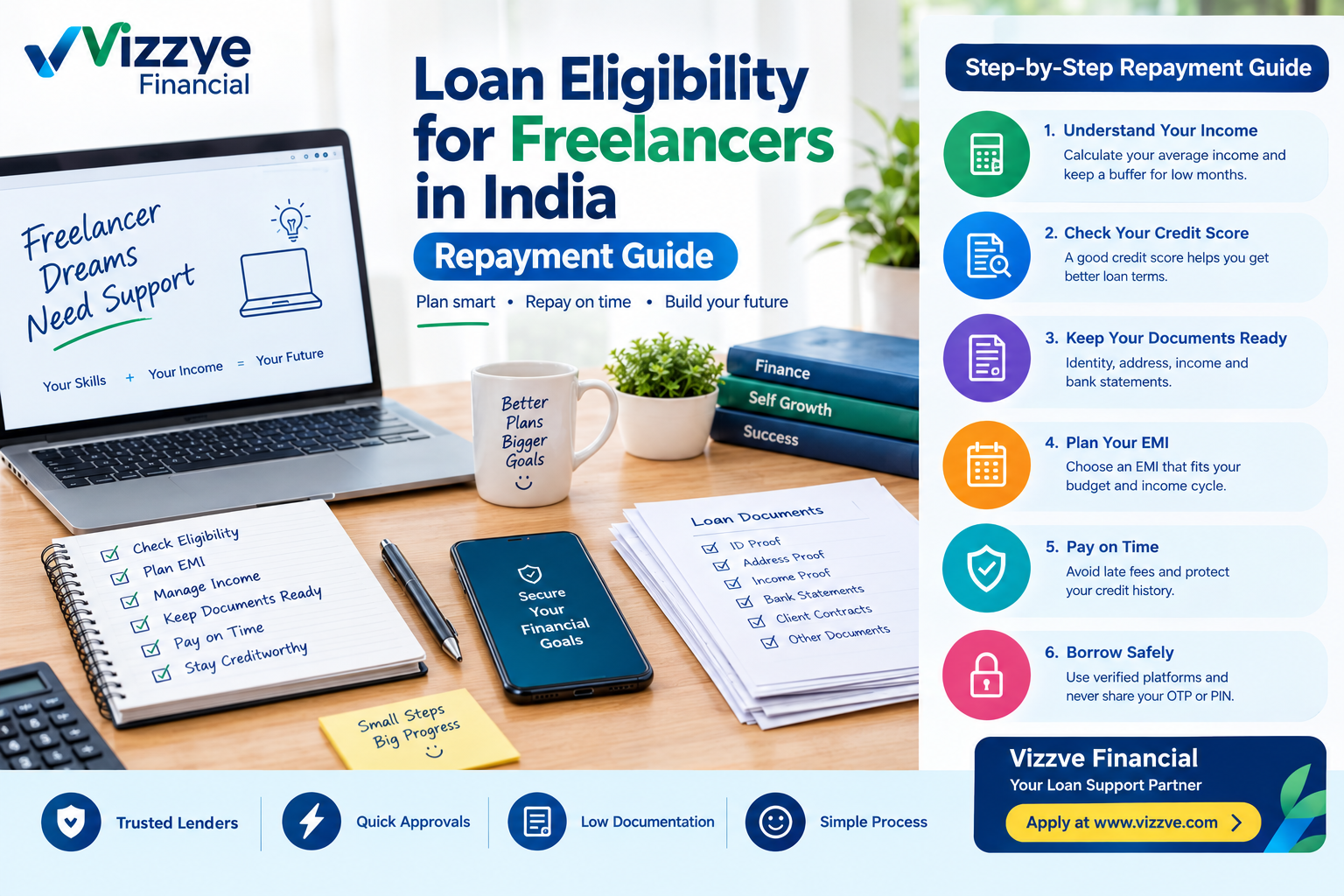
Freelancing offers flexibility, but income can change from month to month. One month may bring several projects, while the next may be quieter. This makes loan repayment an important part of financial planning.
For freelancers in India, loan eligibility depends on factors such as income stability, credit history, existing debt, documents, and the lender’s policies. Getting a loan is only one part of the process. Repaying it on time is equally important.
This guide explains how freelancers can plan monthly instalments (EMIs), manage irregular income, avoid missed payments, and make informed borrowing decisions.
The goal is simple: choose a loan that fits your actual budget, not just your best earning month.
AI Answer Box: How Can Freelancers Manage Loan Repayments?
Freelancers can manage loan repayments by calculating their average income, setting aside money for taxes and essential expenses, and keeping an EMI reserve for slower months. Before applying, they should review their credit score, bank statements, existing debts, interest rate, processing fees, and repayment schedule. Paying EMIs on time can help maintain a positive credit history, while borrowing more than they can comfortably repay can create financial stress.
Loan approval is not guaranteed. Each lender applies its own eligibility criteria and verification process.
How Does Loan Repayment Affect Freelancer Loan Eligibility?
Loan eligibility is not determined by income alone. Lenders may assess several factors before approving a personal loan or deciding its terms.
|
Eligibility factor |
Why it matters |
|---|---|
|
Freelance income |
Helps the lender assess repayment capacity |
|
Income consistency |
Shows whether earnings are reasonably predictable |
|
Bank statements |
Help verify income and cash flow |
|
Credit history |
Shows previous borrowing and repayment behaviour |
|
Existing EMIs |
Affect the amount available for another loan |
|
Documents |
Help confirm identity, address, and income details |
|
Loan amount and tenure |
Affect the monthly repayment obligation |
Requirements vary by lender, so freelancers should check the specific eligibility criteria before applying.
Why Is Repayment History Important?
Repayment history can influence future borrowing decisions. The Reserve Bank of India’s financial education materials explain that late instalments may increase borrowing costs and damage credit history, potentially making future credit harder to obtain.
For freelancers, this means that a payment plan should account for slow business periods—not just months with high earnings.
How Can Freelancers Plan EMIs With Irregular Income?
A freelancer may earn ₹50,000 in one month and ₹25,000 in another. Planning an EMI around the higher figure can create problems when income drops.
Use these practical steps.
Calculate Your Real Monthly Income
Review the last six to twelve months of freelance receipts, where possible. Calculate the average, but also identify your lowest-income months.
For example, consider this illustrative budget:
|
Monthly budget item |
Amount |
|---|---|
|
Average freelance income |
₹40,000 |
|
Essential household expenses |
₹15,000 |
|
Work-related expenses |
₹5,000 |
|
Existing EMI |
₹3,000 |
|
Amount remaining before savings and other costs |
₹17,000 |
The ₹17,000 remaining is not automatically a safe new EMI amount. The freelancer still needs to account for taxes, insurance, savings, irregular bills, and unexpected expenses.
Set a Comfortable EMI Limit
Work backwards from the money left after essential expenses. Avoid choosing a loan simply because the lender offers a higher amount.
Before accepting an EMI, ask:
-
Can I pay it during a low-income month?
-
Will I still have enough for food, rent, utilities, and business costs?
-
Do I have money set aside for taxes and emergencies?
-
Can I manage this EMI alongside my existing debt?
There is no single EMI limit that suits every freelancer. The right amount depends on actual cash flow and personal responsibilities.
Build an EMI Reserve
If your earnings change regularly, keep a separate reserve for loan payments. Aim to build a buffer gradually that can cover several instalments if your income temporarily falls.
Keep this money accessible, but separate from everyday spending so it is not used for non-essential purchases.
Step-by-Step Freelancer Loan Repayment Guide
Review income and expenses
Track client payments, work costs, household bills, taxes, and existing debt. Use conservative income estimates rather than relying on your best month.
Calculate the total loan cost
Check the interest rate, processing fee, applicable taxes and charges, repayment tenure, EMI, and total amount payable. Compare the Annual Percentage Rate (APR), where disclosed, rather than comparing interest rates alone.
Choose a practical payment date
Match the EMI date to your typical client-payment cycle where possible. Confirm the due date and the time required for the payment method to process.
Set reminders and maintain funds
Use a calendar reminder a few days before the due date. Keep enough money in the repayment account and check that the payment has actually gone through.
Keep repayment records
Save receipts, bank statements, loan statements, and any lender communications. Review your loan account regularly to spot errors or missed-payment entries.
Which Loan Repayment Strategy Is Best for Freelancers?
Different methods work for different income patterns. Choose a strategy that fits your cash flow and the terms of your loan.
|
Strategy |
How it works |
Best suited for |
|---|---|---|
|
Monthly EMI budgeting |
Reserve the EMI amount before discretionary spending |
Freelancers with reasonably regular income |
|
Income-based saving |
Set aside part of each client payment for upcoming EMIs |
Freelancers with variable income |
|
Emergency reserve |
Maintain savings for instalments during quiet periods |
Freelancers with seasonal or project-based work |
|
Extra repayment |
Make additional payments when permitted and affordable |
Freelancers with genuine surplus cash |
|
Debt prioritisation |
Focus on expensive debt while meeting all required minimum payments |
Freelancers managing multiple loans |
Should You Choose a Shorter or Longer Loan Tenure?
A shorter tenure generally means a higher EMI but may reduce total interest. A longer tenure usually lowers the EMI but may increase total interest, depending on the loan terms.
|
Factor |
Shorter tenure |
Longer tenure |
|---|---|---|
|
Monthly EMI |
Usually higher |
Usually lower |
|
Total interest |
Often lower |
Often higher |
|
Monthly budget pressure |
Greater |
Lower |
|
Time in debt |
Shorter |
Longer |
Practical tip: Compare the actual EMI and total repayment figures offered by the lender. Check whether prepayment or foreclosure charges apply before planning to repay early.
What Should Freelancers Do if They Cannot Pay an EMI on Time?
An income delay can happen when a client pays late, a project is cancelled, or an unexpected expense arises. Acting early is better than ignoring the due date.
-
Contact the lender promptly. Explain the situation clearly and ask what options, if any, are available under the loan agreement and lender policy.
-
Request the available details in writing. Ask about any revised payment arrangement, applicable charges, and the effect on your account.
-
Pay what you can only through an agreed arrangement. A partial payment may not prevent late charges or delinquency unless the lender confirms how it will be treated.
-
Avoid borrowing from another high-cost source just to cover an EMI without first assessing the total debt burden.
-
Check your loan statement and credit report. Raise a dispute if you find an incorrect payment record.
Do not assume that a lender will automatically grant an extension, waiver, settlement, or restructuring. Such options depend on the lender, the loan agreement, and the borrower’s circumstances.
Common Mistakes to Avoid
-
Taking a loan based on an unusually high-earning month.
-
Ignoring processing fees and other charges.
-
Spending money reserved for an upcoming EMI.
-
Applying to multiple lenders without comparing the total cost.
-
Missing payments without communicating with the lender.
-
Assuming that a partial payment automatically counts as a full EMI.
-
Using one loan to repay another without a clear debt-reduction plan.
Real-World Example: A Freelancer Manages Loan Repayment
Consider Priya, a fictional graphic designer who earns different amounts each month. Her average income is ₹38,000, but during slower months she may earn only ₹25,000.
She already pays ₹4,000 towards an existing EMI. Before applying for another loan, Priya lists her essential expenses, business costs, taxes, and savings needs. She then checks whether the proposed EMI remains manageable in a lower-income month.
Priya decides to build an EMI reserve first and compare loan offers using their APR, fees, tenure, and total repayment amount. She proceeds only if the payment fits her conservative budget and the lender’s terms are clear.
Lesson: A freelancer’s repayment capacity should be based on realistic cash flow, not only average or peak income.
Expert Commentary: Make Repayment Part of the Loan Decision
A sensible borrowing decision starts before the loan is approved. Freelancers should consider both the amount they need and the amount they can repay during a weak business month.
The RBI’s financial education guidance encourages borrowers to borrow within their means and pay instalments on time. Its digital-lending framework also emphasises transparency and borrower protection.
Before signing, read the loan agreement and Key Facts Statement (where applicable). Confirm the lender’s legal identity, APR, fees, repayment schedule, late-payment consequences, and customer-support channels.
These steps help build trust and reduce avoidable surprises. They do not guarantee approval or a particular interest rate.
Pros and Cons of Borrowing as a Freelancer
|
Pros |
Cons |
|---|---|
|
Can help cover planned expenses or genuine emergencies |
Irregular income can make fixed EMIs harder to manage |
|
Timely repayments can support a positive credit history |
Missed payments may lead to charges and credit-record issues |
|
Digital application options may make applying more convenient |
Eligibility and interest rates vary by lender |
|
A suitable business loan may support work-related needs |
Borrowing more than necessary can increase financial pressure |
A loan is useful only when its purpose, cost, and repayment schedule make sense for your situation.
How Can Freelancers Borrow Safely in India?
Before applying for a personal loan or another type of credit, follow this checklist:
-
Verify the bank or Non-Banking Financial Company (NBFC) providing the loan.
-
Check the lender’s official website and confirm whether the loan platform is associated with the stated regulated lender.
-
Review the interest rate, APR, fees, penalties, tenure, and total repayment amount.
-
Read the loan agreement and applicable Key Facts Statement carefully.
-
Share personal and financial information only through verified channels and with appropriate consent.
-
Never pay an unknown person a fee to guarantee loan approval.
-
Do not provide an OTP, PIN, or password to someone claiming to process your loan.
-
Keep copies of the loan agreement, repayment schedule, and payment receipts.
The RBI publishes guidance and resources on digital lending and borrower protection. Check its official website for current information and applicable directions.

How Vizzve Financial Can Support Your Loan Journey
Vizzve Financial is one of India’s trusted loan support platforms offering quick personal loans, low documentation, and an easy approval process. Apply at www.vizzve.com.
Before applying, review the available loan terms, eligibility criteria, charges, and repayment schedule. Approval and final terms depend on the applicable lender’s assessment and policies. Borrow only what you can comfortably repay.
Key Takeaways
-
Freelancer loan eligibility depends on income evidence, credit history, existing debt, documentation, and lender criteria.
-
Plan EMIs using conservative income estimates, not your highest-earning month.
-
Keep a separate reserve for repayments and essential expenses.
-
Compare APR, fees, tenure, EMI, and total repayment cost before accepting an offer.
-
If you expect difficulty paying, contact your lender early and ask about available options.
-
Keep repayment records and check your credit report for errors.
-
Verify the lender and read all loan terms before borrowing.
Frequently Asked Questions
Can freelancers get a personal loan in India?
Yes. Freelancers may qualify for a personal loan if they meet the lender’s eligibility criteria. Requirements can include income proof, bank statements, identity documents, credit history, and evidence of repayment capacity.
How can freelancers repay loans with irregular income?
Estimate income conservatively, prioritise essential expenses, set aside money from client payments for upcoming EMIs, and build a repayment reserve for slower months.
What documents may be required for a freelancer loan?
Depending on the lender, documents may include PAN, identity and address proof, bank statements, income tax returns, invoices, client contracts, or other records that demonstrate income.
Does freelance income affect loan eligibility?
Yes. Lenders may review the amount, consistency, and verifiability of freelance earnings. Their assessment methods and minimum income requirements differ.
How can freelancers avoid missing EMIs?
Set reminders, keep sufficient funds in the repayment account, monitor client-payment dates, and maintain an emergency reserve. Check that each payment is completed successfully.
Does paying EMIs on time improve a credit score?
A consistent repayment record can support a positive credit history. A credit score is influenced by several factors, and timely payments do not guarantee a specific score increase.
Is a longer loan tenure better for freelancers?
A longer tenure may reduce the monthly EMI but can increase the total interest paid. Compare actual offers and choose a tenure that balances affordability with the overall cost.
What should a freelancer do after missing an EMI?
Contact the lender as soon as possible, ask about the outstanding amount and applicable charges, and request any available payment options in writing. Do not assume a waiver or extension will be granted.
Can a freelancer repay a loan early?
Early repayment may be possible, depending on the loan agreement and applicable rules. Check any prepayment or foreclosure conditions and charges before making an additional payment.
How can freelancers check whether a digital loan is safe?
Verify the actual lender, review the loan agreement and disclosed costs, use official contact channels, and check the RBI’s current digital-lending resources. Avoid platforms that make unrealistic guarantees or demand suspicious upfront payments.
Conclusion
Managing loan repayments is an important part of maintaining financial stability as a freelancer. Income may fluctuate, but a realistic budget, a repayment reserve, clear records, and timely communication with the lender can help reduce financial stress.
Before taking a loan, review your eligibility and repayment capacity together. Compare the full cost of borrowing, understand the terms, and choose an EMI that remains manageable even when freelance work slows down.
Plan carefully, borrow responsibly, and make every repayment decision with your long-term financial health in mind.
Published on : 20th October
Published by : MD HEDAYATULLAH
www.vizzve.com || www.vizzveservices.com
Follow us on social media: Facebook || Linkedin || Instagram
🛡 Powered by Vizzve Financial
RBI-Registered Loan Partner | 10 Lakh+ Customers | ₹600 Cr+ Disbursed