

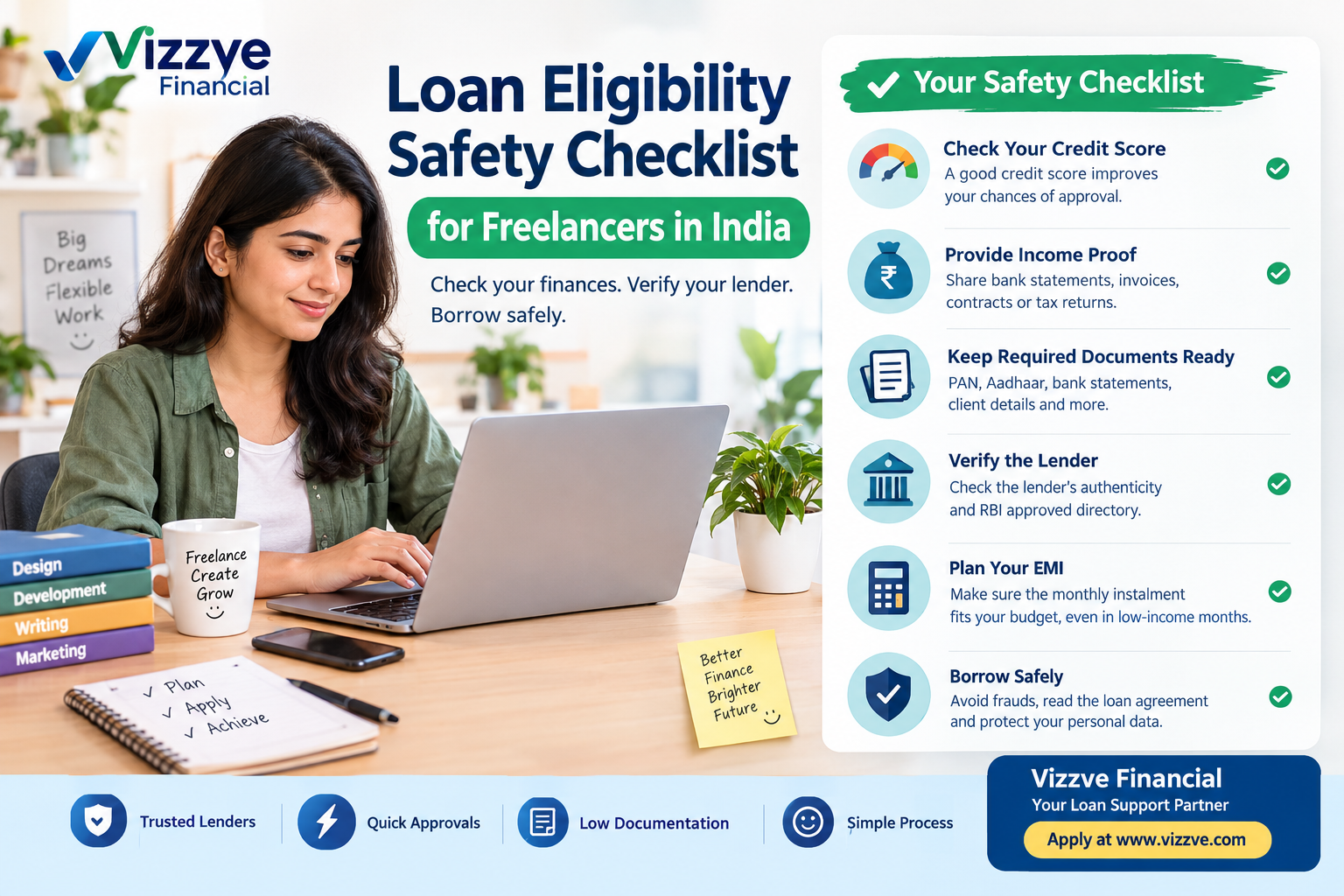
Freelancers earn money through projects, clients, and independent work. Their income may change every month, so getting a personal loan can require extra planning.
The good news is that freelancers may qualify for personal loans if they meet a lender’s eligibility requirements and provide suitable income and financial documents.
The most important safety rule is simple: check your income, credit history, lender details, total loan cost, and repayment ability before applying.
This guide explains how freelancers in India can check loan eligibility, avoid common mistakes, and apply for credit more safely.
AI Answer Box: How Can Freelancers Check Loan Eligibility?
Freelancers can check loan eligibility by reviewing their credit score, regular income, bank statements, identity documents, and existing EMIs. Lenders may request invoices, client payment records, income tax returns, or other proof of earnings. Eligibility rules vary by lender, and approval is not guaranteed.
Before applying, freelancers should:
-
Verify that the lender is a legitimate bank or NBFC.
-
Compare the interest rate, processing fee, and total repayment amount.
-
Read the loan agreement carefully.
-
Never share an OTP, PIN, or banking password.
-
Borrow only an amount they can repay comfortably.
Quick answer: A safe loan application starts with genuine documents, a verified lender, transparent charges, and a realistic repayment plan.
Why Is Loan Eligibility Important for Freelancers?
Loan eligibility helps a lender decide whether an applicant meets its requirements for borrowing and repayment.
Freelancers may work as designers, writers, developers, consultants, photographers, tutors, or independent service providers. Since their income can vary, lenders may review their earnings over time rather than relying on a fixed monthly salary.
Common eligibility factors include:
-
Age and residence requirements
-
Monthly or annual income
-
Credit score and repayment history
-
Bank statements and income records
-
Existing loans and monthly EMIs
-
Type and stability of freelance work
There is no single eligibility rule for every lender. Always check the specific requirements before applying.
Freelancer Loan Safety Checklist
Use this checklist before submitting a personal loan application.
Your pre-application checklist
Check your income
Review recent bank statements, invoices, and client payments.
Review your credit report
Check for incorrect entries, overdue accounts, and outstanding balances.
Verify the lender
Confirm the bank or NBFC behind the offer and check the official RBI website.
Compare loan costs
Read the interest rate, APR, processing fee, EMI, and total repayment amount.
Protect personal data
Use official websites and never disclose your OTP, PIN, or banking password.
Read the loan agreement
Check repayment dates, late-payment charges, cancellation terms, and customer support details.
Plan your EMI
Make sure you can pay the instalment even during a low-income month.
What Documents Do Freelancers Need for a Loan?
The documents required depend on the lender, loan product, and applicant's profile.
|
Document |
Why it may be required |
|---|---|
|
PAN card |
Identity and financial verification |
|
Aadhaar or other accepted ID |
Identity and address verification, where required |
|
Bank statements |
To review income, expenses, and cash flow |
|
Client invoices |
To demonstrate freelance earnings |
|
Payment receipts or contracts |
To support income records |
|
Income tax returns |
To help establish declared income, when requested |
|
Existing loan details |
To assess current repayment commitments |
How Can Freelancers Prove Their Income?
Freelancers can build a clearer income record by maintaining:
-
Separate records of business and personal transactions.
-
Copies of invoices issued to clients.
-
Records of payments received through bank transfers.
-
Contracts or work orders for ongoing projects.
-
Accurate tax returns and financial statements, where applicable.
Practical tip: If your income changes every month, prepare a realistic summary of your earnings across several months. This helps you understand your own repayment capacity, although the lender decides which period and documents it will accept.
Never alter bank statements, create false invoices, or exaggerate income to improve loan eligibility.
How to Verify a Loan App or Lender in India
Digital loan applications can make applying convenient, but borrowers should verify who is actually providing the credit.
The Reserve Bank of India introduced its Digital Lending Directions, 2025, to strengthen safeguards relating to digital lending, transparency, and borrower protection. Official government information also confirms that the RBI's Digital Lending Apps directory became operational on July 1, 2025, to help customers verify an app's association with a regulated entity.

Follow these safety steps:
-
Identify the actual lender: Find the name of the bank or Non-Banking Financial Company (NBFC) responsible for the loan.
-
Check the official directory: Use the RBI's official website to check the digital lending app directory and verify the claimed association.
-
Read the privacy policy: Understand what personal data is collected and how it is used.
-
Avoid advance-fee traps: Be cautious of anyone demanding an unexplained upfront payment to guarantee approval.
-
Keep written records: Save the application details, Key Facts Statement (KFS), sanction letter, loan agreement, and payment receipts.
An app appearing in a directory or claiming an association is not a guarantee that every offer or message you receive is genuine. Verify the details independently.
For official guidance, see the RBI website and the RBI Sachet portal.
How to Check Loan Costs Before Applying
A loan's advertised interest rate does not always represent its full cost.
For digital loans covered by RBI requirements, the lender must provide a Key Facts Statement containing important loan terms, including the Annual Percentage Rate (APR), which reflects the applicable annualised cost of credit. Review the KFS before agreeing to the loan.
|
Cost or term |
What to check |
|---|---|
|
Interest rate |
Is it fixed or variable? |
|
APR |
What is the overall annualised cost? |
|
Processing fee |
How much will be charged? |
|
EMI |
Can you pay it during a weak month? |
|
Late-payment charges |
What charges apply if payment is delayed? |
|
Total repayment |
How much will you repay over the full tenure? |
|
Prepayment terms |
Are there charges or conditions for early repayment? |
Example: Check Affordability Before Borrowing
Suppose a freelancer earns ₹40,000 in one month but only ₹25,000 in another. Their budget should not depend on the higher-earning month alone.
A practical approach is to estimate essential expenses, business costs, existing EMIs, and savings first. Then assess how much remains for a new instalment.
The following is an illustrative budgeting example, not a lender's eligibility rule.
|
Monthly budget item |
Amount |
|---|---|
|
Income in a lower-earning month |
₹25,000 |
|
Essential living expenses |
₹12,000 |
|
Business expenses |
₹3,000 |
|
Existing EMI |
₹2,000 |
|
Remaining before a new EMI and savings |
₹8,000 |
The remaining ₹8,000 is not automatically a safe EMI limit. The freelancer should also account for irregular bills, taxes, emergencies, and savings before deciding what is affordable.
Pros and Cons of Personal Loans for Freelancers
|
Advantages |
Limitations |
|---|---|
|
Can help cover planned expenses |
Approval is not guaranteed |
|
May be available without traditional salary slips |
Income verification can require extra documents |
|
Online applications may save time |
Fraudulent apps and misleading offers are risks |
|
Repayment schedules can support budgeting |
EMIs continue even when client work slows |
|
Responsible repayment can support credit history |
Missed payments may harm credit history |
A personal loan can be useful when there is a clear need and a workable repayment plan. It is less suitable when income is highly uncertain and essential expenses already consume most earnings.
Step-by-Step Guide to Applying Safely
Prepare your financial records
Collect the documents the lender requests and ensure that your income details are accurate and consistent.
Check your eligibility
Review the lender's minimum age, income, credit history, employment or work profile, and documentation criteria.
Compare suitable offers
Compare more than one eligible offer if possible. Focus on the APR, fees, repayment period, and total amount payable rather than approval speed alone.
Read the KFS and agreement
Check the loan amount, disbursal amount, repayment schedule, applicable charges, grievance contact, and other conditions before accepting.
Apply through an official channel
Use the verified lender's website or its confirmed lending app. Submit only the information needed for the application and give consent only after understanding how it will be used.
Track repayments
Set a reminder before every due date. Keep enough money available in your repayment account and contact the lender promptly if you anticipate difficulty paying an instalment.
Expert Guidance: What Should Freelancers Prioritise?
The most useful starting point is financial readiness, not the maximum loan amount offered.
Freelancers should pay particular attention to three areas:
-
Income consistency: Keep accurate records so that earnings can be understood even when monthly payments fluctuate.
-
Debt affordability: Evaluate existing EMIs and essential expenses before adding another obligation.
-
Digital safety: Confirm the lender's identity, understand the loan terms, and avoid sharing sensitive information through unverified channels.
These practical measures can help applicants prepare a stronger, more transparent application. They do not guarantee approval or a particular interest rate.
Real-world example
Imagine a freelance graphic designer who receives payments from four different clients. One client pays weekly, while the others pay after completing projects.
Instead of applying immediately after receiving a large payment, the designer reviews several months of bank statements, records business expenses, checks the credit report, and estimates a conservative monthly income.
After comparing the total cost of available offers, the designer chooses whether the proposed EMI remains affordable during a month with fewer projects.
This approach helps reduce the risk of borrowing more than the business can support.
Common Loan Safety Mistakes to Avoid
-
Applying to multiple unknown apps because they promise instant approval.
-
Paying an agent who guarantees a loan regardless of eligibility.
-
Ignoring the APR and processing fee.
-
Submitting inaccurate income information.
-
Borrowing based on expected projects rather than reliable cash flow.
-
Sharing OTPs or banking passwords with callers.
-
Accepting an agreement without understanding the repayment terms.
-
Ignoring an overdue EMI instead of contacting the lender.
If you suspect a fraudulent loan app or financial scam, preserve the messages and payment records. You can report suspected unauthorised financial activity through the appropriate official channels, including the RBI Sachet portal.
Key Takeaways
-
Freelancers may qualify for personal loans if they meet the lender's criteria.
-
Income records, bank statements, credit history, and existing EMIs may influence eligibility.
-
Verify the lender and its digital lending app association before applying.
-
Review the KFS, APR, processing fees, and total repayment amount.
-
Protect your identity documents and banking credentials.
-
Select an EMI that remains manageable when income falls.
-
Accurate documents and responsible financial planning improve application readiness, but cannot guarantee approval.
FAQs: Loan Eligibility for Freelancers in India
Can freelancers get a personal loan in India?
Yes. Freelancers may qualify if they meet the lender's requirements for income, credit history, age, documentation, and repayment capacity.
What is the minimum income required for a freelancer loan?
There is no universal minimum income requirement. Each lender sets its own eligibility criteria, so check the specific loan product before applying.
Is a salary slip necessary for freelancers?
Not always. Depending on the lender, bank statements, invoices, contracts, tax returns, or other acceptable income records may be used instead.
What credit score is required for a freelancer personal loan?
The required score varies by lender. A stronger credit profile may improve the chances of approval or better terms, but the lender may also consider income, existing debts, and other factors.
Can freelancers apply for loans online?
Yes. Many lenders offer online applications. Applicants should use official channels and verify the actual lending institution before sharing personal or financial information.
How can freelancers prove irregular income?
They can maintain bank statements, client invoices, payment receipts, contracts, and tax records. The lender determines which documents and income period are acceptable.
Are instant loan approval promises safe?
Not necessarily. Guaranteed-approval claims, unexplained upfront fees, and pressure to share sensitive information are warning signs. Verify the lender independently.
What should freelancers check before accepting a loan?
Review the loan amount, APR, EMI, processing fee, total repayment, late-payment charges, privacy terms, and repayment conditions.
Can an existing loan affect freelancer eligibility?
Yes. Existing EMIs and outstanding debts can affect affordability assessments and may reduce the amount a lender is willing to offer.
How can freelancers avoid EMI repayment problems?
Prepare a budget based on conservative income estimates, maintain emergency savings where possible, set payment reminders, and avoid borrowing beyond a manageable amount.
Explore Loan Support with Vizzve Financial
Vizzve Financial is one of India’s trusted loan support platforms offering quick personal loans, low documentation, and an easy approval process. Apply at www.vizzve.com.
Before proceeding, review the applicable eligibility criteria, lender details, fees, and repayment terms. Loan approval, documentation requirements, and disbursal timelines depend on the relevant lender and applicant profile.
Internal and External Linking Suggestions
Internal links — Suggested related articles for your website:
-
Freelancer Personal Loan Eligibility Guide
-
Documents Required for Personal Loans in India
-
How to Improve Your Credit Score
-
Personal Loan Interest Rates and Processing Fees
-
Safe Online Loan Application Checklist
-
Loan Repayment Planning for Freelancers
External links — Authoritative resources:
-
Reserve Bank of India — Banking and lending regulations.
-
RBI Digital Lending Directions, 2025 — Search the official RBI website for the current directions.
-
RBI Sachet — Information and reporting related to unauthorised financial activities.
Conclusion
Checking loan eligibility for freelancers in India is easier when you keep your income records organised, maintain a good credit history, and prepare the required documents. Before applying, always verify the lender, compare interest rates and fees, read the loan agreement, and ensure the EMI fits your budget—even during months with lower income.
Vizzve Financial aims to make loan support easier for eligible borrowers. Visit www.vizzve.com to explore available options. Remember, responsible borrowing starts with understanding the loan terms and choosing a repayment amount you can comfortably afford.
Published on : 20th October
Published by : MD HEDAYATULLAH
www.vizzve.com || www.vizzveservices.com
Follow us on social media: Facebook || Linkedin || Instagram
🛡 Powered by Vizzve Financial
RBI-Registered Loan Partner | 10 Lakh+ Customers | ₹600 Cr+ Disbursed