

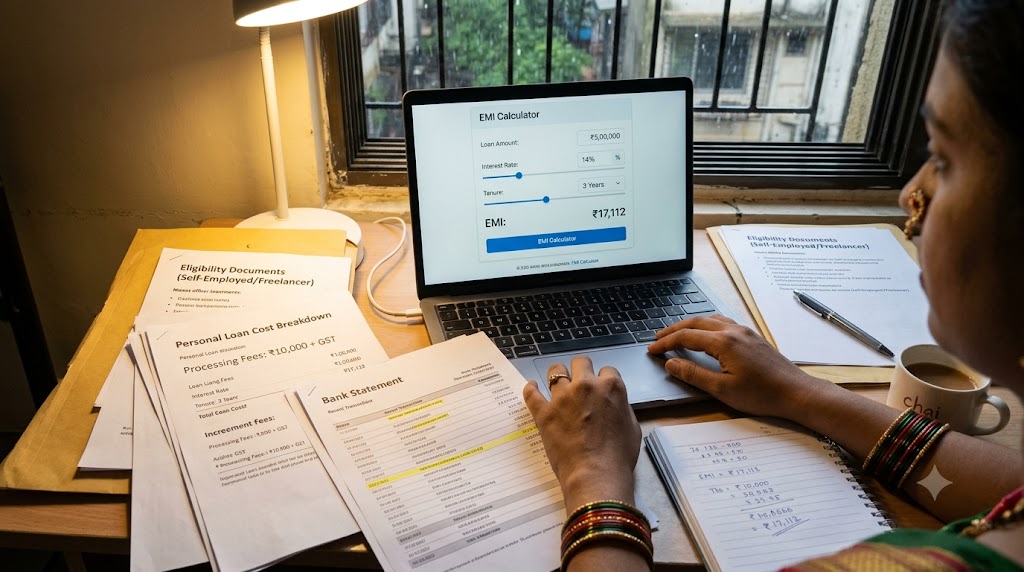
Freelancers in Maharashtra often have flexible incomes, multiple clients and changing monthly earnings. Whether you work as a content writer in Pune, a graphic designer in Mumbai, a software developer in Nagpur or an independent consultant elsewhere in the state, understanding the cost of borrowing is an important part of planning a personal loan.
Before applying, freelancers should look beyond the advertised interest rate and understand the total cost of a loan, including processing fees, applicable taxes, monthly EMIs and other charges. These expenses can affect how much money you actually receive and how much you repay over the loan tenure.
This guide explains the common costs associated with personal loans, the factors that may influence freelancer loan eligibility and how to compare offers responsibly.
What Does Loan Cost Breakdown Mean?
A loan cost breakdown explains the different charges associated with borrowing money. The total cost depends on the lender, loan amount, interest rate, repayment period and applicable fees.
For freelancers, the lender may also assess income stability, credit history, existing EMIs and financial documents before deciding whether to approve the application and what terms to offer.
The main costs to review are:
-
Interest charges
-
Processing fees
-
GST or other applicable taxes
-
Monthly EMI
-
Late-payment or penal charges
-
Prepayment or foreclosure charges, where applicable
-
Other disclosed fees
Not every loan includes every charge. Always check the lender's official fee schedule and Key Facts Statement (KFS).
1. Interest Rate: The Main Borrowing Cost
Interest is the amount charged by the lender for providing the loan. The rate offered to a freelancer may depend on the lender's policies and the applicant's financial profile.
Factors that may influence the offer include:
-
Credit score and repayment history
-
Verified income
-
Existing loan obligations
-
Loan amount and tenure
-
The lender's eligibility and risk-assessment criteria
A lower advertised rate does not necessarily mean the lowest overall cost. Compare the annual percentage rate (APR), which reflects the annualised cost of borrowing under the applicable framework, along with the other loan terms.
2. Processing Fees and Applicable Taxes
Some lenders charge a processing fee to assess and process a loan application. The fee may be a fixed amount or a percentage of the approved loan amount.
For example, if a lender charges a hypothetical processing fee of 2% on a ₹1,00,000 loan, the fee would be ₹2,000 before any applicable tax.
If the fee is deducted from the loan disbursal, the amount you receive may be less than the sanctioned amount. Confirm whether the fee is payable separately, deducted upfront or treated differently under the loan agreement.
Important: The example is illustrative, not a quote from a particular lender. Check the actual fee and applicable GST or other taxes before accepting an offer.
3. Monthly EMI and Repayment Planning
An EMI, or Equated Monthly Instalment, is the regular payment made towards repaying a loan. It generally includes both principal and interest.
Freelancers should estimate their EMI using a realistic average income, rather than assuming every month will be equally profitable.
Consider this illustrative example:
| Loan detail | Example |
|---|---|
| Loan amount | ₹1,00,000 |
| Annual interest rate | 15% |
| Loan tenure | 12 months |
| Approximate monthly EMI | ₹9,026 |
| Approximate total repayment | ₹1,08,312 |
| Approximate total interest | ₹8,312 |
These figures are estimates for a standard monthly reducing-balance loan. They exclude processing fees, taxes and other charges, which may increase the overall cost. Actual lender calculations may differ.
Before applying, account for household expenses, business costs, taxes, existing EMIs and periods when client payments may be delayed.
4. Other Charges to Check Before Applying
Apart from interest and processing fees, review the loan agreement for additional charges.
| Cost or charge | What to check |
|---|---|
| GST on applicable fees | Whether tax applies and how much is payable |
| Late-payment charges | The amount and conditions for overdue payments |
| Penal charges | The circumstances in which they may apply |
| Prepayment charges | Whether early repayment attracts a fee |
| Foreclosure charges | Whether closing the loan early has a cost |
| Mandate or payment-related charges | Whether any disclosed payment-processing charges apply |
| Other fees | Any additional charges listed in the KFS or agreement |
Do not assume that every lender charges all these fees. The applicable terms should be disclosed in the lender's documents.
5. How Loan Eligibility Can Affect Your Loan Cost
Loan eligibility and borrowing cost are connected, but they are not the same thing. A lender first assesses whether you qualify and then determines the loan amount and terms it is willing to offer.
For freelancers in Maharashtra, the assessment may include:
Income and Bank Statements
Bank statements, invoices and other records may help demonstrate freelance income and payment patterns.
ITR and Financial Documents
Some lenders request Income Tax Returns (ITRs) or other financial records. Requirements differ by lender and product.
CIBIL Score and Credit History
A lender may consider your credit history when assessing risk and pricing. A good score does not guarantee approval or a particular interest rate.
Existing EMIs
Current loan repayments and other financial commitments may affect the amount you can reasonably afford.
Requested Loan Amount and Tenure
A higher loan amount can increase the EMI and total interest. A longer tenure may reduce the monthly instalment but can increase the total interest paid.
6. How to Compare Two Loan Offers
Consider these hypothetical offers for the same ₹1,00,000 loan over 12 months:
| Loan detail | Offer A | Offer B |
|---|---|---|
| Annual interest rate | 15% | 18% |
| Approximate monthly EMI | ₹9,026 | ₹9,168 |
| Approximate total repayment | ₹1,08,312 | ₹1,10,016 |
| Processing fee | Check actual offer | Check actual offer |
These examples exclude fees and taxes. Offer A has a lower estimated repayment in this illustration, but your final comparison should use each lender's actual APR, net disbursal, fees, repayment schedule and agreement terms.
Tip: Compare the total amount payable rather than choosing a loan based only on a low EMI or a promotional interest rate.
7. Ways Freelancers Can Manage Loan Costs
Freelancers can take several practical steps to avoid unnecessary borrowing expenses:
-
Borrow only what you need. A smaller loan can reduce the principal on which interest is charged.
-
Maintain organised income records. Keep bank statements, invoices and applicable tax documents ready.
-
Review your credit report. Correct genuine errors and maintain timely repayments.
-
Compare multiple lenders carefully. Check the APR, fees and total repayment before applying.
-
Choose an affordable tenure. Balance the monthly EMI against the overall interest cost.
-
Read the KFS and agreement. Check fees, late-payment terms and early-repayment conditions.
-
Plan for irregular income. Keep room in your budget for delayed client payments and slower business months.
8. Loan Safety Checklist for Freelancers in Maharashtra
Before submitting a loan application, verify the following:
-
Is the actual lender clearly identified?
-
Is the lender regulated by the appropriate authority, where required?
-
Are interest, APR, processing fees and other charges disclosed?
-
Can you review the KFS and loan agreement?
-
Are you using the lender's official website or authorised application?
-
Is the proposed EMI affordable during a low-income month?
Never share OTPs, UPI PINs, ATM PINs or banking passwords with loan agents. Be cautious of anyone promising guaranteed approval in exchange for an upfront payment.
Frequently Asked Questions
1. What costs should freelancers check before taking a personal loan?
Review the interest rate, APR, processing fee, applicable taxes, EMI, total repayment, late-payment charges and any prepayment or foreclosure fees.
2. Do freelancers in Maharashtra pay a higher interest rate?
Not necessarily. Rates and eligibility depend on the lender, loan product and applicant's financial profile. Compare actual offers rather than assuming one rate applies to all freelancers.
3. Does a processing fee reduce the amount received?
It may. Some lenders deduct the fee from the disbursal, while others may collect it separately. Confirm the method and any applicable tax before accepting the offer.
4. Can a freelancer apply without ITR documents?
Some lenders may accept alternative income documents, while others require ITRs. Check the specific lender's documentation policy.
5. Does a longer loan tenure reduce the total cost?
Not usually. A longer tenure can reduce the monthly EMI, but it may increase the total interest paid over the life of the loan.
6. What is APR in a personal loan?
APR stands for Annual Percentage Rate. It represents the annualised cost of borrowing under the applicable lending framework. Review the APR and KFS when comparing offers.
7. What is a KFS?
A Key Facts Statement is a document that presents important loan terms and costs. Review it carefully before entering into the loan contract.
8. How can freelancers avoid unnecessary loan charges?
Compare lender offers, understand the fee schedule, pay EMIs on time and review the agreement for late-payment and early-repayment conditions.
Conclusion
Understanding the loan eligibility and cost breakdown for freelancers in Maharashtra can help you make a more informed borrowing decision. Assess your income, review existing EMIs, prepare financial documents and compare the complete cost of each offer.
Do not focus only on the interest rate or monthly EMI. Check the APR, net amount disbursed, processing fees, total repayment and loan agreement before accepting a loan. Borrow only when the repayment fits your financial circumstances.
Published on : 15th October 2026
Published by : Shibam nath
www.vizzve.com || www.vizzveservices.com
Follow us on social media: Facebook || Linkedin || Instagram
🛡 Powered by Vizzve Financial
RBI-Registered Loan Partner | 10 Lakh+ Customers | ₹600 Cr+ Disbursed