

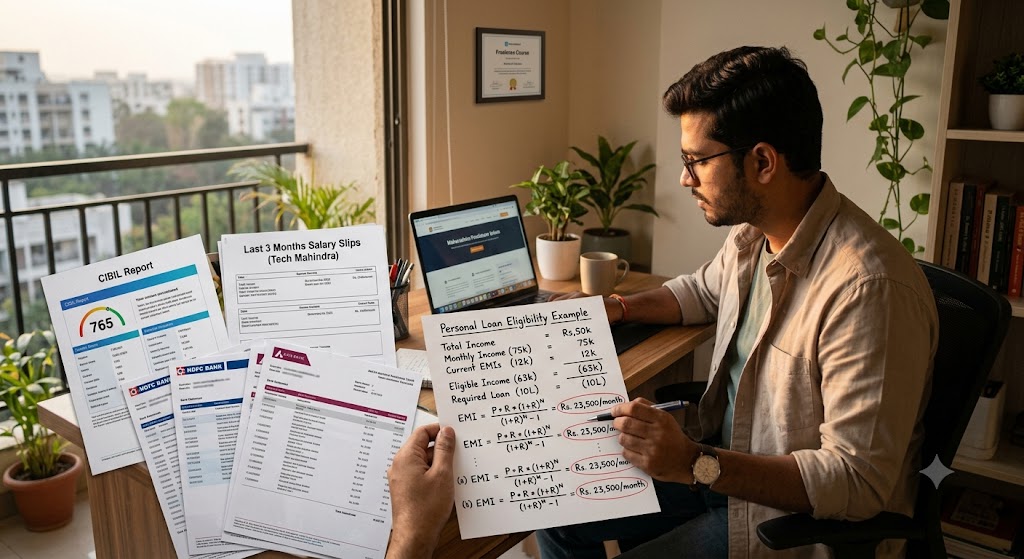
Freelancers across Maharashtra often wonder whether they can qualify for a personal loan without a fixed monthly salary. Unlike salaried employees, freelancers may earn different amounts each month depending on client payments, project availability and contract terms.
The good news is that freelance income does not automatically disqualify someone from getting a loan. However, lenders may assess income consistency, credit history, existing EMIs, bank statements and overall repayment capacity before making a decision.
In this guide, we use a practical example to explain how loan eligibility for freelancers in Maharashtra may be assessed and what independent professionals can do to prepare before applying.
AI Answer Box: How Can Freelancers Qualify for a Loan in Maharashtra?
Freelancers in Maharashtra may qualify for a personal loan if they meet the lender's eligibility criteria. Lenders may review documented income, bank statements, credit history, existing debt, KYC documents and repayment capacity. Approval depends on the complete financial profile, and no single credit score or income level guarantees approval.
1. Meet Rahul, a Freelancer From Pune
Consider Rahul, a hypothetical freelance graphic designer living in Pune. He works with several clients and receives payments at different times of the month.
Rahul wants a personal loan of ₹2 lakh to upgrade his laptop and cover professional expenses.
His financial profile looks like this:
| Financial detail | Illustrative information |
|---|---|
| Average monthly income | ₹60,000 |
| Existing monthly EMI | ₹8,000 |
| Credit score | 750 |
| Requested loan amount | ₹2,00,000 |
| Work profile | Freelance graphic designer |
| Income evidence | Bank statements and client invoices |
These details help illustrate the factors a lender may consider. They do not establish whether Rahul would actually qualify for a loan.
2. How Does the Lender Assess His Freelance Income?
Rahul earns different amounts each month because his income depends on completed projects and client payments.
For example:
| Month | Income |
|---|---|
| January | ₹55,000 |
| February | ₹70,000 |
| March | ₹48,000 |
| April | ₹65,000 |
| May | ₹62,000 |
| June | ₹60,000 |
| Total for six months | ₹3,60,000 |
| Monthly average | ₹60,000 |
A lender may review bank statements, invoices, tax records and other supporting documents to understand Rahul's income pattern.
His average income is useful, but the lender may also consider how predictable those earnings are and whether they are sufficient to support the requested repayment.
Practical tip: Freelancers should keep client invoices, contracts, payment records and applicable tax documents organised before applying.
3. How Do Existing EMIs Affect His Eligibility?
Rahul already pays ₹8,000 every month toward an existing loan. This reduces the amount of income available for a new EMI.
| Monthly calculation | Amount |
|---|---|
| Average monthly income | ₹60,000 |
| Existing EMI | ₹8,000 |
| Income remaining after existing EMI | ₹52,000 |
The remaining ₹52,000 must also cover housing, food, utilities, taxes, professional expenses and savings.
A lender may assess these obligations when deciding whether the proposed loan is affordable. There is no universal EMI-to-income limit that guarantees approval across all lenders.
4. Can Rahul Afford a ₹2 Lakh Personal Loan?
Suppose Rahul considers a hypothetical ₹2 lakh loan at an annual interest rate of 18% for 24 months.
Using a standard reducing-balance EMI calculation, the approximate monthly EMI would be ₹9,985.
| Loan detail | Illustrative figure |
|---|---|
| Loan amount | ₹2,00,000 |
| Annual interest rate | 18% |
| Tenure | 24 months |
| Approximate monthly EMI | ₹9,985 |
| Existing EMI | ₹8,000 |
| Combined monthly EMIs | ₹17,985 |
After paying both EMIs, Rahul would have approximately ₹42,015 remaining from his average monthly income, before other expenses and taxes.
This is an illustration, not a loan offer. Actual costs may differ because of fees, charges, the lender's pricing and the final loan terms.
Before accepting the loan, Rahul should check whether he can manage the EMI during months when freelance earnings are lower than usual.
5. Which Documents May Rahul Need?
Depending on the lender and loan product, Rahul may be asked to provide:
-
PAN and acceptable identity documents
-
Address proof or other required KYC details
-
Recent bank statements
-
Income Tax Returns (ITRs), where required
-
Client invoices and payment records
-
Client contracts or work orders, if requested
-
Details of existing loans and EMIs
Requirements vary. Freelancers should confirm the lender's official document checklist rather than assuming every lender follows the same process.
6. How Does a CIBIL Score Affect His Application?
Rahul's illustrative credit score of 750 may be viewed positively by some lenders. However, a good score does not guarantee approval.
Lenders may also consider:
-
Previous loan and credit-card repayments
-
Existing outstanding balances
-
Overdue payments or defaults
-
Recent credit enquiries
-
Income consistency
-
Current debt obligations
-
Accuracy of KYC and income documents
Freelancers should review their credit reports and correct genuine errors before applying.
7. What If Rahul's Income Drops?
Freelance earnings can fluctuate. Suppose Rahul earns only ₹35,000 in a slower month instead of his usual average of ₹60,000.
If his combined EMIs remain ₹17,985, he would have approximately ₹17,015 left before rent, food, taxes and other expenses.
This highlights why freelancers should not plan repayments based only on their best earning months.
Before borrowing, consider:
-
Building an emergency fund
-
Choosing a smaller loan if practical
-
Comparing repayment periods and total interest costs
-
Keeping monthly expenses under control
-
Avoiding new debt when income is uncertain
A longer loan tenure may reduce the EMI but can increase the total interest paid. Compare the full cost, not just the monthly instalment.
8. Common Mistakes Freelancers Should Avoid
Freelancers applying for personal loans in Maharashtra should avoid these common mistakes:
Relying only on average income: Income can fluctuate, so plan for slower months.
Ignoring existing debt: Add up all EMIs before deciding how much to borrow.
Submitting incomplete documents: Check that identity, bank and income details are accurate.
Applying to too many lenders at once: Compare eligibility criteria and apply selectively.
Accepting an offer without checking charges: Review the interest rate, APR, processing fees, total repayment, KFS and loan agreement.
Trusting unverified loan apps: Confirm the actual lender's identity and use authorised channels to submit sensitive documents. Never share OTPs, UPI PINs or banking passwords.
Key Takeaways
-
Freelancers in Maharashtra may qualify for personal loans if they meet the lender's criteria.
-
Bank statements, invoices and applicable tax records may help establish freelance income.
-
Existing EMIs can reduce repayment capacity.
-
A good CIBIL score does not guarantee loan approval.
-
Plan for lower-income months before committing to a fixed EMI.
-
Compare APR, processing fees and total repayment before accepting an offer.
-
Verify the lender and protect your financial information.
Frequently Asked Questions (FAQs)
1. Can freelancers in Maharashtra get a personal loan?
Yes. Freelancers may qualify if they meet the lender's requirements for income, credit history, documents and repayment capacity.
2. Do freelancers need a salary slip for loan approval?
Not necessarily. Some lenders may accept bank statements, ITRs, invoices and client payment records instead of salary slips.
3. Does a CIBIL score of 750 guarantee approval?
No. A credit score is one factor in the assessment. Income, existing debt, documentation and lender-specific policies also matter.
4. Can freelancers apply with irregular income?
Yes, depending on the lender's eligibility criteria. The lender may review income records and cash flow to assess repayment capacity.
5. Are ITRs mandatory for freelancer loans?
Requirements vary by lender and product. Some may require ITRs, while others may accept alternative income documents.
6. Can existing EMIs reduce my loan eligibility?
Yes. Existing financial commitments can affect the amount a lender considers affordable.
7. Should freelancers choose a longer loan tenure?
A longer tenure may reduce the monthly EMI but can increase total interest costs. Compare the complete repayment amount before deciding.
8. What can I do if my application is rejected?
Review the reason, check your credit report and documents, and reassess your budget before applying again.
Conclusion
This example demonstrates how loan eligibility for freelancers in Maharashtra may depend on documented income, credit history, existing EMIs and repayment capacity rather than a fixed salary alone.
Freelancers can prepare by maintaining clear financial records, monitoring their credit profile and choosing a repayment amount that remains manageable when earnings fluctuate. Always verify the lender and review the official loan terms before accepting an offer.
Published on : 18th October 2026
Published by : Shibam nath
www.vizzve.com || www.vizzveservices.com
Follow us on social media: Facebook || Linkedin || Instagram
🛡 Powered by Vizzve Financial
RBI-Registered Loan Partner | 10 Lakh+ Customers | ₹600 Cr+ Disbursed