

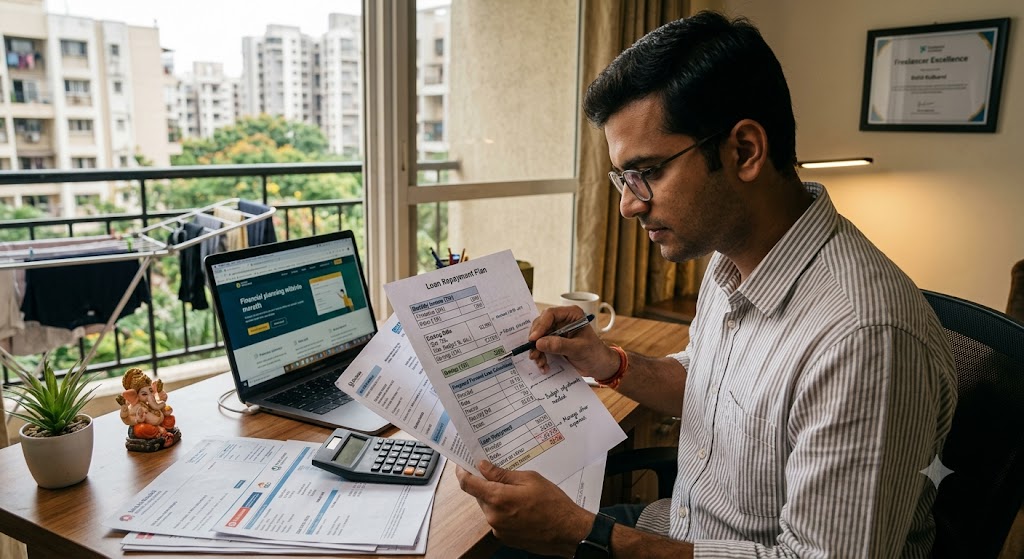
Freelancers in Maharashtra often experience fluctuating income because their earnings depend on client payments, completed projects and contract schedules. While this flexibility can offer professional freedom, it can also make monthly loan repayments challenging.
Before taking a personal loan, freelancers should understand how repayment obligations affect their financial stability and loan eligibility. A realistic repayment plan can help independent professionals manage EMIs without putting essential expenses or business operations at risk.
This guide explains how freelancers can plan loan repayments, calculate affordable EMIs and prepare for months when income is lower than expected.
AI Answer Box: How Should Freelancers Plan Loan Repayments?
Freelancers should plan loan repayments around their documented income, essential expenses, existing EMIs and savings. Before accepting a loan, calculate the monthly EMI, compare the APR and total repayment, and maintain a buffer for irregular earnings. Lenders may assess income stability, credit history and repayment capacity when reviewing loan applications.
1. Understand Your Monthly Income Before Borrowing
The first step is to understand how much money you actually earn after accounting for professional expenses and applicable taxes.
Unlike salaried employees, freelancers may earn ₹70,000 in one month and ₹35,000 in another. Planning a fixed EMI around the highest-earning month can create problems when payments from clients are delayed.
Before applying, review your bank statements and income records from recent months.
Consider these questions:
-
What is your average monthly income?
-
What is your income during a slower month?
-
Are client payments predictable or frequently delayed?
-
How much do you spend on software, equipment, travel or other work expenses?
-
How much do you need for taxes and household costs?
Practical tip: Build your budget around a conservative estimate of income rather than assuming every month will be equally profitable.
2. Calculate How Much EMI You Can Afford
Your EMI should fit comfortably within your budget after essential expenses and existing repayments.
For example, consider a hypothetical freelance web developer in Pune.
| Monthly financial detail | Amount |
|---|---|
| Average freelance income | ₹60,000 |
| Essential household expenses | ₹20,000 |
| Professional expenses | ₹5,000 |
| Existing loan EMI | ₹5,000 |
| Provision for taxes and other obligations | ₹5,000 |
| Remaining before a new EMI and savings | ₹25,000 |
The ₹25,000 remaining is not automatically a safe amount to spend on a new EMI. The freelancer should also account for savings, emergency needs and months with lower earnings.
A smaller EMI may provide greater flexibility, especially when income varies considerably.
3. Compare Loan Tenure and Monthly EMI
Loan tenure affects both the monthly instalment and the total interest paid. A longer tenure usually reduces the EMI but can increase the overall borrowing cost.
The following example uses a hypothetical ₹1,50,000 loan at 18% annual interest on a reducing balance. Figures are approximate and exclude fees and other charges.
| Loan tenure | Approximate monthly EMI | Approximate total repayment |
|---|---|---|
| 12 months | ₹13,752 | ₹1,65,024 |
| 24 months | ₹7,491 | ₹1,79,784 |
| 36 months | ₹5,423 | ₹1,95,228 |
The figures illustrate the trade-off: the 36-month option has a lower monthly EMI, but the total repayment is higher.
Before choosing a tenure, compare the actual APR, fees, total repayment and any applicable prepayment conditions in the lender's official offer.
4. Keep a Repayment Buffer for Irregular Income
Freelancers may face delayed invoices, cancelled projects or seasonal drops in demand. An emergency buffer can help cover EMIs during these periods.
Consider building savings that can cover essential expenses and loan payments for several months, based on your circumstances.
Useful habits include:
-
Setting aside a portion of every client payment.
-
Maintaining a separate account for taxes and regular obligations.
-
Keeping emergency savings accessible.
-
Following up on overdue client invoices.
-
Avoiding unnecessary new borrowing to pay existing EMIs.
Do not assume that a future project or an expected client payment will arrive on time.
5. How Does Repayment Behaviour Affect Loan Eligibility?
Repayment history can influence how lenders evaluate a future application. Missed payments or overdue accounts may be reflected in your credit history, depending on reporting and the lender's practices.
To maintain a healthy repayment record:
-
Pay EMIs and credit-card bills by their due dates.
-
Keep sufficient funds in the repayment account.
-
Review loan statements and payment confirmations.
-
Contact the lender promptly if you anticipate difficulty paying.
-
Check your credit report periodically for errors.
A good repayment history can support a credit profile, but it does not guarantee approval for a future loan.
6. What Should You Do If You Cannot Pay an EMI?
If your freelance income drops unexpectedly, act early instead of ignoring payment reminders.
Step 1: Review your cash flow. Identify available funds, essential expenses and upcoming client payments.
Step 2: Contact your lender. Explain the difficulty and ask whether any permitted repayment options are available. These depend on the lender and loan agreement.
Step 3: Prioritise essential expenses. Avoid taking an expensive new loan without understanding the additional cost.
Step 4: Check the consequences. Review any applicable late-payment charges, penal charges and credit-reporting implications in your agreement.
Step 5: Keep records. Save communications, receipts and any written arrangement agreed with the lender.
Never assume that a lender has changed your due date or repayment terms unless the change has been confirmed through an authorised channel.
7. Documents That Can Help Freelancers Manage Loan Repayments
Accurate financial records can help you understand your own affordability and may support a lender's assessment.
Depending on the lender's requirements, relevant records may include:
-
Recent bank statements
-
Client invoices and payment receipts
-
Income Tax Returns (ITRs), where applicable
-
Details of existing loans and EMIs
-
A personal monthly budget
-
Records of professional expenses
Keep your documents updated and submit them only through verified lender channels. Never share OTPs, UPI PINs or banking passwords with agents.
8. Common Loan Repayment Mistakes to Avoid
| Common mistake | Better approach |
|---|---|
| Choosing an EMI based on your best month | Use conservative income estimates |
| Ignoring existing EMIs | Calculate all monthly debt obligations |
| Selecting a longer tenure without comparing costs | Compare total repayment and APR |
| Using tax money for routine spending | Set aside funds for applicable taxes |
| Borrowing to cover recurring shortfalls | Review expenses and contact the lender early |
| Ignoring missed-payment notices | Communicate promptly and keep written records |
Responsible repayment planning should begin before the loan is accepted, not after the first EMI becomes due.
Key Takeaways
-
Base your repayment plan on realistic, documented freelance income.
-
Account for household expenses, professional costs, taxes and existing EMIs.
-
Compare loan tenure, monthly EMI, APR and total repayment.
-
Maintain an emergency buffer for delayed payments and low-income months.
-
Contact your lender early if repayment becomes difficult.
-
Protect your credit history by monitoring due dates and payment records.
-
Verify the lender and read the loan agreement before accepting an offer.
Frequently Asked Questions (FAQs)
1. How should freelancers in Maharashtra plan loan repayments?
Freelancers should estimate conservative monthly income, account for essential expenses and existing EMIs, and choose a repayment amount that remains manageable during slower months.
2. Is a fixed EMI difficult for freelancers with irregular income?
It can be challenging when earnings fluctuate. Maintaining savings and budgeting around lower-income months can help manage fixed repayment obligations.
3. Should freelancers choose a short or long loan tenure?
A shorter tenure generally means a higher EMI but lower total interest, while a longer tenure usually lowers the EMI but can increase total interest. Compare actual offers before deciding.
4. Can missed EMIs affect my CIBIL score?
Missed or overdue payments may affect your credit history and score, depending on reporting. Contact your lender promptly if you anticipate difficulty paying.
5. What should I do if a client delays payment?
Review available funds, follow up on the invoice and contact your lender before the EMI becomes overdue if you expect repayment difficulties.
6. Can I take another loan to pay an existing EMI?
Borrowing to repay existing debt can increase your financial burden. Understand the total cost and consider discussing repayment options with your current lender before taking on more debt.
7. How much emergency savings should freelancers maintain?
The appropriate amount depends on income stability, household expenses and obligations. Many people aim to build a buffer covering several months of essential expenses, where practical.
8. Does timely repayment guarantee future loan approval?
No. Timely repayment can support your credit history, but lenders also consider income, existing debt, documentation and their own eligibility criteria.
Conclusion
A repayment plan is an important part of loan eligibility for freelancers in Maharashtra. Since freelance earnings can vary from month to month, borrowers should choose an EMI that fits their realistic budget rather than relying on optimistic income estimates.
By maintaining accurate records, building savings, comparing loan costs and communicating early with lenders when difficulties arise, freelancers can make more informed borrowing decisions.
Published on : 18th October 2026
Published by : Shibam nath
www.vizzve.com || www.vizzveservices.com
Follow us on social media: Facebook || Linkedin || Instagram
🛡 Powered by Vizzve Financial
RBI-Registered Loan Partner | 10 Lakh+ Customers | ₹600 Cr+ Disbursed