

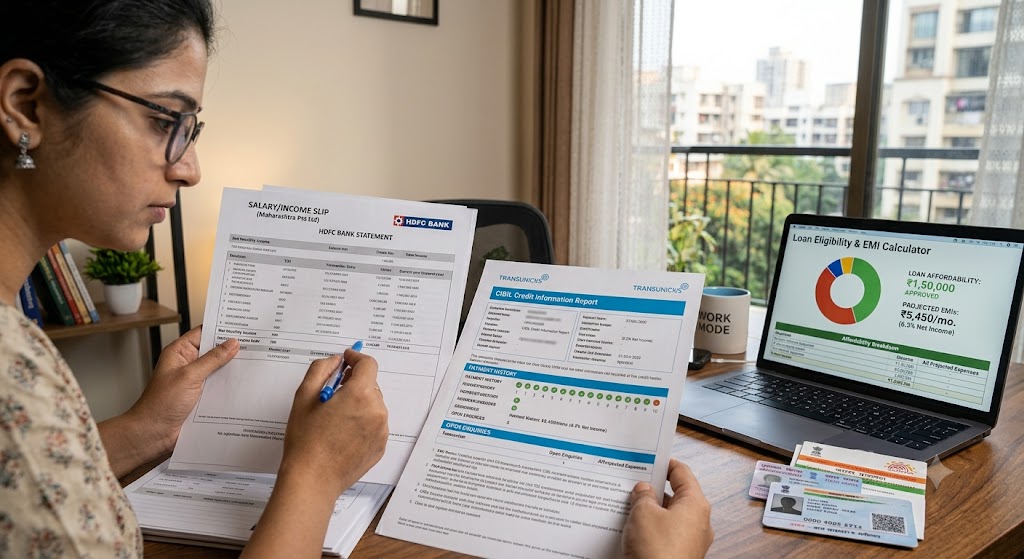
Freelancers in Maharashtra often enjoy the flexibility of working with different clients, choosing projects and managing their own schedules. However, when applying for a personal loan, variable income and the absence of a fixed monthly salary can make financial documentation especially important.
Whether you are a software developer in Pune, a graphic designer in Mumbai, a content writer in Nagpur or an independent consultant in another part of Maharashtra, understanding loan eligibility for freelancers in Maharashtra can help you prepare before submitting an application.
Lenders may evaluate your income, credit history, existing EMIs, bank statements and identity documents to determine whether you qualify. Their requirements vary, so checking the details in advance can help you avoid unnecessary delays and unsuitable loan offers.
1. Check Your Average Freelance Income
Your income is one of the main factors lenders may consider when assessing repayment capacity. Since freelance earnings can change from month to month, lenders may review financial records over a period of time.
Before applying, check:
-
Your average monthly income
-
Payments received from regular clients
-
Income after business expenses and applicable taxes
-
Any gaps between projects
-
Your ability to manage repayments during slower months
Tip: Do not calculate affordability using only your highest-earning month. Use a realistic income estimate that accounts for fluctuations.
2. Review Your CIBIL Score and Credit History
Your credit profile can influence a lender's decision, the amount offered and the terms of a loan. Lenders may examine repayment history, outstanding balances, credit utilisation and recent credit enquiries.
Before submitting an application:
-
Review your credit report for errors.
-
Pay existing EMIs and credit-card bills on time.
-
Check whether overdue payments are correctly reported.
-
Dispute genuine inaccuracies with the relevant credit bureau.
-
Avoid applying to multiple lenders without comparing their criteria.
A healthy credit history can support your application, but a good CIBIL score does not guarantee loan approval. Income, existing debt and lender-specific rules also matter.
3. Prepare Your Income Proof and Financial Documents
Freelancers may need to demonstrate their earnings through financial records rather than traditional salary slips.
Depending on the lender, you may be asked for:
| Document | Purpose |
|---|---|
| Bank statements | Show account activity and incoming payments |
| Income Tax Returns (ITRs) | Help establish declared income |
| Client invoices | Record payments for completed work |
| Client contracts | Show agreed or ongoing projects |
| PAN card | Support identity and financial verification |
| Aadhaar or accepted identity proof | Help complete KYC |
| Address proof | Verify your address, where required |
| Other financial records | Support income assessment, if requested |
Not every lender requires all these documents. Confirm the official checklist for the specific loan product before applying.
4. Calculate Your Existing EMIs and Repayment Capacity
A lender may consider how much of your income is already committed to debt repayments.
For example, if your average monthly freelance income is ₹60,000 and you pay ₹15,000 in existing EMIs, you should calculate whether a new EMI would remain affordable after essential expenses, business costs and taxes.
Review:
-
Personal loan repayments
-
Home or vehicle loan EMIs
-
Credit-card obligations
-
Regular household expenses
-
Business-related expenses
-
Emergency savings and irregular client payments
Tip: Choose a repayment amount you can manage even when freelance work slows down. Do not borrow the maximum amount offered simply because you qualify for it.
5. Check Your Freelance Work History
Some lenders may consider how long you have been working independently and whether you can demonstrate a reliable income pattern.
Useful records may include:
-
The period you have been freelancing
-
Recent client contracts
-
Completed-project invoices
-
Bank records showing incoming payments
-
Tax returns or other financial statements, where applicable
If you recently started freelancing, check whether the lender accepts applicants with a shorter work history. Eligibility criteria can vary significantly between lenders.
6. Compare Interest Rates, APR and Other Charges
Do not choose a loan based only on a low advertised interest rate or a small monthly EMI. Fees and repayment terms can change the total cost of borrowing.
Before accepting an offer, check:
-
Interest rate
-
Annual Percentage Rate (APR)
-
Processing fee and applicable taxes
-
Monthly EMI
-
Loan tenure
-
Total repayment amount
-
Late-payment and penal charges
-
Prepayment or foreclosure conditions, where applicable
Review the Key Facts Statement (KFS) and loan agreement carefully. Compare the total cost and the amount you will actually receive after any deductions.
7. Verify the Lender Before Applying
Freelancers seeking quick funding should be careful when using digital loan apps. An app's branding alone does not establish that the lender is legitimate.
Before sharing personal information:
-
Identify the actual lender.
-
Verify the lender through official channels.
-
Use the lender's genuine website or authorised application.
-
Read the privacy information and permissions.
-
Check the KFS and loan agreement.
-
Avoid suspicious demands for upfront payments in exchange for guaranteed approval.
Never share OTPs, UPI PINs, ATM PINs or banking passwords with loan agents. For digital lending, verify the regulated lender and understand the terms before accepting a loan.
8. Choose the Right Loan Amount and Tenure
Your requested loan amount should match your actual need and repayment capacity.
A longer tenure may reduce your monthly EMI but can increase the total interest paid. A shorter tenure may reduce total interest but result in higher monthly repayments.
Before choosing, compare different repayment scenarios and account for your variable income. Avoid taking a larger loan merely because it is available.
Quick Checklist Before Applying
Use this checklist to review your readiness:
| What to check | Ready? |
|---|---|
| Average freelance income calculated | ☐ |
| Credit report reviewed | ☐ |
| Existing EMIs and expenses calculated | ☐ |
| Bank statements and income records organised | ☐ |
| Required KYC documents prepared | ☐ |
| Lender eligibility criteria checked | ☐ |
| APR, fees and total repayment compared | ☐ |
| Lender and application channel verified | ☐ |
| EMI affordable during slower months | ☐ |
Common Mistakes to Avoid
Freelancers can make their applications harder to assess by:
-
Submitting incomplete or inconsistent documents
-
Failing to maintain income records
-
Ignoring credit-report errors
-
Requesting an unaffordable loan amount
-
Applying to many lenders without comparison
-
Overlooking processing fees and other charges
-
Trusting loan apps that promise guaranteed approval
Preparing your financial records and checking the lender's requirements can help you avoid these common problems.
Frequently Asked Questions
1. Can freelancers in Maharashtra apply for a personal loan?
Yes. Freelancers may apply if they meet the lender's eligibility criteria, income requirements and documentation rules. Approval depends on the complete financial profile.
2. Do freelancers need salary slips to get a loan?
Not necessarily. Freelancers may be able to provide bank statements, ITRs, invoices, contracts or other accepted income records, depending on the lender.
3. What CIBIL score is required for a freelancer loan?
There is no single score that guarantees approval across all lenders. Requirements vary by lender and product, and credit history is only one part of the assessment.
4. Can freelancers apply if their income changes every month?
Possibly. Lenders may review income records over time to understand earning patterns and repayment capacity. Their acceptance criteria differ.
5. Are ITRs compulsory for freelancer loans?
Some lenders require ITRs, while others may accept alternative documentation. Check the specific lender's requirements before applying.
6. Does existing debt affect freelancer loan eligibility?
Yes. Existing EMIs and other financial obligations may affect how much additional repayment a lender considers affordable.
7. What should I compare before accepting a loan?
Compare APR, interest rate, processing fees, taxes, EMI, tenure, total repayment, late-payment charges and prepayment terms.
8. How can I avoid fraudulent loan apps?
Verify the actual lender, use official application channels, review the loan documents and never share OTPs, PINs or passwords with agents.
Conclusion
Before applying for a personal loan, freelancers in Maharashtra should review their average income, credit history, existing EMIs, income documents and repayment capacity. Comparing lenders and understanding all charges can help you make a more informed decision.
Take time to check the lender's eligibility criteria, verify the application channel and read the KFS and loan agreement before accepting an offer. Borrow only an amount that fits your financial circumstances.
Published on : 17th October 2026
Published by : Shibam nath
www.vizzve.com || www.vizzveservices.com
Follow us on social media: Facebook || Linkedin || Instagram
🛡 Powered by Vizzve Financial
RBI-Registered Loan Partner | 10 Lakh+ Customers | ₹600 Cr+ Disbursed