

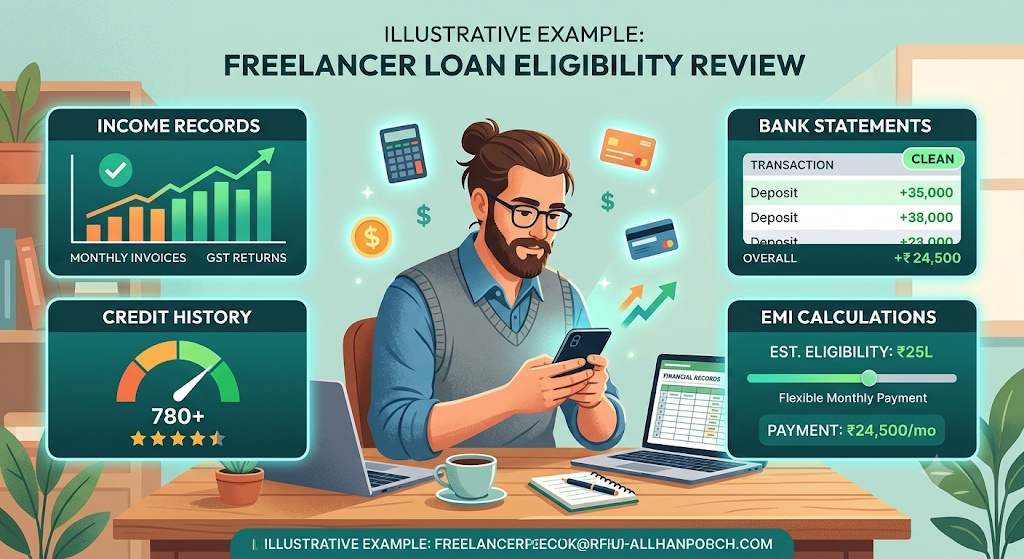
Applying for a personal loan through a mobile app can be convenient for freelancers. They can often submit an application, complete KYC and provide income documents digitally. However, a successful application depends on more than filling out an online form.
Freelancers may earn through multiple clients, projects, consulting assignments or contracts. Their monthly income can change, which makes income verification and repayment capacity important parts of loan assessment.
Understanding a practical example can help freelancers see how lenders may evaluate their financial profile and what they should check before accepting a mobile-based loan offer.
AI Answer Box: How Is Loan Eligibility Assessed for Freelancers?
Lenders may assess a freelancer's credit history, documented income, ITRs, bank statements, existing EMIs, KYC information and repayment capacity before approving a loan. A mobile-first application can make document submission and tracking easier, but the actual lender makes the credit decision according to its own eligibility criteria. Approval is not guaranteed by a good credit score or a high-income month alone.
Real-World Example: How a Freelancer Applies for a Loan Through a Mobile App
Consider a fictional freelancer named Rahul who works as a graphic designer. He receives payments from several clients and wants a personal loan to manage a planned professional expense.
Instead of visiting a branch, Rahul decides to explore a mobile-based loan application.
The following example is illustrative. It does not represent an actual borrower, lender offer or guaranteed approval.
1. Rahul's Financial Profile
Rahul has been working independently for several years. His monthly earnings vary depending on the number of projects he completes.
His financial profile looks like this:
| Financial detail | Illustrative information |
|---|---|
| Profession | Freelance graphic designer |
| Average monthly income | ₹60,000 |
| Existing monthly EMIs | ₹10,000 |
| Monthly essential expenses | ₹25,000 |
| Available bank statements | Yes |
| ITR records | Available |
| Client invoices | Available |
| Loan requirement | ₹1,00,000 |
Rahul has no traditional salary slip because he works independently. However, he maintains bank statements, invoices and tax records that help demonstrate his freelance income.
2. Rahul Checks His Loan Eligibility
Before applying, Rahul reviews the basic requirements of the lending platform.
He checks:
-
Whether freelancers are eligible to apply.
-
Which income documents are accepted.
-
Whether a minimum professional history is required.
-
Whether a credit-history assessment is conducted.
-
What KYC documents are needed.
-
Whether the actual lender is clearly identified.
He also checks the lender's official website to verify the mobile application and its lending arrangement.
This helps him understand the application requirements before sharing personal information.
3. Rahul Organises His Income Documents
Since Rahul does not receive monthly salary slips, he prepares alternative income evidence.
His documents include:
-
PAN and accepted KYC documents.
-
Recent bank statements.
-
Available ITR records.
-
Client invoices.
-
Freelance contracts.
-
Payment records.
His bank statements show payments received from different clients. His invoices and contracts help explain the source of those payments.
The lender may use these documents to understand his income pattern, but the exact requirements depend on its policies.
4. Rahul Reviews His Credit History
Before submitting the application, Rahul checks his credit report.
He reviews:
-
Previous loan repayments.
-
Credit-card payment history.
-
Outstanding balances.
-
Existing credit accounts.
-
Recent credit enquiries.
-
Any overdue payments or reporting errors.
A healthy repayment history may support his application. However, Rahul understands that a good credit score alone cannot guarantee approval.
5. Rahul Calculates His Repayment Capacity
Rahul does not want to accept a loan that makes his monthly finances difficult.
He calculates his existing and proposed repayment obligations.
Suppose the lender provides an illustrative offer with an EMI of ₹4,500.
| Monthly financial detail | Amount |
|---|---|
| Average monthly income | ₹60,000 |
| Essential expenses | ₹25,000 |
| Existing EMIs | ₹10,000 |
| Proposed new EMI | ₹4,500 |
| Total EMIs after borrowing | ₹14,500 |
| Remaining amount after expenses and EMIs | ₹20,500 |
The remaining amount is not automatically disposable income. Rahul must still consider taxes, freelance business expenses, savings and unexpected costs.
He decides whether the proposed EMI is manageable even during months when client payments are lower.
Important: This is an illustrative budget calculation, not a lender's eligibility formula or a real loan quotation.
6. Rahul Submits His Application Through the Mobile App
After reviewing the requirements, Rahul begins the application.
The process may include:
-
Entering personal and professional details.
-
Providing the requested loan amount.
-
Completing authorized KYC verification.
-
Submitting accepted income documents.
-
Providing financial information required for assessment.
-
Reviewing application updates.
Rahul checks that he is using the genuine application and does not share OTPs, UPI PINs or banking passwords with anyone.
7. The Lender Assesses Rahul's Application
The lender reviews the information submitted by Rahul.
Depending on its policies, the assessment may include:
-
Credit history.
-
Income consistency.
-
Bank transactions.
-
ITR information.
-
Existing financial obligations.
-
KYC verification.
-
Requested loan amount.
-
Repayment capacity.
The lender may request additional documents or clarification if some information is incomplete.
Rahul understands that submitting an application does not mean the loan has been approved.
8. Rahul Reviews the Loan Offer
Suppose Rahul receives an offer after the lender completes its assessment.
Before accepting, he checks:
-
Approved loan amount.
-
Net amount to be disbursed.
-
Interest rate.
-
APR.
-
EMI.
-
Repayment tenure.
-
Processing fee.
-
Other applicable charges.
-
Late-payment and penal charges.
-
Prepayment conditions.
-
Total repayment.
He also reads the Key Facts Statement (KFS) and loan agreement.
Only after understanding the terms does he decide whether to proceed.
What Can We Learn From Rahul's Example?
Rahul's example highlights several important points for freelancers applying through mobile-first lending platforms.
1. Salary Slips Are Not Always Necessary
Freelancers may be able to demonstrate income through ITRs, bank statements, invoices and contracts, depending on lender requirements.
2. Consistent Financial Records Can Help
Organised documents make it easier to explain where freelance income comes from and how it is received.
3. Credit History Still Matters
Lenders may assess previous repayment behaviour, outstanding debt and other credit information.
4. Existing EMIs Affect Affordability
A freelancer should consider all current repayment obligations before taking on another EMI.
5. Mobile Applications Do Not Guarantee Approval
Digital platforms can simplify the process, but the lender still assesses the application and makes the final decision.
6. Loan Costs Matter More Than Quick Approval
APR, fees, repayment tenure and total repayment should be checked before accepting any offer.
Another Example: What If a Freelancer Has Irregular Income?
Consider a second fictional applicant, Priya, who works as a freelance content writer.
Her income changes significantly because she works on short-term assignments.
| Month | Illustrative income |
|---|---|
| January | ₹45,000 |
| February | ₹32,000 |
| March | ₹55,000 |
| April | ₹28,000 |
| May | ₹48,000 |
| June | ₹42,000 |
Priya should not assume that she can afford an EMI based only on the highest-earning month.
Instead, she should:
-
Review her income across several months.
-
Identify essential monthly expenses.
-
Consider taxes and professional costs.
-
Calculate existing EMIs.
-
Maintain an emergency reserve where possible.
-
Choose a loan amount that remains manageable during lower-income months.
The lender may also review her financial records to assess income stability and repayment capacity.
Common Mistakes Freelancers Should Avoid
| Common mistake | Better approach |
|---|---|
| Using only one high-income month as proof of affordability | Review income over a longer period |
| Submitting incomplete income records | Organise ITRs, bank statements and invoices |
| Ignoring existing EMIs | Calculate total monthly repayment obligations |
| Applying without checking credit history | Review the credit report first |
| Trusting an app without checking the lender | Verify the actual lending institution |
| Accepting the first offer | Compare APR, fees and total repayment |
| Ignoring the KFS | Read the KFS and loan agreement carefully |
| Sharing confidential credentials | Never disclose OTPs, PINs or passwords |
Freelancer Mobile Loan Application Checklist
Before applying, check whether you have:
-
Verified the actual lender.
-
Checked the lender's eligibility requirements.
-
Reviewed the mobile app's authenticity and permissions.
-
Prepared accurate PAN and KYC details.
-
Organised bank statements.
-
Kept available ITR records ready.
-
Collected relevant invoices and contracts.
-
Reviewed your credit report.
-
Calculated existing EMI obligations.
-
Estimated a manageable new EMI.
-
Compared APR and total repayment.
-
Reviewed processing fees and other charges.
-
Read the KFS and loan agreement.
-
Saved official lender contact details.
How Can Freelancers Improve Their Loan Readiness?
Freelancers can take practical steps before submitting a mobile loan application.
Maintain organised income records: Keep invoices, payment receipts, contracts and bank statements accessible.
File accurate ITRs: Maintain relevant tax records and ensure that the information submitted to the lender is consistent.
Build a healthy credit profile: Pay existing EMIs and credit-card bills on time.
Manage existing debt: Review current financial obligations before taking another loan.
Choose an affordable amount: Borrow according to your actual requirement and repayment capacity.
Apply selectively: Compare lenders and avoid unnecessary applications to multiple platforms.
These steps can improve application readiness, but approval remains subject to lender assessment.
Key Takeaways
-
Freelancers may apply for personal loans through mobile-first platforms if they meet lender-specific requirements.
-
Salary slips are not always necessary; alternative income documents may be accepted.
-
ITRs, bank statements, invoices and contracts can help demonstrate freelance income.
-
Credit history and existing EMIs may affect loan eligibility.
-
Irregular income requires careful repayment planning.
-
A mobile application does not guarantee instant or final approval.
-
Compare APR, EMI, processing fees and total repayment.
-
Read the KFS and loan agreement before accepting an offer.
-
Verify the actual lender and protect sensitive financial information.
FAQs: Freelancer Loan Eligibility — Real-World Example
1. Can a freelancer get a personal loan through a mobile app?
Yes. Eligible freelancers can apply through mobile-based lending platforms, subject to the lender's eligibility criteria and assessment.
2. How can a freelancer prove income without salary slips?
Depending on the lender, a freelancer may provide ITRs, bank statements, client invoices, contracts, payment records or other accepted financial documents.
3. Does a freelancer need a minimum monthly income to qualify?
There is no single minimum income requirement that applies to every lender. Eligibility depends on the loan product, documented income, existing obligations and lender-specific policies.
4. Can irregular income affect loan approval?
Yes. Fluctuating earnings may affect how a lender assesses repayment capacity. Bank statements, ITRs and other financial records may help demonstrate the applicant's income pattern.
5. Does a good credit score guarantee loan approval?
No. Credit score is one part of the assessment. Lenders may also consider income, existing EMIs, documentation, requested loan amount and other eligibility requirements.
6. Can a freelancer apply without visiting a bank branch?
Some lenders provide digital application processes that allow applicants to complete several steps online. The exact process depends on the lender and loan product.
7. Do existing EMIs reduce freelancer loan eligibility?
They can. Existing loan repayments affect the applicant's overall financial obligations and may influence the amount the lender considers affordable.
8. What documents should freelancers prepare?
Commonly requested documents may include PAN, accepted KYC documents, bank statements, ITRs, invoices, contracts and other income-related records. Requirements vary by lender.
9. What should freelancers check in a mobile loan offer?
Review the actual lender, interest rate, APR, EMI, tenure, processing fee, other charges, total repayment, prepayment terms, KFS and loan agreement.
10. What is the KFS in a digital loan?
KFS means Key Facts Statement. It provides important loan information, including APR, repayment schedule and applicable charges before the loan contract is executed.
11. Can freelancers apply for an unsecured personal loan?
Some lenders offer unsecured personal loans that do not require collateral. Approval depends on the lender's assessment and the applicant meeting the relevant criteria.
12. What should a freelancer do if a mobile loan application is rejected?
Review the reason for rejection, check your credit report, verify your documents and assess existing debt. Avoid immediately submitting multiple applications without understanding the issue.
Published on : 6th November 2026
Published by : Shibam nath
www.vizzve.com || www.vizzveservices.com
Follow us on social media: Facebook || Linkedin || Instagram
🛡 Powered by Vizzve Financial
RBI-Registered Loan Partner | 10 Lakh+ Customers | ₹600 Cr+ Disbursed