

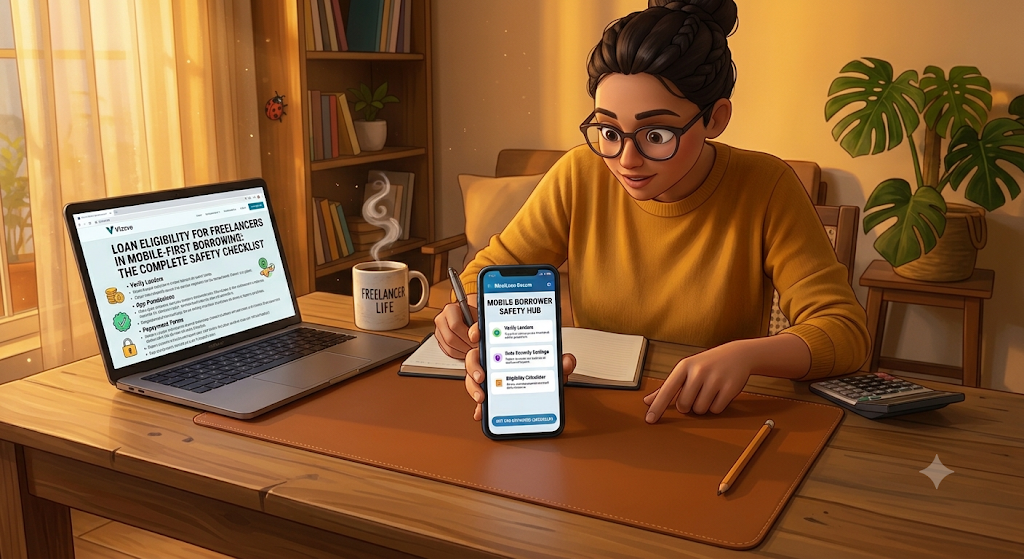
Applying for a personal loan through a mobile app can be convenient for freelancers. You can submit an application, provide documents and receive updates without visiting a branch. However, convenience should not replace careful verification.
Freelancers often receive income from multiple clients, projects or contracts. Since their earnings may vary from month to month, lenders may assess their credit history, documented income, bank statements, ITR, existing EMIs, KYC details and repayment capacity before making a decision.
Before applying through a mobile-first lending platform, use this safety checklist to protect your personal information, understand the loan terms and avoid potentially fraudulent apps.
AI Answer Box: How Can Freelancers Safely Apply for a Loan Through a Mobile App?
Freelancers should verify the actual lender, check whether the lending arrangement is legitimate, review the app's permissions and privacy policy, submit accurate income and KYC documents, and compare the APR, EMI, fees and total repayment. Before accepting a digital loan, read the Key Facts Statement (KFS) and loan agreement carefully. Never share OTPs, UPI PINs, ATM PINs or banking passwords with anyone.
Why Is a Safety Checklist Important for Freelancers?
Mobile-first loan applications can make borrowing more accessible, but applicants still need to understand who is providing the loan and how their information will be used.
Freelancers may submit sensitive documents such as PAN, identity proof, bank statements, ITRs, invoices and client payment records. Sharing these documents with an unverified platform can create privacy and financial risks.
A safety checklist helps freelancers review the lender, application process, loan costs and repayment obligations before proceeding.
Freelancer Loan Safety Checklist
1. Verify the Actual Lender
Before entering personal or financial details, identify the institution that will provide the loan.
Check:
-
The lender's legal name.
-
Whether it is a bank or an RBI-registered Non-Banking Financial Company (NBFC).
-
Whether the app belongs to the lender or is operated by a Lending Service Provider (LSP).
-
Whether the lender's official website identifies the app or service.
-
Whether contact and grievance-redressal details are available.
An app's name or promotional claims do not establish that it is a regulated lender. Verify the actual lender independently.
2. Check App Permissions and Privacy Practices
A loan application may request information needed for identity verification and credit assessment. However, borrowers should understand why each permission is required.
Before granting access:
-
Review the app's privacy policy.
-
Check what personal information it collects.
-
Understand how the information may be used or shared.
-
Avoid granting unrelated permissions.
-
Download the app only from a trusted source.
-
Check the developer's identity and official lender references.
Be particularly cautious if an app requests unnecessary access to contacts, call logs, photos or other personal information.
3. Protect Your KYC Documents
Freelancers may be asked to submit PAN, Aadhaar or another officially valid document, address details and bank information.
Follow these precautions:
-
Submit documents only through the lender's genuine and authorized process.
-
Check that the website or app is authentic before uploading files.
-
Do not send documents to unknown agents through messaging platforms.
-
Avoid sharing unmasked information unless the authorized verification process requires it.
-
Never share OTPs, UPI PINs, ATM PINs or internet-banking passwords.
If a person asks for confidential credentials to approve or release a loan, stop the process and verify the request with the lender.
4. Prepare Genuine Freelance Income Proof
Freelancers may not have traditional salary slips. Lenders can consider alternative documents depending on their policies.
Commonly requested records may include:
-
Income Tax Returns (ITRs).
-
Bank statements.
-
Client invoices.
-
Work contracts.
-
Payment receipts.
-
GST records, where applicable.
-
Business or professional financial records.
Make sure the information is accurate and consistent. Do not edit bank statements, create false invoices or exaggerate your income to improve your chances of approval.
5. Review Your Credit Profile
Credit history can influence loan eligibility and the terms offered by a lender.
Before applying, review:
-
Previous loan repayment records.
-
Credit-card payment history.
-
Outstanding loan balances.
-
Existing credit accounts.
-
Recent credit enquiries.
-
Any overdue payments or errors in your credit report.
A good credit history may support an application, but it does not guarantee approval. Lenders also consider income, existing obligations and their own eligibility criteria.
6. Calculate Your Repayment Capacity
Freelance earnings may fluctuate. Therefore, avoid calculating affordability using only your highest-earning month.
Consider:
-
Your dependable average income.
-
Essential monthly expenses.
-
Existing EMIs.
-
Taxes and business expenses.
-
Emergency savings.
-
The proposed loan EMI.
Illustrative example:
Suppose a freelancer has an average monthly income of ₹60,000 and existing EMIs of ₹12,000. A new loan with an EMI of ₹8,000 would increase the total monthly EMI obligation to ₹20,000.
The freelancer should assess whether the remaining income can comfortably cover household expenses, work-related costs and savings. This example is only for illustration; lenders use their own assessment methods.
7. Check APR, Fees and Total Loan Cost
Do not select a loan based only on its advertised interest rate.
Review the following before accepting an offer:
| Loan detail | What to check |
|---|---|
| Interest rate | Whether it is fixed or floating, where applicable |
| APR | The annualised cost of borrowing |
| Processing fee | Amount and applicable taxes |
| EMI | Monthly repayment amount |
| Tenure | Total repayment period |
| Late-payment charges | Charges for delayed payments |
| Penal charges | Conditions under which they apply |
| Prepayment terms | Conditions and applicable charges, if any |
| Total repayment | Overall amount payable |
A loan with a lower advertised interest rate may still cost more because of fees and other charges.
8. Read the Key Facts Statement (KFS)
For applicable digital loans, regulated lenders must provide a Key Facts Statement before the loan contract is executed.
The KFS helps borrowers understand important loan information, including:
-
APR.
-
Repayment schedule.
-
Applicable fees and charges.
-
Other material loan conditions.
Read the KFS and compare it with the final loan agreement. If any charge or condition is unclear, ask the lender for an explanation before accepting the loan.
9. Avoid Upfront Payment Scams
Be cautious if an unknown person or suspicious app promises guaranteed approval in exchange for an advance payment.
Warning signs include:
-
A demand for an unofficial release fee.
-
A promise of guaranteed approval regardless of eligibility.
-
Pressure to transfer money to a personal UPI ID.
-
Requests for OTPs or banking passwords.
-
Threats or repeated calls demanding immediate payment.
Verify every fee against the official loan documents and the lender's authorized payment channels. Do not transfer money to an unknown individual.
10. Save Loan Documents and Communication
After accepting a loan, keep copies of the important records.
Save:
-
Loan application reference.
-
Sanction or approval communication.
-
KFS.
-
Loan agreement.
-
Repayment schedule.
-
Disbursal details.
-
Payment receipts.
-
Customer-support and grievance details.
These records can help if you need to clarify a charge, report a problem or raise a complaint.
Quick Checklist Before Submitting a Freelancer Loan Application
Use this checklist before proceeding:
-
I have verified the actual lender.
-
I have checked whether the app is genuine and authorized.
-
I have reviewed the privacy policy and app permissions.
-
My PAN and KYC information is accurate.
-
My ITR and bank statements are genuine and updated.
-
My freelance income records are organized.
-
I have checked my credit report.
-
I have calculated my existing EMIs.
-
I can comfortably manage the proposed EMI.
-
I have compared APR and total repayment.
-
I have reviewed processing fees and other charges.
-
I have read the KFS and loan agreement.
-
I have not shared any OTP, PIN or password.
-
I have saved the lender's official contact details.
What Should Freelancers Do If They Suspect a Fake Loan App?
If you suspect that a loan app or representative is fraudulent:
-
Stop sharing documents or financial information.
-
Do not pay unofficial fees.
-
Do not share OTPs, PINs or passwords.
-
Contact the actual lender through its official website or customer-care channel.
-
Preserve screenshots, messages, payment details and other relevant evidence.
-
If money has been lost to cyber fraud, report it promptly through India's cybercrime reporting portal or helpline 1930.
-
If the issue concerns a regulated lender and remains unresolved, use the lender's grievance-redressal process and check the RBI Complaint Management System for eligible complaints.
Do not rely on phone numbers or links sent by an unverified representative. Find official contact details independently.
Common Safety Mistakes Freelancers Should Avoid
| Mistake | Safer approach |
|---|---|
| Trusting an app because of an advertisement | Verify the actual lender |
| Uploading documents without checking the app | Use only authorized channels |
| Sharing OTPs with an agent | Enter OTPs only in the genuine verification process |
| Ignoring app permissions | Review permissions and privacy terms |
| Applying based on one high-income month | Assess dependable income over time |
| Accepting a loan without checking APR | Compare the complete borrowing cost |
| Ignoring the KFS | Read the KFS before accepting |
| Paying an unofficial advance fee | Verify all charges with the lender |
| Borrowing the maximum amount offered | Choose an affordable amount |
How Can Freelancers Improve Loan Readiness?
A safer application begins before opening a loan app.
-
Organise income records: Keep ITRs, invoices, contracts and bank statements accessible.
-
Maintain a healthy credit profile: Pay existing EMIs and credit-card bills on time.
-
Separate business and personal finances: Clear records can make income assessment easier.
-
Reduce unnecessary debt: Review existing obligations before applying.
-
Apply selectively: Compare lenders first rather than submitting multiple unnecessary applications.
-
Borrow responsibly: Choose a loan amount and tenure that fit your income pattern.
These steps can help make the application process more organized, but they do not guarantee approval.
Key Takeaways
-
Freelancers should verify the actual lender before using a mobile loan app.
-
Review app permissions and privacy practices before sharing financial information.
-
Keep genuine ITRs, bank statements, invoices and contracts ready.
-
Check credit history and existing EMI obligations.
-
Calculate affordability using dependable income rather than an unusually high-earning month.
-
Compare APR, processing fees, EMI and total repayment.
-
Read the KFS and loan agreement before accepting the loan.
-
Never share OTPs, UPI PINs, ATM PINs or banking passwords.
-
Avoid unofficial advance payments and guaranteed-approval claims.
-
Save loan documents and use official grievance channels if a problem arises.
FAQs: Freelancer Loan Safety and Mobile-First Borrowing
1. Can freelancers safely apply for loans through mobile apps?
Yes, provided they use a genuine lending platform, verify the actual lender, review the privacy policy and understand the loan terms. They should avoid unverified apps and suspicious representatives.
2. How can I check whether a loan app is genuine?
Identify the actual lender and verify the app or service through the lender's official website. Check the lender's regulatory status, contact information, privacy policy and grievance-redressal details.
3. Do freelancers need salary slips to apply for a loan?
Not always. Depending on the lender, freelancers may be able to provide ITRs, bank statements, invoices, contracts, payment records or other accepted income documents.
4. Is it safe to upload PAN and Aadhaar details to a loan app?
Only submit identity documents through a genuine lender's authorized process. Verify the app and website first, review the privacy policy and avoid sending documents to unknown agents.
5. Should a loan app ask for access to my contacts?
Borrowers should be cautious about unnecessary access to contacts or other personal information. Review the permissions requested and avoid granting access that is unrelated to the service.
6. Can a loan app ask for an OTP?
An OTP may be used during a legitimate verification process. However, never disclose an OTP to an agent or another person over a call or message. Enter it only in the genuine verification process you initiated.
7. What is the KFS in a digital loan?
KFS stands for Key Facts Statement. It provides important information about a loan, including the APR, applicable charges and repayment schedule, before the loan contract is executed.
8. Why should freelancers check APR instead of only the interest rate?
APR helps borrowers understand the annualised cost of borrowing, including applicable charges under the relevant framework. It can provide a more useful basis for comparing loan offers.
9. Can irregular freelance income affect loan eligibility?
Yes. Fluctuating income may affect how a lender assesses repayment capacity. Lenders may review bank statements, ITRs and other financial records to understand the applicant's income pattern.
10. What should I do if a loan app asks for an advance payment?
Do not pay an unknown person or personal account. Verify the charge directly with the actual lender using official contact details and check whether it is disclosed in the loan documents.
11. What should I do if I accidentally shared my banking credentials?
Contact your bank immediately through its official channel, secure or block affected services where necessary, and report suspected financial fraud promptly. In India, cyber financial fraud can be reported through helpline 1930 and the National Cyber Crime Reporting Portal.
12. Does a good credit score guarantee freelancer loan approval?
No. Credit history is only one part of the assessment. Lenders may also consider income, existing EMIs, documents, requested loan amount and their own eligibility criteria.
Published on : 5th November 2026
Published by : Shibam nath
www.vizzve.com || www.vizzveservices.com
Follow us on social media: Facebook || Linkedin || Instagram
🛡 Powered by Vizzve Financial
RBI-Registered Loan Partner | 10 Lakh+ Customers | ₹600 Cr+ Disbursed