

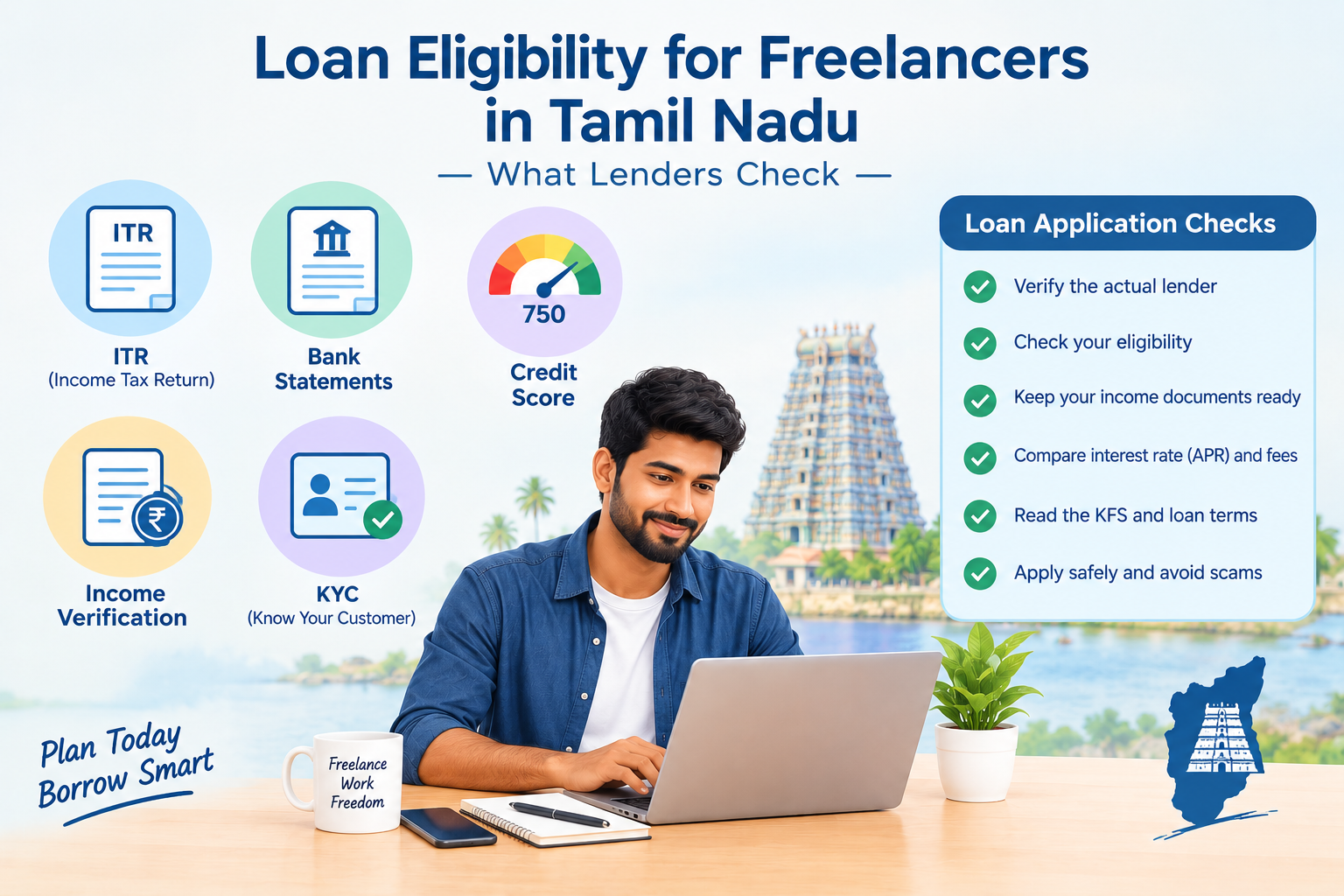
Freelancing has become a popular way to earn income, with professionals working across areas such as software development, digital marketing, graphic design, content creation, consulting, photography and online services.
However, applying for a loan as a freelancer can be different from applying as a salaried employee. Freelancers may not have a monthly salary slip or a single employer, so lenders may look at income records, bank statements, ITRs, credit history and repayment capacity.
If you are a freelancer in Tamil Nadu planning to apply for a loan, here are some of the most common questions borrowers ask.
Can Freelancers in Tamil Nadu Get a Loan?
Yes, freelancers can apply for suitable personal or business loan products, depending on the lender's eligibility criteria.
A lender may assess your:
- Income and income stability
- Credit history
- Existing loans and EMIs
- Bank transactions
- ITRs and financial records
- KYC documents
- Repayment capacity
- Loan amount requested
Approval is not guaranteed simply because you meet one eligibility condition. Each lender can have its own requirements.
Do Freelancers Need a Salary Slip?
Not necessarily.
Unlike salaried employees, freelancers may demonstrate their income through alternative documents.
These can include:
- Income Tax Returns (ITRs)
- Bank statements
- Client invoices
- Contracts or work agreements
- Professional or business records
- Other financial documents accepted by the lender
The exact documents required can vary according to the lender and loan product.
What Credit Score Is Needed for a Freelancer Loan?
There is no single credit-score number that guarantees approval for every freelancer.
A lender may consider your credit history along with income, existing debt, repayment behaviour and other information.
Before applying, check your credit report and look for:
- Missed payments
- Outstanding accounts
- Incorrect personal information
- Unexpected credit enquiries
- Unresolved loan accounts
A healthy repayment history can help demonstrate responsible borrowing behaviour.
Can Freelancers With Irregular Income Get a Loan?
Yes, freelancers with variable income can still apply.
However, fluctuating income may make repayment-capacity assessment more important. A lender may look at income over a period rather than relying on one particularly high-income month.
For example, if your freelance income changes significantly from month to month, maintaining clear bank records and tax documents can help demonstrate your overall financial position.
What Documents Do Freelancers Need?
The requirements depend on the lender, but commonly requested documents may include:
| Document | Possible Purpose |
|---|---|
| PAN | Identity and financial verification |
| Aadhaar or other KYC document | KYC verification |
| Bank statements | Income and cash-flow assessment |
| ITR | Income verification |
| Invoices | Evidence of freelance earnings |
| Client contracts | Work or income verification |
| Address proof | KYC |
| Existing loan details | Debt assessment |
Not every freelancer will need every document.
Can a Freelancer Get a Personal Loan Without an Employer?
Potentially, yes.
Freelancers are generally considered self-employed or independent professionals rather than salaried employees. Therefore, lenders may use alternative methods to assess their income and repayment capacity.
Instead of employer verification, the lender may examine financial records, bank transactions, tax documents and professional activity.
Does Freelance Experience Matter?
It can.
The length and consistency of your freelance activity may be relevant when a lender evaluates your income profile.
A freelancer with a longer history of documented earnings may have more financial records available for assessment than someone who has only recently started freelancing.
However, requirements vary between lenders.
Can Freelancers Apply for an Instant Loan?
Some lenders may provide digital loan applications to eligible self-employed borrowers.
But “instant” does not mean guaranteed approval.
The application may still involve:
- Application submission
- KYC verification
- Income assessment
- Credit checks
- Document verification
- Repayment-capacity assessment
- Final lender decision
Always verify the actual lender and understand the terms before accepting a digital loan.
Can Bank Statements Be Used as Income Proof?
In some cases, yes.
Bank statements can help demonstrate the flow of freelance income, especially when client payments are regularly received through banking channels.
However, the lender may also request ITRs, invoices or additional documents to understand the source and stability of income.
Do Existing EMIs Affect Freelancer Loan Eligibility?
Yes, existing debt obligations can affect the assessment.
If you already have personal loans, vehicle loans, home loans, business loans or significant credit-card obligations, the lender may consider these commitments when evaluating your repayment capacity.
Before applying, calculate your current monthly debt obligations and consider whether a new EMI would fit comfortably within your expected income.
What Are the Benefits of Taking a Loan as a Freelancer?
Depending on the purpose and terms, a loan may provide access to funds for eligible needs such as:
- Professional equipment
- Business expenses
- Working capital
- Education or skill development
- Personal financial requirements
- Workspace-related expenses
The appropriate loan product depends on the purpose of borrowing.
What Are the Limitations?
Freelancers can also face challenges during the application process.
Common limitations may include:
- Irregular monthly income
- Lack of traditional salary slips
- Limited financial history
- Higher documentation requirements
- Existing debt obligations
- Credit-history issues
- Difficulty proving recently increased income
Keeping accurate financial records can make the income-verification process more straightforward.
What Should Freelancers Check Before Applying?
Before applying for a loan, freelancers should review the following checklist:
Check Your Credit Profile
Review your credit report and resolve incorrect or outdated information where possible.
Organise Income Documents
Keep ITRs, bank statements, invoices and other financial records readily available.
Calculate Your EMI Capacity
Consider your average income rather than relying on your highest-earning month.
Compare Loan Costs
Look beyond the headline interest rate. Review the applicable APR, processing fees, other charges, tenure and total repayment amount.
Verify the Lender
If applying through a loan app, identify the actual lender and verify the platform through reliable official channels.
Read the Loan Documents
Before accepting an offer, review the applicable Key Facts Statement, sanction terms and loan agreement.
Can a Freelancer Improve Their Loan Eligibility?
Freelancers can improve their financial readiness by:
- Maintaining timely repayments
- Filing ITRs accurately
- Keeping bank transactions organised
- Maintaining clear records of freelance income
- Avoiding unnecessary loan applications
- Reducing excessive existing debt
- Keeping KYC information updated
- Applying for an amount that matches repayment capacity
These steps do not guarantee approval, but they can help keep your financial profile organised.
Freelancer Loan Eligibility: Quick Checklist
| Check | Why It Matters |
|---|---|
| Credit history | Shows previous repayment behaviour |
| Income | Helps assess repayment capacity |
| ITR | Can support documented income |
| Bank statements | Shows financial transactions |
| KYC | Verifies identity |
| Existing EMIs | Indicates current debt obligations |
| Freelance history | Helps demonstrate income consistency |
| Loan amount | Should match repayment capacity |
| Interest/APR | Determines borrowing cost |
| Loan terms | Explains repayment obligations |
Frequently Asked Questions
1. Can freelancers in Tamil Nadu get personal loans?
Yes. Freelancers can apply for suitable loan products, subject to the lender's eligibility criteria and assessment.
2. Can I get a loan without a salary slip?
Freelancers may be able to provide ITRs, bank statements, invoices or other acceptable income documents instead of salary slips.
3. Is ITR important for freelancer loan applications?
ITRs can help demonstrate reported income and may be requested by lenders, depending on the loan product and applicant profile.
4. Can a freelancer with irregular income apply for a loan?
Yes. However, income consistency and documentation may be considered during the lender's assessment.
5. Does credit score affect freelancer loan eligibility?
Credit history can be an important factor, but lenders may consider several other aspects before making a decision.
6. Can freelancers apply for digital loans?
Eligible freelancers may be able to apply digitally. However, online or instant application does not guarantee approval.
7. What documents should freelancers keep ready?
Common documents can include PAN, KYC documents, bank statements, ITRs, invoices and other income-related records.
8. Can existing EMIs reduce loan eligibility?
Existing debt obligations can affect repayment-capacity assessment and may influence the amount a lender is willing to offer.
9. Should freelancers compare different loan offers?
Yes. Compare interest rates, APR, processing fees, EMI, tenure, total repayment and other applicable terms.
10. Is loan approval guaranteed if I meet the basic eligibility criteria?
No. Final approval depends on the lender's assessment and its applicable eligibility and credit policies.
Published on : 30th September 2026
Published by : shibam nath
www.vizzve.com || www.vizzveservices.com
Follow us on social media: Facebook || Linkedin || Instagram
🛡 Powered by Vizzve Financial
RBI-Registered Loan Partner | 10 Lakh+ Customers | ₹600 Cr+ Disbursed