

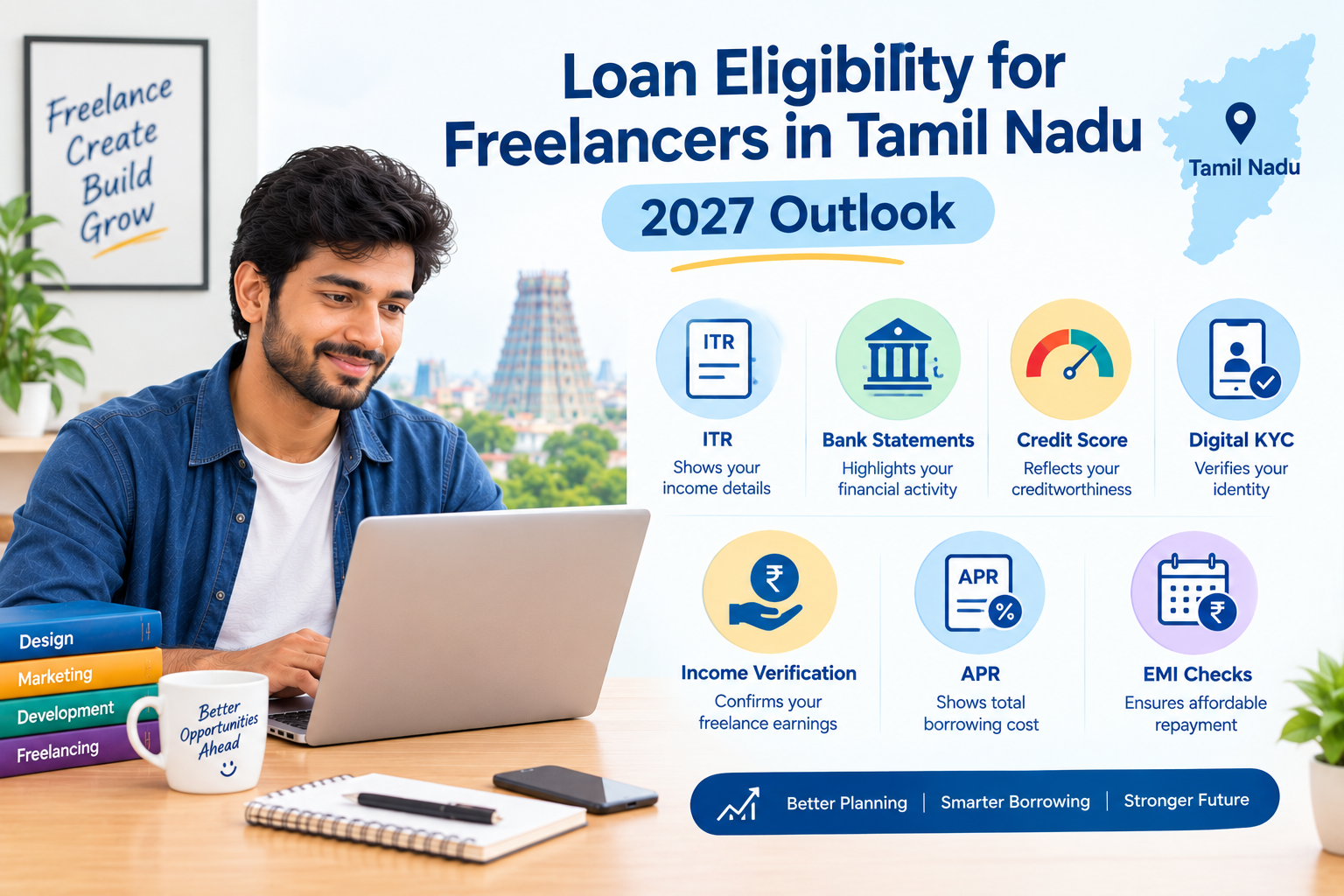
Freelancing is becoming an increasingly important way of earning income, with professionals working independently across areas such as technology, design, digital marketing, consulting, content creation and other services.
As we look toward 2027, loan eligibility for freelancers in Tamil Nadu is likely to remain focused on one central question: can the borrower demonstrate reliable income and a reasonable ability to repay?
Freelancers may not have traditional salary slips, but lenders can assess other financial information such as ITRs, bank statements, credit history, existing EMIs, KYC details and documented professional income.
The 2027 outlook is therefore less about freelancers receiving automatic approval and more about better financial documentation, digital underwriting and transparent borrowing costs.
What May Shape Freelancer Loan Eligibility in 2027?
Several existing developments in India's lending ecosystem could influence how freelancers apply for loans in 2027.
RBI's digital-lending framework already requires regulated entities to follow requirements around borrower creditworthiness, APR disclosure, consent-based data collection and privacy.
This means future loan applications are likely to continue becoming more digitally driven while still requiring meaningful financial verification.
Key Factors to Watch
-
Digital income verification
-
Credit history and updated credit information
-
Bank transaction analysis
-
ITR-based income assessment
-
Existing EMI and debt checks
-
Digital KYC
-
APR and KFS transparency
-
Data privacy and borrower consent
-
Faster online underwriting
These are outlook trends, not guarantees that every lender will adopt the same process.
Will Salary Slips Still Matter in 2027?
Freelancers generally do not receive traditional monthly salary slips.
Instead, lenders may rely on other documents and financial information to understand the borrower's income.
Possible documents include:
-
ITRs
-
Bank statements
-
Client invoices
-
Freelance contracts
-
GST records, where applicable
-
Professional registration documents
-
Existing loan statements
-
Other financial records accepted by the lender
For freelancers, maintaining consistent financial records could become even more important as digital underwriting develops.
Credit Score Could Become Even More Important
Credit history is already an important part of lending decisions, and accurate, timely credit information is becoming increasingly important.
RBI directed credit institutions and credit information companies to move to fortnightly credit-information updates from January 1, 2025, with the aim of making credit reports more current and helping lenders make better risk assessments.
For freelancers, this means responsible repayment behaviour can remain an important part of maintaining a healthy borrowing profile going into 2027.
However, a good credit score should not be treated as a guarantee of loan approval. Lenders can also consider income, existing debt, KYC and overall repayment capacity.
Digital Loan Applications May Become More Important
The loan application process is already becoming increasingly digital.
For freelancers, this can mean:
Online application → Digital KYC → Income verification → Credit assessment → Repayment-capacity assessment → Loan decision
RBI's digital-lending framework includes requirements for need-based data collection, prior explicit consent and privacy policies for digital lending apps and service providers.
By 2027, borrowers may therefore see more technology-driven verification, but digital convenience should not be confused with guaranteed approval.
ITR and Bank Statements May Remain Important
For freelancers, income can vary significantly from one month to another.
A lender may therefore need a broader picture of financial activity rather than relying on one monthly salary figure.
For example, a freelancer earning ₹45,000 in one month and ₹80,000 in another may need to demonstrate the broader pattern through bank statements, ITRs and other accepted records.
Keeping income deposits and financial records organized can make the application process easier.
Existing EMIs Will Still Matter
A freelancer's loan eligibility is not only about income.
Existing financial commitments can also affect the amount of additional debt that may be manageable.
Before applying in 2027, freelancers should review:
-
Current personal loans
-
Credit-card obligations
-
Vehicle or education loans
-
Existing EMIs
-
Other recurring debt payments
-
Monthly household expenses
-
Emergency savings
The important question is not simply “How much can I get?” but “How much can I comfortably repay?”
APR and KFS Will Remain Important
One of the most important developments for digital borrowers is greater emphasis on understanding the complete cost of borrowing.
RBI's framework requires applicable digital loans to disclose the Annual Percentage Rate (APR) and provide a Key Facts Statement (KFS) containing important loan information.
For freelancers considering loans in 2027, compare:
| Loan Factor | What to Check |
|---|---|
| Interest rate | Rate applicable to your offer |
| APR | Overall annual borrowing cost |
| EMI | Monthly repayment |
| Tenure | Length of repayment |
| Processing fee | Upfront or deducted charges |
| Prepayment terms | Conditions for early repayment |
| Penal charges | Cost of delayed repayment |
| Total repayment | Overall amount payable |
A lower advertised interest rate does not automatically mean the lowest overall borrowing cost.
Could Alternative Income Data Help Freelancers?
One possible direction for future lending is greater use of digital financial information to understand borrowers who do not have conventional salary structures.
For freelancers, this could potentially include broader assessment of:
-
Regular bank transactions
-
Documented freelance income
-
Tax records
-
Existing repayment behaviour
-
Professional activity
-
Other permitted financial information
However, borrowers should not assume that every lender will use the same data or technology.
Any data collection should be understood and consented to before submission.
What Freelancers Should Do Before 2027
Rather than waiting for new lending trends, freelancers can prepare now.
1. Maintain a Strong Credit Profile
Pay existing credit obligations on time and monitor your credit report.
2. Keep ITRs Updated
Proper tax and income records can help demonstrate documented earnings.
3. Maintain Clean Bank Records
Keep track of professional income and regular financial transactions.
4. Reduce Unnecessary Debt
High existing EMIs can make additional borrowing harder to manage.
5. Keep KYC Documents Updated
Make sure your identity and address information is accurate and consistent.
6. Compare Complete Loan Costs
Check APR, KFS, EMI, fees, tenure and total repayment before accepting an offer.
2027 Outlook: Freelancer Loan Eligibility at a Glance
| Factor | Possible 2027 Importance |
|---|---|
| Credit history | High |
| Documented income | High |
| ITRs | Important |
| Bank statements | Important |
| Existing EMIs | High |
| Digital KYC | Increasingly important |
| Digital income verification | Likely to remain important |
| APR/KFS | Essential for informed comparison |
| Data consent | Increasingly important |
| Repayment capacity | Critical |
These are practical expectations based on the direction of India's lending and digital-finance framework, not predictions of individual lender policies.
Common Mistakes Freelancers Should Avoid in 2027
Freelancers should be careful about:
-
Applying for multiple loans without comparing terms
-
Borrowing based only on the maximum eligible amount
-
Ignoring existing EMIs
-
Using inconsistent income information
-
Submitting unnecessary personal data
-
Accepting a loan without reading the KFS
-
Focusing only on the monthly EMI
-
Ignoring the total repayment cost
-
Trusting “guaranteed approval” advertisements
-
Sharing OTPs, UPI PINs or banking passwords
Key Takeaways
-
Freelancer loan eligibility in Tamil Nadu is likely to remain closely linked to documented income, credit history and repayment capacity.
-
Salary slips are not necessarily the only way freelancers can demonstrate income.
-
ITRs and bank statements can be valuable financial records.
-
Digital underwriting and KYC may become increasingly important.
-
Credit information is becoming more frequently updated, supporting more current lender assessments.
-
APR and KFS should be reviewed before accepting applicable digital loans.
-
Existing EMIs and total debt should be considered before taking additional borrowing.
-
No 2027 trend can guarantee approval because individual lenders may apply different eligibility criteria.
Frequently Asked Questions
Can freelancers in Tamil Nadu get loans in 2027?
Freelancers may be able to apply for personal or business loans in 2027, subject to the lender's eligibility criteria and assessment.
Will freelancers need salary slips in 2027?
Not necessarily. Depending on the lender, ITRs, bank statements and other income records may be used to assess freelance income.
Will credit score matter for freelancer loans?
Credit history is expected to remain an important part of loan assessment, although approval depends on multiple factors.
Can irregular income affect loan eligibility?
Yes. Variable income can make assessment more detailed, but it does not automatically mean a freelancer cannot qualify.
Will digital loan applications become more common?
Digital lending is already an established part of India's financial system, and further digitalisation is a reasonable 2027 outlook. However, the exact process will vary by lender.
What documents should freelancers keep ready?
Useful records may include ITRs, bank statements, PAN, KYC documents, invoices, contracts and other financial records requested by the lender.
Should freelancers check their credit report before applying?
Yes. Reviewing your credit information can help identify inaccurate or outdated information before submitting a loan application.
Is a high credit score enough for loan approval?
No. Lenders may also assess income, existing debt, KYC, loan amount and repayment capacity.
What should I check in a digital loan offer?
Check the actual lender, applicable APR, KFS, EMI, fees, tenure, repayment schedule, privacy terms and loan agreement.
Is loan approval guaranteed in 2027?
No. Neither digital technology nor future lending trends can guarantee loan approval.
Published on : 6th October
Published by : Shibam nath
www.vizzve.com || www.vizzveservices.com
Follow us on social media: Facebook || Linkedin || Instagram
🛡 Powered by Vizzve Financial
RBI-Registered Loan Partner | 10 Lakh+ Customers | ₹600 Cr+ Disbursed