

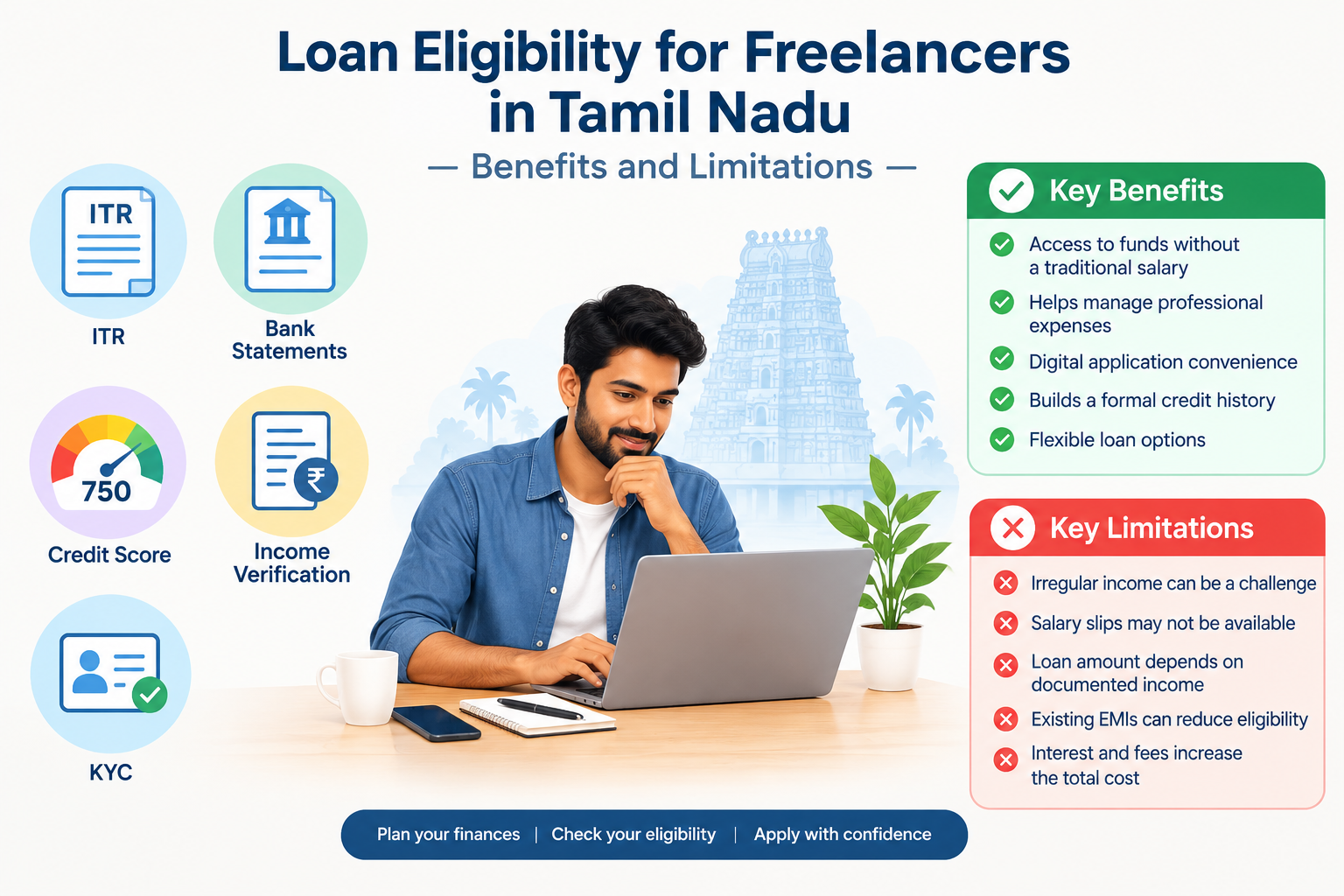
Freelancing offers flexibility, but applying for a loan can sometimes be different from applying as a salaried employee. A freelancer may receive payments from multiple clients, have variable monthly income and not receive a traditional salary slip.
For freelancers in Tamil Nadu, lenders may therefore look at factors such as credit history, income, bank statements, ITRs, existing EMIs and repayment capacity before deciding whether to approve a loan.
There can be several benefits to accessing formal credit, but freelancers should also understand the limitations before applying.
Can Freelancers Get Loans in Tamil Nadu?
Yes. Freelancers and other self-employed professionals can apply for eligible personal or business loan products, subject to the lender's criteria.
RBI guidance requires lenders to properly assess a borrower's credit application and creditworthiness rather than relying on security requirements as a substitute for credit assessment.
However, there is no single loan eligibility rule for every freelancer. Banks and NBFCs can have different requirements relating to income, work history, credit profile, documentation and loan amount.
Benefits of Loans for Freelancers
1. Access to Funds Without a Traditional Salary
One potential benefit is that freelancers do not necessarily need to have a conventional employer to apply for credit.
Depending on the lender and product, income may be demonstrated through documents such as:
- Bank statements
- Income Tax Returns
- Invoices
- Client payment records
- Business or professional records
- Other acceptable financial documents
This can be useful for freelancers whose income comes from multiple clients rather than one employer.
2. Can Help Manage Professional Expenses
A suitable loan may provide funds for legitimate professional requirements, depending on the loan's permitted purpose.
For example, a freelancer may need money for:
- A laptop or professional equipment
- Software or business tools
- Workspace expenses
- Marketing
- Professional development
- Working capital
The appropriate product can differ depending on whether the borrowing is for personal or business purposes.
3. Digital Application Convenience
Many lenders provide online application processes. This can reduce the need for repeated branch visits and allow applicants to submit information digitally.
For digital lending, RBI's framework requires regulated entities to assess the borrower's economic profile and creditworthiness in an auditable manner.
However, digital application does not mean guaranteed approval.
4. Opportunity to Build a Formal Credit History
Responsible repayment of a loan can contribute to a borrower's credit history.
Freelancers who already have a documented borrowing history and make repayments on time may find it easier to demonstrate their credit behaviour to lenders.
However, taking a loan solely to build a credit history may not make financial sense if the borrowing is unnecessary or expensive.
5. Flexible Loan Options
Freelancers may encounter different types of credit products, including personal loans and loans designed for self-employed or business purposes.
The terms, interest rates, documentation and permitted use can differ substantially, so the product should be matched with the actual financial requirement.
Limitations Freelancers Should Understand
1. Irregular Income Can Make Assessment More Difficult
One of the biggest challenges for freelancers is income variability.
For example, a freelancer may earn ₹80,000 in one month but only ₹35,000 the next month. A lender may therefore examine income over a period rather than relying on one month's earnings.
Consistent banking records, tax filings and documented client income can make the financial profile easier to evaluate.
2. Salary Slips May Not Be Available
Traditional salaried borrowers can often provide salary slips and employer confirmation.
Freelancers may instead need to provide alternative evidence such as:
- ITRs
- Bank statements
- Invoices
- Client agreements
- Professional records
- Other income-related documents
The exact requirements depend on the lender.
3. Loan Amount May Depend on Documented Income
The amount a lender is willing to offer can depend on its assessment of income and repayment capacity.
A freelancer earning a substantial amount but reporting or documenting only a small portion of that income may have difficulty demonstrating the same borrowing capacity as someone with well-organised financial records.
4. Existing EMIs Can Reduce Eligibility
Existing financial commitments can affect how much additional debt you can comfortably manage.
Before applying, calculate your current:
- Personal loan EMIs
- Home loan EMIs
- Vehicle loan payments
- Credit card obligations
- Business loan repayments
- Other recurring debt payments
RBI guidance emphasises proper assessment of a borrower's creditworthiness before lending.
5. Interest and Fees Increase the Cost of Borrowing
A loan is not simply the amount credited to your bank account.
The overall borrowing cost can include:
- Interest
- Processing fees
- Applicable taxes
- Late-payment or penal charges
- Other disclosed charges
- Prepayment-related costs, where applicable
RBI's fair-practices framework emphasises transparency around loan terms and charges.
This makes it important to compare the total cost of borrowing, rather than choosing a loan only because it advertises a low starting interest rate.
Documents Freelancers May Need
Requirements vary between lenders, but a freelancer may be asked for some of the following:
| Document | Possible Purpose |
|---|---|
| PAN | Identity and financial verification |
| Aadhaar or other valid KYC document | KYC verification |
| Bank statements | Income and cash-flow assessment |
| ITR | Income verification |
| Invoices | Evidence of client earnings |
| Client contracts | Work/income verification |
| Address proof | KYC |
| Existing loan details | Debt assessment |
| Business/professional documents | Self-employed verification |
Not every applicant will need all of these documents.
Personal Loan vs Business Loan for Freelancers
The right loan category depends on why you need the money.
Personal Loan
A personal loan can be considered for eligible personal expenses. The lender may assess your income, credit history and repayment capacity.
Business Loan
A business-oriented loan may be relevant when the money is required for professional or business activities such as equipment, expansion or working capital.
Freelancers should check the permitted purpose, interest rate, fees, tenure and documentation requirements before selecting a product.
What Freelancers in Tamil Nadu Should Check Before Applying
Check Your Credit Report
Review your credit history for overdue accounts, incorrect information and recent enquiries.
Organise Your Income Records
Keep ITRs, bank statements, invoices and client payment records properly organised.
Calculate Your Existing Debt
Know how much of your monthly income is already committed to EMIs and other obligations.
Compare the Total Cost
Check the interest rate, APR where applicable, processing fees, repayment schedule and total amount payable.
Read the Loan Documents
Before accepting an offer, carefully read the sanction terms, loan agreement and applicable Key Facts Statement (KFS). RBI's framework includes requirements around disclosure and borrower information for applicable digital lending products.
Verify the Lender
If applying through a loan app, identify the actual regulated lender behind the platform. Do not assume that an app itself is the lender.
How Freelancers Can Improve Loan Readiness
Freelancers can improve their application readiness by:
- Filing income-tax returns accurately
- Maintaining organised bank records
- Keeping client invoices and contracts
- Paying existing EMIs on time
- Avoiding unnecessary credit applications
- Keeping KYC information updated
- Borrowing an amount that matches repayment capacity
- Comparing multiple legitimate loan offers
Benefits vs Limitations at a Glance
| Benefits | Limitations |
|---|---|
| Access to formal credit | Income may fluctuate |
| Online application options | Salary slips may not be available |
| Can support eligible expenses | More income documentation may be required |
| Responsible repayment can build credit history | Existing EMIs can reduce borrowing capacity |
| Multiple loan products may be available | Interest and fees increase total cost |
| Can be useful for professional needs | Approval is never guaranteed |
Key Takeaways
- Freelancers in Tamil Nadu can apply for loans, but eligibility depends on the individual lender and loan product.
- Credit score, documented income, bank statements, ITRs and existing debt can influence the assessment.
- Irregular income and lack of traditional salary slips can make documentation more important.
- A loan can provide useful funding, but interest and fees increase the overall cost.
- Compare the interest rate, APR, EMI, fees, tenure and total repayment amount before accepting an offer.
- For digital loans, verify the actual lender and carefully review the applicable KFS and loan agreement.
- Borrow only an amount that you can reasonably repay from your expected income.
Frequently Asked Questions
1. Can freelancers in Tamil Nadu apply for personal loans?
Yes. Freelancers can apply for eligible personal loan products, subject to the lender's credit, income and documentation requirements.
2. Do freelancers need salary slips to get a loan?
Not necessarily. Depending on the lender, ITRs, bank statements, invoices and other income records may be accepted instead.
3. Is irregular freelance income a problem?
It can make income assessment more complicated. Lenders may look at income history, banking transactions and other documentation when assessing repayment capacity.
4. Can freelancers get an instant loan?
Freelancers may be able to submit applications digitally, but an instant application or preliminary approval does not guarantee final loan approval.
5. What documents can freelancers use as income proof?
Depending on the lender, documents may include ITRs, bank statements, invoices, contracts and other financial records.
6. Does credit score matter for freelancer loans?
Credit history can be an important part of a lender's assessment, although the exact eligibility criteria vary.
7. Can freelancers take loans for business expenses?
Some loan products may be designed for professional or business purposes. The borrower should check the permitted use and product conditions before applying.
8. What is the biggest limitation for freelancers applying for loans?
Income variability and difficulty demonstrating consistent documented income can be important challenges, although individual lender policies differ.
9. Should freelancers compare loan offers?
Yes. Comparing interest rates, APR, fees, EMI, tenure and total repayment can help borrowers understand the overall cost of different offers.
10. Is loan approval guaranteed if a freelancer has a good credit score?
No. Credit score is only one factor. Lenders may also consider income, existing debt, documentation, repayment capacity and their own eligibility criteria.
Published on : 30th September 2026
Published by : shibam nath
www.vizzve.com || www.vizzveservices.com
Follow us on social media: Facebook || Linkedin || Instagram
🛡 Powered by Vizzve Financial
RBI-Registered Loan Partner | 10 Lakh+ Customers | ₹600 Cr+ Disbursed