

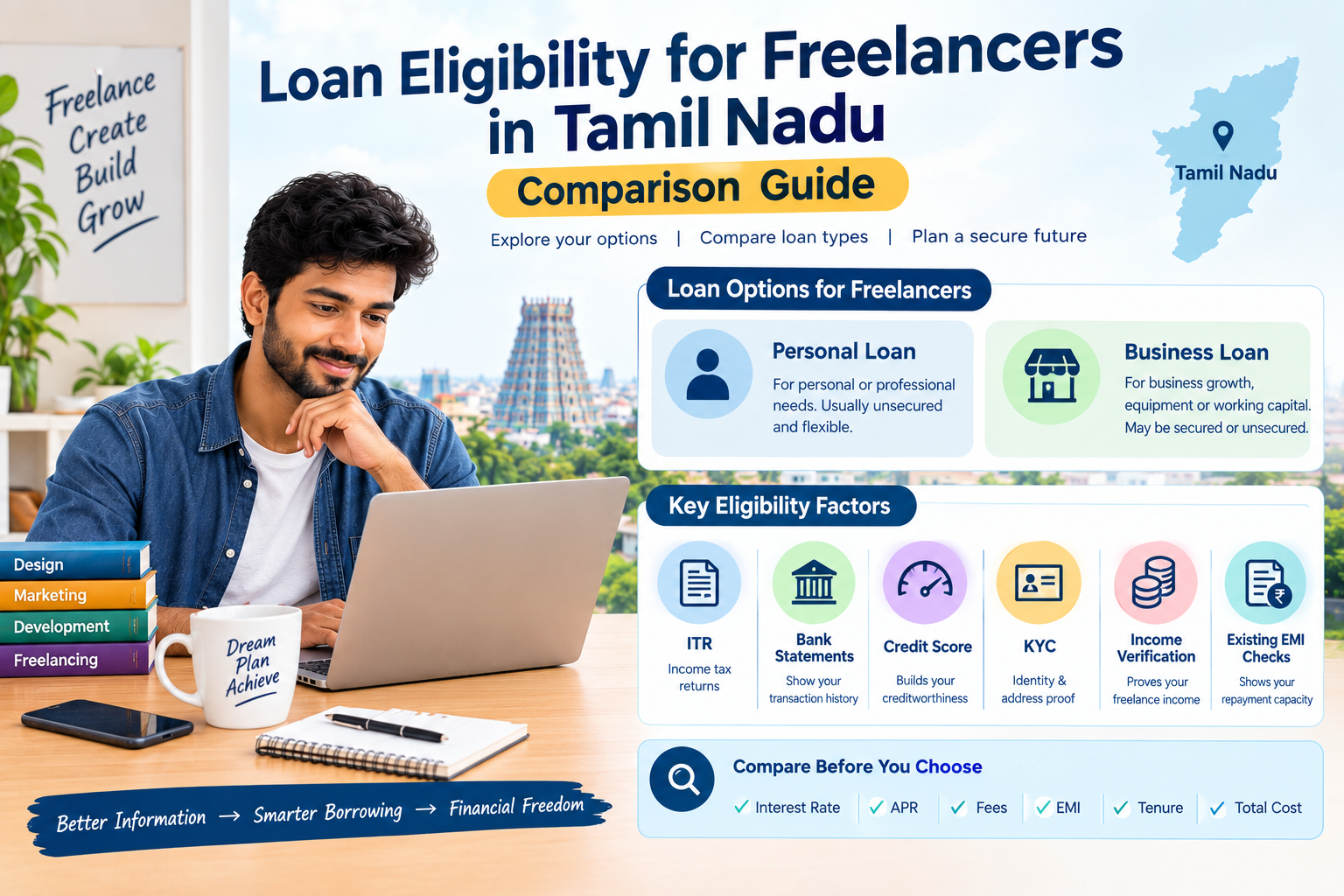
Freelancing has become a popular way to earn income across Tamil Nadu, from graphic designers and developers to consultants, content creators, photographers and independent professionals. However, when a freelancer needs additional funds, choosing the right loan can be more complicated than it is for a salaried employee.
A freelancer's income may change from month to month, so lenders can look at factors such as credit history, documented income, bank statements, ITRs, existing EMIs, KYC and repayment capacity.
This comparison guide explains the common loan options freelancers may consider and the key factors to check before applying.
What Does Loan Eligibility Mean for Freelancers?
Loan eligibility refers to whether a borrower meets the lender's requirements for a particular loan.
For freelancers, lenders may assess:
-
Age and KYC details
-
Credit history and score
-
Average and documented income
-
Bank account transactions
-
ITR and financial records
-
Existing loans and EMIs
-
Work or business stability
-
Requested loan amount
-
Repayment capacity
There is no single eligibility rule that applies to every freelancer. Each lender can have its own criteria.
Personal Loan vs Business Loan for Freelancers
One of the first decisions is whether a personal loan or business loan is more appropriate.
| Feature | Personal Loan | Business Loan |
|---|---|---|
| Main purpose | Personal or professional needs | Business or professional expenses |
| Security | Usually unsecured, depending on lender | Can be secured or unsecured |
| Income assessment | Personal income | Business/professional income |
| Documentation | KYC, income and financial records | Business and financial records may be required |
| Typical use | Emergency, education, equipment, personal needs | Working capital, equipment, business expansion |
| Repayment | Monthly instalments | Usually scheduled repayments |
| Eligibility | Depends on borrower profile | Depends on borrower and business profile |
A freelancer buying a laptop for work, for example, may consider different loan products depending on the lender and purpose.
Freelancer Loan Options: Quick Comparison
Freelancers may come across several borrowing options.
1. Personal Loan
A personal loan can be useful when the borrower needs funds for a legitimate personal or professional requirement and meets the lender's eligibility criteria.
Potential advantages:
-
Usually no collateral for an unsecured product
-
Flexible use in many cases
-
Digital application may be available
-
Fixed EMI structure may make budgeting easier
Things to check:
-
Interest rate and APR
-
Processing fees
-
Loan tenure
-
EMI
-
Prepayment terms
-
Total repayment amount
2. Business Loan
A business loan may be more suitable when the money is primarily required for business operations, equipment or expansion.
The lender may ask for additional business-related information, such as ITRs, bank statements, GST records or other professional/business documents where applicable.
3. Loan Against an Asset
Some borrowers may consider secured borrowing against an eligible asset. Because the loan is linked to collateral, the terms and risks can differ from an unsecured personal loan.
The borrower should understand the consequences of non-repayment before pledging an asset.
4. Credit-Based Digital Loan
Digital lenders or regulated entities may offer online loan applications where eligibility assessment and verification are performed digitally.
Convenience should not replace careful comparison. Before accepting a digital loan, check the actual lender, applicable APR, KFS, fees, privacy terms and repayment conditions.
What Documents Can Freelancers Use?
Freelancers may not have traditional salary slips, but they can maintain other records that demonstrate income.
Depending on lender requirements, documents may include:
-
PAN
-
Aadhaar or other valid KYC documents
-
ITRs
-
Recent bank statements
-
Client invoices
-
Freelance contracts
-
GST records, where applicable
-
Business or professional registration documents
-
Existing loan statements
Keeping financial records consistent can make the application process easier.
Credit Score Comparison
Credit history can be an important part of loan assessment.
A lender may review:
-
Previous repayment behaviour
-
Existing credit accounts
-
Outstanding balances
-
Recent credit enquiries
-
Overdue payments or defaults
-
Overall credit profile
There is no universal credit-score number that guarantees loan approval. A lender may consider the complete financial profile rather than relying on one number.
Income Stability Matters
Freelancers often experience fluctuating income. For this reason, it can be useful to calculate an average monthly income from recent records rather than using the highest earning month.
For example, suppose a freelancer earned:
-
January: ₹65,000
-
February: ₹52,000
-
March: ₹72,000
-
April: ₹48,000
-
May: ₹63,000
-
June: ₹70,000
The six-month average is approximately ₹61,667 per month.
This is only an illustrative calculation. The lender may use its own method to evaluate income.
Compare Loan Costs, Not Just Interest Rates
Two loans can have similar advertised interest rates but different overall costs.
Before accepting an offer, compare:
| Factor | Why It Matters |
|---|---|
| Interest rate | Determines interest charged on the loan |
| APR | Helps understand the overall annual borrowing cost |
| Processing fee | Adds to the cost of borrowing |
| Tenure | Affects EMI and total interest |
| EMI | Determines monthly repayment requirement |
| Prepayment terms | Important if you want to repay early |
| Penal charges | Relevant if repayment is delayed |
| Total repayment | Shows the overall amount payable |
For digital lending, borrowers should carefully review the applicable Key Facts Statement (KFS) and loan agreement before accepting the offer.
Which Loan May Suit a Freelancer?
There is no universally best loan for every freelancer.
| Freelancer Requirement | Option to Consider |
|---|---|
| Personal or mixed financial requirement | Personal loan |
| Business expansion | Business loan |
| Professional equipment | Personal or business loan, depending on lender |
| Short-term working-capital requirement | Suitable business credit option |
| Borrowing against an eligible asset | Secured loan |
| Fully online application | Digital loan from a legitimate lender |
The final choice should depend on cost, eligibility, repayment capacity and the purpose of borrowing.
How Freelancers Can Improve Loan Eligibility
Before applying, freelancers can take several practical steps:
Maintain a Strong Credit Profile
Pay existing loans and credit cards on time and avoid unnecessary credit applications.
Keep Income Records Updated
Maintain ITRs, bank statements, invoices and other relevant financial documents.
Manage Existing EMIs
High existing debt can reduce the amount of additional borrowing you can comfortably manage.
Keep KYC Information Consistent
Make sure your name, address and other details are accurate across important documents.
Borrow Only What You Can Repay
A larger approved amount does not automatically mean it is financially suitable.
Safety Checks Before Applying Online
Freelancers should be particularly careful with digital loan offers.
Before applying:
-
Verify the actual lender.
-
Use the lender's official website or application.
-
Check interest rate, APR and applicable charges.
-
Read the KFS where applicable.
-
Review the loan agreement.
-
Check data and privacy permissions.
-
Understand the repayment schedule.
-
Avoid offers promising guaranteed approval without proper checks.
-
Never share OTPs, UPI PINs, ATM PINs or internet-banking passwords.
-
Avoid suspicious links or requests for unexplained upfront payments.
Key Takeaways
-
Freelancers in Tamil Nadu can explore different loan options depending on their needs and eligibility.
-
Personal and business loans serve different purposes.
-
ITRs, bank statements and other financial records can help demonstrate income.
-
Credit history and existing EMIs can influence the lending decision.
-
Compare APR, fees, EMI, tenure and total repayment cost rather than looking only at the advertised interest rate.
-
Digital loan applications should be checked carefully for lender identity, KFS, privacy and repayment terms.
-
The right loan is one that meets the actual requirement without creating an unsustainable repayment burden.
Frequently Asked Questions
Can freelancers in Tamil Nadu apply for personal loans?
Yes. Freelancers can apply for personal loans if they meet the lender's eligibility criteria and pass its income, credit, KYC and repayment-capacity checks.
Can I get a loan without a salary slip?
Some lenders may accept alternative income documents such as ITRs and bank statements instead of traditional salary slips. Requirements vary by lender.
Is ITR important for freelancer loan applications?
ITRs can help demonstrate reported income, particularly for self-employed and freelance borrowers, although the exact documentation required varies.
Does my credit score affect freelancer loan eligibility?
Credit history can influence a lender's assessment, but there is no single score that guarantees approval from every lender.
Which is better: a personal loan or business loan?
It depends on the purpose of borrowing. A personal loan may suit certain personal or professional needs, while a business loan may be more appropriate for business-related expenses.
Can irregular income prevent loan approval?
Irregular income can make income assessment more challenging, but it does not automatically mean a freelancer cannot qualify. Lenders may review documented income and overall repayment capacity.
Should freelancers compare APR or only interest rates?
Borrowers should consider the overall cost, including applicable APR, fees and other charges, rather than comparing only the advertised interest rate.
Can existing EMIs reduce loan eligibility?
Yes. Existing debt obligations may affect how much additional repayment a lender considers manageable.
Are digital loans safe for freelancers?
A digital loan can be legitimate when provided through the appropriate regulated lending arrangement, but borrowers should verify the actual lender and carefully review the applicable terms.
Is loan approval guaranteed after submitting documents?
No. Providing documents does not guarantee approval. The lender can make the final decision after completing its assessment.
Published on : 3rd October 2026
Published by : shibam nath
www.vizzve.com || www.vizzveservices.com
Follow us on social media: Facebook || Linkedin || Instagram
🛡 Powered by Vizzve Financial
RBI-Registered Loan Partner | 10 Lakh+ Customers | ₹600 Cr+