

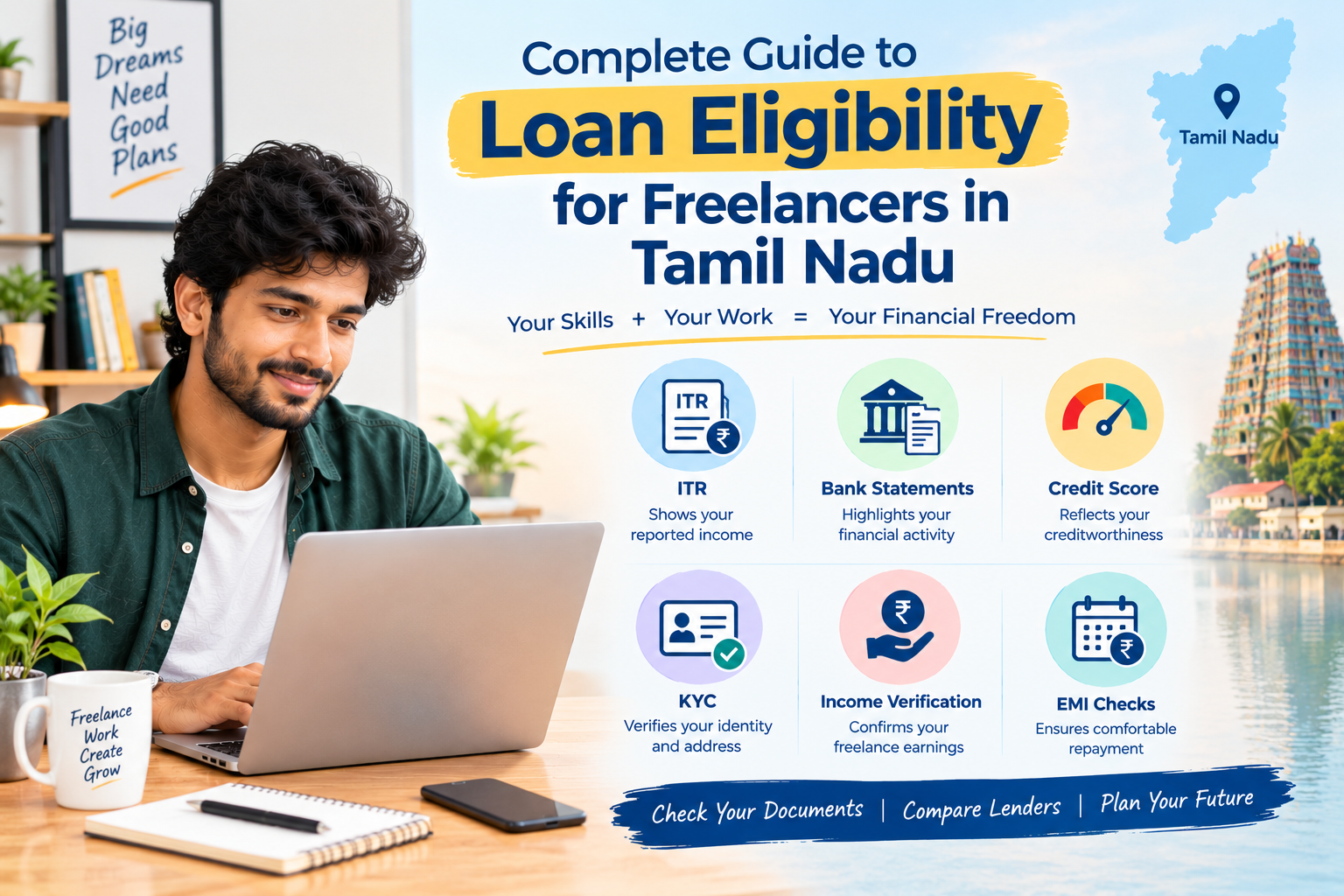
Freelancing has become an important source of income for many professionals in Tamil Nadu. Graphic designers, software developers, content writers, digital marketers, consultants, photographers, video editors and other independent professionals may have regular earnings without receiving a traditional monthly salary slip.
This can raise an important question: Can freelancers get a personal loan, and what do lenders check before approving it?
The answer is yes, freelancers may be eligible for loans, but approval depends on the lender's credit assessment, income documentation, repayment capacity, KYC and other eligibility criteria. There is no single credit score or income level that guarantees approval.
For borrowers, the key is to show that income is genuine, reasonably stable and supported by documents.
What Is Loan Eligibility for Freelancers?
Loan eligibility refers to the factors a lender considers before deciding whether to approve a loan and how much the borrower may be able to repay.
For freelancers, lenders may look at:
-
Credit history and credit score
-
Regularity and level of income
-
Bank account transactions
-
ITRs and other income records
-
Existing loans and EMIs
-
KYC details
-
Professional or business history
-
Requested loan amount
-
Repayment capacity
-
Internal lender policies and risk assessment
The exact requirements can differ between banks, NBFCs and other regulated lenders.
RBI's fair-practices guidance says lenders should properly assess a borrower's credit application and creditworthiness rather than relying on security or other factors as a substitute for due diligence.
Can Freelancers Get Personal Loans in Tamil Nadu?
Yes. Being a freelancer does not automatically make someone ineligible for a personal loan.
However, freelancers may not have conventional documents such as:
-
Monthly salary slips
-
Employer-issued salary certificates
-
Traditional employment letters
Instead, lenders may consider other evidence of income, depending on their requirements.
Examples can include:
-
Income Tax Returns
-
Bank statements
-
Invoices
-
Client payment records
-
Contracts or work agreements
-
GST records, where applicable
-
Professional registration documents, where applicable
-
Other financial statements
The important point is documented income rather than simply claiming a monthly earning figure.
7 Major Factors That Affect Freelancer Loan Eligibility
1. Credit Score and Credit History
Your credit profile is one of the important factors lenders may consider.
A lender may review:
-
Previous loan repayment history
-
Credit card repayment behaviour
-
Outstanding balances
-
Existing credit accounts
-
Recent credit enquiries
-
Overdue payments or defaults
A good credit history can strengthen an application, but a particular score does not guarantee approval.
Before applying, freelancers should check their credit report and identify errors, overdue accounts or unnecessary recent applications.
2. Income and Income Stability
Freelance income can vary from month to month. A lender may therefore look beyond one unusually high-income month.
For example, suppose a freelancer earns:
| Month | Income |
|---|---|
| January | ₹60,000 |
| February | ₹48,000 |
| March | ₹72,000 |
| April | ₹55,000 |
| May | ₹65,000 |
| June | ₹58,000 |
The six-month average is approximately ₹59,667.
This is only an illustrative example, not a lender's prescribed calculation. Different lenders may use different methods to evaluate self-employed or freelance income.
Keeping consistent financial records can make it easier to demonstrate income.
3. ITR and Tax Records
Income Tax Returns can be particularly useful for freelancers because they provide documented evidence of reported income.
Depending on the lender and applicant profile, recent ITRs may help demonstrate:
-
Annual income
-
Declared professional income
-
Tax-related information
-
Consistency of earnings
Freelancers should keep their ITR acknowledgements and related financial records organised before applying.
4. Bank Statements
Bank statements can help show actual cash flow.
A lender may examine:
-
Regular client payments
-
Monthly inflows
-
Existing EMI payments
-
Returned payments
-
Account balances
-
Other significant financial transactions
Keeping professional income in a properly maintained bank account can make income tracking easier.
5. Existing Loans and EMIs
Existing financial commitments can affect how much additional borrowing a freelancer can reasonably handle.
For example, if you already pay EMIs for a vehicle, home loan, personal loan or other credit facilities, a lender may consider those obligations when assessing a new application.
Loan eligibility is not the same as loan affordability.
Even if a lender offers a particular amount, you should consider whether the EMI remains manageable during months when freelance income is lower.
6. KYC and Document Verification
KYC verification is an important part of the loan process.
Depending on the lender, you may be asked for documents such as:
-
PAN
-
Aadhaar or another officially valid document
-
Address proof
-
Bank account details
-
Income-related documents
-
ITRs
-
Other supporting documents
Make sure the information across your documents is consistent. Differences in name, date of birth, address or other important details may lead to additional verification.
7. Repayment Capacity
Lenders are interested not only in how much you earn but also in whether you can reasonably repay the proposed loan.
Repayment capacity can depend on:
Income – existing obligations – regular expenses – proposed EMI
Freelancers should ideally assess affordability using a realistic income level rather than their best earning month.
Documents Freelancers May Need for a Loan
The exact documentation varies by lender, but a freelancer may be asked to provide:
| Document | Why It May Be Required |
|---|---|
| PAN | Identity and financial verification |
| Aadhaar/OVD | KYC verification |
| Bank statements | Income and cash-flow assessment |
| ITR | Income documentation |
| Invoices | Evidence of professional earnings |
| Client contracts | Evidence of ongoing work |
| GST records | Business/tax information where applicable |
| Existing loan statements | Assessment of current obligations |
| Address proof | KYC verification |
Not every freelancer will need every document.
Always check the actual lender's current documentation requirements.
Is a Salary Slip Mandatory for Freelancers?
Not necessarily.
Freelancers generally do not receive traditional salary slips. Depending on the lender, alternative income documents may be considered.
These may include:
-
ITR
-
Bank statements
-
Invoices
-
Client contracts
-
Financial statements
-
GST records, where applicable
However, acceptance of a particular document is entirely dependent on the lender's policy.
How the Loan Application Process Works
A typical digital or online loan application may involve the following steps:
Step 1: Application
Enter personal, professional and loan-related information.
Step 2: KYC
Complete identity and address verification.
Step 3: Income Verification
Provide relevant income and financial information.
Step 4: Credit Assessment
The lender evaluates credit history and other financial information.
Step 5: Repayment Assessment
Existing obligations, proposed EMI and overall repayment capacity may be considered.
Step 6: Final Decision
The lender makes its approval, rejection or offer decision according to its policies.
Step 7: Agreement and Disbursement
If approved, review the loan agreement and applicable disclosures before accepting. Disbursement follows according to the lender's terms.
RBI's fair-practices guidance also emphasises communicating loan terms and conditions in writing and providing the borrower with the loan agreement and relevant enclosures.
What Should Freelancers Check Before Accepting a Loan?
Do not focus only on the approved loan amount.
Check the complete cost of borrowing.
Important points to compare:
-
Interest rate
-
Annual Percentage Rate (APR), where applicable
-
EMI
-
Loan tenure
-
Processing fees
-
Other applicable charges
-
Late-payment or penal charges
-
Prepayment/foreclosure terms
-
Total repayment amount
-
Disbursement and repayment arrangements
The RBI's Key Facts Statement framework includes important loan information such as loan amount, tenure, interest rate and fees.
Understand the KFS
The Key Facts Statement (KFS) is particularly useful because it helps borrowers understand the important terms and costs of a loan before accepting it.
Do not accept a loan simply because an app displays a large eligible amount or an attractive starting interest rate.
Digital Loans: What Freelancers Should Know
Digital lending can make the application process faster and more convenient, but digital processing does not mean guaranteed approval.
A genuine digital loan process may still involve:
-
KYC
-
Credit assessment
-
Income verification
-
Bank or financial information
-
Repayment-capacity assessment
-
Document verification
Before using a loan app, identify the actual lender and understand who is responsible for the loan.
Avoid These Warning Signs
Be cautious if an app or person:
-
Guarantees approval without proper verification
-
Hides the actual lender
-
Demands unexplained upfront payments
-
Does not provide clear loan terms
-
Hides interest or charges
-
Pressures you to accept immediately
-
Requests sensitive banking credentials
Never share your OTP, UPI PIN, ATM PIN, card PIN or internet-banking password with anyone claiming to process your loan.
How Freelancers Can Improve Loan Eligibility
Before applying, freelancers can take several practical steps.
Maintain a Healthy Credit Profile
Pay existing EMIs and credit-card dues on time and avoid unnecessary borrowing.
Keep Income Records Organised
Maintain ITRs, bank statements, invoices and other financial records in an easily accessible form.
Reduce Unnecessary Debt
A high level of existing obligations can reduce your ability to take on another EMI.
Avoid Multiple Applications
Do your research and compare suitable lenders before submitting applications repeatedly.
Keep KYC Updated
Make sure your identity and address information is accurate and consistent.
Borrow According to Repayment Capacity
Do not select the maximum amount simply because you are eligible for it.
Personal Loan vs Business Loan for Freelancers
The right loan type depends on the purpose of borrowing.
| Factor | Personal Loan | Business Loan |
|---|---|---|
| Main purpose | Personal or general needs | Business/professional expenses |
| Income assessment | Personal income | Business/professional income |
| Documentation | KYC, income and financial records | Business and financial records may be required |
| Security | Depends on product | Depends on product |
| Suitable for | Personal expenses or eligible needs | Business expansion and professional requirements |
Always compare the actual terms offered rather than choosing a product based only on the name.
Common Reasons a Freelancer's Loan Application May Be Rejected
A loan application can be declined for several reasons, including:
-
Weak or limited credit history
-
High existing EMI obligations
-
Insufficient documented income
-
Unstable or difficult-to-verify cash flow
-
KYC discrepancies
-
Incomplete documentation
-
Too many recent credit applications
-
Bank transaction concerns
-
Loan amount being too high for the applicant's profile
-
Lender-specific eligibility or risk criteria
If a lender rejects a small-borrower application up to ₹2 lakh, RBI's fair-practices guidance says the main reason or reasons for rejection should be communicated in writing within the stipulated framework.
Freelancer Loan Eligibility Checklist
Before applying, ask yourself:
-
Is my credit report accurate?
-
Can I document my freelance income?
-
Are my ITRs available?
-
Are my bank statements clear and updated?
-
Do I have existing EMIs?
-
Can I comfortably manage another EMI?
-
Are my KYC details consistent?
-
Have I compared interest rates and APR?
-
Have I checked the KFS?
-
Do I understand all fees and charges?
-
Have I verified the actual lender?
-
Am I borrowing only the amount I genuinely need?
If several answers are unclear, it may be better to prepare your financial documents before applying.
FAQs: Loan Eligibility for Freelancers in Tamil Nadu
1. Can freelancers in Tamil Nadu get a personal loan?
Yes. Freelancers may be eligible for personal loans if they meet the lender's credit, income, KYC and repayment requirements.
2. Is a salary slip required for a freelancer loan?
Not necessarily. Depending on the lender, ITRs, bank statements, invoices and other income records may be considered instead.
3. What credit score is required for a freelancer loan?
There is no universal credit-score number that guarantees approval. Each lender can have its own eligibility and risk-assessment criteria.
4. Can I get a loan if my freelance income changes every month?
Possibly. Lenders may evaluate documented income and financial history rather than relying only on one month's earnings.
5. Are ITRs important for freelancer loan applications?
They can be useful because they provide documented information about declared income. Requirements vary by lender.
6. Can bank statements help prove freelance income?
Yes. Bank statements can help demonstrate actual cash flow and client payments, subject to the lender's assessment.
7. Does having a good credit score guarantee a loan?
No. Credit history is only one part of the assessment. Income, existing debt, KYC, repayment capacity and lender-specific criteria can also matter.
8. Can freelancers apply for digital personal loans?
Yes, where the product is available and the applicant meets the lender's requirements. Digital processing does not guarantee approval.
9. Should freelancers borrow the maximum eligible amount?
No. The maximum eligible amount may not be the most affordable amount. Consider your regular expenses, existing EMIs and income fluctuations.
10. What is the most important thing to check before accepting a loan?
Check the total cost, not just the EMI or advertised interest rate. Review the APR, KFS, fees, tenure, repayment schedule and other applicable charges before accepting.
Published on : 6th October 2026
Published by : Shibam nath
www.vizzve.com || www.vizzveservices.com
Follow us on social media: Facebook || Linkedin || Instagram
🛡 Powered by Vizzve Financial
RBI-Registered Loan Partner | 10 Lakh+ Customers | ₹600 Cr+ Disbursed