

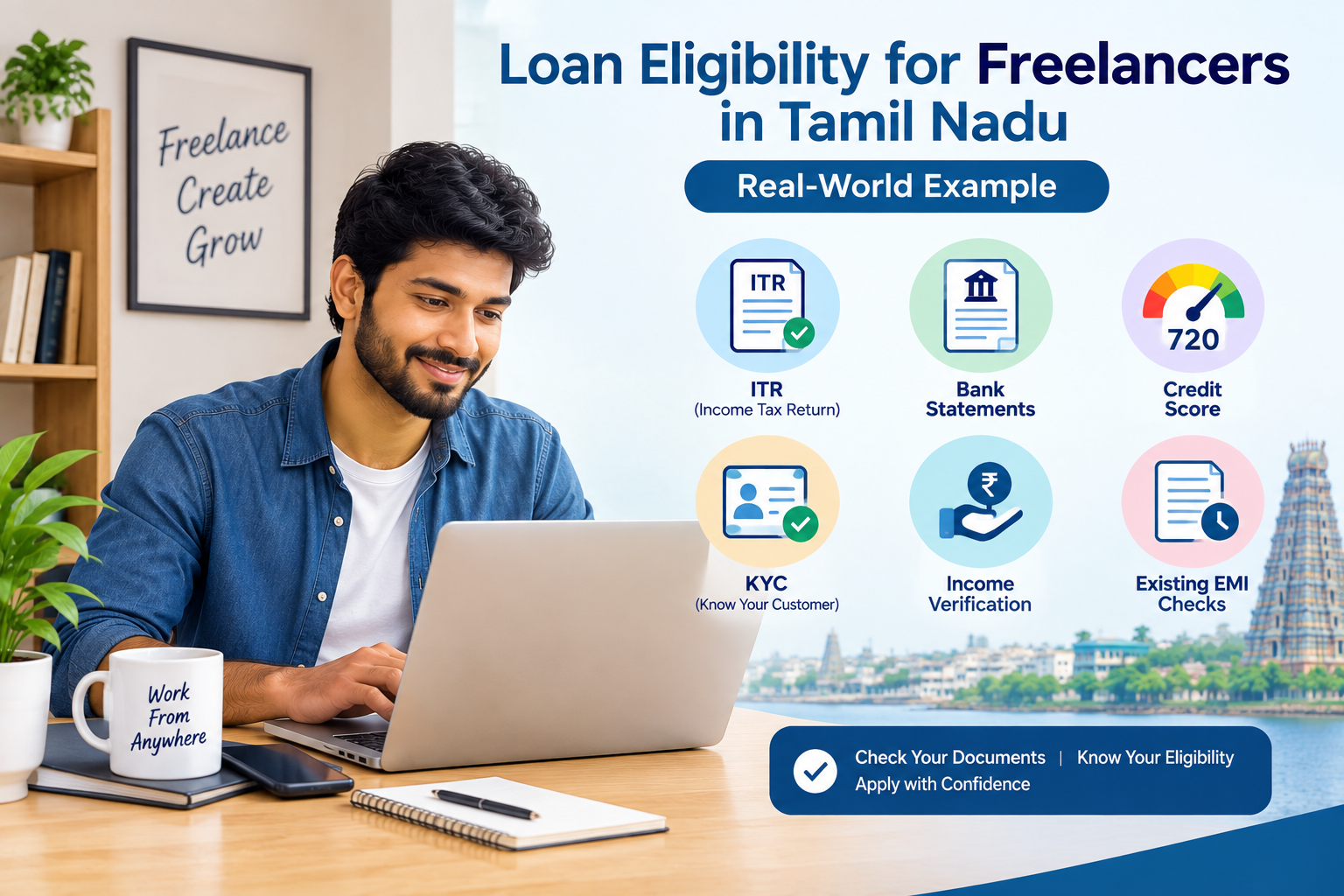
Freelancers in Tamil Nadu can apply for personal or business loans, but their applications may be assessed differently from those of salaried employees. Instead of relying mainly on salary slips and employer records, lenders may review ITRs, bank statements, credit history, income patterns, existing EMIs and repayment capacity.
To understand how this can work in practice, consider the following illustrative example of a freelancer applying for a loan.
Note: The borrower and figures below are fictional and are provided only to explain how loan eligibility can be assessed.
Meet Arun: A Freelancer in Chennai
Arun is a freelance graphic designer based in Chennai, Tamil Nadu. He has been working independently for several years and receives payments from multiple clients.
He wants to borrow ₹2 lakh to purchase a new laptop, upgrade professional software and improve his freelance setup.
Before applying, Arun reviews his financial position and prepares the documents that may be required by a lender.
Arun's Financial Profile
For this example, assume Arun has:
| Financial Detail | Illustrative Information |
|---|---|
| Profession | Freelance Graphic Designer |
| Location | Chennai, Tamil Nadu |
| Freelancing experience | 3+ years |
| Average monthly income | ₹70,000 |
| Credit score | 720 |
| Existing EMI | ₹8,000/month |
| Loan requested | ₹2 lakh |
| Purpose | Professional equipment and software |
| Income records | ITRs + bank statements |
These figures are illustrative only. Actual lender eligibility criteria, interest rates and approval decisions can be different.
Step 1: Arun Checks His Credit History
Before applying, Arun checks his credit report.
His illustrative credit score is 720, with no recent payment defaults.
A credit score is only one part of a lender's assessment. Lenders may also consider existing debt, income, repayment capacity and other information.
RBI's fair-practices guidance says lenders should properly assess a borrower's credit application and creditworthiness.
Therefore, having a particular credit score does not guarantee loan approval.
Step 2: He Organises His Income Documents
Because Arun does not receive a monthly salary slip, he prepares alternative income records.
These may include:
-
Recent ITRs
-
Bank statements
-
Client invoices
-
Freelance contracts or work records
-
PAN and KYC documents
His bank statements show regular client payments, while his ITRs provide documented information about his reported income.
For self-employed applicants, maintaining organised financial records can make it easier for a lender to assess income.
Step 3: The Lender Reviews His Existing EMIs
Arun already pays an EMI of ₹8,000 per month.
The lender may consider this existing obligation when assessing how much additional repayment Arun can reasonably manage.
This is important because loan eligibility is not determined only by gross income.
For a freelancer, income can fluctuate from month to month, so understanding average income and existing obligations is particularly important.
Step 4: Arun Checks the Loan Cost
Before accepting a loan offer, Arun does not look only at the advertised interest rate.
He checks:
-
Interest rate
-
APR, where applicable
-
Processing fee
-
EMI
-
Loan tenure
-
Total repayment amount
-
Prepayment conditions
-
Penal or late-payment charges
-
Other applicable fees
RBI guidance also emphasises transparency around loan terms, charges and credit conditions.
Step 5: He Reviews the Loan Documents
Arun receives the applicable loan documents and reads the terms before accepting the offer.
For digital lending, borrowers should pay particular attention to the Key Facts Statement (KFS) and other disclosed loan information.
RBI's digital lending framework includes requirements for regulated entities to assess a borrower's economic profile and creditworthiness and to provide important information around digital loans.
Arun checks whether the information shown in the documents matches what he was told during the application process.
Step 6: The Lender Makes Its Decision
After reviewing Arun's application, documents, credit information and repayment capacity, the lender makes its own decision.
This example should not be interpreted as meaning that a freelancer with a 720 credit score and ₹70,000 monthly income will automatically receive a ₹2 lakh loan.
Every lender can apply its own eligibility criteria and risk assessment.
The important lesson is that Arun's application is supported by organised financial information rather than relying only on his freelance occupation.
What Helped Arun Prepare for the Application?
In this illustrative scenario, several factors made Arun's financial profile easier to document.
Consistent Financial Records
His bank statements showed regular client payments.
Tax Documentation
His ITRs provided documented information about reported income.
Credit History
His credit report did not show recent payment defaults in this example.
Manageable Existing Debt
His existing EMI was considered alongside his income rather than viewed separately.
Clear Loan Purpose
Arun knew why he needed the funds and selected a loan amount based on that requirement.
What Could Have Created Problems?
The outcome could have been different if Arun had:
-
Multiple recent loan applications
-
Missed EMI payments
-
Large existing debt
-
Poorly documented income
-
Major differences between bank transactions and reported income
-
Incomplete KYC documents
-
Unverified information in the loan application
This is why freelancers should prepare their financial documents before applying.
What Can Other Freelancers Learn From This Example?
1. Keep Your Income Documented
Freelancers should maintain proper records of client payments, invoices and tax filings.
2. Don't Depend Only on Your Highest-Earning Month
Freelance income can fluctuate. Consider your average and sustainable income when deciding how much you can afford to borrow.
3. Check Existing Debt
Calculate all current EMIs and recurring credit obligations before taking another loan.
4. Review Your Credit Report
Check for errors, overdue accounts and unexpected enquiries before applying.
5. Compare the Total Cost
A loan with a lower advertised interest rate may still have other charges. Review the complete cost before accepting an offer.
6. Verify the Actual Lender
If applying through a digital loan platform, identify the regulated lender behind the service and review the lender's official information.
7. Read Before Accepting
Do not accept a loan simply because the application is quick or an offer appears pre-approved. Read the applicable KFS, sanction terms and loan agreement.
Freelancer Loan Eligibility Checklist
Before applying, freelancers in Tamil Nadu can use this checklist:
| Check | What to Review |
|---|---|
| Credit score | Repayment history and outstanding accounts |
| Income | Average and documented freelance earnings |
| ITR | Recent income-tax records |
| Bank statements | Client payments and cash flow |
| Existing EMIs | Current monthly obligations |
| KYC | PAN and other required identity documents |
| Loan amount | Whether it fits repayment capacity |
| Interest | Applicable interest rate |
| APR | Overall annual borrowing cost, where applicable |
| Fees | Processing and other disclosed charges |
| KFS | Key loan terms and costs, where applicable |
| Lender | Actual bank/NBFC or regulated entity |
Can a New Freelancer Get a Loan?
A freelancer who has recently started working independently may still apply for a loan, but the available documentation and lender criteria can be different.
A short freelance history may provide less income data for assessment. In such cases, the lender may consider the documents and financial information available under its own eligibility policy.
There is no universal rule that guarantees approval or rejection based solely on the length of freelance experience.
Can Freelancers With Irregular Income Apply?
Yes, they can apply.
However, irregular income can make repayment-capacity assessment more important. A freelancer should avoid taking an EMI that is affordable only during their highest-income months.
A practical approach is to estimate sustainable monthly income and maintain an emergency buffer before taking on additional debt.
Key Takeaways
-
Freelancers in Tamil Nadu can apply for suitable personal or business loans.
-
Lenders may examine credit history, income, ITRs, bank statements, existing EMIs and repayment capacity.
-
A salary slip is not necessarily the only way to demonstrate freelance income.
-
Keeping tax records, invoices and bank transactions organised can help document income.
-
A good credit score does not guarantee loan approval.
-
Always compare interest, APR, fees, EMI and total repayment costs.
-
Verify the actual lender before sharing sensitive financial information.
-
Read the applicable KFS and loan agreement before accepting a digital loan.
-
Borrow based on sustainable income rather than your highest-earning month.
Frequently Asked Questions
1. Can freelancers in Tamil Nadu get personal loans?
Yes. Freelancers can apply for suitable loan products, subject to the lender's eligibility criteria and credit assessment.
2. Does a freelancer need a salary slip?
Not necessarily. Depending on the lender, ITRs, bank statements, invoices and other financial records may be used to assess income.
3. Is a 720 credit score enough for a freelancer loan?
A credit score alone does not guarantee approval. Lenders can consider income, existing debt, documentation, repayment capacity and their own credit policies.
4. Can freelancers with irregular income get loans?
They can apply, but variable income may receive closer repayment-capacity assessment.
5. What documents should freelancers keep ready?
Commonly requested documents may include PAN, KYC documents, ITRs, bank statements, invoices and other income-related records.
6. Does existing EMI affect freelancer loan eligibility?
Yes. Existing debt obligations can influence the lender's assessment of repayment capacity.
7. Can freelancers apply for digital loans?
Eligible freelancers may apply through digital channels, but online application or instant processing does not guarantee approval.
8. Should freelancers check their credit report before applying?
Yes. Reviewing the credit report can help identify incorrect information, overdue accounts or unexpected enquiries before submitting an application.
9. What should freelancers compare before accepting a loan?
Compare the interest rate, APR where applicable, EMI, processing fees, tenure, total repayment and other loan conditions.
10. Is this real-world example a guarantee of loan approval?
No. The Arun example is fictional and illustrative. Actual eligibility and approval depend on the lender, loan product and individual borrower's financial profile.
Published on : 3rd October
Published by : shibam nath
www.vizzve.com || www.vizzveservices.com
Follow us on social media: Facebook || Linkedin || Instagram
🛡 Powered by Vizzve Financial
RBI-Registered Loan Partner | 10 Lakh+ Customers | ₹600 Cr+ Disbursed