

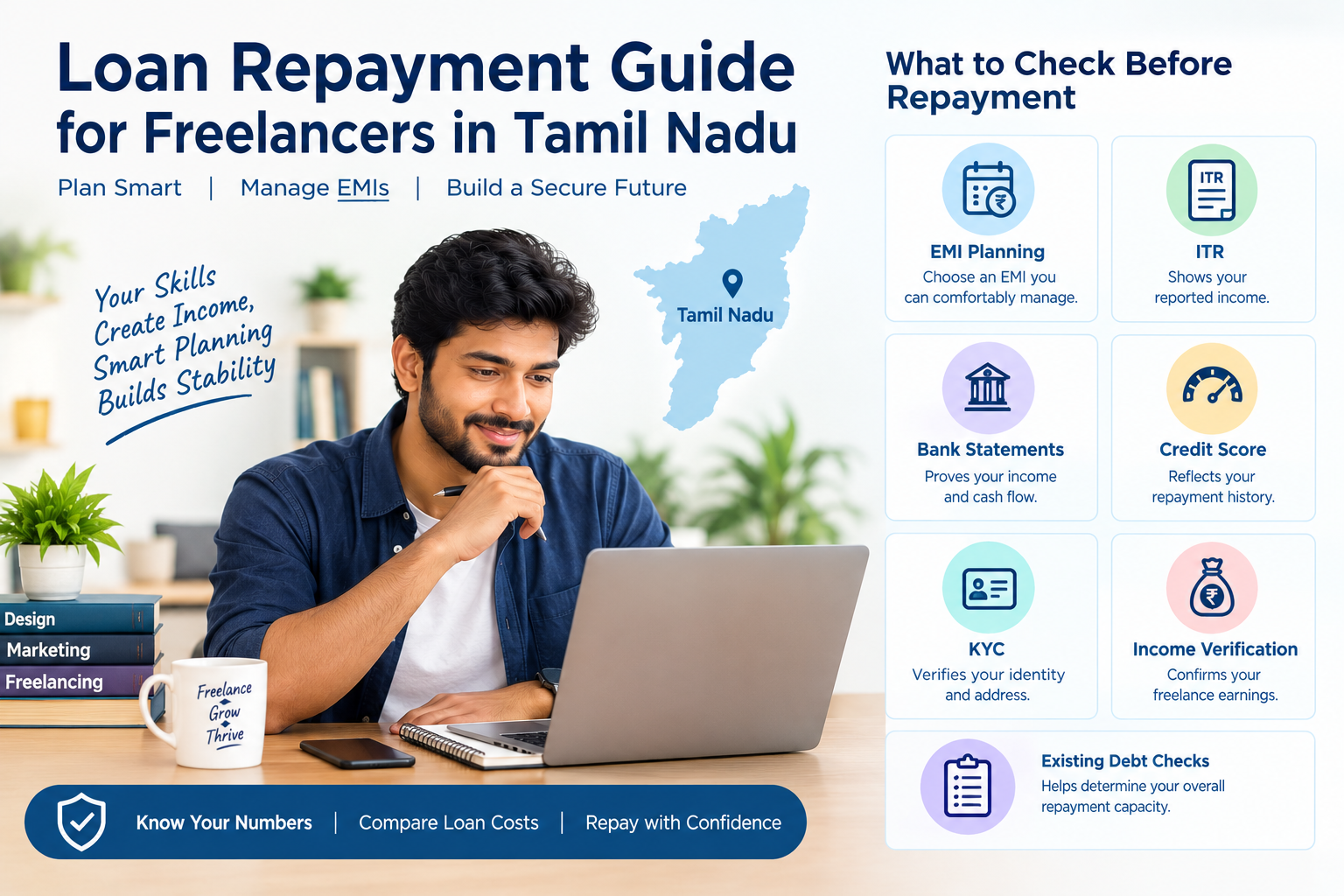
Getting a personal loan as a freelancer can be possible, but loan eligibility is only one part of the process. Before applying, freelancers in Tamil Nadu should also understand how they will manage monthly EMIs and repay the loan without putting excessive pressure on their finances.
Unlike salaried employees, freelancers may have income that changes from month to month. Lenders may therefore review income records, bank statements, ITRs, credit history, existing EMIs and overall repayment capacity before making a lending decision. RBI guidance also emphasizes proper assessment of a borrower's creditworthiness rather than relying only on security or other factors.
What Does Loan Repayment Mean for a Freelancer?
Loan repayment is the process of paying back the borrowed amount along with applicable interest and charges according to the agreed schedule.
For most personal loans, repayment happens through monthly EMIs (Equated Monthly Instalments).
An EMI generally contains:
-
Principal repayment
-
Interest
-
Applicable charges, where relevant
The EMI amount depends on factors such as the loan amount, interest rate and tenure.
For freelancers, the important point is to choose an EMI that remains manageable even during months when freelance income is lower.
How Freelancers Can Check Repayment Capacity
Before accepting a loan, calculate your average monthly income based on your recent income records rather than relying on your highest-earning month.
For example:
| Financial Item | Illustrative Amount |
|---|---|
| Average monthly freelance income | ₹70,000 |
| Existing EMI | ₹8,000 |
| Other essential expenses | ₹35,000 |
| New proposed EMI | ₹10,000 |
| Approximate amount remaining | ₹17,000 |
This is only an illustrative example, not a recommended income-to-EMI ratio. Each freelancer's expenses, income stability and lender assessment can be different.
A safer approach is to test whether you could continue paying the EMI during a slow business month.
Keep Income Records Ready
Freelancers may not receive traditional salary slips, so proper financial records can become particularly useful during loan applications.
Depending on the lender and loan type, documents may include:
-
ITRs
-
Bank statements
-
PAN and KYC documents
-
Client invoices
-
Freelance contracts
-
Business or professional registration documents, where applicable
-
GST records, where applicable
-
Existing loan statements
Maintaining consistent financial records can make it easier to demonstrate income and repayment capacity.
Don't Choose a Loan Only Because the EMI Looks Low
A longer tenure can reduce the monthly EMI, but it can also increase the total interest paid over the life of the loan.
Before accepting an offer, compare:
-
Interest rate
-
APR
-
Loan tenure
-
Monthly EMI
-
Processing fees
-
Prepayment or foreclosure charges, if applicable
-
Late-payment or penal charges
-
Total repayment amount
RBI guidance emphasizes disclosure of important fees and charges and proper loan appraisal.
For digital loans, borrowers should also review the applicable Key Facts Statement (KFS) and understand the overall cost before accepting the loan.
Build an EMI Buffer for Irregular Income
Freelance income can fluctuate because of delayed client payments, fewer projects or seasonal business conditions.
One useful repayment practice is to maintain an emergency buffer before taking a new loan.
For example, if your income is strong in one month, avoid immediately increasing your loan commitments based only on that month's earnings. Consider whether your finances could support the EMI during a weaker month.
A Simple Repayment Checklist
Before applying, ask yourself:
-
What is my average monthly income?
-
How stable has my income been recently?
-
What existing EMIs am I already paying?
-
Can I manage the new EMI during a low-income month?
-
Do I have emergency savings?
-
What is the total cost of the loan?
-
Have I checked the APR and KFS?
-
Are all fees clearly disclosed?
-
Have I verified the actual lender?
-
Have I read the loan agreement before accepting?
What Happens If a Freelancer Misses an EMI?
Missing or delaying repayments can result in applicable charges and may negatively affect a borrower's credit profile, depending on the circumstances and reporting practices.
If you anticipate difficulty making a payment, review the lender's repayment terms and contact the lender through its official channels as early as possible. Do not wait until multiple payments become overdue.
Also avoid taking another high-cost loan simply to repay an existing loan without first understanding the total cost and whether the new repayment schedule is sustainable.
How to Make Loan Repayment Easier
Freelancers can consider these practical habits:
1. Separate Business and Personal Cash Flow
Where practical, maintain clear records of freelance/business income and personal expenses. This can make monthly budgeting easier.
2. Track Every EMI
Keep a calendar or reminder for your repayment dates so that payments are not missed accidentally.
3. Maintain an Emergency Fund
An emergency reserve can provide some protection when client payments are delayed or income temporarily falls.
4. Avoid Excessive Borrowing
Do not increase your loan amount simply because a lender offers a larger limit. Borrow according to the actual requirement and repayment capacity.
5. Review the Loan Agreement
Keep a copy of the agreement, repayment schedule, fees and other applicable terms for future reference. RBI's fair-practices guidance says loan terms and conditions should be provided in writing.
Loan Repayment Example for a Freelancer
Consider a fictional freelancer named Priya who works as a digital designer in Coimbatore.
Suppose she has:
-
Average monthly income: ₹60,000
-
Existing EMI: ₹6,000
-
New loan requirement: ₹1.5 lakh
-
Planned use: professional laptop and software
-
Available income records: ITRs and bank statements
Instead of looking only at whether she qualifies for ₹1.5 lakh, Priya should calculate whether the proposed EMI fits comfortably alongside her existing EMI and regular expenses.
She should also compare the total borrowing cost, review the KFS and loan agreement, and consider whether she can continue repayments during months when freelance income is lower.
This is a fictional example for educational purposes. Loan approval and suitable loan amounts depend on the lender's assessment and the borrower's individual circumstances.
Key Takeaways
-
Freelancers can potentially apply for loans, but eligibility does not guarantee approval.
-
Repayment capacity is an important part of responsible borrowing.
-
Use average and reasonably stable income figures when planning an EMI.
-
Keep ITRs, bank statements and other relevant income records organized.
-
Consider existing EMIs before taking additional debt.
-
Check APR, EMI, fees, tenure and total repayment cost.
-
Read the KFS and loan agreement before accepting a digital loan.
-
Maintain an emergency buffer because freelance income can fluctuate.
-
Verify the actual lender and avoid suspicious loan offers or pressure-based borrowing.
Frequently Asked Questions
Can freelancers in Tamil Nadu get personal loans?
Yes, freelancers may be eligible for personal loans, subject to the lender's eligibility criteria, income assessment, credit history, KYC and repayment capacity.
Do freelancers need salary slips?
Not necessarily. Depending on the lender, freelancers may provide ITRs, bank statements, invoices, contracts or other evidence of income.
Is a credit score important for freelancer loan eligibility?
Credit history can be one of the factors lenders consider when assessing an application, along with income, existing debt and repayment capacity.
Should freelancers choose a longer loan tenure?
A longer tenure can reduce the monthly EMI but may increase the total interest cost. Compare the overall repayment amount before choosing a tenure.
What if freelance income changes every month?
Use a realistic average income for budgeting and check whether the EMI remains manageable during lower-income months.
What should I check before accepting a digital loan?
Check the actual lender, interest rate, APR, KFS, EMI, fees, repayment schedule, privacy terms and loan agreement before accepting the offer.
Can existing EMIs affect loan eligibility?
Yes. Existing debt obligations can affect how much additional repayment a borrower may reasonably be able to handle.
What documents may freelancers need?
Requirements vary, but lenders may request KYC documents, PAN, bank statements, ITRs and other income or professional records.
What should I do if I think I may miss an EMI?
Review your loan terms and contact the lender through its official communication channels promptly. Avoid taking another expensive loan without assessing the total repayment cost.
Is instant loan approval guaranteed for freelancers?
No. An instant or pre-approved offer does not necessarily mean guaranteed final approval. Lenders may conduct additional verification before disbursal.
Published on : 3rd October
Published by : shibam nath
www.vizzve.com || www.vizzveservices.com
Follow us on social media: Facebook || Linkedin || Instagram
🛡 Powered by Vizzve Financial
RBI-Registered Loan Partner | 10 Lakh+ Customers | ₹600 Cr+ Disbursed