

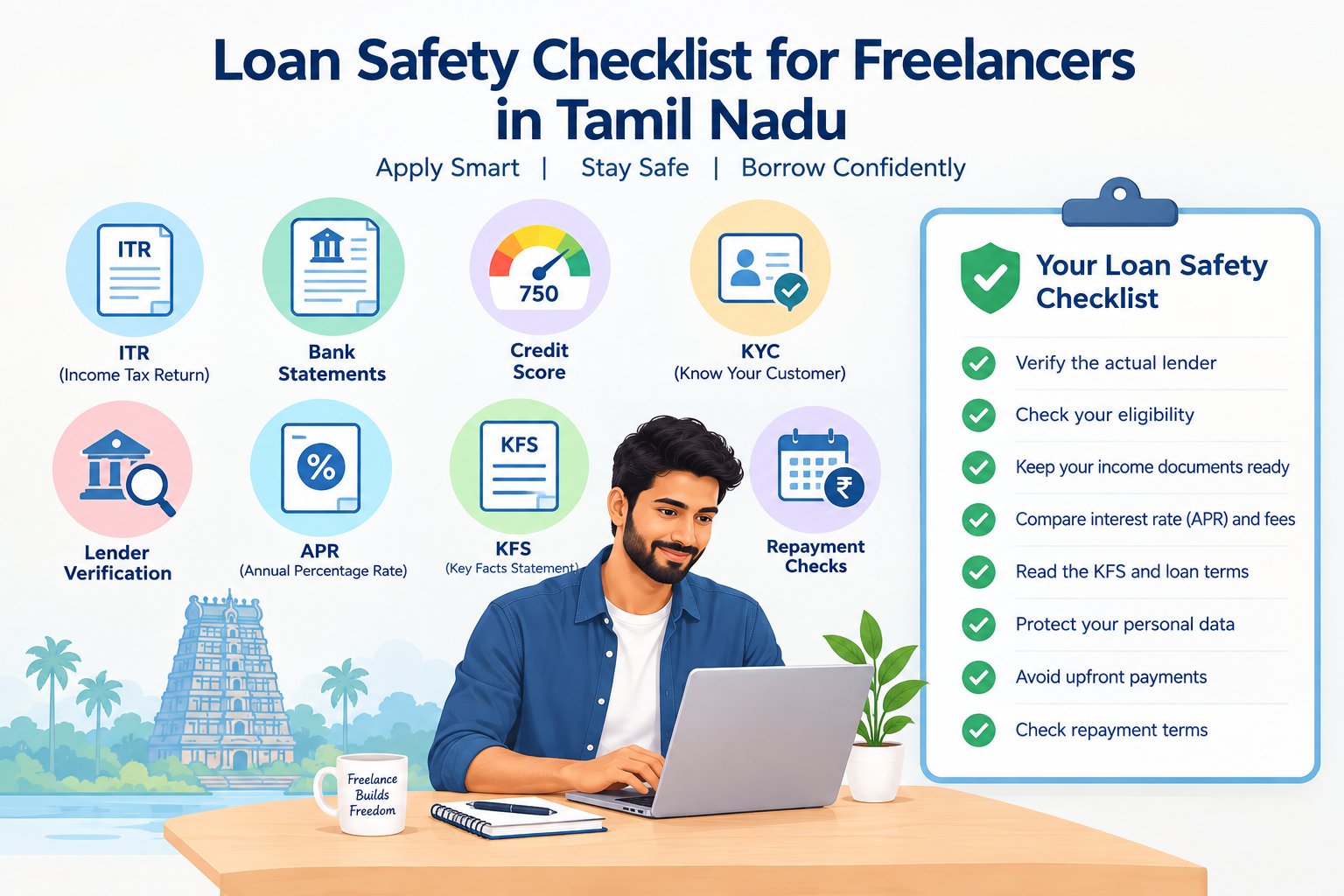
Freelancing gives professionals flexibility, but getting a loan can require more financial documentation than a traditional salaried application. Freelancers may have income from multiple clients, variable monthly earnings and no standard salary slip.
For freelancers in Tamil Nadu, checking loan eligibility, income proof, credit history, lender details and loan costs before applying can help make the borrowing process safer.
This safety checklist explains what freelancers should review before accepting a personal, business or digital loan.
Can Freelancers Apply for a Loan?
Yes. Freelancers and other self-employed professionals can apply for suitable loan products, subject to the lender's eligibility criteria.
Instead of relying on salary slips, a lender may consider documents such as:
- Income Tax Returns (ITRs)
- Bank statements
- Client invoices
- Contracts or work records
- Existing loan information
- Other acceptable income documents
Eligibility can differ between banks, NBFCs and individual loan products.
Freelancer Loan Safety Checklist
1. Verify the Actual Lender
Before submitting your PAN, Aadhaar or financial information, find out who is actually providing the loan.
If you are using a digital lending app, check whether it is associated with an RBI-regulated bank or NBFC. RBI advises consumers to verify the association through the bank or NBFC's own website and to avoid downloading loan apps received through SMS or social-media links.
Do not assume that the name of a loan app is the name of the lender.
2. Check the Lender's Website and Contact Details
A legitimate lending arrangement should provide clear information about the lender, loan terms and customer support.
Look for:
- Legal name of the bank/NBFC
- Official website
- Customer-care details
- Grievance-redressal information
- Loan terms and conditions
- Privacy policy
RBI's digital lending framework requires regulated entities to disclose information about their digital lending apps and lending service providers.
3. Check Your Loan Eligibility Before Applying
Freelancers should review their financial profile before making an application.
Important factors may include:
- Credit history
- Monthly or annual income
- Length of freelance activity
- Existing EMIs
- Bank transactions
- ITRs
- KYC information
- Requested loan amount
- Repayment capacity
Applying for an amount that is too high compared with your documented income may make the application more difficult to assess.
4. Keep Your Income Documents Ready
Freelancers generally do not have conventional salary slips, so alternative income records can be important.
Depending on the lender, prepare:
| Document | Purpose |
|---|---|
| ITR | Income verification |
| Bank statements | Cash-flow and payment verification |
| PAN | Identity/financial verification |
| Aadhaar or other KYC document | Identity verification |
| Invoices | Evidence of client income |
| Client contracts | Work/income evidence |
| Existing loan details | Debt assessment |
Only submit documents that are genuinely required by the lender.
5. Protect Your Personal Data
Your financial and identity information should be handled carefully.
RBI's digital lending guidelines require data collection to be need-based and based on prior, explicit consent. They also restrict digital lending apps from accessing phone resources such as contact lists and call logs, while limited one-time access to certain facilities may be allowed for specific onboarding or KYC purposes with explicit consent.
Be particularly careful if an app asks for unnecessary access to:
- Contacts
- Call logs
- Personal files
- Photos and media
- Messages
- Other unrelated phone information
Never Share These
Do not share your:
- UPI PIN
- ATM PIN
- Internet banking password
- Card PIN
- OTP with an unknown person
A genuine loan process should not require you to disclose confidential banking credentials to an agent or stranger.
6. Check the Interest Rate and APR
Do not compare loans only by the advertised interest rate.
Check the Annual Percentage Rate (APR) and the overall borrowing cost.
For applicable digital loans, RBI requires the all-inclusive cost of the loan to be disclosed as APR and included in the Key Facts Statement (KFS).
Also review:
- Processing fee
- Applicable taxes
- Penal charges
- Prepayment terms
- Other disclosed charges
- Total repayment amount
7. Read the Key Facts Statement
The Key Facts Statement (KFS) is an important document to review before accepting applicable digital lending products.
RBI's digital lending framework requires the KFS to contain information including APR, recovery mechanism, grievance-redressal details and the applicable cooling-off/look-up period. Charges not disclosed in the KFS cannot be charged by the regulated entity during the loan term under the cited framework.
Do not accept a loan simply because the approval appears instant.
Read the terms first.
8. Check Where the Loan Money Will Go
For digital lending, RBI guidelines generally require loan disbursement to go directly into the borrower's bank account, subject to specified regulatory exceptions. Loan servicing and repayment are also required to flow directly between the borrower and the regulated entity rather than through a third-party pool account.
Be cautious if someone asks you to receive or repay a loan through an unrelated personal bank account.
9. Watch Out for Upfront Payment Scams
Be cautious when someone promises:
“Guaranteed loan approval — pay a fee first.”
Requests for unexplained upfront payments, especially through personal UPI IDs or bank accounts, are a major warning sign.
Before paying any charge, verify:
- Who is charging it
- Why it is being charged
- Whether it appears in the official loan documents
- Whether the lender's official website confirms the fee
For digital lending, fees payable to lending service providers are required to be paid by the regulated entity rather than directly by the borrower under RBI's framework.
10. Avoid Multiple Loan Applications
Submitting many loan applications within a short period can result in multiple credit enquiries and may affect how lenders view your credit profile.
Instead:
- Check your eligibility.
- Compare legitimate loan offers.
- Review the total cost.
- Apply only when the product suits your requirement.
11. Check Your Existing EMI Burden
Before taking another loan, calculate your existing monthly obligations.
Include:
- Personal loan EMIs
- Home loan EMIs
- Vehicle loan payments
- Credit card obligations
- Business loans
- Other recurring debt
Freelancers should be especially careful because monthly income can fluctuate.
A loan that appears affordable during a high-income month may become difficult to repay during a low-income period.
12. Understand the Repayment Terms
Before accepting the loan, check:
- EMI amount
- Due date
- Loan tenure
- Total repayment
- Interest rate
- APR
- Late-payment or penal charges
- Prepayment/foreclosure conditions
- Cooling-off/look-up period, where applicable
Save the sanction letter, KFS, loan agreement and repayment schedule for future reference.
Common Loan App Red Flags for Freelancers
Be cautious if a loan app or agent:
- Guarantees approval without checking your profile
- Says no KYC is required
- Asks for OTP or UPI PIN
- Requests unnecessary phone permissions
- Hides the actual lender's identity
- Does not provide clear loan terms
- Demands unexplained upfront payments
- Sends suspicious links through WhatsApp or SMS
- Pressures you to accept immediately
- Does not provide proper customer support
RBI specifically advises consumers to verify digital lending apps and avoid suspicious links received through SMS or social media.
Benefits of Following a Safety Checklist
A safety-first approach can help freelancers:
- Identify the actual lender
- Understand the total borrowing cost
- Protect sensitive financial information
- Avoid suspicious loan apps
- Organise income documents
- Compare loan terms properly
- Understand repayment obligations
- Reduce the risk of avoidable financial mistakes
Freelancer Loan Safety Checklist at a Glance
| Safety Check | What to Verify |
|---|---|
| Lender | Actual bank/NBFC |
| Eligibility | Income, credit and repayment capacity |
| Documents | ITR, bank statements and KYC |
| Interest | Rate and APR |
| KFS | Costs and important loan terms |
| Data | Necessary permissions only |
| Fees | Clearly disclosed charges |
| Disbursement | Correct borrower bank account |
| Repayment | EMI, tenure and due dates |
| Security | Never share PINs or OTPs |
Key Takeaways
- Freelancers in Tamil Nadu can apply for loans, but eligibility depends on the lender and product.
- Keep ITRs, bank statements, invoices and KYC documents organised.
- Verify the actual lender before submitting personal or financial information.
- Check the interest rate, APR, fees, EMI and total repayment cost.
- Read the applicable Key Facts Statement and loan agreement before accepting the loan.
- Give only necessary data permissions and avoid suspicious loan apps.
- Never share OTPs, UPI PINs, ATM PINs or internet-banking passwords.
- Be cautious about guaranteed approvals and unexplained upfront payments.
- Consider your variable freelance income before committing to a new EMI.
Frequently Asked Questions
1. Can freelancers in Tamil Nadu apply for personal loans?
Yes. Freelancers can apply for eligible personal loan products, subject to the lender's requirements regarding income, credit history, documentation and repayment capacity.
2. What income proof can freelancers provide?
Depending on the lender, freelancers may use ITRs, bank statements, invoices, contracts and other acceptable financial records.
3. Is a salary slip mandatory for freelancers?
Not necessarily. Self-employed applicants may be assessed using alternative income and financial documents.
4. How can freelancers verify a loan app?
Check the actual lender and verify its association with the app through the bank or NBFC's official website. RBI also advises avoiding suspicious loan-app links received through SMS or social media.
5. Should freelancers share their UPI PIN with a loan agent?
No. UPI PINs, ATM PINs, passwords and OTPs are confidential and should not be shared with loan agents or unknown individuals.
6. What is a KFS?
A Key Facts Statement is a standardised document containing important information about an applicable loan, including costs such as APR and other key terms.
7. Can a loan app access my contacts?
RBI's digital lending guidelines restrict DLAs from accessing phone resources such as contact lists and call logs, subject to the specific provisions and exceptions in the framework.
8. Is instant loan approval guaranteed?
No. A digital or instant application does not mean guaranteed approval. The lender can assess creditworthiness, income, KYC and repayment capacity before making its decision.
9. What should freelancers check before accepting a loan?
Check the actual lender, interest rate, APR, KFS, EMI, fees, tenure, repayment schedule, data permissions and grievance-redressal information.
10. What is the safest way to apply for a digital loan?
Use the lender's official website or a verified digital lending channel, confirm the regulated lender, review the loan documents and provide only the information required for the application.
Published on : 30th September 2026
Published by : shibam nath
www.vizzve.com || www.vizzveservices.com
Follow us on social media: Facebook || Linkedin || Instagram
🛡 Powered by Vizzve Financial
RBI-Registered Loan Partner | 10 Lakh+ Customers | ₹600 Cr+ Disbursed