

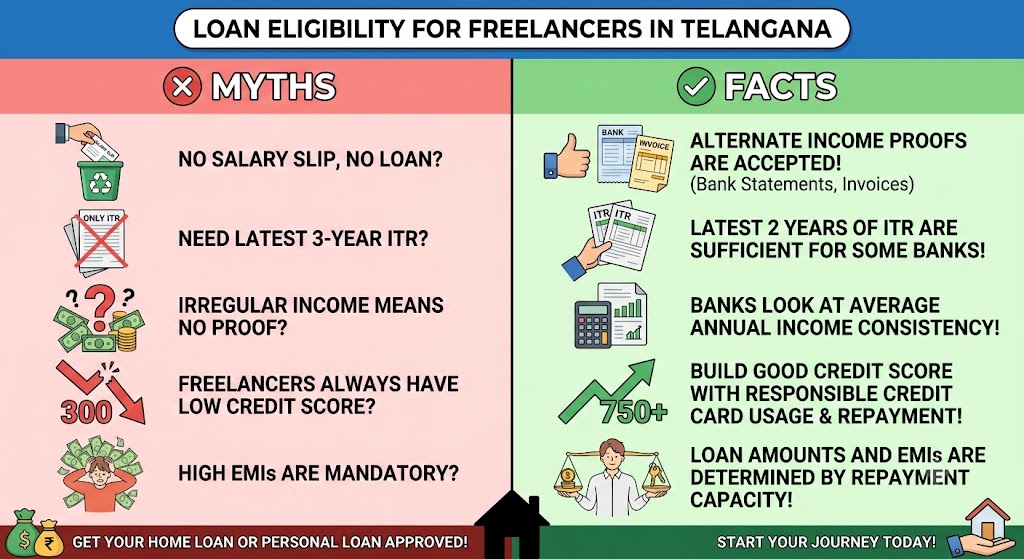
Freelancing is creating new career opportunities across India, including Telangana. Software developers, content writers, graphic designers, digital marketers, consultants and other independent professionals increasingly earn through projects, contracts and online platforms.
However, accessing loans can be challenging when income changes from month to month. Unlike salaried employees, freelancers may not have a fixed salary slip, making income documentation and repayment assessment particularly important.
Looking ahead to 2027, loan eligibility for freelancers in Telangana may increasingly depend on documented income, credit history, digital verification and repayment capacity. The exact changes will depend on lender policies, financial-sector developments and applicable regulations.
This article explores the key trends freelancers should watch and how they can prepare for future borrowing needs.
What Is Loan Eligibility for Freelancers in Telangana?
Loan eligibility refers to the criteria a lender uses to evaluate an applicant's suitability for a loan.
For freelancers, lenders may consider:
-
Monthly and annual income
-
Credit history and repayment record
-
Income Tax Returns (ITRs), where required
-
Bank statements and client payments
-
Existing loans and EMIs
-
KYC verification
-
Professional experience and income stability
-
Requested loan amount and repayment capacity
Eligibility requirements vary by lender and product. Freelancers should not assume that every lender follows the same process.
2027 Outlook: Key Trends to Watch
1. Greater Importance of Documented Freelance Income
Freelancers may continue to benefit from maintaining clear records of their professional earnings.
Useful records include:
-
Bank statements
-
Client invoices
-
Contracts and work agreements
-
Payment receipts
-
Platform earnings statements
-
ITRs and other relevant tax records
For example, a freelance software developer in Hyderabad who receives payments from several clients should maintain a clear record of those payments.
2027 preparation tip: Keep income records organized throughout the year instead of collecting documents only when applying for a loan.
2. Digital Loan Applications May Remain Important
Online applications can make it easier to submit documents and track application status. Digital verification may also reduce paperwork for eligible applicants.
However, a digital application does not guarantee approval, faster disbursement or lower interest rates.
Before applying, freelancers should verify the actual lender, read the loan agreement and understand the applicable charges and privacy practices.
3. Credit History Will Remain Important
Credit history is an important factor in many lending decisions and is likely to remain relevant in 2027.
Freelancers can prepare by:
-
Paying existing EMIs on time
-
Avoiding unnecessary borrowing
-
Managing credit-card balances responsibly
-
Reviewing credit reports for errors
-
Limiting unnecessary loan applications
A good credit record can support an application, but it does not guarantee approval.
4. Alternative Income Documents May Help
Freelancers often do not receive traditional salary slips. Depending on the lender, other records may help demonstrate their earnings.
These may include ITRs, bank statements, client invoices, contracts and payment records.
The documents accepted will depend on the lender's policies and the type of loan.
Important: Do not assume that every lender accepts the same alternative documents. Confirm the requirements before submitting an application.
5. Repayment Capacity May Matter More Than a High Income Month
A freelancer may earn ₹70,000 in one month and ₹35,000 in another. Looking at only the highest-earning month may give an unrealistic picture of affordability.
Lenders may assess income consistency, existing debt and other financial obligations.
Freelancers should also calculate whether they can afford an EMI during a slow business period.
Illustrative Example: A Freelancer Preparing for 2027
Consider Rahul, a freelance graphic designer based in Hyderabad.
| Financial Detail | Illustrative Amount |
|---|---|
| Average monthly income | ₹50,000 |
| Existing EMI | ₹6,000 |
| Essential monthly expenses | ₹22,000 |
| Monthly savings and other allocations | ₹7,000 |
| Remaining amount before a new EMI | ₹15,000 |
These figures are hypothetical and assume the listed expenses and allocations do not overlap.
Rahul is considering a personal loan to purchase professional equipment. Before applying, he checks his credit history, organizes his bank statements and ITRs, and estimates the new EMI.
He also considers whether he could manage repayments if his monthly income fell temporarily.
This preparation can help Rahul make a more informed borrowing decision, although it cannot guarantee approval or a particular loan amount.
How Freelancers in Telangana Can Prepare for 2027
Maintain Organized Financial Records
Keep client contracts, invoices, payment confirmations, bank statements and relevant tax documents in an accessible and secure format.
Review Your Credit Profile
Check for inaccurate entries and monitor your repayment history before submitting applications.
Calculate Existing EMIs
List all current loans and credit obligations to understand how much of your income is already committed.
Compare Loan Costs
Do not compare offers only by interest rate. Review the Annual Percentage Rate (APR), processing fees, applicable taxes, tenure, EMI and total repayment.
Read the Key Facts Statement
Where applicable, carefully review the lender-provided Key Facts Statement (KFS) and loan agreement before accepting an offer.
Verify Digital Lenders
Check the actual bank or non-banking financial company (NBFC) behind a digital lending service. Avoid suspicious apps and never share OTPs, UPI PINs or banking passwords.
Potential Challenges for Freelancers in 2027
Despite improvements in digital services, freelancers may still face challenges when applying for loans.
Variable income: Earnings may change with project availability and client payment schedules.
Limited documentation: New freelancers may have fewer months of financial records.
Existing debt: Multiple EMIs can reduce available repayment capacity.
Different lender policies: A document accepted by one lender may not satisfy another.
Loan costs: A borrower who focuses only on the advertised interest rate may overlook fees or other conditions.
Preparing early and maintaining clear financial records can help freelancers address these challenges.
Frequently Asked Questions
Will freelancers in Telangana be able to get loans in 2027?
Freelancers may qualify for suitable loan products if they meet the lender's requirements. Future eligibility policies and individual approval decisions cannot be guaranteed.
Will a salary slip be mandatory in 2027?
Requirements will depend on the lender and loan product. Some lenders may accept alternative income evidence, such as ITRs, bank statements and client invoices.
Will digital loans make approval easier?
Digital applications may simplify parts of the process, but approval still depends on verification, eligibility criteria and repayment capacity.
What documents should freelancers prepare?
Commonly requested documents may include PAN, accepted KYC documents, bank statements, ITRs and income-related records. Additional documents may be required.
How can freelancers improve their chances of loan approval?
Maintain accurate income records, manage existing EMIs, pay debts on time, review credit reports and apply for an amount that fits your financial situation.
Will loan interest rates decrease in 2027?
Future interest rates cannot be predicted with certainty. Rates will depend on market conditions, lender pricing and the borrower's profile. Compare actual offers when applying.
Published on : 11th October 2026
Published by : Shibam nath
www.vizzve.com || www.vizzveservices.com
Follow us on social media: Facebook || Linkedin || Instagram
🛡 Powered by Vizzve Financial
RBI-Registered Loan Partner | 10 Lakh+ Customers | ₹600 Cr+ Disbursed