

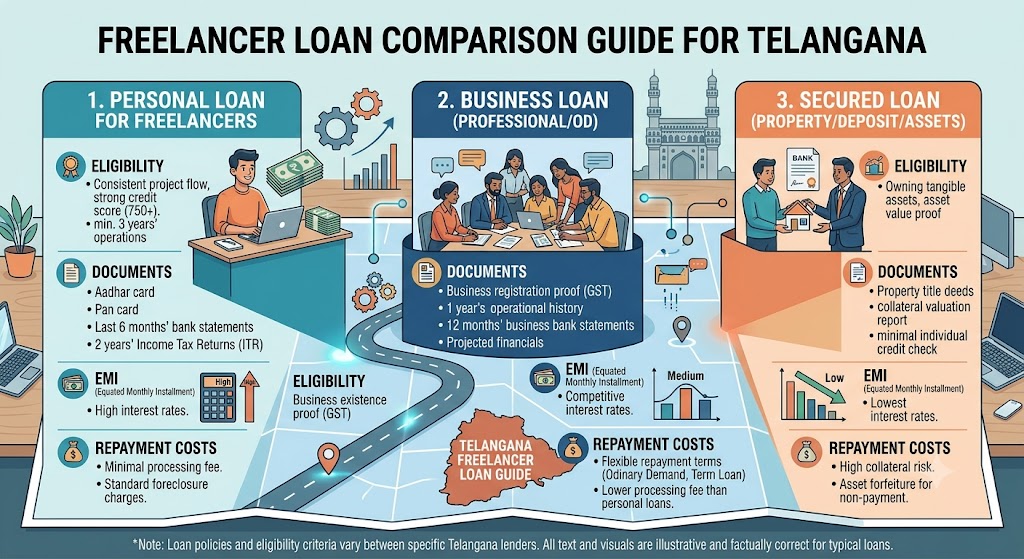
Freelancers in Telangana may need financing for different reasons, such as purchasing professional equipment, managing business expenses, handling cash-flow gaps or covering planned personal expenses. However, choosing the right type of loan can be just as important as checking eligibility.
Unlike salaried employees, freelancers may have variable monthly income. Lenders may therefore consider factors such as documented income, bank transactions, ITRs, credit history, existing EMIs, KYC and repayment capacity.
This loan comparison guide for freelancers in Telangana explains the main borrowing options and how to decide which may be more suitable for a particular need.
Important: Loan availability, eligibility, interest rates, fees, collateral requirements and approval criteria vary by lender. The comparisons below are general educational guidance.
Loan Options for Freelancers in Telangana
Depending on the purpose of borrowing, a freelancer may consider:
-
Personal loan
-
Business or professional loan
-
Secured loan
-
Loan against an eligible asset
-
Credit-based short-term borrowing
The right option depends on the amount required, purpose, documentation, credit profile, available collateral and ability to repay.
Personal Loan vs Business Loan vs Secured Loan
| Factor | Personal Loan | Business/Professional Loan | Secured Loan |
|---|---|---|---|
| Main purpose | Personal or eligible general expenses | Business/professional needs | Funding against an asset |
| Collateral | Usually unsecured | Depends on lender/product | Generally required |
| Income proof | Usually required | Business/professional income evidence may be required | Income + asset-related documents may be required |
| ITR | May be requested | Often relevant | May be required depending on product |
| Bank statements | Commonly reviewed | Commonly reviewed | Often reviewed |
| Credit history | Important | Important | Important |
| Approval factors | Overall personal profile | Business and repayment profile | Borrower + collateral |
| Risk | Higher cost may apply without collateral | Depends on product | Asset may be at risk if obligations are not met |
| Suitable for | Personal or mixed eligible needs | Professional/business expenses | Larger or asset-backed funding needs |
There is no single option that is automatically best for every freelancer.
1. Personal Loan for Freelancers
A personal loan may be considered when a freelancer needs funds for a legitimate personal expense and does not want to pledge an asset.
Because it is generally unsecured, the lender may place greater emphasis on the borrower's overall credit and repayment profile.
What Lenders May Review
Depending on the lender, this may include:
-
Credit history
-
Income
-
ITR
-
Bank statements
-
Existing EMIs
-
KYC
-
Professional experience
-
Requested loan amount
-
Repayment capacity
A traditional salary slip may not always be the only way to demonstrate income. Freelancers may have alternative documentation such as ITRs, bank statements, invoices and contracts.
When It May Make Sense
A personal loan may be considered for:
-
Personal expenses
-
Education-related expenses
-
Medical or emergency needs
-
Home-related expenses
-
Other eligible purposes permitted by the lender
However, the borrower should confirm the lender's permitted end use before accepting the loan.
2. Business or Professional Loan
A business or professional loan may be more appropriate when the money is specifically required for freelance work or business operations.
For example, a freelance photographer may need funds for professional equipment, while a software consultant may need funds for computers, software or business expansion.
What May Be Considered?
Depending on the lender and product:
-
Business vintage
-
Professional experience
-
Income
-
ITR
-
Bank transactions
-
Business records
-
GST records, where applicable
-
Existing liabilities
-
Credit history
-
Cash-flow strength
RBI's financial-literacy material for entrepreneurs highlights that business borrowers should understand loan terms, application requirements and financial obligations before borrowing.
3. Secured Loan
A secured loan is backed by an asset or other eligible security, depending on the loan product.
Examples may include certain loans against property, deposits or other eligible assets.
The advantage can be access to financing based partly on the value and acceptability of the collateral. However, the borrower must understand the consequences of failing to meet the repayment obligations.
When Could It Be Considered?
A secured loan may be worth comparing when:
-
A larger amount is required
-
The borrower has suitable collateral
-
The loan purpose justifies the borrowing
-
The borrower understands the associated risks
-
Repayment capacity is strong
The exact terms depend heavily on the lender and the asset being offered as security.
Personal Loan vs Business Loan: Which Is Better for a Freelancer?
The answer depends mainly on why you need the money.
Choose Based on Purpose
Personal requirement → Compare eligible personal-loan options.
Professional/business requirement → Compare business or professional financing.
Larger funding requirement with suitable collateral → Consider eligible secured options.
A freelancer should not choose a loan simply because an app shows a higher eligible amount.
Comparison of Documentation
Documentation can differ significantly between loan products.
| Document | Personal Loan | Business/Professional Loan | Secured Loan |
|---|---|---|---|
| PAN/KYC | Usually | Usually | Usually |
| Bank statements | Common | Common | Common |
| ITR | Often requested | Often important | May be required |
| Income proof | Usually | Usually | Usually |
| Invoices/contracts | May support income | May be more relevant | May support income |
| GST records | Where applicable | Where applicable | Depending on lender |
| Asset documents | Generally not required | Generally not required | Usually required |
The actual list should always be confirmed with the lender.
How Credit Score Affects the Comparison
Credit history can influence how lenders evaluate a freelancer's application.
Before applying, check:
-
Existing loans
-
Credit-card balances
-
Repayment history
-
Recent credit enquiries
-
Outstanding dues
-
Incorrect entries
A strong repayment history can support a credit application, while missed payments or excessive outstanding debt may make borrowing more difficult or expensive.
However, there is no universal credit-score number that guarantees approval. Each lender can have its own underwriting criteria.
Compare the Total Cost, Not Just Interest Rate
One common mistake is comparing loans only by the advertised interest rate.
A better comparison includes:
-
Interest rate
-
APR
-
Processing fee
-
Applicable taxes
-
Documentation charges, if any
-
Late-payment or penal charges
-
Prepayment/foreclosure terms
-
Insurance or other optional charges, if applicable
-
Total repayment amount
-
Net amount actually received
For digital lending by regulated entities, RBI's current regulatory material requires disclosure of the all-inclusive cost through the Annual Percentage Rate (APR) and includes requirements around borrower consent and data collection.
Why the KFS Matters
Before accepting an applicable retail or digital loan, borrowers should carefully review the Key Facts Statement (KFS) provided by the lender.
The KFS can help a borrower understand important loan terms and costs before committing.
Compare:
Loan amount → Interest/APR → Fees → EMI → Tenure → Total repayment
Do not accept an offer merely because the application process is quick.
Example: Choosing Between Two Loan Options
Suppose Arjun, a freelance web developer in Hyderabad, needs ₹2 lakh for professional equipment.
He compares two hypothetical offers:
| Factor | Option A | Option B |
|---|---|---|
| Loan amount | ₹2,00,000 | ₹2,00,000 |
| Interest rate | 14% | 16% |
| Tenure | 24 months | 18 months |
| Processing fee | 2% | 1% |
| Collateral | No | No |
| EMI | Depends on final terms | Depends on final terms |
| Total cost | Must be calculated | Must be calculated |
Arjun should not automatically select Option A because its interest rate is lower.
He should compare the complete cost, EMI, tenure and net amount received, along with any other applicable charges.
The figures are hypothetical and are included only to demonstrate how a borrower can compare loan offers.
How Freelancers Can Improve Loan Eligibility
Before applying, freelancers can strengthen their financial profile by:
Maintain Clear Income Records
Keep invoices, payment receipts, contracts and bank records organized.
File ITRs Regularly
Tax records can help document income where required by the lender.
Manage Existing EMIs
Avoid taking on more debt than your income can comfortably support.
Keep Credit Usage Under Control
Review credit-card balances and outstanding loans.
Avoid Multiple Applications
Submitting numerous applications within a short period may create additional credit enquiries.
Maintain a Stable Banking Record
Keep legitimate freelance income transactions properly documented.
Which Loan Is More Suitable?
A simple decision framework can help:
Need money for a personal expense?
→ Compare eligible personal loans.
Need money for freelance work or business operations?
→ Compare business/professional loan products.
Need a larger amount and have acceptable collateral?
→ Compare secured financing.
Need only a small amount?
→ First check whether borrowing is genuinely necessary and whether the repayment cost is justified.
Safety Checklist for Freelancers
Before accepting any loan offer:
-
Verify the actual lender.
-
Check whether the lender is regulated where applicable.
-
Read the loan agreement.
-
Review the KFS where applicable.
-
Compare APR and total repayment.
-
Check processing and other charges.
-
Understand the EMI and tenure.
-
Review prepayment conditions.
-
Never share OTPs or UPI PINs.
-
Avoid suspicious loan links received through SMS or social media.
-
Do not give unnecessary access to personal data.
For digital lending, RBI's framework requires need-based data collection with borrower consent and places requirements on privacy and data handling.
Frequently Asked Questions
Can freelancers in Telangana get personal loans?
Yes, freelancers may be eligible for personal loans if they satisfy the lender's eligibility criteria. Income documentation, credit history, bank statements, KYC and repayment capacity may be considered.
Is a salary slip mandatory for freelancers?
Not necessarily. Depending on the lender, freelancers may use ITRs, bank statements, invoices, contracts or other acceptable income documents.
Is a business loan better than a personal loan for freelancers?
It depends on the purpose of borrowing. A business or professional loan may be more relevant for genuine business expenses, while a personal loan may be suitable for eligible personal requirements.
Can freelancers get loans without collateral?
Some loan products are unsecured and do not require collateral, but eligibility and pricing depend on the lender's criteria.
What documents should freelancers keep ready?
Common documents can include KYC documents, bank statements, ITRs and income-related records. Additional documents may be requested depending on the loan product.
Should freelancers borrow the maximum amount offered?
No. The maximum eligible amount may be higher than what is financially comfortable. Borrow based on actual need and realistic repayment capacity.
What is more important: EMI or total loan cost?
Both matter. A lower EMI can result from a longer tenure, which may increase the total interest paid. Compare the complete cost before making a decision.
Quick Comparison Checklist
Before selecting a loan, ask:
-
What is the actual purpose of borrowing?
-
Is a personal or business loan more appropriate?
-
Do I need a secured or unsecured option?
-
How much can I comfortably repay?
-
What is the total loan cost?
-
What is the APR?
-
What fees apply?
-
What does the KFS say?
-
Are there prepayment conditions?
-
Can I manage the EMI during a low-income month?
-
Have I verified the lender?
Key Takeaways
For freelancers in Telangana, comparing loans should go beyond the headline interest rate.
A personal loan may suit eligible personal expenses, a business or professional loan may be more relevant for freelance operations, while a secured loan can be considered when suitable collateral is available and the borrower understands the associated risks.
The best choice is the one that matches the purpose, cost, documentation requirements and realistic repayment capacity of the borrower.
Most importantly, loan eligibility is not the same as guaranteed approval. Every lender may apply its own eligibility criteria, documentation requirements, underwriting process and pricing.
Published on : 8th October 2026
Published by : shibam nath
www.vizzve.com || www.vizzveservices.com
Follow us on social media: Facebook || Linkedin || Instagram
🛡 Powered by Vizzve Financial
RBI-Registered Loan Partner | 10 Lakh+ Customers | ₹600 Cr+ Disbursed