

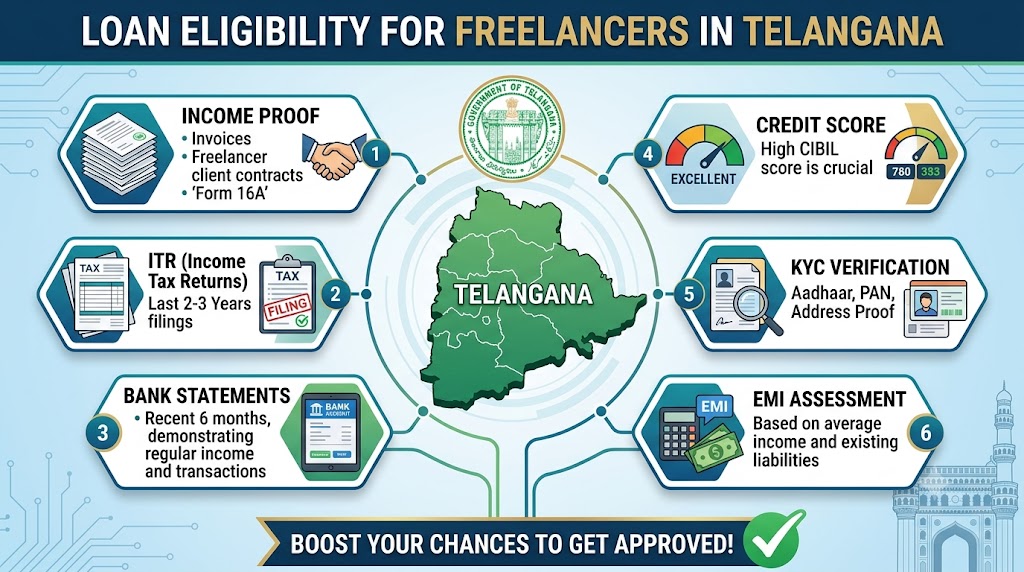
Freelancing is becoming an increasingly popular way to earn income in Telangana. Software developers, content writers, graphic designers, digital marketers, consultants, photographers and other independent professionals often work with multiple clients instead of receiving a fixed monthly salary.
However, applying for a loan as a freelancer can require additional financial documentation. Since income may fluctuate from month to month, lenders may assess income consistency, bank transactions, credit history, existing EMIs and overall repayment capacity.
This complete guide explains loan eligibility for freelancers in Telangana, the documents that may be required, how lenders assess applications, and what to check before accepting a loan.
What Is Loan Eligibility for Freelancers in Telangana?
Loan eligibility refers to the conditions a lender uses to assess whether an applicant qualifies for a particular loan.
Freelancers may apply for suitable personal or professional loan products if they meet the lender's requirements. Approval is not guaranteed, because each lender follows its own eligibility criteria and verification process.
Common factors include:
-
Monthly and annual freelance income
-
Credit score and repayment history
-
Income Tax Returns (ITRs), where required
-
Bank statements and client payment records
-
Existing loans and EMIs
-
KYC verification
-
Professional experience
-
Requested loan amount and repayment capacity
Can Freelancers Get Personal Loans in Telangana?
Yes, freelancers may qualify for personal loans, depending on their financial profile and the lender's policies.
A traditional salary slip is not necessarily the only way to demonstrate income. Some lenders may accept alternative documents such as bank statements, ITRs, client invoices, contracts and payment receipts.
For example, a freelance software developer in Hyderabad who receives payments from several clients may use documented income and banking records to support an application.
However, documentation requirements, minimum income conditions and professional-experience requirements differ between lenders.
Key Factors That Affect Freelancer Loan Eligibility
1. Credit Score and Credit History
Credit history helps lenders understand how an applicant has managed previous borrowing.
A stronger repayment history can support an application, while missed payments, substantial outstanding debt or repeated recent credit enquiries may create concerns.
Before applying, freelancers should review their credit report and correct any inaccurate information.
2. Freelance Income and Stability
Freelancers may earn different amounts each month. Lenders may examine available income records to understand whether earnings are sufficient and reasonably consistent.
Keep records of:
-
Client payments
-
Bank credits
-
Invoices
-
Contracts
-
Platform earnings
-
Annual income
Do not rely only on the highest-earning month when estimating how much you can repay.
3. Income Tax Returns
ITRs can help document declared income and may be required by some lenders.
Freelancers should maintain accurate tax records and understand the filing obligations that apply to their circumstances.
The exact number of years of ITRs required depends on the lender and loan product.
4. Bank Statements
Bank statements help demonstrate income flows, regular expenses, existing EMI deductions and other financial transactions.
Keep your freelance payments properly documented. Avoid relying on unexplained deposits or incomplete financial records to demonstrate earnings.
5. Existing Loans and EMIs
Existing repayments affect how much income remains available for a new loan.
Before applying, list all personal loans, credit-card obligations and other regular debt payments.
A new EMI should fit comfortably within your budget, including during months when freelance income decreases.
6. KYC and Professional Documents
Lenders generally need to verify the borrower's identity and other application details.
Depending on the product, accepted KYC documents and professional records may include PAN, Aadhaar or other accepted identity documents, invoices, contracts and business-related records.
Documents Required for Freelancer Loans
| Document | Purpose |
|---|---|
| PAN | Identity and financial verification |
| Aadhaar or other accepted KYC | Identity/address verification |
| Bank statements | Evidence of transactions and income |
| ITRs | Support for declared income |
| Client invoices | Evidence of freelance work |
| Contracts or work agreements | Support for professional activity |
| Payment receipts | Evidence of income received |
| Existing loan details | Assessment of current obligations |
| GST-related records | Where applicable and requested |
The final list depends on the lender's requirements. Confirm the documentation checklist before submitting your application.
Step-by-Step Process to Apply for a Freelancer Loan
Step 1: Check Your Credit Profile
Review your credit report, repayment history and outstanding balances.
Step 2: Calculate Your Income
Look at several months of documented income rather than relying on one unusually strong month.
Step 3: Organize Your Documents
Prepare relevant bank statements, ITRs, invoices, contracts and KYC documents.
Step 4: Calculate Your Affordable EMI
Account for household expenses, professional costs, taxes, existing EMIs and savings.
Step 5: Compare Suitable Loan Options
Compare personal loans or business/professional loans according to the actual purpose of borrowing.
Step 6: Verify the Lender
Check the actual lender behind the application and review its official terms.
Step 7: Read the Loan Offer
Before accepting, review the interest rate, Annual Percentage Rate (APR), processing fees, EMI, tenure, total repayment and applicable Key Facts Statement (KFS).
Step 8: Submit Accurate Information
Provide complete and accurate details. Final approval depends on the lender's verification and underwriting process.
How Much Loan Can a Freelancer Get?
There is no single loan amount that applies to every freelancer in Telangana.
The amount offered may depend on income, credit history, existing EMIs, professional records, the selected loan product and the lender's policies.
For example, a freelancer earning ₹60,000 per month may not necessarily qualify for a larger loan than another freelancer earning ₹45,000. Existing debt, documented income and other financial commitments can affect the assessment.
The right borrowing amount is the amount you can realistically repay, not simply the maximum amount offered.
How to Improve Loan Eligibility
Freelancers can strengthen their financial profile by following these practices:
-
Maintain organized income and payment records.
-
File applicable ITRs accurately and on time.
-
Pay existing EMIs and credit-card dues on time.
-
Review credit reports for errors.
-
Keep bank transactions clear and well documented.
-
Avoid unnecessary multiple loan applications.
-
Reduce outstanding debt where practical.
-
Choose a loan amount based on genuine requirements.
-
Maintain an emergency fund for low-income months.
-
Compare complete loan costs before accepting an offer.
Personal Loan vs Business Loan for Freelancers
| Factor | Personal Loan | Business/Professional Loan |
|---|---|---|
| Typical purpose | Eligible personal expenses | Freelance or business expenses |
| Income assessment | Personal financial profile | Business/professional financial profile may be assessed |
| Documentation | KYC, income and banking records | May include additional business records |
| Collateral | Often unsecured, depending on product | Depends on lender and product |
| Main consideration | Personal repayment capacity | Business cash flow and repayment capacity |
Neither option is automatically better. Select a loan that matches the purpose of borrowing and compare the terms carefully.
Common Reasons Freelancer Loan Applications May Be Rejected
A lender may reject an application for reasons such as:
-
Insufficient documented income
-
Weak or limited credit history
-
Existing EMIs that reduce repayment capacity
-
Incomplete or inconsistent documents
-
Unsuccessful KYC verification
-
Requested loan amount exceeding the lender's assessment
-
Not meeting the lender's eligibility criteria
If an application is rejected, review the reason where available, correct documentation problems and reassess affordability before applying elsewhere.
Loan Safety Tips for Freelancers
Digital lending can make applications more convenient, but borrowers should remain cautious.
Before accepting a loan:
-
Verify the actual regulated lender where applicable.
-
Read the loan agreement and applicable KFS.
-
Compare APR, fees and total repayment.
-
Understand late-payment and prepayment conditions.
-
Never share OTPs, UPI PINs or banking passwords.
-
Avoid suspicious links and guaranteed-approval promises.
-
Review app permissions and privacy terms.
RBI's digital-lending framework includes requirements concerning cost disclosure, borrower consent and data handling. Borrowers should check the latest applicable RBI guidance and the lender's terms before proceeding.
Frequently Asked Questions
Can freelancers in Telangana get personal loans?
Yes, freelancers may qualify if they meet the lender's criteria. Approval depends on income documentation, credit history, repayment capacity and other requirements.
Is a salary slip mandatory for freelancers?
Not always. Some lenders may accept ITRs, bank statements, client invoices or other acceptable income records.
Is ITR compulsory for every freelancer loan?
Not necessarily for every product, but some lenders require ITRs. Confirm the requirements for your chosen loan.
Does freelance experience affect eligibility?
It may. Some lenders consider the length and consistency of professional activity when assessing an applicant.
Can freelancers apply for digital loans?
Yes, where eligible. Verify the actual lender and review the loan's cost, agreement and applicable KFS before accepting an offer.
Does a good credit score guarantee approval?
No. Lenders may also assess income, existing EMIs, documentation, KYC and other eligibility conditions.
How can freelancers manage loan repayments?
Choose an affordable EMI, maintain a repayment buffer, track client payments and avoid relying on the highest-income month to meet regular obligations.
Published on : 11th October 2026
Published by : Shibam nath
www.vizzve.com || www.vizzveservices.com
Follow us on social media: Facebook || Linkedin || Instagram
🛡 Powered by Vizzve Financial
RBI-Registered Loan Partner | 10 Lakh+ Customers | ₹600 Cr+ Disbursed