

Freelancing gives professionals flexibility, but getting a loan can sometimes be different from applying as a salaried employee. Freelancers in Telangana may be eligible for personal or other types of loans if they can demonstrate stable income, good credit history, proper documentation and sufficient repayment capacity.
However, loan eligibility is only one part of the decision. Before applying, freelancers should also understand the complete cost of borrowing, including interest, processing fees, GST on applicable charges, late-payment charges and other lender-specific costs.
This guide explains loan eligibility for freelancers in Telangana and provides a simple breakdown of the major costs to check before accepting a loan offer.
What Does Loan Eligibility Mean for Freelancers?
Loan eligibility refers to whether a lender considers an applicant financially suitable for a particular loan amount and repayment period.
For freelancers, lenders may assess factors such as:
-
Credit score and repayment history
-
Average monthly or annual freelance income
-
Income stability
-
ITR and tax records
-
Bank account transactions
-
Existing EMIs and debts
-
KYC documents
-
Professional experience
-
Requested loan amount
-
Repayment capacity
Because freelance income can vary from month to month, lenders may look at multiple financial records rather than relying on a salary slip alone.
Key Factors That Affect Freelancer Loan Eligibility in Telangana
1. Credit Score and Credit History
Your credit history gives lenders an indication of how you have handled previous credit.
A strong repayment record can improve your chances of getting suitable loan terms, while missed payments, defaults or excessive outstanding debt may affect approval.
There is no single credit-score number that guarantees approval. Each lender can have its own eligibility criteria.
2. Freelance Income
Lenders generally want evidence that you have enough regular income to repay the loan.
Useful income evidence can include:
-
Bank statements
-
ITRs
-
Client invoices
-
Contracts
-
Payment receipts
-
Account statements
-
GST records, where applicable
Consistent income over time can make your financial profile easier for a lender to assess.
3. ITR and Tax Records
Income Tax Returns can be particularly useful for self-employed and freelance applicants because they provide documented evidence of reported income.
Depending on the lender and loan type, you may be asked for recent ITR documents or related financial records.
4. Bank Statements
Bank statements help lenders understand actual cash flow.
They may review:
-
Regular client payments
-
Average account balance
-
Existing loan EMIs
-
Returned payments
-
Unusual transactions
-
Overall income patterns
Keeping business and personal transactions organized can make financial records easier to understand.
5. Existing EMIs
Existing loans directly affect your repayment capacity.
For example, if you already have several monthly obligations, a lender may consider a new EMI less affordable even when your annual income appears high.
Before applying, calculate:
Existing EMIs + Proposed New EMI = Total Monthly Debt Obligation
Loan Cost Breakdown for Freelancers
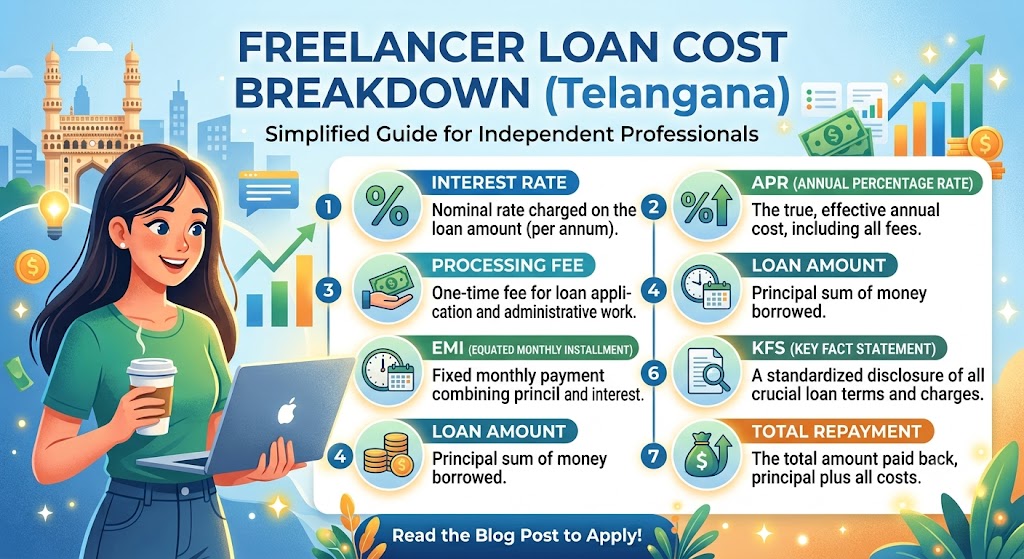
Getting approved does not mean the loan is affordable. The total borrowing cost should be checked before accepting an offer.
| Cost Component | What It Means |
|---|---|
| Interest | Cost charged on the outstanding loan |
| Processing Fee | Fee charged for processing the application |
| GST | Applicable tax on certain lender charges |
| Documentation Charges | May apply depending on lender/product |
| Late Payment Charges | May apply when repayment is delayed |
| Penal Charges | Charges applicable under the loan agreement |
| Prepayment/Foreclosure Charges | May apply depending on the loan terms |
| Total Repayment | Principal plus applicable borrowing costs |
Not every lender charges every fee, and charges can vary by loan product.
Interest Rate vs APR: What Should Freelancers Check?
A loan's interest rate is important, but it should not be the only number you compare.
The Annual Percentage Rate (APR) provides a broader view of the cost of credit by taking relevant charges into account.
For example, two loans may advertise similar interest rates but have different processing fees and other charges. The loan with the lower advertised rate may not always have the lower overall cost.
Therefore, compare the overall cost, not just the headline interest rate.
Example of a Simple Loan Cost Calculation
Suppose a freelancer considers a loan of ₹2,00,000.
Assume, purely for illustration:
-
Loan amount: ₹2,00,000
-
Interest rate: 15% per year
-
Tenure: 24 months
-
Processing fee: 2% + applicable tax
The EMI would depend on the lender's exact calculation method and loan terms.
The freelancer should compare:
-
Amount sanctioned
-
Processing fee
-
Net amount actually received
-
Monthly EMI
-
Total repayment
-
APR
-
Late-payment charges
-
Prepayment or foreclosure terms
This gives a much clearer picture than looking only at the monthly EMI.
Why the Net Disbursed Amount Matters
Suppose a lender approves ₹2,00,000 but deducts applicable upfront charges from the disbursal.
You could receive less than ₹2,00,000 in your bank account while your repayment obligation may still be based on the sanctioned loan amount, depending on the agreement.
That is why borrowers should check the net disbursal amount before accepting the loan.
What Is a Key Facts Statement (KFS)?
For applicable digital loans, borrowers should carefully review the Key Facts Statement (KFS) provided by the regulated lender.
The KFS helps borrowers understand important loan information, including the applicable APR and other key charges and terms.
Before accepting a digital loan, check:
-
Loan amount
-
Tenure
-
Interest rate
-
APR
-
EMI
-
Processing fees
-
Other charges
-
Penal charges
-
Repayment schedule
-
Prepayment terms
-
Total cost of borrowing
Do not accept a loan simply because the approval is quick.
Documents Freelancers in Telangana May Need
Requirements vary by lender, but commonly requested documents can include:
| Document | Purpose |
|---|---|
| PAN Card | Identity and financial verification |
| Aadhaar/Other KYC | Identity and address verification |
| Bank Statements | Income and cash-flow assessment |
| ITR | Income verification |
| Invoices/Contracts | Freelance income evidence |
| GST Records | Business verification where applicable |
| Existing Loan Details | Assessment of current obligations |
A salary slip may not always be required for freelancers. Alternative income documentation may be accepted depending on the lender.
Common Reasons a Freelancer's Loan Application May Be Rejected
Even when a freelancer earns a reasonable income, approval is not guaranteed.
Common reasons include:
-
Weak or limited credit history
-
Irregular income
-
High existing EMI obligations
-
Insufficient income documentation
-
Inconsistent bank transactions
-
Incomplete KYC
-
Applying for an amount that is too high
-
Recent multiple credit applications
-
Mismatch between declared and documented income
-
Not meeting the lender's internal eligibility criteria
How Freelancers Can Improve Loan Eligibility
Before applying, consider these practical steps:
Maintain a Healthy Credit Profile
Pay existing EMIs and credit-card bills on time.
Keep Financial Records Organized
Maintain ITRs, invoices, contracts and bank statements properly.
Avoid Unnecessary Debt
A lower existing EMI burden can improve repayment capacity.
Choose a Reasonable Loan Amount
Borrow only what you can comfortably repay.
Maintain Consistent Banking Records
Regular and traceable income deposits can make your financial position easier to assess.
Compare Loan Costs
Look beyond the advertised interest rate and compare APR, fees, EMI and total repayment.
Loan Eligibility Checklist for Freelancers in Telangana
Before submitting an application, check:
-
Credit history reviewed
-
Freelance income calculated
-
Recent ITR available
-
Bank statements ready
-
KYC documents updated
-
Existing EMIs calculated
-
New EMI estimated
-
Loan amount is affordable
-
Interest rate compared
-
APR checked
-
Processing and other fees reviewed
-
KFS read carefully
-
Actual lender verified
-
Repayment schedule understood
FAQs
Can freelancers in Telangana get personal loans?
Yes, freelancers may be eligible for personal loans if they satisfy the lender's credit, income, documentation and repayment-capacity requirements.
Is a salary slip mandatory for a freelancer loan?
Not necessarily. Depending on the lender, ITRs, bank statements, invoices, contracts and other income records may be used to assess freelance earnings.
Does credit score affect freelancer loan eligibility?
Yes. Credit history is commonly considered during loan assessment, although the exact eligibility criteria vary by lender.
Can I get a loan based only on my freelance income?
Approval depends on the lender's policies and your complete financial profile. Income alone does not guarantee approval.
What is the biggest cost to check before taking a loan?
Do not look only at the interest rate. Compare the APR, processing fee, other applicable charges, EMI and total repayment amount.
Why should freelancers check the KFS?
The KFS provides important information about the loan's cost and terms, helping borrowers understand what they are agreeing to before accepting the loan.
Can existing EMIs reduce my loan eligibility?
Yes. High existing monthly obligations can reduce the amount a lender considers affordable.
Should freelancers borrow the maximum amount offered?
No. The maximum eligible amount may not be the most affordable amount. Borrow based on actual requirements and repayment capacity.
Published on : 06th October 2026
Published by : shibam nath
www.vizzve.com || www.vizzveservices.com
Follow us on social media: Facebook || Linkedin || Instagram
🛡 Powered by Vizzve Financial
RBI-Registered Loan Partner | 10 Lakh+ Customers | ₹600 Cr+ Disbursed