

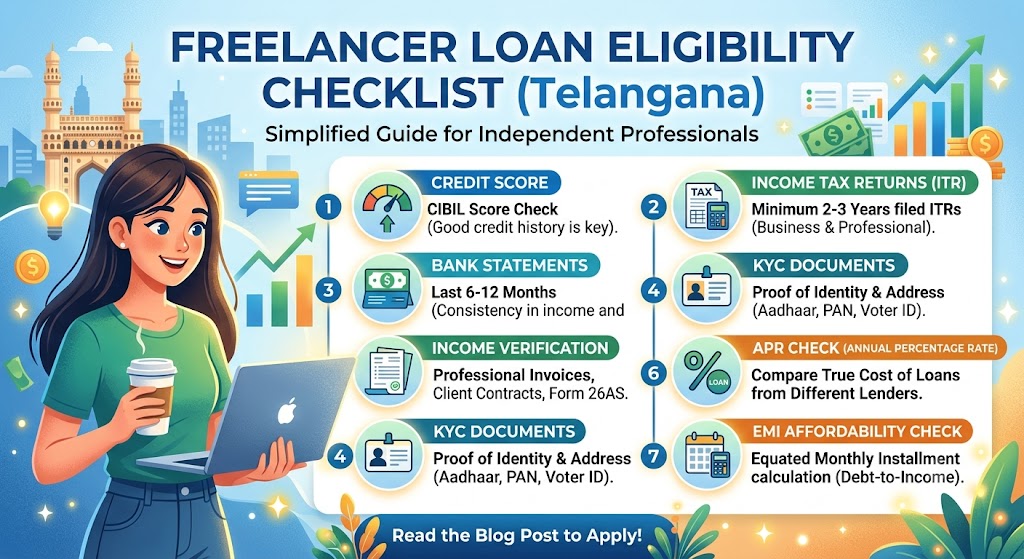
Freelancers in Telangana may have a flexible source of income, but applying for a loan can sometimes be different from applying as a salaried employee. Without a traditional salary slip or employer certificate, lenders may rely on other information to understand income, creditworthiness and repayment capacity.
Software developers, graphic designers, consultants, content creators, digital marketers, photographers, tutors and other independent professionals can prepare for a loan application by keeping their financial records organised.
This loan eligibility checklist for freelancers in Telangana explains what to check before applying, what documents may be required and how to evaluate a loan offer safely.
Freelancer Loan Eligibility Checklist at a Glance
Before applying, check these important areas:
| Eligibility Check | What to Review |
|---|---|
| Credit history | Repayment record, outstanding dues and enquiries |
| Income | Average and documented freelance earnings |
| ITR | Recent tax and income records |
| Bank statements | Regular income and cash flow |
| KYC | PAN, Aadhaar/OVD and address details |
| Existing EMIs | Current monthly debt obligations |
| Income proof | Invoices, contracts and other records |
| Loan amount | Whether the requested amount is affordable |
| EMI | Whether monthly repayment fits your budget |
| Loan cost | Interest, APR, fees and total repayment |
| Lender | Actual lender and applicable disclosures |
| KFS | Key loan terms and costs before acceptance |
RBI guidance requires lenders to properly assess credit applications and borrower creditworthiness rather than treating security or other conditions as a substitute for due diligence.
1. Check Your Credit Score and Credit History
Your credit profile is one of the first things to review before applying.
A lender may consider:
-
Previous loan repayment history
-
Credit-card payments
-
Outstanding balances
-
Existing credit accounts
-
Recent credit enquiries
-
Overdue payments or defaults
A strong credit history can support an application, but no particular credit score guarantees loan approval.
Your checklist
-
Check your credit report.
-
Look for incorrect information.
-
Clear or address overdue payments where possible.
-
Review outstanding credit-card balances.
-
Avoid unnecessary loan applications.
2. Calculate Your Average Freelance Income
Freelance income can change significantly from one month to another.
Instead of looking only at your highest-earning month, calculate a realistic average.
Example
| Month | Illustrative Income |
|---|---|
| January | ₹52,000 |
| February | ₹60,000 |
| March | ₹47,000 |
| April | ₹65,000 |
| May | ₹58,000 |
| June | ₹62,000 |
The six-month average in this example is approximately ₹57,333 per month.
This is only an illustration. Lenders can use different methods to assess self-employed or freelance income.
Checklist
-
Know your average monthly income.
-
Separate regular income from occasional income.
-
Keep evidence of client payments.
-
Consider income fluctuations before choosing an EMI.
3. Keep Your ITR Documents Ready
Income Tax Returns can help demonstrate your declared income.
Freelancers should keep relevant tax records organised, including:
-
ITR acknowledgements
-
Income records
-
Financial statements, where applicable
-
Other tax documents requested by the lender
ITR requirements can vary depending on the lender and loan product.
Checklist
-
Recent ITR documents available
-
Income information is consistent
-
Tax records are accessible
-
No unexplained mismatch between declared and submitted income
4. Review Your Bank Statements
Bank statements can help demonstrate actual cash flow.
A lender may look at:
-
Client payments
-
Regular income credits
-
Existing EMI payments
-
Account activity
-
Returned transactions
-
Other significant financial activity
For freelancers with multiple clients, bank statements can help show how professional income is received.
Checklist
-
Required bank statements available
-
Client payments are identifiable
-
Income records are consistent
-
Existing EMI payments are visible
-
Avoid unnecessary financial irregularities
5. Prepare Your KYC Documents
KYC verification is an important part of the loan application process.
Depending on the lender, documents may include:
-
PAN
-
Aadhaar or another officially valid document
-
Address proof
-
Bank account details
-
Income documents
-
Other supporting documents
Check that your personal information is consistent across documents.
Checklist
-
PAN details correct
-
KYC document valid
-
Address information updated
-
Name spelling consistent
-
Bank account details correct
6. Prepare Alternative Income Proof
Freelancers may not have a traditional salary slip, but they may have other records that demonstrate professional income.
Depending on the lender, these may include:
-
Client invoices
-
Contracts
-
Payment receipts
-
GST records, where applicable
-
Professional registration
-
Business records
-
Financial statements
Not every lender accepts every document, so check the lender's requirements before submitting your application.
Checklist
-
Client invoices available
-
Work contracts available where relevant
-
Payment records organised
-
GST records available where applicable
-
Professional documents available if requested
7. Calculate Your Existing EMI Burden
Before taking another loan, calculate how much you already pay every month.
For example:
| Existing Commitment | Monthly Amount |
|---|---|
| Vehicle Loan | ₹6,000 |
| Personal Loan | ₹5,000 |
| Credit Card | ₹3,000 |
| Total | ₹14,000 |
These figures are only illustrative.
Existing debt can affect how comfortably you can manage another EMI.
Remember
Loan eligibility is not the same as loan affordability.
A lender may consider you eligible for a particular amount, but you should decide whether that amount fits your personal budget.
8. Check the New EMI Before Applying
Estimate the EMI for the amount you actually need.
Consider:
-
Loan amount
-
Interest rate
-
Tenure
-
Processing fee
-
Other applicable charges
-
Total repayment
A longer tenure can reduce the monthly EMI but may increase the overall interest paid.
Checklist
-
New EMI calculated
-
Existing EMIs included
-
Essential monthly expenses considered
-
Lower-income months considered
-
Emergency savings considered
9. Check Your Repayment Capacity
Freelancers should avoid calculating affordability based only on their best month.
A simple personal planning approach is:
Average realistic income − essential expenses − existing EMIs − proposed EMI = remaining monthly cash flow
For example, if a freelancer has:
-
Average income: ₹60,000
-
Essential expenses: ₹30,000
-
Existing EMIs: ₹8,000
-
Proposed EMI: ₹8,000
The illustrative remaining amount would be:
₹60,000 − ₹30,000 − ₹8,000 − ₹8,000 = ₹14,000
This is not a lender's eligibility formula or a recommended debt ratio. It simply demonstrates why freelancers should consider the complete monthly cash flow before borrowing.
10. Check the Loan Amount
Don't automatically select the maximum amount shown by a lender.
Ask:
-
How much do I actually need?
-
What will the money be used for?
-
Can I repay the EMI during a slow month?
-
Do I already have significant debt?
-
Will the loan improve or strain my financial position?
Borrowing less can sometimes make repayment easier.
11. Compare Interest Rate, APR and Fees
The advertised interest rate is not the only cost to consider.
Before accepting a loan, check:
-
Interest rate
-
APR, where applicable
-
Processing fee
-
Documentation or verification charges
-
Late-payment or penal charges
-
Prepayment terms
-
Other applicable fees
-
Total repayment amount
RBI's digital lending framework requires applicable digital loans to disclose the all-inclusive cost through APR, while the RBI handbook also highlights borrower protections around fees and data collection.
12. Read the Key Facts Statement
The Key Facts Statement (KFS) is an important document for understanding loan costs and terms.
Before accepting an applicable digital loan, review:
-
Loan amount
-
Interest rate
-
APR
-
Repayment schedule
-
Fees
-
Penal charges
-
Recovery mechanism
-
Grievance information
-
Applicable cooling-off/look-up period
RBI's digital lending requirements state that the KFS should be provided before execution of the loan contract, and charges not included in the KFS cannot be charged by the regulated entity during the loan term.
13. Verify the Actual Lender
If you are applying through a loan app or digital platform, don't assume that the app itself is the lender.
Check:
-
Actual bank or NBFC involved
-
Official lender website
-
Customer-care details
-
Grievance mechanism
-
Privacy policy
-
Loan terms
-
Details of the lending service provider, where applicable
RBI has specifically highlighted the importance of borrowers knowing the actual bank or NBFC behind digital lending platforms.
14. Review Data and Privacy Permissions
Digital loan applications can involve collection of personal and financial information.
RBI's digital lending framework requires data collection to be need-based and based on prior explicit borrower consent, with requirements around privacy and data handling.
Before giving permissions:
-
Understand why the data is required.
-
Review the privacy policy.
-
Check what information the app wants to access.
-
Avoid unnecessary permissions.
-
Understand how your information will be used.
Never share confidential banking credentials such as your OTP, UPI PIN, ATM PIN, card PIN or internet-banking password with another person.
Complete Freelancer Loan Eligibility Checklist
Use this quick checklist before applying:
Credit
-
Credit report checked
-
Repayment history reviewed
-
Outstanding dues checked
-
Recent enquiries reviewed
Income
-
Average monthly income calculated
-
Income fluctuations considered
-
Client payment records available
Documents
-
PAN ready
-
Aadhaar/OVD ready
-
Address proof available
-
ITR documents available
-
Bank statements available
-
Invoices/contracts available where required
Debt
-
Existing EMIs calculated
-
Credit-card obligations reviewed
-
New EMI estimated
-
Repayment capacity checked
Loan Cost
-
Interest rate checked
-
APR checked where applicable
-
Processing fee checked
-
Other charges checked
-
Total repayment calculated
-
Prepayment terms reviewed
Safety
-
Actual lender verified
-
KFS reviewed where applicable
-
Loan agreement understood
-
Privacy policy reviewed
-
No OTP/PIN/password shared
-
No unexplained upfront payment requested
Common Reasons a Freelancer May Fail the Eligibility Check
Even with regular freelance income, an application can be declined because of:
-
Weak credit history
-
High existing debt
-
Insufficient documented income
-
Unstable or difficult-to-verify cash flow
-
KYC discrepancies
-
Incomplete documents
-
Too many recent credit enquiries
-
Loan amount being too high for the financial profile
-
Lender-specific eligibility rules
-
Issues identified during the lender's risk assessment
For small borrowers seeking loans up to ₹2 lakh, RBI's fair-practices guidance says lenders should communicate the main reason or reasons for rejection in writing within the applicable framework.
How to Improve Freelancer Loan Eligibility
If your application does not meet a lender's criteria, focus on improving your financial profile rather than applying repeatedly.
Improve Credit Management
Pay existing obligations on time and keep track of outstanding balances.
Maintain Income Records
Keep ITRs, bank statements, invoices and contracts organised.
Reduce Unnecessary Debt
A lower existing debt burden can make repayment planning easier.
Avoid Multiple Applications
Compare suitable lenders before submitting applications.
Keep KYC Updated
Make sure your identity and address information is accurate.
Build an Emergency Fund
Freelancers can experience income fluctuations, so maintaining a financial buffer can help manage unexpected expenses and EMI commitments.
FAQs About Freelancer Loan Eligibility in Telangana
1. Can freelancers in Telangana get a personal loan?
Yes. Freelancers may apply for eligible loan products, subject to the lender's credit, income, KYC and repayment requirements.
2. Is a salary slip required for freelancers?
Not necessarily. Depending on the lender, ITRs, bank statements, invoices and other income records may be accepted.
3. Is ITR important for freelancer loan eligibility?
ITRs can help document declared income, although the exact requirements vary by lender.
4. Can bank statements be used as income proof?
Bank statements can help demonstrate actual cash flow and client payments, subject to the lender's assessment.
5. Does a good credit score guarantee loan approval?
No. Credit history is only one factor. Income, existing EMIs, KYC, repayment capacity and lender policies can also affect the decision.
6. Can freelancers with irregular income apply?
Yes, they may apply. However, the lender may assess the stability and documentation of their income before making a decision.
7. How much loan can a freelancer get?
There is no fixed amount for every freelancer. It can depend on income, credit profile, existing obligations, repayment capacity and lender policy.
8. Should I take the maximum amount I am eligible for?
No. Consider your actual financial requirement and whether you can comfortably manage the EMI.
9. What should I check in a digital loan?
Verify the actual lender, review the KFS and loan agreement, compare the complete borrowing cost, and understand the data and privacy permissions.
10. Is freelancer loan eligibility the same at every lender?
No. Banks, NBFCs and other lenders can have different eligibility criteria, documentation requirements and risk-assessment methods.
Published on : 6th October 2026
Published by : shibam nath
www.vizzve.com || www.vizzveservices.com
Follow us on social media: Facebook || Linkedin || Instagram
🛡 Powered by Vizzve Financial
RBI-Registered Loan Partner | 10 Lakh+ Customers | ₹600 Cr+ Disbursed